


Your bag is empty.
Dad and his new wife Elina were living in a one-bedroom apartment in Hollywood—mattress on the floor, filthy bathroom, clothes everywhere, dishes stacked in the sink. The front door opened onto a corridor overlooking a tiny fenced-in swimming pool. Don’t go out onto Hollywood Boulevard, Dad warned Adam and me—too many junkies, muggers and prostitutes. The other tenants were a mixed bag of Sid-and-Nancys and Ike-and-Tinas. Dad said he and Elina didn’t plan on staying long; they would get a proper apartment. You just couldn’t beat that $125 weekly rate. And it was all they could afford now. In a few months he would start seeing royalty checks from his first record, which had just gone gold, but it took time for that money to funnel through all those pipes into his account. He said that the next time we came out to see him, we should expect to go to sleep to the sound of something other than alley cats in heat.
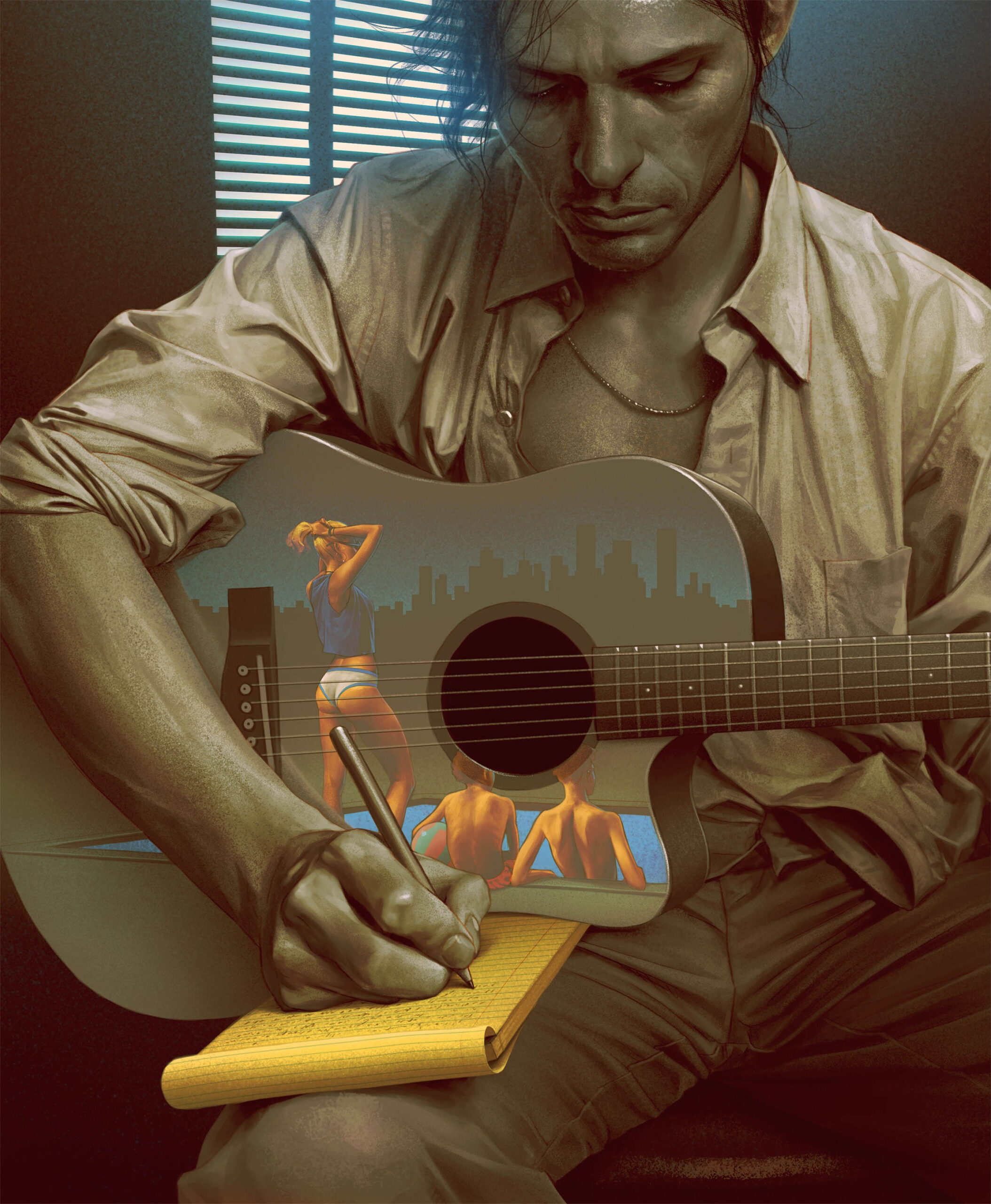
Dad spent the daytime hours behind the bedroom door, writing his second record. He didn’t come out, not to eat or stretch his legs or say hello. He had a coffeemaker and perhaps a sandwich and a bottle of pills or a bag of blow in there with him. My brother and I would put our ears to the door and listen to him play. But to make sense of the still-unformed songs through the thick wood separating us was impossible. He was stopping and starting and picking up at odd places, rewriting words one moment and testing new melodies the next. I imagined his chest leaned over the curved upper half of his Gibson acoustic, his long black hair held back in a rubber band, a writing pad pinned between the guitar and his right thigh, his left hand up on the guitar neck, a pick between his teeth and a pen behind his ear and a tape recorder on the desk just in front of him. Every few minutes he moved from the chair to the windowsill, then to the bed and to the edge of the desk, before returning to the chair and scribbling down another line or two and crossing out others. He smoked a cigarette and listened back to the tape, recorded a new version of the same track and then moved on. At the end of a day he emerged looking worn-out, unwell.
This evening, after yet another full day of writing—his fourth since our arrival, five days ago—Dad went straight from the bedroom out the front door, had a swim, came back, showered, put on a bathrobe and then dropped down onto the couch and began staring at the television. He put his arm around my older brother. “How’s it going, Adam?”“Mmm.”
“You’re bored?” Dad said.
“Yeah.”
“You too, Jules?”
“What?”
“You’re bored too?”
“Yes.”
“Well, that’s great,” he said. “So you’re both bored.”
Our attention shifted back to the television. Bugs Bunny. Dad, skinny and strung out, red-eyed, began accusing us of a failure of imagination. There was a pool outside, he shouted, the sun was shining. If he was our age, he would have spent the whole day in that pool, and he would have been happy about it too. Did we know what our problem was? We were spoiled. We got everything we wanted from our mother, and we didn’t know how to appreciate anything.
Fortunately, Elina came out of the bathroom and started to defend us. “The kids just want to see you, Walter. They have a right to be upset. They came all this way.”
“Give me a break! They are seeing me. Here I am.” Dad held his hands out to the sides.
“They were in the pool all day. It’s six o’clock,” Elina said. “They want to do something else…something with their dad.”
“I know, I know, you want to go spend my last hundred bucks on dinner, a dinner you won’t even appreciate because you don’t appreciate anything.”
“Calm down. You’re freaking out, and you’re making things worse.”
“Oh yeah, am I?”
“Just get out of here, Walter. Come back when you’ve pulled yourself together.”
Dad only had to be told. He put on his leather jacket and slammed the door behind him without a word. Elina didn’t run after him. She took a seat on one end of the couch, next to Adam, shaking her head. Her husband, our father, was crazy, she said. He had no self-control. He wasn’t good at saying what he needed. It was idiotic, childish. Now he was out there on Hollywood Boulevard, furious, in pain.
Elina was 24, from Stockholm. She had been in the country just over two years and married to our father for seven months. They had met on the dance floor of an L.A. nightclub about a year ago, while Dad was out here recording his first album at the Capitol Records Building. On his return to New York, Mom had found Polaroids in Dad’s suitcase—and with those photos, one marriage had ended, making room for the next. Elina’s two front teeth, a gap between them, were set slightly forward because she still sucked her thumb. Her long blonde hair was swept into a ponytail; she had bangs. She wore a black T-shirt, sleeves torn off and bottom cut to expose her navel, her large chest bulging behind the dark fabric, and a pair of white underwear but no pants. She crossed her legs. Like our own mother, Elina didn’t wear much around the home. And, as with our own mother, sometimes you had to look away. But now she was staring straight at us.
“He loves you guys. You know that, right? He feels bad that he can’t spend more time with you. He doesn’t want to fail you. So he gets upset when he sees you’re not happy. And of course he feels a lot of pressure about the second record. He wants it to be great.”
“I hate him,” Adam said.
“No you don’t,” I told him. I didn’t want to think it was possible.
“No, I really do. I hate him.”
“Stop saying that,” I said.
Just then, Dad returned. He didn’t speak but stalked into the bedroom and swung the door shut. The tension in the dead-quiet room was enough to make me sick. I heard Dad’s guitar knock against wood, perhaps the desk or a chair leg. He strummed for about 20 seconds before cursing. “Fuck! Unbelievable!”
I grimaced. Adam lowered his head. But Elina wasn’t going to put up with this. She went into the bedroom, and then they were arguing. She said he had two minutes to pull it together or else she was sending us home to New York and she was going to a girlfriend’s apartment for the rest of the week. But Dad was unreachable. He was shouting, as if he were trying to hit the back row of an arena with his voice, that we should go back to New York, and Elina should go to a girlfriend’s apartment, and that that would be fine by him. To emphasize his point he kicked the bedroom door; we saw it shake from our seats on the couch. I could feel myself ready to cry, and I turned to my brother, saw the rage building behind his dark eyes.
He said, “Come on. Let’s go.”
I followed Adam down to the pool. We sat side by side on the diving board with our feet in the water and discussed going home early. Was it an option? Could we go? Tonight? What did it cost to change a plane ticket? Was Mom even in New York? Or was she away with her boyfriend? Maybe we could go to New Jersey and stay with Dad’s parents. We couldn’t remain here. That was impossible.
“We have to protect each other,” I said.
“We will,” my brother answered.
“Promise me.”
“I promise.”
“Baby, we got to get down and make love tonight. I want to have a song on their desk by Monday.”
All of a sudden Billy appeared. Uncle Billy, we called him. Billy Andrews—long brown hair, light eyes, five o’clock shadow; he wore blue jeans and a brown suede vest with a white T-shirt underneath. He and our father were old friends, songwriting partners. Dad had played bass in Billy’s band, and together they had written “Up in the Sky,” which became a hit for Billy, who performed it, as well as for Dad, its co-author. The song had peaked in the top 10 and earned a Grammy nomination.
We weren’t sure what Billy was doing here; we hadn’t been told he was coming. But he picked me up, chortling “Boobie baby, oh baby, boobie,” as he embraced me, then threw me over his shoulder before tossing me in the pool. Adam outweighed me by 20 pounds, but Billy, thin yet built, swung him under his arm too, squeezed his head to his chest and then lobbed him into the water.
Billy, surely high on cocaine, couldn’t believe how big we’d gotten. The last time he’d seen us, he said, was back on 94th Street. “Adam, baby, you were naked, I remember, and you had my new LP in your hands and you were covering up your privates with the album sleeve, which was real cute, yeah. And Julie, baby, you were sucking on your mama’s tit. God bless the lord. God bless him!” Billy kneeled down.
He said that Uncle Billy thought of us as his own baby boys and we could always count on him for anything we ever needed and we should spend more time together because life went too fast and he couldn’t stand to think that the whole thing could pass us by without the three of us having more time together. He waved his arms around to emphasize his excitement, no longer about the fact that we were seeing one another for the first time in five years but because the world and God and love and Los Angeles and my father and Elina and the sky and the air and the universe was a gift that we had to celebrate right now.
“You know what I’m saying, babies? You hear Uncle Billy? God, your dad and I are going to write some hits this week. That I know. Billy’s been at his piano all day writing songs like you never heard before. I’m talking James Brown and Stevie Wonder and John Lennon stuck their golden hands deep down into my belly and sent a message to me that went right through my hands and up into my head and I started to sing—and wham bam thank you ma’am, we are back. You know I love you, don’t you? You know Billy loves you. Oh God, you two are beautiful. You are my beautiful boys.”
Adam and I stared up at Billy from the pool, our hair in our faces, ears clogged with water. Billy threw each of us a towel and told us to dry off and take him up to the apartment because he had big news to tell our father. Any fears about what was happening between Dad and Elina were vanquished. Billy was too powerful a force, his presence shone too brightly, his enthusiasm was larger than any conflict—and we followed behind him, jogging up the stairs. Billy threw open the door. The apartment was quiet.
“Anybody home?” Billy shouted. He looked back at us, grinning. “Where’s my hit-maker? Where’s my second wife? Come on, kids, get out here and give me some love. I’m about to make you wish you could live forever.”
Dad stepped out of the bedroom, his eyes small and corrupted by mania. Elina walked just behind him, her face red from tears and her blonde hair disheveled. But Billy was too disposed to joy—and, yes, high on drugs—to let anything spoil his good feeling.
“Baby, baby, baby, baby…all my babies look so sad and I don’t care if you think you’re face-to-face with the end of the world, but you guys have got too much love in your hearts and too much beauty in your souls to let the pain take over and get the better of your minutes here on God’s earth.”
“Billy, please,” my dad said. He was at the fridge, drinking from a liter of orange juice. “Not now.”
“Not now, Walty? Not now!” Billy held his hands out toward my father. “Baby, you got a beautiful wife and you got your holy, holy children and the day is growing old, my friend, and we got to get on with the loving ’cause there ain’t no encore in this game. Now, what in the world could be tearing you boys and girls up like this that you can’t find the glory of this day in your heart? Give it to me. Tell Billy. Tell him. Let him know. I want to hear what hurts. I got to know what hurts you so bad inside that the tears are running down your sweet, sweet wife’s eyes.”
Dad said, “Billy, this is not the time, okay?”
“Okay, you say? Okay? No, boobie, no. No, no, no. I need love. I need you to give me the Walty Newman love I come for. Okay, you got to take the time now to clear the black from your heart and find the love. Now, would it help if I told you I been on the phone all day with Polydor”—the label had released Billy’s last two records—“and they want another album and that I need Walty, my hit-maker, to testify with a cut or two or three? Baby, we got to get down and make love tonight. I want to have a song on their desk by Monday.”
“I’m working on my record, Billy. I don’t have time.”
Billy brought his hands through his hair, blew air out his mouth, then stared, first at Elina, then at me and Adam, a long stare that asked each of us to question whether this was my father or some impostor. Then, as if he were working out the chorus of a song, he said, “Oh, baby, baby, baby, baby, baby, baby, baby.…”
Billy dreamed big. He believed God had given him one of the greatest rock-and-roll voices ever and that he would be as successful, as famous, as Bruce Springsteen or Bob Seger; that was that. He was always after my father to help him take over the world. They had written one big hit, in 1980. Now it was 1987. If you had asked Billy seven years earlier how many chart-toppers they’d have penned by now, Billy would have asked how many Hall and Oates had to their credit and then he would have told you to double the number. But alas, Billy and Dad were stuck at one. And Billy, speaking to my father in this depressing Hollywood apartment, and feeling all the anger and despair and darkness pulsating between these walls, was stupefied by my father’s resistance but far from giving up.
“So you’re saying my most talented master songwriter can’t spend a couple of extra hours this week at the piano with his brother-in-arms, his best man Billy, and get down a little harder? The people are dying for more. They are dying, Walty, dying to turn on their radios and make love to Walty and Billy, and God tells me that we got no choice but to give them what they want. Are you going to say no? Julie, baby! Adam, baby! You think your daddy should say no to me right now when what I’m offering is to dance right back to the top of the airwaves and earn a mint and give love to the world?”
The air-conditioning was on, and my wet bathing suit was cold against my legs. This was no time to open my mouth. Adam, likewise, kept his shut. But Elina said, “Billy, Walter is having a hard time.”
“Oh, well, God gave me eyes and I can see that my brother is hurting. I will ease your pain, Walty.”
Billy had seen action in Vietnam. Though he never mentioned the details of his tour, he did like to bring up—as he did now—the fact that he’d nearly lost his life and that he would not waste a minute feeling pity for himself. “Oh, yes, you know where I’ve been, Walter, and you know I can’t talk about it, not here, in front of the kids and your beautiful wife. But we cannot waste our time in this world. Any minute could be our last. We’ve got to do what we’ve been put here to do, and for you and me that’s write great songs. Come to me, Walty. Don’t say no. I need you. And you need me. Now let’s bring it on home.”
Dad didn’t say yes, but Billy had shaken him from his black-dog mood, gotten him to smile. Dad said, “You’re out of your fucking mind, you know that?”
“I do know that, Walty. But that’s why Billy’s one of the special ones, damn it. I love you. I love you so much, Walty. I love your boys. I love your wife. I’m crazy and in love with all of you so much it makes me want to cry and sing and write hit songs. Right now, though, right now, I think it’s time we go eat some cheeseburgers. Your kids look hungry.”
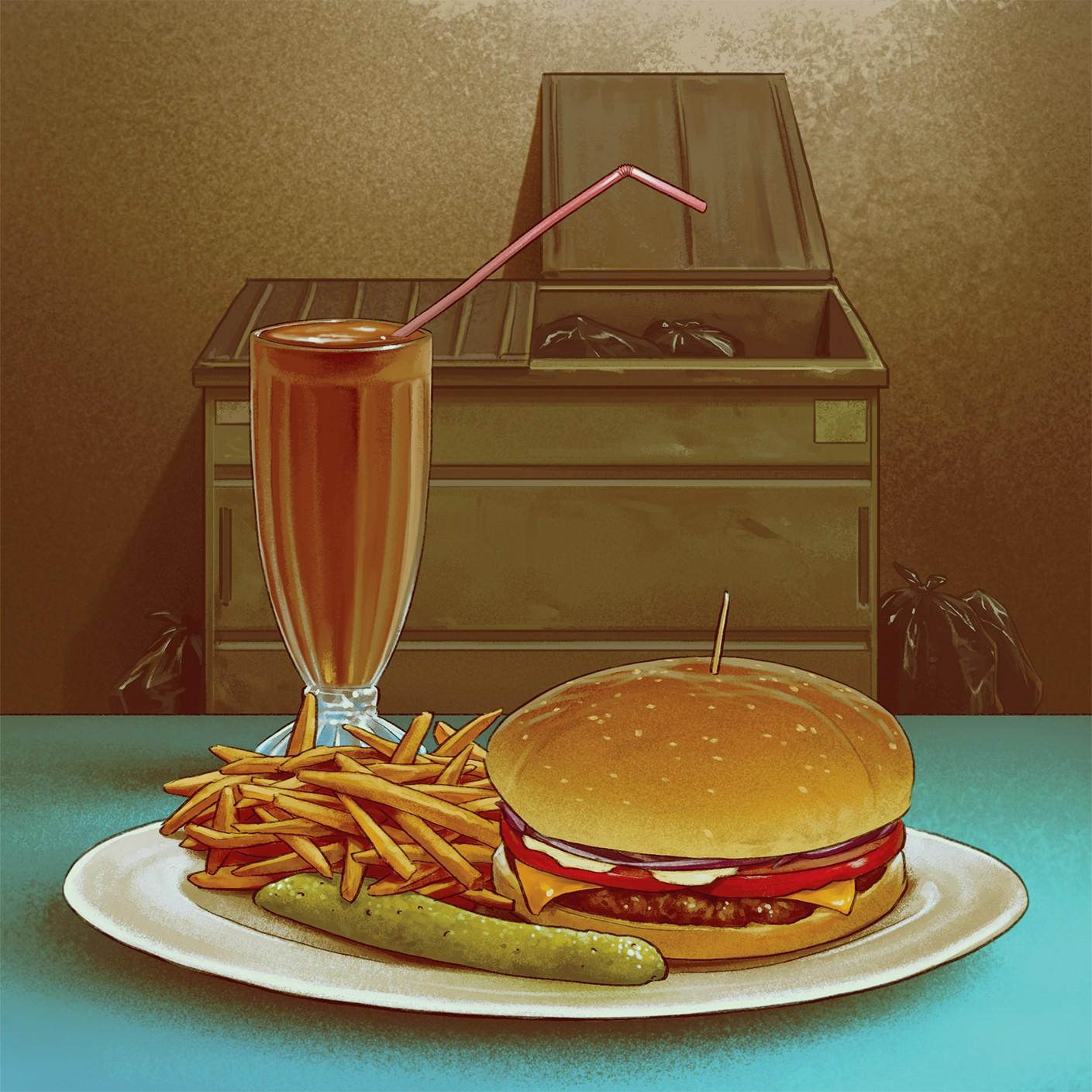
We went to a diner on Sunset and took a booth in the back with windows facing out at a dumpster. Billy told the waitress we were definitely going to need a plate of french fries right away, and a couple of chocolate milkshakes, and that these boys, that is, Adam and I, were from New York City. “In L.A. for a little fun!” He was laughing and pointing and shooting knowing looks at the waitress as if they had a history. But the waitress was unimpressed or didn’t care, and she asked if we still needed menus. Billy, slapping his hands to the table and gazing deeply into Adam’s eyes, then mine, shook his head and said five cheeseburgers medium rare would do but to hold the lettuce and keep any coleslaw that might come on the side as far from the table as she could.
“Thanks, darling. You have a gorgeous soul.”
The waitress was over 60, her eyeshadow was the orange of a smoggy L.A. sky at sunset, her hair was white and heavily curled, and her lips looked like they’d pulled on over a hundred thousand cigarettes. She flipped her pad closed and gave Billy a wink. Billy returned the gesture and said, “Billy loves you.” Then he turned to Dad and began to tell him how much he missed him and that he had been writing more songs than ever, tunes were spilling out of him fully formed, with words and melodies and piano lines, but that he was hearing Dad’s voice in the room with him, these harmonies that Dad would have to add to the tracks. In particular, to the chorus of a song called “Memory Repeats.” Billy began to sing the part right there at the table:
“ ‘Mem-or-y…re-peats…dah…day…day…dah…day…dah.’ And Walty, Walty, you go”—now Billy sang in falsetto, with all 10 of his fingers opening like the petals of a tulip above his head—“‘Mem-or-y…re-peats.’ Like that, up there, ‘Re-peats!’ I got a tape of it in the car. We’ll take a drive up in the hills after we eat and have a couple of listens, talk it out, then pop over to my place and spend the night at the piano, treating our souls to the mercy, the mercy, Walty, that they’re crying out for.”
Dad nodded. By now, his coloring, his brow, his posture, were commensurate with the sort of relief that came with letting go, the gratitude of being free of it. Though Billy was responsible for Dad’s improved mental state, this didn’t mean that Dad was pleased to be in Billy’s company or that he was even comfortable around him in general. Dad was at his best with Billy when the two old friends were seated together at a piano with a pen and pad resting on the music stand with a song in the works.
I could remember them in the living room on 94th Street, going from noon until the early morning hours. At the piano, at work with Billy, Dad was confident, focused, open, inspired. But anywhere else, with the God wants me to go to number one Billy, with the Billy loves you more than you could ever know Billy, with the day is too beautiful to let sadness into your heart Billy—anywhere with any of these other Billys, and Dad grew irritable. He looked up to Billy, who was four years older and had already released three solo records and experienced what it was to be a pop star. Dad craved a mentor-disciple relationship with Billy, and the acceptance and confirmation that came with that. Yes, had Billy asked my father how his record was coming along, or if he wanted to play any of the cuts and talk about them, or if he could help in any way; had he been able to quiet the part of himself that made my father truly bristle most—that is, the Billy who, like right now, raved on evangelically about the two of them writing number one hits—this would have brought my father to life, caused him to open up and treat Billy with love.
“Oh, that burger is juicy. Hey, Julie, baby…Adam…now, you know…you know that your daddy’s the most handsome man in rock and roll, don’t you? I’m saying, I have met every leading man in the business and there is no better-looking living example than your daddy.” Billy was hunkered over the table, his grin mischievous yet serious. “Now, Elina, you cover up your ears if you have to, but the boys have got to know this about their daddy, okay? Boys, I’m telling you, more women have fallen in love with your daddy than any man to grace a stage, including Elvis Presley—and that’s the truth. Just look at him. Look at that face, those eyes, those lips. Walty Newman is a lady-killer, and the day he married you, beautiful,” he said to Elina, “a million sweet young girls cried themselves to sleep. Yes, they cried, and I heard them and I held them and I told them that it was all going to be okay, because Billy was going to write a song for them, for all the girls who couldn’t have Walty Newman of Hoboken, New Jersey.”
“Billy, the boys don’t have to hear this.”
“Sure they do! They do, they love to hear it. Don’t you, boys? Don’t you? You know how good a daddy you got, don’t you?”
“Yeah,” we said.
Billy reached over the table and took my father’s head in his hands. “Walty, you got it all, my brother. You have got it all.” He let go of Dad and then said to him, “I’m so proud of you. You inspire me, baby.”
“If he was on stage, he was throwing roses to the girls in the front rows, confessing his love for them.”
Dad went off with Billy after dinner, who knows where. But the next day, when I told Dad how nice it had been to see Billy and what a terrific guy he was and funny too, Dad said that Billy was great, sure, that everyone loved Billy and that Dad did too, that they were like brothers, but that Billy could be a real pain in the ass. He swung in, from nowhere. You never saw Billy coming, because if he called and told you he was on his way then he’d be forfeiting the impact of blindsiding you, which would decrease his chances of getting what he wanted. That’s right, he was never there just to say hi and give you an hour about what he had been up to since the last time and to find out about your life. There was always an agenda, my father was telling me as I worked the foldout bed in the living room back into a couch. You saw Billy and you had to deal with a whole vision that included you and every second of your life.
“And I’ve got nothing to give him right now. Nothing,” my father said sharply.
We were alone together in the apartment, Adam and Elina down at the pool. I folded the blanket, straightened the pillows, avoiding Dad’s eyes. It would have been the wrong time to tell him how last night Billy had saved us from Dad, and that I was grateful to him. That if Billy hadn’t showed up when he had, Dad and Elina would have fought all night. Who knew if we would have ever gotten around to dinner. And we would have gone to sleep to their screaming.
“He’s telling me, ‘Just come over for a week and we’ll write a whole record.’ But he doesn’t see what I’m going through. He doesn’t care that I’m making a solo record of my own right now. It means nothing to him. It’s all about Billy, Jules.”
“Yeah.”
“And I gave him 10 years. I did the Billy thing for 10 years. Now I’m doing me, and I can’t let him in. I just can’t do it!”
“Okay, Dad.”
“There’s a lack of respect,” he said. “He takes no interest in my work, unless it benefits him. And what kind of friend is that? I mean, I don’t even know if he ever listened to the first record. He might have put it on. But I mean, did he really listen? I doubt it. He had no comments whatsoever about any of it. And it’s just unbelievable. Because I’ve supported him so long. I have dug in so hard to his music, written so much of it with him, and know it all so well. But there’s no reciprocation, Jules. It’s just all about him. And you know, music’s not like that. Sure, you’re competing with your peers, but you’re also in it together, and you want to know what everyone’s making and, if possible, let it inspire you. But not with Billy. At least not when it comes to me and my solo career. Maybe he’s threatened I’m going to outdo him. As far I’m concerned, that’s no excuse. He says he loves me. Well, he’s got to love me when I’m doing better than him too. He’s got to champion me, just like I do him.”
We went to the Ralphs to buy a loaf of bread and a dozen eggs. I was following Dad through the grocery store, and I could tell he was lost in the aisles, distracted, almost happily, talking about the pain and fear and confusion of a person who goes out and seeks the acceptance of all people, who cannot bear to be disliked by anyone, cannot tolerate it, and will try to take down in the eyes of others any person who does not or cannot be made to love him.
But Billy was a performer, Dad was saying, always turning it on. If he was on stage, he was throwing roses to the girls in the front rows, confessing his love for them—and their city—from down on his knees, and begging after the second encore to never let the night end because it was going to hurt him too much to say good night. And if he was having a meeting with the heads at Polydor he was swiveling in his chair, rolling his shoulders and snapping his finger in time with a song he was making up right there on the spot, and then telling those executives how lucky they were to have a voice like his on their label and how the good lord had blessed Billy by bringing them together so that his voice could get to the people. And if he was in your mother’s living room, he was telling her that she was the most beautiful woman he’d ever seen in all his life and that he’d like to move right into her house if she’d let him because there seemed to him no better place to live in the whole wide world. Even the guy washing his car would have been asked what he was doing shining windshields when he was handsome enough to be a leading man in Hollywood. The routine was practiced, but it was genuine; it came from a real place inside him. Becoming that person was so natural for Billy. Dad said so now, not without adding, however, that a part of it was schtick, a game that Dad was not willing to participate in.
“But I worry about Billy, Jules. I do,” he said breathlessly. “You look at him and you think he’s having the best time, that life’s so good for him, but he’s in a lot of pain. A lot of pain.”
“Is he?”
“Anyone who expends that kind of effort trying to make everyone love him is destroyed inside.”
“Can you help him, Dad?”
My father shook his head. And for a moment, in the dairy aisle at Ralphs, I could tell my father felt above Billy. He might have loved his friend, yes, but he was taking pleasure in the thought that between the two of them, Billy was the truly damaged one.