Your bag is empty.
In 2004, when Donald Trump was still a reality TV star, he gave a *Playboy Interview* about everything from the value of self-promotion to his famous fear of germs. Now, for the first time, we’ve excavated long-forgotten passages from the full interview transcript. Playboy executive editor Liz Suman talks with journalist David Hochman about what didn’t make it into print 16 years ago, and what happens when a celebrity interview subject ends up becoming president
It’s May 2004, and David Hochman is sitting across a desk from Donald Trump on the 26th floor of Trump Tower. Hochman, a veteran entertainment journalist who has probed the interior lives of everyone from Julia Roberts to George Clooney, is here to interview the future president of the United States for the October 2004 issue of PLAYBOY.
The Playboy Interview has served as the cultural heart of the publication since it first appeared in 1962, when Miles Davis sat with Alex Haley. Malcolm X and Martin Luther King Jr. appeared as subjects; so did Maya Angelou and Betty Friedan. Such luminaries as Billie Jean King, Vladimir Nabokov, Kareem Abdul-Jabbar, Cecile Richards, Jay Z, Bernie Sanders, Michael Jordan, John Lennon and Yoko Ono (together), Stanley Kubrick, Ayn Rand, Steve Jobs, Ta-Nehisi Coates and Tarana Burke have been interviewed for the series, which over the decades has become renowned as one of the most candid and in-depth interviews in journalism.
This early aughts tête-à-tête marked Hochman’s first of 30 Playboy Interviews and Trump’s second of two. (The latter’s first was an eerily prophetic 1990 conversation with Glenn Plaskin that would warrant a separate analysis in itself.) The interview took place in the immediate wake of the breakout success of The Apprentice. As the very American story goes, the show catapulted Trump from campy tabloid fodder to the semblance of thriving real estate powerhouse. Over the course of a single heavily edited, highly produced, wildly popular season, the show turned Trump into a winner. “People like me much better than they did before The Apprentice,” Trump told PLAYBOY at the time. “It’s like being a rock star.”
Although neither interviewer nor subject could have known it then, the conversation was a deep dive into Trump’s world at the crucial moment the struggling real-estate mogul’s public persona was coagulating into that of a man the American public would ultimately elect to the highest office in the world.
As originally published, the sweeping interview covers a range of topics, some of which have new resonance as Trump has gained power: The Apprentice’s swift impact on Trump’s image; sexuality in the workplace; his disdain for germs; the amount of cash he keeps in his wallet; sexual performance enhancers; his haircare routine; Omarosa; his relationships with Melania and former wives Ivana and Marla; his parents (“If you put the two of them together, perhaps you have Donald Trump.”); his assertion that “Black entertainers love Donald Trump”; his admiration for Democrat John Kerry; how he’d like to be remembered; and nuclear war. But as any good journalist knows, a published interview can never include everything that was discussed, and if the interviewer has done the job right, there will be valuable scraps left on the cutting room floor.
Flash forward 16 years. It’s October 2020, and I’m sitting across a screen from Hochman on a Zoom call from my living room in Hollywood and his office in Venice. The topic? Not only the parts of his conversation with Trump that were published back in 2004, but also the ones that weren’t—until now.
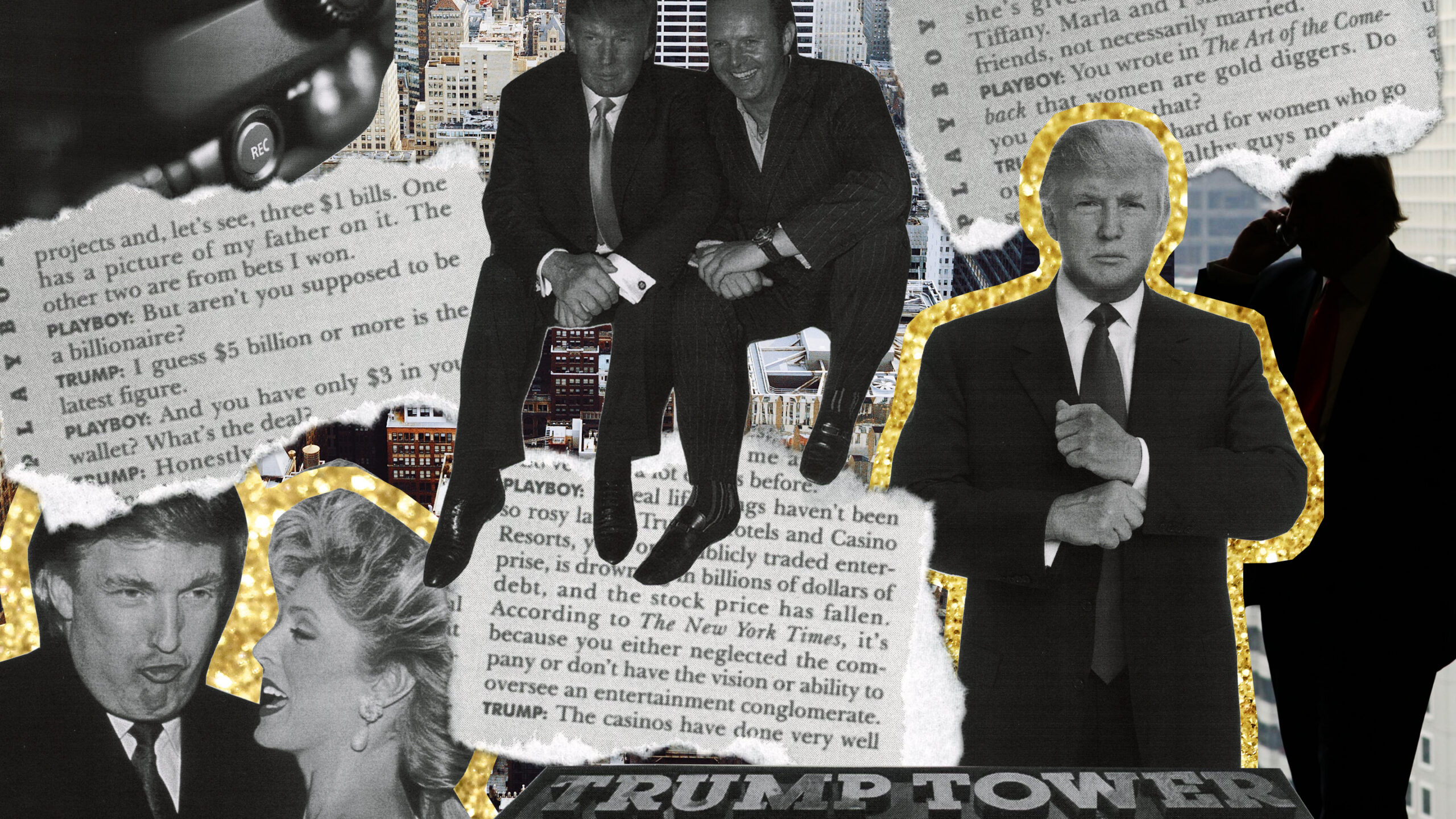
My mission to find the original transcript that served as the basis for the 2004 Interview began in early 2017, as Trump was settling into the White House. At the time, I was a fact-checker in the research department at PLAYBOY. Seeing his name (and hearing his voice) everywhere, I became fascinated not only by the published interview with Trump, but also by the possibility of what hadn’t been printed. After doing some digging, I tracked down the full transcript via PLAYBOY’s then-transcriptionist, who discovered the 104-page relic on an old hard drive. (Shout-out to Grace from Keystrokes in Santa Monica.)
I’ve been quietly sitting on the time capsule ever since, waiting for the right time—and the right way—to unearth it. The raw, unpublished material is overwhelming, both in length and breadth. And it provides new perspective on the motivation and showmanship behind “the Donald.”
On the eve of what will likely be the most important election of our lifetimes, I sat down virtually with the other person who was in the room with Trump during that interview. Hochman and I discussed previously unpublished excerpts from the transcript, how the interview has aged and how the Apprentice era contributed to the making of the 45th president.
Editor’s Note: The following Q&A has been edited and condensed for clarity. The previously unpublished material from PLAYBOY’S 2004 interview with Trump has not been altered, aside from minor corrections to spelling, grammar and punctuation.
HOCHMAN: I read through the published interview last night, which was funny because it was the first one I’d ever done.
PLAYBOY: Your first Playboy Interview? Ever?
HOCHMAN: Ever. And I was really nervous. It was the only interview I’ve ever done where I wore a suit. I remember going to Trump Tower, and there was that pink waterfall near the escalator he came down when he announced he was running for president. I needed the coolness of the waterfall to cool me down. But the thing with Trump is, as soon as you start talking, he just talks at you. He tries to set the agenda. Before the recorder even went on, he spent quite a while showing me all the magazine covers he was on and awards he won. He just needed to show me all that stuff, and I didn’t need it. I didn’t ask for it. I didn’t want it, because I knew I had a limited amount of time with him.
My editor had said, “You have to have a hundred questions ready.” So I had a hundred questions in my pocket, folded up. I was ready to go, but he kept saying things like, “Here’s me on the cover of Time magazine. Here’s me on Newsweek. And I was like, “Great. Let’s get this started.” But for whatever reason, he needed to tell me how great he was. I actually asked him at one point, “What’s the value in constantly telling people how great you are?” And he said, “Because if I don’t, nobody else will.”
Unpublished Transcript:
PLAYBOY: I know everyone says you’re a great promoter. What’s the value of promoting and telling everyone things that people know?
TRUMP: Promotion is very [benefiting]. So often, somebody will call from a television station who’s doing a big show—20/20 or 60 Minutes or Dateline—and they’re like, “Do you want to do it?” Of course I’ll do it, because if I take an ad in the show, it’s going to cost me a half a million dollars if I took that kind of time—or more. I get it for free. And the ads—people turn them off to a large extent, as opposed to a show, which is unbelievable. So having the ability to promote is just a great thing. Again, I think building is my greatest asset and not promoting.
PLAYBOY: He certainly was ahead of the curve with self-promotion. He was kind of born for social media. Do you remember the offices being nice? I was listening to a podcast about The Apprentice and how Trump was such a hustler that he managed to get Apprentice creator Mark Burnett and The Apprentice to spiff up the Trump Tower offices, which were in disrepair. He turned that whole situation into a makeover for his image on multiple levels, and that helped paved the way for everything to come.
HOCHMAN: Right. At that time, he was kind of a joke around New York. There was definitely something tacky about him, like the gold letters everywhere. He was this guy from Queens who came to try to be something in Manhattan. He had his own overly garish footprint all over the city. I remember thinking, “This is just, like, cheesy in here.” There was too much gold, and the receptionist—you just felt like you were in a sitcom.
As he got closer and closer to being president, I remember feeling that he was kind of a clown who made it big on this reality show. And people were starting to pay attention to him, but in a funny, kitschy way: “You’re fired.” There was nothing real about it. And as it turned out, he was misleading me. When I asked him about bankruptcy and all that, he was skirting the truth. [Hochman is referring to Trump’s claim in the published interview that he had never been bankrupt. His companies had filed for bankruptcy four times at the time of the interview and his casino would file for bankruptcy a month after its publication].
PLAYBOY: I bet the fact-checking on that Playboy Interview was exciting.
HOCHMAN: The first thing he did, and I don’t think it’s ever been done in any interview I’ve conducted, was he said, “Welcome. I’m going to turn on a tape recorder too.” He brought out a tape recorder and put it on the desk, and no one’s ever done that. So he did not trust the media. He thought it was fake news then. Even though I think he had some sort of connection with Hugh Hefner, he didn’t trust me.
PLAYBOY: What was his reaction when the interview came out? Did he have any complaints about how he was portrayed or contest anything that was included?
HOCHMAN: I don’t think so.
PLAYBOY: You said that at the time he was still kind of a joke celebrity. When he became the Republican nominee in 2016, what was your reaction as someone who had seen inside his world?
HOCHMAN: Was it surprising? Yeah, it was shocking that he became president of the United States. Everyone is still shocked every single day, but I saw where it came from. At the time, he wasn’t someone who people loved in New York. I know he resented that. I know love is a big thing for him. By some accounts, he didn’t really get much love or affection from his father as a kid. So I feel these were, like, ancient psychologies—that, on top of any Russian intervention or whatever got him elected, these were the things that propelled him.
Unpublished Transcript
PLAYBOY: Does it hurt you when people don’t like you?
TRUMP: No, it doesn’t hurt me. They like me in a certain way, because when people wanted me to run for president, the only reason they wanted me to run was because I had high poll numbers. So in a certain way they liked me. I think they didn’t like me as much as they respected me. They did respect me, and now I think there is that but they also like me better and that’s because of the power of having a big show on television.
PLAYBOY: Was there anything else in that conversation that seems particularly prophetic for his current behaviors and obsessions?
HOCHMAN: I spent two days with him, and on the first day, it was really, really, really, really hard to get beyond the soundbite with him, especially because it was the first Playboy Interview I ever did. I wasn’t getting anywhere, and he was just giving me things I had already heard before. Then he got a phone call from Eric, one of his sons. After he hung up, we were talking about his son and something happened in his face. He loosened up a little bit. I felt like, Oh, wow, there’s a real connection there. Maybe now I’m going to be able to get somewhere with him. There was something with his family that was real—more real than his show. That was significant.
Unpublished Transcript
PLAYBOY: Any strange hobbies that nobody knows about, other than golf?
TRUMP: No, I really don’t. I’m really into that. I was the captain of my baseball team. I was the captain of everything. If there was a sport, I was the captain of the team. I was always the best athlete. That’s something that people don’t know about me—that I was an athlete.
[Picks up phone] Eric, how are you doing, babe? What’s up? All right. Wow. Hey, that’s fantastic. Good job, Eric. This is good training for you. Well, you’ve got to call Donnie and tell him that because we’re paying for the architecture in Chicago, you know? Right. When is he going to meet with you in Bedminster? That’s fantastic. That is great. All right. That’s great. Good, honey. Well you have somebody to work with now that you can really relate to, right? Fantastic. That’s really fantastic. Good. I’m proud of you. Get back here and get it going. Good building, okay? Okay, honey. Bye.
[Back to interview] Okay, go ahead.
PLAYBOY: Was Melania around during the interview or was it just the two of you?
HOCHMAN: It was just us, and then he had one of his ghost writers sit in for a while. And his secretary—his old-fashioned, straight-out-of-central-casting secretary—kept coming in with those pink phone memos. It felt like from another era.
I believe in God. I think that there’s got to be something, because I can’t believe we’re doing this all for no reason.
PLAYBOY: One thing that made me laugh out loud were all the exchanges about his germaphobia, which show up in both the published interview and the transcript.
HOCHMAN: I knew from Howard Stern—because he had made so many appearances on Howard’s show—that Trump was a germaphobe like Howard, and it was unlikely he was going to shake my hand. So I was prepared for that, and I remember him not shaking my hand and then us talking about it. You had this sense, at the time, that he didn’t want to touch anyone, and he was later quoted saying, “I don’t like shaking hands with people.”
Unpublished Transcript
TRUMP: I was in a restaurant the other day where a man came up to me who had just come out of the bathroom, and he wants to shake my hand. He’s a fan. “Oh, Mr. Trump, could I shake your hand, sir?” It’s so rude, and yet I had a choice. Do I shake his hand and make him happy? He wasn’t doing it as a bad person. He’s doing it as a fan of mine. Do I shake his hand and make him happy, or do I refuse to shake his hand and for the next 30 years he’ll be saying, “That guy is no good.” I shook his hand, and the one benefit to it is that I didn’t eat any more of my dinner. And that’s okay because I lost a little weight. It’s not the worst thing in the world. Leaving some on the plate is not so bad. But it’s disgusting. Who knows where that hand has been?
PLAYBOY: Do you carry that Purell stuff?
TRUMP: No, I carry— Not Purell. I carry something else, but it’s—
PLAYBOY: Antibacterial?
TRUMP: Yeah, and supposedly it’s good. Who knows? At least it makes you feel better.
PLAYBOY: Did you think about that part of the conversation when you learned he got coronavirus?
HOCHMAN: I certainly thought about it when he was campaigning for president in 2015 and 2016. I thought, He must hate this. He must hate these people he has to be out among. And then recently, when he made his appearance at a Florida rally a week after he got out of the hospital, I thought again: The plane lands and he goes into the audience and these are the people he was always most terrified of. Yet this is the base that has elevated him to something like love. So, the masses won out, I guess. The ugliness won out.
PLAYBOY: Were there any other moments that particularly stand out?
HOCHMAN: There were a couple moments of introspection that surprised me, when he talked about life being short and how we’re just a speck in the universe. I was surprised to hear him in any way be reflective or thinking about God. I mean, I’ve interviewed other people for PLAYBOY, too, like Deepak Chopra. He was no Deepak. But he was at least bringing up some of these ideas.
Unpublished Transcript
On being a speck…
PLAYBOY: What hurts you?
TRUMP: Look, I look at life and, sadly, life is what you do while you’re waiting to die. From the time you’re born, you’re here for an instant. When you look at— They found Neanderthal man two billion years ago. When you think of time, we’re here for a speck. If you live to be 100 years old, it’s just a millisecond in the overall scope of things. You realize that. You realize that nothing is really so earth-shattering, nothing is really so important. You realize that you live a life, you live a good life, enjoy it, have a lot of fun—which I do—and you’re only going to be here for a short time.
On God…
PLAYBOY: You said yesterday that [ex-wife] Marla [Maples] might have been a little too spiritual for you. Do you believe in God?
TRUMP: Yes. Marla is very spiritual and a very good person, but a little bit too spiritual for me. Mine— I’m much more grounded. I don’t knock the spirituality. I think it’s great, but it was too much for me. But she’s a very spiritual person.
PLAYBOY: What’s your sense of God?
TRUMP: I believe in God. I think that there’s got to be something, because I can’t believe we’re doing this all for no reason.
PLAYBOY: Do you pray?
TRUMP: Probably not as much as I used to. I’ve seen too much negativity. When you see a church collapse and 300 children killed, you would think that couldn’t happen. That bothers me. Now maybe that’s the test that ministers and priests [inaudible]. Or when you see people blown to pieces in a temple, you say, “How can that happen in a temple? Wouldn’t we be protected here?” Maybe there’s just a much higher calling. I don’t know, but I do believe in God. Sometimes when you see what’s going on in the world, it’s not the easiest thing to believe.
PLAYBOY: That’s very existential stuff.
HOCHMAN: I thought that was interesting. I don’t know what to make of it. But part of me thinks he was just saying those words because he knew he was supposed to—because he knew I wanted something. That was him trying to go deep.
PLAYBOY: To put on a show.
HOCHMAN: I had the sense that it was almost like interviewing an old Catskills performer or an old PR agent from the 1970s or a guy who had done late-night infomercials or something like that. That was my sense of the kind of guy he was. Trying to get beyond the veneer of a person like that is hard, but that was my goal. I was like, “Can you be real for five minutes?”
PLAYBOY: In the transcript, he speaks at length about the death of his brother Fred in 1981. Was that a moment where he seemed a little bit more human?
HOCHMAN: It felt cognitively dissonant. It felt disconnected. Saying your brother was better off dying just seemed emotionless to me. There was not a hint of emotion in that. So it didn’t even register enough to include in the interview, because it didn’t feel like a significant moment. Usually, that’s a major part of your adulthood, the loss of a sibling. I was surprised it didn’t land in our conversation with more of an impact.
Unpublished Transcript
PLAYBOY: What’s kept you from [drinking, smoking, doing drugs and drinking coffee]?
TRUMP: I had a brother named Fred, who was a great brother and a great guy and a very handsome guy. He was the life of a party, and he was a drinker. He became an alcoholic and died of alcoholism. He also smoked a lot, and he was 10 years older than me. He would lecture me constantly about not drinking and not smoking because he had a problem. He knew he had the problem, and he used to say, “I will absolutely come down on you if I ever see you drinking or smoking.” And it just had an impact because at a fairly young age I saw what it was doing to him.
There was no better looking guy than him. There was no better personality than him. He had the best personality of anybody. Alcohol got him. I’ve seen it with a lot of my friends. I have a friend who is a highly respected guy, who you would know. And I didn’t know he had a problem with alcohol, but recently they were at a party and we literally carried this man out of the party. He was so drunk that he couldn’t even move. To be honest with you, when I saw that, I don’t have the same respect for him as I had for him before.
PLAYBOY: Is there any way you can stop somebody like that? Is there any way you could have stopped your brother from doing what he did?
TRUMP: No. I hear all about the clinics and I hear all about everything. I see currently alcohol is all around me—so many people, people that are very close to me. I have never seen people stop. They don’t. I know there are cases where people are able to stop. I know I read about the Betty Ford Clinic and all of this, but it just seems that they just relapse. Unless you stop early and before it’s too late, I just don’t see people being able to stop. It just shows you the power of that drug. The cigarette companies have taken a tremendous beating, and rightfully so, in the courts. I think that’s great, but I don’t understand why the alcohol companies aren’t sued the same way the cigarette companies are, because alcohol killed my brother and killed many of my friends.
Even worse, alcohol kills people that are outside—drunken drivers have killed innocent children walking across the street. Drunk drivers hit them and they don’t even know what’s happening, so they kill people other than themselves. If they kill themselves, that’s one thing. But they kill many people other than themselves and I don’t understand why the warriors haven’t gone after the alcohol companies the way they have the cigarette companies. I don’t get it, because it’s far worse than cigarettes and cigarettes are bad.
PLAYBOY: When your brother died, did you go through that feeling of, What could I have done differently?
TRUMP: I’ve always had that, but my brother suffered tremendously the last couple of years in his life because the alcohol was just eating his body away.
PLAYBOY: And were you in constant touch with him?
TRUMP: Yeah, he was living with us at the time. There was nothing you could have done. He was so much better off passing away, because he suffered serious effects of alcohol and, to a lesser degree, smoking too. He would smoke two packs a day, three packs a day. He was a smoker and an alcoholic and he suffered greatly with it. Alcohol is just a terrible thing. But then you take the extension of that—drugs—and, of course, I view them as the same thing. I think alcohol and drugs are really the same thing.
If they ever get rid of that ridiculous rule in Congress where you have to be born here, I think [Arnold Schwarzenegger] would be a great president.
PLAYBOY: How much of an impact do you think The Apprentice had on his public persona? Would he be President if there hadn’t been that transition from “Trump the joke” to “Trump the joke but a powerful real estate mogul”?
HOCHMAN: Definitely not. I’ve interviewed Mark Burnett a lot too. I’ve spent time with Mark at his house, and I’ve seen that his world is also kind of a creation. His public self and private self are very different. He’s a very religious person, which is not really reflected in some of the products he puts out. So, it’s about the creation of these characters, and I think Trump was a pure product of America. Everyone bought it, and they still buy it no matter what happens.
PLAYBOY: The unpublished material includes some insights into how he views morality and its relationship to celebrity.
HOCHMAN: There’s a sense of celebrity trumping all. We talked about Arnold Schwarzenegger, we talked about Martha Stewart, we talked about Mike Tyson. To him, the big failing of someone like Mike Tyson or Martha Stewart was that they had fallen from their celebrity perch—almost more than the obstruction of justice Stewart went to jail for or the violence against women Mike Tyson was convicted of. That was the big crime for him.
Unpublished Transcript
PLAYBOY: Do you sympathize with Martha Stewart?
TRUMP: Yes. I think Martha made a tragic mistake when she didn’t testify. I watched the jury come out of the chambers, and those people were having such a good time. They were so happy to have their 15 minutes of fame. I’m not sure that anything could have convinced them. They were so loving it. So I don’t know. If she would have testified, maybe that wouldn’t have made a difference.
I was doing the Larry King show the day before the jury came back, and I told Larry, “I believe that Martha made a tragic mistake in not testifying.” And the next day the jury came down and she was guilty. Now, assuming I read the jury wrong and they were looking to do the right thing, which I’m not sure I can believe after watching how much fun they were having. But, assuming that I read the jury wrong, Martha just had to tell them that she wasn’t guilty. I just can’t believe her lawyers would not have asked her to get on the stand. Then to be screwed by her friend, who traveled with her, probably paid for by Martha and everything else, it’s just inconceivable what happened to her. It’s just a very sad thing that it happened—the destruction of a great woman and a great life.
I agree, she probably handled it very badly. I don’t think it was the act. I think it was the way she tried to get out of the act or define what happened. The Martha Stewart case is a very sad situation, but I really believe that it was just devastating that she didn’t testify. Nobody likes to testify or anything like that. You know your life is on the line and all, and it’s a lot easier if you can just say, “Oh, good, I don’t have to testify.” I just think in her case—I thought it was a very bad thing when Mike Tyson testified. In fact, he was going to be exonerated by the jury. They were going to exonerate Mike Tyson until he testified, but it’s different. Mike is a fighter who is not a professional person other than at fighting, and Martha is a highly sophisticated woman who I think would have testified very well and nicely. Not that it’s something she wanted to do, but she had to do it.
As soon as they announced, shockingly—and even the jury was shocked. They couldn’t believe it, they were gasping. They couldn’t believe that she wasn’t going to testify. Because if they were legit—when I say legit, if they were looking to do the right thing—then they really would have wanted to have heard her testify and at least say, “I’m innocent.” There’s nobody who said she was innocent. Even her friend said she was guilty, so what did she have to lose at that point in life? So when I heard she wasn’t testifying, I said, “She’s absolutely going to be convicted.” I think the jury really had no choice.
PLAYBOY: The Schwarzenegger exchange also illuminates some contradictions in regard to his future political track record.
Unpublished Transcript
PLAYBOY: Were you surprised to see Governor Schwarzenegger do as well as he’s doing?
TRUMP: No. I know Arnold Schwarzenegger. He’s a friend of mine. I had dinner with him recently, and he’s a very smart, strong guy who— I have a lot of property in California all of a sudden, and I am so happy that he’s the governor. He’s a fantastic guy who is going to be a great governor who, frankly, if they ever get rid of that ridiculous rule in Congress where you have to be born here, I think would be president and I think he would be a great president. Arnold Schwarzenegger is a man who is very smart, but also has great common sense. One of the reasons that California is all coming together is that he’s used his common sense. Also, he doesn’t stop. He doesn’t give up. He’ll never, ever give up. That’s why he was so successful prior to being governor.
HOCHMAN: Think about how much trouble he gave Obama, right? The leader of the Birther movement, and here he is saying it’s a stupid law. So, yes, there were some inconsistencies.
PLAYBOY: Knowing what you know now about his trajectory, is there one thing you wish you had included in the interview?
HOCHMAN: I wish I would have had a little more reporting on his finances so I could have called him on that. He was a TV character, so I was doing it as a celebrity interview the way I would interview the star of Friends or The West Wing or any other big show at the time. It was really about this TV star. I wasn’t thinking, This guy is going to be the leader of the free world so I better call him on his business dealings. Once he said, “Oh, no. All is well,” I let him slide. That wasn’t the focus there. I asked him how much he’s worth and other things. I just wanted to get his reactions. But I do wish I had more of an arsenal of the financials to say, “Well, what’s the deal here? Your taxes say this, or we can’t see your taxes.” You know?
PLAYBOY: If you had the chance to interview him today, would you jump on it?
HOCHMAN: That’s a good question. It’s really become an art to interview him well, and so few people are able to do it. I’m happy I interviewed him when I did, and I’m also happy to be a spectator now.
PLAYBOY: Other than the financials, is there anything else you would ask him now?
HOCHMAN: I really do want to know as much as possible about the private side. I guess it’s the same thing I wanted then, which was: How can you strip away this fake public persona and get to the real person—about his regrets and his sense of what’s right and wrong and getting past the show. I really, really want to get past the show, and it’s so hard to do because I don’t think he knows.
PLAYBOY: The delusion and performance are embedded in him. I think he’d have to go on an ayahuasca retreat to shed all the layers.
HOCHMAN: It would be hard. The things I want from every interview are, I don’t care about the movie you have. I don’t care about the show you have. I don’t care about your success. I just want to know who you are. What keeps you up at night? What are the relationships that really matter to you? What terrifies you? What’s going to upset you most if you don’t get to do it in your life? I want to get to that place with him. And with Trump—almost more than anyone—it was hard. It was impossible to get there with him, to get to the real person.
PLAYBOY: Earlier, you said you weren’t sure how he reacted to the interview after it came out. Did you ever speak to him again?
HOCHMAN: No.
PLAYBOY: Is there anything else you’d like to say about the experience?
HOCHMAN: When you see the Trump name all over town, as it was in those days, and then you go to Trump Tower and go upstairs to meet him, there is a little bit of pulling back the curtain in The Wizard of Oz and seeing the fallible human being behind it all. That’s how I went into it: thinking, I’m not sure this guy is who he says he is. And I left feeling that way too. So I guess people don’t surprise you. They tell you who they are.
Additional research by Andrew Shafer