
Your bag is empty.
Playboy’s first “Sweetheart of the Month,” Marilyn Monroe, died on August 4, 1962, at age 36. Her appearance on the cover and as the centerfold of the first issue of Playboy launched the magazine to success from its very first issue and raised Monroe’s profile in the same breath. But that’s not where her story with Playboy ends. Monroe didn’t know she would be Playboy’s first cover star, but the summer she died, there was another cover in the works—and this time it was hoped to be a collaboration.
When Marilyn Monroe graced the cover and centerfold of Playboy’s premiere issue in December 1953, she was hurtling toward mega-stardom. Four years earlier, the cash-strapped, struggling actress took a series of nude photos because she was behind on her bills. She was paid only $50 at the time. The photographer, Tom Kelley, sold the photos to a printing company, which filed them away until Monroe found unexpected fame in The Asphalt Jungle. Even with her hair longer and her face half-hidden by an upstretched arm, when the 1952 “Golden Dreams” calendar appeared, it was unmistakably Marilyn. Amidst the press frenzy around the nude photos and calendar, Playboy’s founder purchased the photo session for $500 to use in the magazine; because the nature of the licensing deal didn’t require it, Monroe did not receive any money, nor did she give her approval. Emblazoned with “the famous Marilyn Monroe nude” on the cover, Playboy’s first issue helped cement Monroe as the sex symbol of the Atomic Age. Perhaps moreso, Monroe catapulted Playboy to success from its very first issue.
The construction of “Marilyn Monroe, Sex Symbol” took place somewhat outside of herself. At first, Monroe was fearful that the photos re-published by Playboy would tank her newly successful acting career. The opposite happened: “I admitted it was me who posed for that nude calendar even when the Fox executives became nervous and believed this would cause the ruination of any films I would appear in and also the end of my movie career,” Monroe told photographer George Barris for his 1995 book, Marilyn: Her Life in Her Own Words. “Of course they were wrong. The fans, my public, cheered when I admitted it was me, and that calendar and that Playboy first-issue publicity helped my career.”
Monroe spoke about her sex symbol status in a recently surfaced interview that took place just days before her death. “I’m going to be a symbol of something, I’d rather have it be sex than some of the other things they’ve got symbols of,” she said. Monroe noted that she’d never done an erotic scene on film, but wanted to try it out. She lamented societal prudishness, saying, “We are all born sexual creatures, thank god. It’s a pity so many people despise and crush this natural gift. Because art, real art, comes from it.”
We are all born sexual creatures, thank god. It’s a pity so many people despise and crush this natural gift.
While it wasn’t a role she publicly fought—after all, when asked about sex, she famously quipped, “Sex is part of nature. I go along with nature”—Monroe also sought to regain her agency. For her, this meant stepping away from the public performance of “sex symbol” for a few years: announcing that she was “tired of the same old sex roles,” she moved to New York, began studying at the Actors Studio, and, breaking her contract with 20th Century Fox, she set up her own production company. When she returned to Hollywood, she did so on her own terms, with a new, highly favorable contract with Fox and enhanced control over her image.
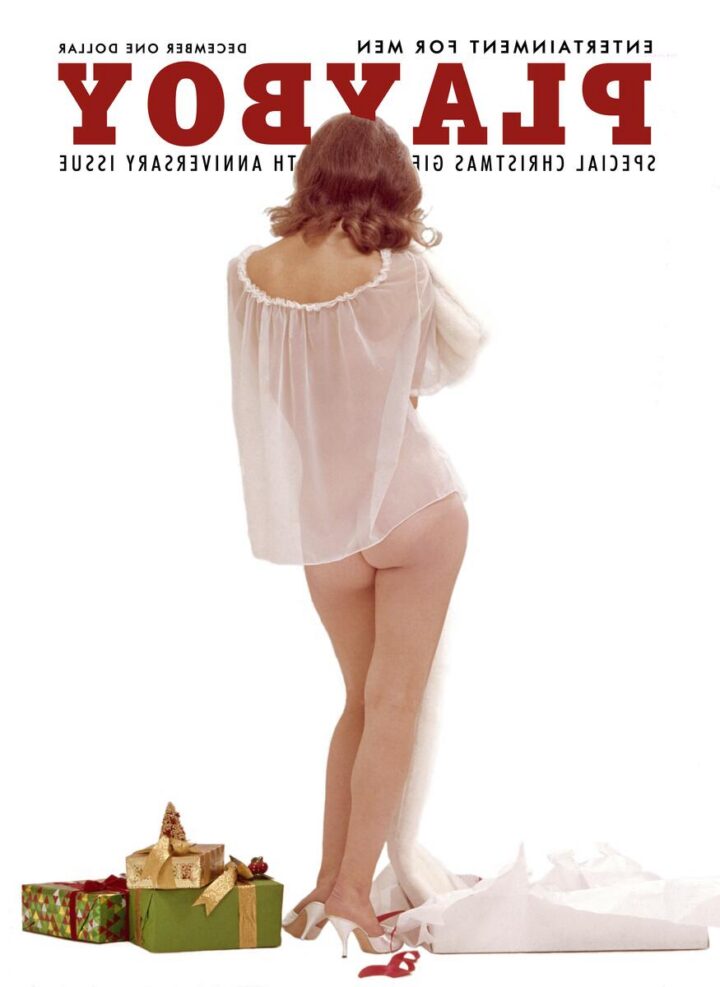
For Marilyn, the first two years of the sixties were plagued by personal difficulties and career setbacks, yet her fame and beauty were untarnished. Larry Schiller, who had first shot her on set during Let’s Make Love for Look Magazine and was a frequent Playboy centerfold photographer, took photos of her skinny-dipping during the filming of Something’s Gotta Give. After Fox fired her for production delays, Schiller sold most of the images from the series to Life, though he kept aside a roll of the most risqué images. Eager to show them to Playboy, he first brought them to Marilyn. After going through the contact sheets, she chose one photo: a full-body nude of her turned to the side, pulling on a bathrobe. Schiller negotiated an exclusive deal with Playboy for the single nude and use of all the previously published images in the series—at $25,000, it was reportedly the most money Playboy had ever paid for a photograph. Known for being highly selective with her image, Playboy’s art director Art Paul concocted a novel cover idea for Marilyn’s hoped-for return: a two-cover concept that would show both her front (on the main cover) and her back (on the other side of the cover paper), to be photographed simultaneously by a pair of synchronized, equidistant cameras.
Schiller presented Monroe with Paul’s cover concept, and the deal stalled as she contemplated the shoot and her career, feeling caught again between the idea of a “sex symbol” and the reality of it. Schiller went to discuss Playboy with her on the morning of August 4th; according to his memoir of her, she told him, “It’s still about nudity. Is that all I’m good for? I’d like to show that I can get publicity without using my ass or getting fired from a picture.” She continued, “I haven’t made up my mind yet—let’s leave it at that. I’ll call you.” Later that night, she died from acute barbiturate poisoning.
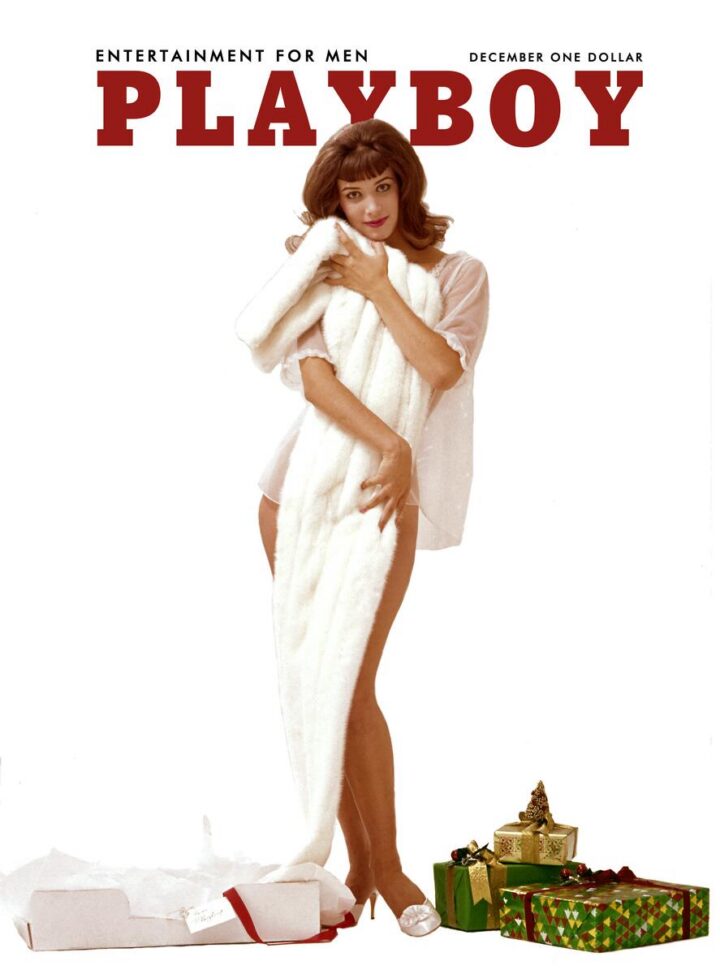
After Marilyn’s death, Playboy moved forward with the same dual-cover design for December 1962. Sheralee Connors, Miss July 1961, took Monroe’s place, clad solely in a sheer chemise and white high-heeled mules—snuggling a long white fur stole, from the front, her body was demurely covered, but once the magazine was flipped open, her pert derriere was provocatively exposed. While Playboy’s agreement for the purchase of the poolside photos of Marilyn was signed in September 1962, the magazine waited to publish them until the January 1964 issue, arriving on newsstands exactly a decade after her first Playboy cover. In the photos, she is luminous and free, smiling and joyful—a painful reminder of what could have been and all that was lost.