

Your bag is empty.

After a bruising few years—and while Dan Auerbach was caring for his dying father—the Black Keys backed into their rawest record in years.
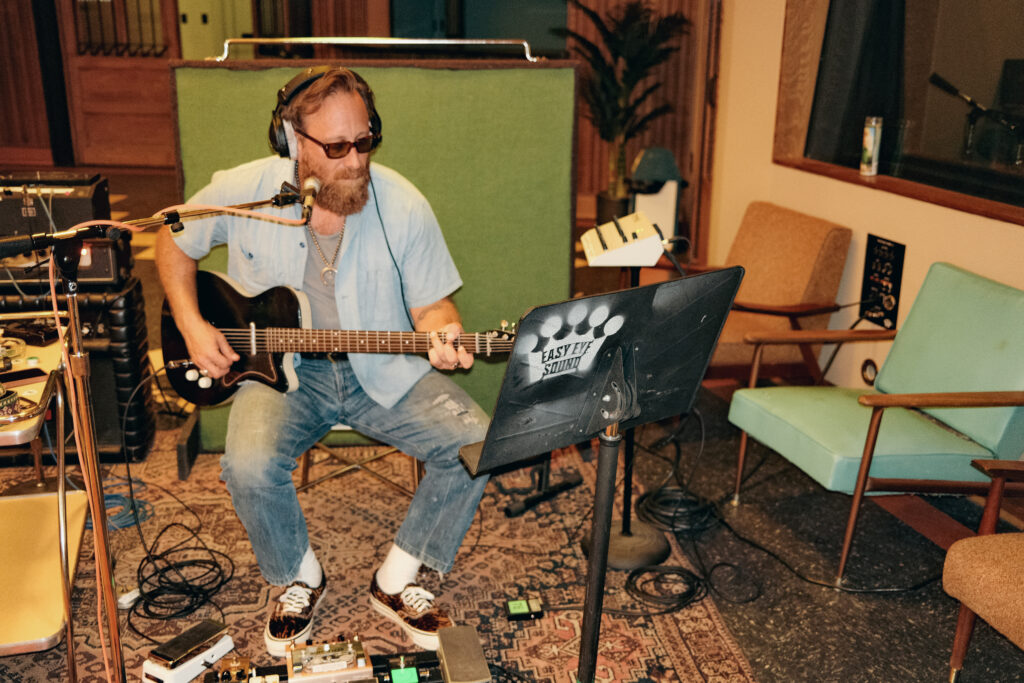
Easy Eye Sound, Dan Auerbach’s Nashville recording studio, only officially opened in its expanded form a few months ago, but nothing about the place feels new: walnut paneling warmed by low amber light, drum heads glowing along the wall like stained glass. In the foyer, an oil-painted stage backdrop from the turn of the last century—black pines against a darkening sky—hangs flat against the wall. It was built to disappear behind performers. Here, Auerbach gives it pride of place.
The Black Keys are absurdly successful by any measure: They’ve won Grammys and have filled arenas and are one of the last rock bands to reach genuine mass scale. The past few years have been rougher: a canceled arena tour, a split with mega-manager Irving Azoff, skepticism around the band’s increasingly polished direction, and, for Auerbach, a cancer diagnosis for his father, Chuck Auerbach.
Last spring, while helping care for his father in the final months of his life, Auerbach found himself back in the smaller room at Easy Eye with drummer Patrick Carney and a handful of self-taught musicians. They played obscure old songs by feel. Only later did it start to look like an album. What he backed into, he says, was the rawer version of the Black Keys his father had loved most.
This is a studio that I built 15 or 16 years ago. We started next door as a small studio, and then bought this space recently and built it out to have a classic large room, West Coast style, like your Capitol Records type of studio. The older studio is set up kind of like American Sound or Muscle Shoals, tight and dry, and that’s got all my gear in it. This new room is not so jam-packed with my shit, so I can actually rent it out.
Classic big room, where you can have everybody in together and get an actual room sound, a natural decay. Next door you can’t really do that. And this kind of room has become harder to find. Usually when you get a big room, it’s owned by a billionaire and super sterile. This is a big room, but it has the charm of the place next door.
We never felt comfortable in a traditional studio. The first time we went in, the guy was like, “Don’t touch anything. Don’t touch the faders, don’t do this, don’t do that.” And when you get on with a real professional engineer, they never want it to be as fucked up as we want it to be.
We like recordings that have distortion, and modern recording engineers don’t understand that. They default to clean, pristine, everything too big. They make the snare this big and the floor tom this big, and then it’s impossible to mix and it doesn’t sound good.
When we listen back to our favorite records, things are kind of shitty, actually distorted. Motown is kind of fucked up. The Beatles’ acoustic guitars are small sounding, crispy. Literally the exact opposite of how they record acoustic guitars in Nashville.
I just had a list of songs I thought might be fun one day to play—rockabilly, blues, R&B. And they’re pretty much completely obscure, which I thought was important. Usually when people do covers albums, they cover hits. You’re trying to trigger some audience base, “juice the algo.” We did the opposite.
Pat hadn’t heard any of the songs except maybe two. And some of them are personal—like “Who’s Been Fooling You,” I saw a guy named Robert Cage play it when I was 17 and it left an impression on me.
I’m not as intrigued by people who get into their fucking feelings. It doesn’t interest me as much as a great vocal, a great feel, a great groove.
You can feel it. It’s shocking how many songs just never saw the light of day. What’s fun about the record hang thing [informal events where the band plays old 45s] is we’ll play records for three or four hours straight, never play a hit, and people dance the whole time—because they feel like hits.
More music went unheard than heard. The artist fizzled out, never got the promotion they deserved, a million different reasons. I can still go searching almost every day and find something I’ve never heard before that’s killer.
We’ve never been the band that just went out and jammed on shit unrehearsed live. We would always make sure we knew the shit before we played it. And the bigger we got, the more we became a slave to our stage production.
If we told our lighting guy we wanted to change the set, he’d have a nervous breakdown, because there are screens moving and stuff is happening. [Editor’s note: Auerbach later clarified that he wasn’t referring to any one crew member, but to the broader demands of a highly choreographed production.] The fixed setlist became an infrastructure problem. To fix that, we’ve set everything up to be free-flowing, able to be malleable and change from night to night. It’s so much more fun.
Eric Deaton on bass, man—there’s something really special there. I dropped out of school because I heard Junior Kimbrough [Mississippi hill country blues musician]. So did Eric. Eric moved to Mississippi because he heard Junior Kimbrough and dedicated his life to that shit, and so did I. It’s our main foundational inspiration.
So when Eric plays bass with me and Pat, it just grooves so fucking hard. It’s the tightest band we’ve ever had, and it’s also the loosest. Everybody up there is self-taught, untrained. I’m getting satisfaction out of it like I’ve never had before.
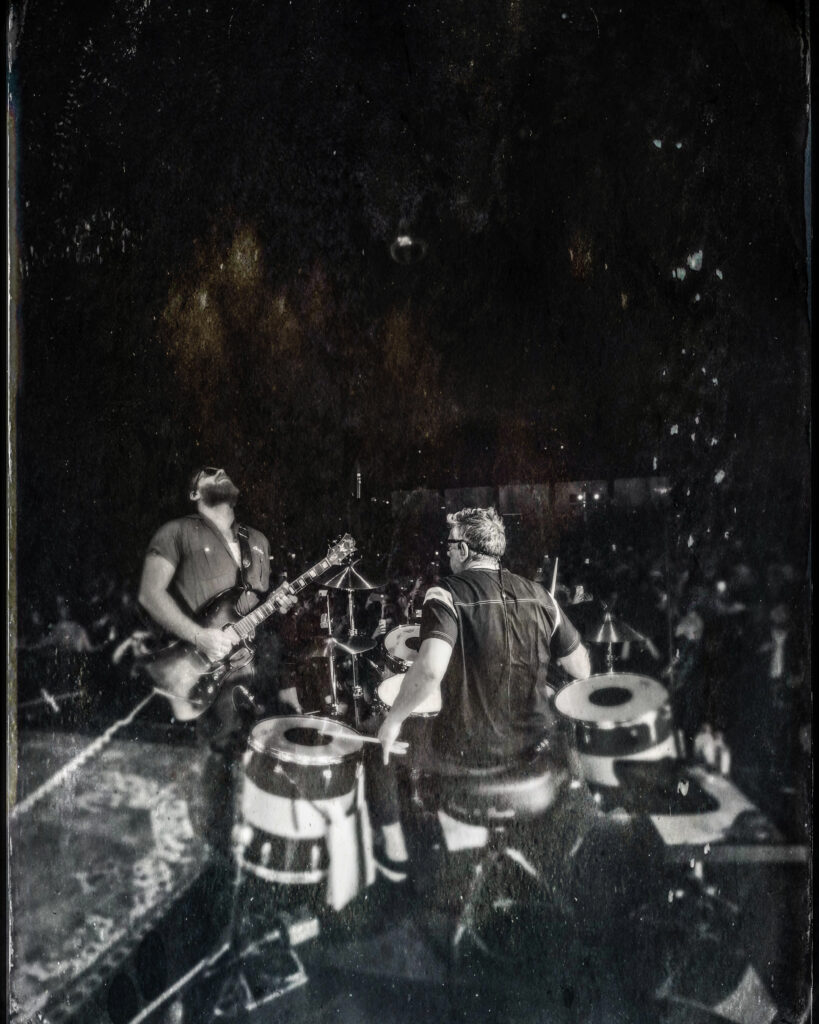
We’re kind of holding on for dear life, but at the same time we have confidence that we’ll make it.
I grew up playing bluegrass and blues music. My Uncle Jack taught me a very early version of “St. James Infirmary Blues”—so the idea of music as folk music, music passed down from generation to generation, that’s how I learned. I think of music as everybody’s music.
I’m not as intrigued by people who get into their fucking feelings and their diary and really tell us all about themselves. It doesn’t interest me as much as a great vocal, a great feel, a great groove. I’m interested in magic moments. That’s how I record—I try to capture live performance. I try to get the chatter before the song and after. All the chatter and the fumbling with the shit before the actual song starts is music to me.
I mean, I knew every single Tom Petty song and I never owned a Tom Petty record. In northeastern Ohio, Tom Petty was playing everywhere I fucking went. I could sing them all. My dad never had a Tom Petty record, I never had one. It was ambient. It was like water.
Not really. I was working so hard and touring so much, I wasn’t really a part of all that. I wasn’t just a kid at home hearing it ambiently.
But for a long time radio wouldn’t play our songs. We turned in “Tighten Up” and they were like, “Nah, this will never work.” That’s what our label told us. Then we started allowing commercials and TV and movies to use our music, and all of a sudden radio was like, “Oh yeah, we want to hear that.” It happened in reverse.
We never had a truck commercial—that was just a joke. I wish we’d had one, because those are the ones that paid.
Our first manager, who was an absolute hipster dipshit, told us we’d never be the type of band to sell out an arena, and also that if we sold a song to a commercial it would ruin our credibility completely. And then we saw the Shins do a McDonald’s commercial and get absolutely no blowback whatsoever, and only see their shows get bigger. And we’re like, “What the fuck?”
We were absolutely broke in a minivan touring by ourselves. As soon as we started letting that stuff happen, it changed everything. We were very blue collar, we didn’t speak to the journalists, they weren’t our people. And that’s fine, but they were the ones writing about music. We’ve never really gotten any respect from journalists, honestly.
Making Peaches! changed what we thought the Black Keys should be more than that [experience] did. It changed our perception of who we should be associating ourselves with, business-wise. It opened our eyes to the business in a way we’d never seen before.
I mean, we’ve got a billionaire having his lawyer threaten us repeatedly. I’m not gonna say [who]. But everything they say about the music business is real.
I feel like this record that we made is the closest to the first album [The Big Come Up, 2002], easily. Because it’s almost the same intention and the exact same process. And I think it was because of my dad. I feel like maybe subconsciously I was trying to put together a record that he would like. This was his favorite version of what I do, just raw and ramshackle.
He was an old hippie, he loved the Grateful Dead. He took me to see Jerry Garcia when I was 14. We used to drive around in his work van listening to Allman Brothers and Dead and live recordings really loud. He loved improvisation, and old songs, and blues. This was his favorite version of kind of what I did, and I think this was the last gift he gave me. This clarity, especially after all the shit we went through. He ended up helping me one more…one last time.
His aesthetic is my aesthetic. You look around the studio: there’s tramp art, folk art, old signs—that was what was in my house, and it was ever-changing because he was a dealer. He’d put something cool up on the wall, and a year later he’d sell it. He really appreciated outsider art, and literally none of my friends’ parents even knew what that was.
We took the name the Black Keys from this artist that my dad found in Akron, named Alfred McMoore [who used “black key” as slang for anything off]. My dad helped him sell his art and helped him keep his art supplies. Alfred would draw crayon on paper—four-foot by 60-foot rolls—and they were stream of consciousness. He was obsessed with funerals. So they’d be funeral trains with cars and a lot of androgyny, like police officers with giant chandelier earrings wearing duck boots. Just wild, very colorful, but also very good, highly detailed.
And then when we went down to Mississippi to go listen to music, I dragged my dad down there. He stopped in Alabama at [folk artist] Jimmy Lee Sudduth’s house. I remember waking up in the van, my dad was gone, and I walked around and found him in the backyard with this old guy who made his own paint with mud and sugar—he’d store it high on the shelf so the ants didn’t get to it.
That was the world I grew up around. It led me to R.L. Burnside and Junior Kimbrough. My dad had instilled this thing in me to see the beauty in all that shit, and it’s really shaped everything about what I do—musically, art-wise, everything. When I’m doing graphic design with people, I make sure they fuck it up. I’m like, “This is too pristine.” I need things to feel lived-in.
There are certain things that are just timeless, and that’s what I’m interested in.
I’ve done that my whole life. I think it’s not necessarily old things—it’s timeless things. There are certain things that are just timeless, and that’s what I’m interested in.
No. He saw me taking care of my dad every day and being super bummed out, and it was heavy. So he said, “You want to get in the studio, make some music?” And so I called Eric and Jimbo and Kenny Brown, Kenny Kimbrough, and we just jammed for a couple days.
This is the first time I’ve ever recorded with Pat where he was just there to play drums for me—not throwing any real opinion around, just trying to enjoy himself and play. I picked a bunch of songs nobody had ever heard, and we’d just try to come up with our own arrangement, not really based on the original, just based on what I remembered of it. Tempos would be very different.
I think in doing that it was almost a more clear representation of who we are than anything we’d done in a long time—just so natural, just us reacting to the music in the room. I didn’t realize it was something until months later. I wasn’t in the headspace to think about making a record.
He was my biggest supporter. He listened to music louder than anybody I know. I remember being in the van with a couple buddies, he took us somewhere, and we got out and my friend goes, “Does he always listen to music that loud? I’ve never heard music played that loud before.” And I was like, “What do you mean? That’s what we do.”
He would have a dealer friend over and say, “Go upstairs and play that slide guitar for my buddy, turn the amp up.” When I said I was gonna drop out of college, he said, “Great. You can live here as long as you’re working at music, as long as you make it your job.” The opposite of Pat’s parents, who were super worried. And then when we played our first show at the Grog Shop, Pat’s shitty drum set literally just exploded on stage, and my dad took us out and bought us a new drum kit.
I’m still really truly addicted to recording and making records, and the possibilities when you get started. It’s so addictive because you really don’t know what’s gonna happen. If you do it right, what can come out is so amazing.
I feel like I was given a gift to be a collaborator in the studio, and I know how to do that, and I’m good at it, and it is so much fun to get a crew of people together and make music. The first time I ever saw a four-track was at Pat’s house, and it changed my life. “Holy fuck, you can do this?”
I still get so excited about it to this day.
The Black Keys are on the Peaches ‘n Kream World Tour now.
This story has been updated to clarify Auerbach’s statement about tour lighting.