

Your bag is empty.
This story appears in our Summer 2026 issue, on newsstands July 28. Want us to come to your place? Become a member to get digital access to the issue and early access to paywalled content.
Scroll long enough and the faces begin to repeat. The same brows, the same lips, the same soft-angled jaw appearing again and again—a look popularized by the Kardashian beauty economy and now reproduced at every scale, from influencers to AI composites. Surgeons advertise variations of the same nose. Contouring kits promise surgical shadows without surgery. Face tape pulls skin toward a lifted ideal. Shapewear promises a Brazilian butt lift silhouette. Even men, once seemingly immune to the infinite onslaught of the imperfection economy, are now being pushed hair transplants, hormone therapy, and biohacking. Influencers quickly learn which angles travel and which don’t, and images that resemble what already circulates move farther and faster. Recognition is rewarded. A face that fits the pattern gathers followers, brand deals, and visibility. Femininity starts to look less like something discovered and more like something extremely, meticulously calibrated.
Drag is the performance art that has always exposed, with humor or uncanny resemblance, the exaggerated feminine, heightening it to the point of spectacle. At its best, drag positions gender as something assembled rather than simply biological or innate. But that kind of exposure used to require a stage (or, at the very least, a camera crew). What’s different now, at least in perennially online culture, is that the performance of the feminine has gradually migrated into ordinary life, becoming so ubiquitous it no longer reads as performance. It is the new normal. We have grown immune to the effects of fillers, lifts, and filters. Our reality is as distorted as our intelligence.
A group of women artists has taken notice. Their response has been to hold a mirror up to beauty culture, sometimes beautifully, sometimes grotesquely. The question they’re asking is why you find something beautiful—or, if you’re a woman, why you might be participating in the first place.
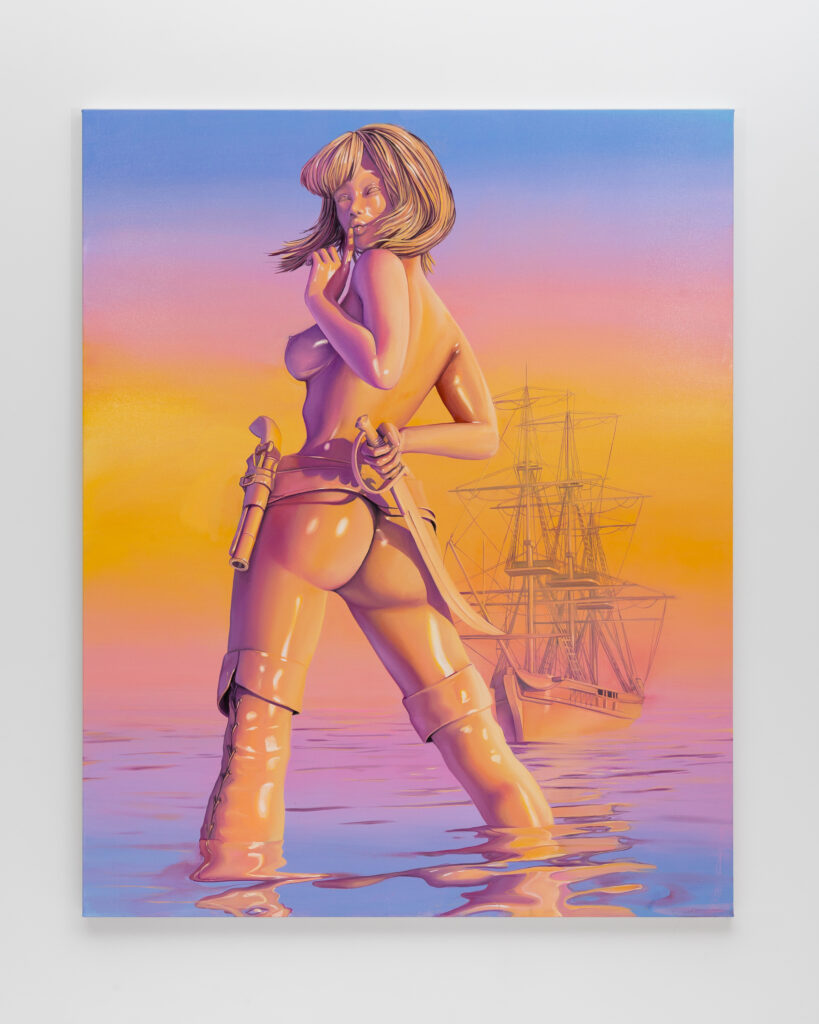
Take Emma Stern. The New York City–based painter starts in the digital and works backward. Her paintings begin as avatars—bodies sculpted in 3D software before being rendered in oil. The women she paints are not quite people and not quite characters. They are closer to models trained on images of femininity itself. Part doll, part cyborg, they echo the long lineage of the female nude, then pornography, then video game characters, now algorithmic imagery. “When I started working with 3D modeling, I realized I was building my own muses,” Stern said in Autre in 2023—and those muses are self-portraits, assembled from circulating images rather than lived experience. Her figures look finished before they exist. Smooth, perfected, hyper-recognizable. In her work, the woman doesn’t perform for the camera. She is the product of it.
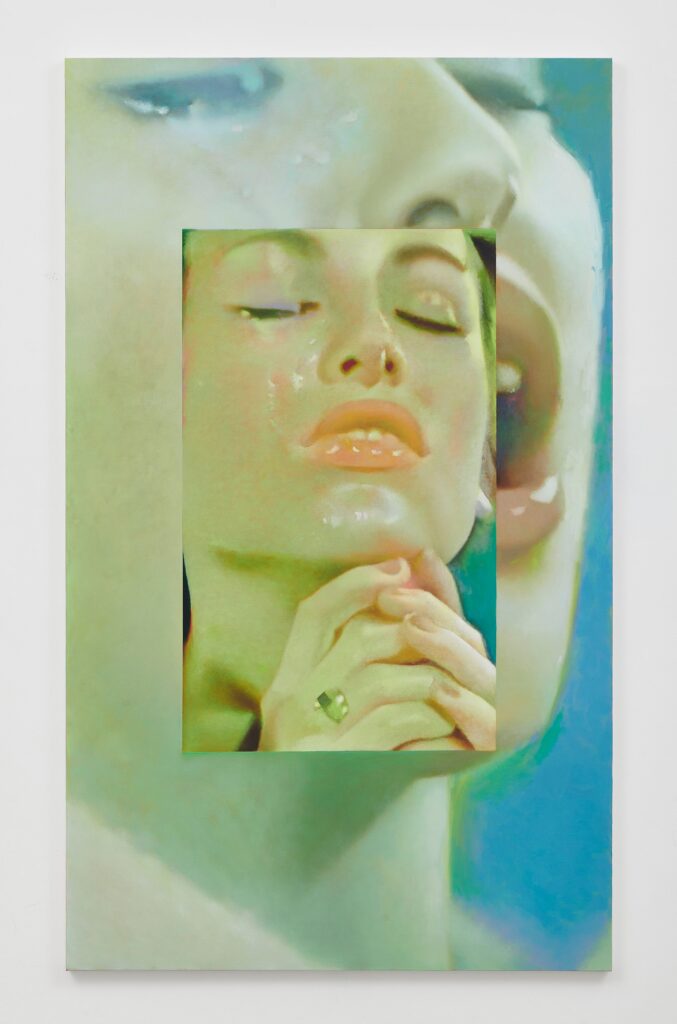
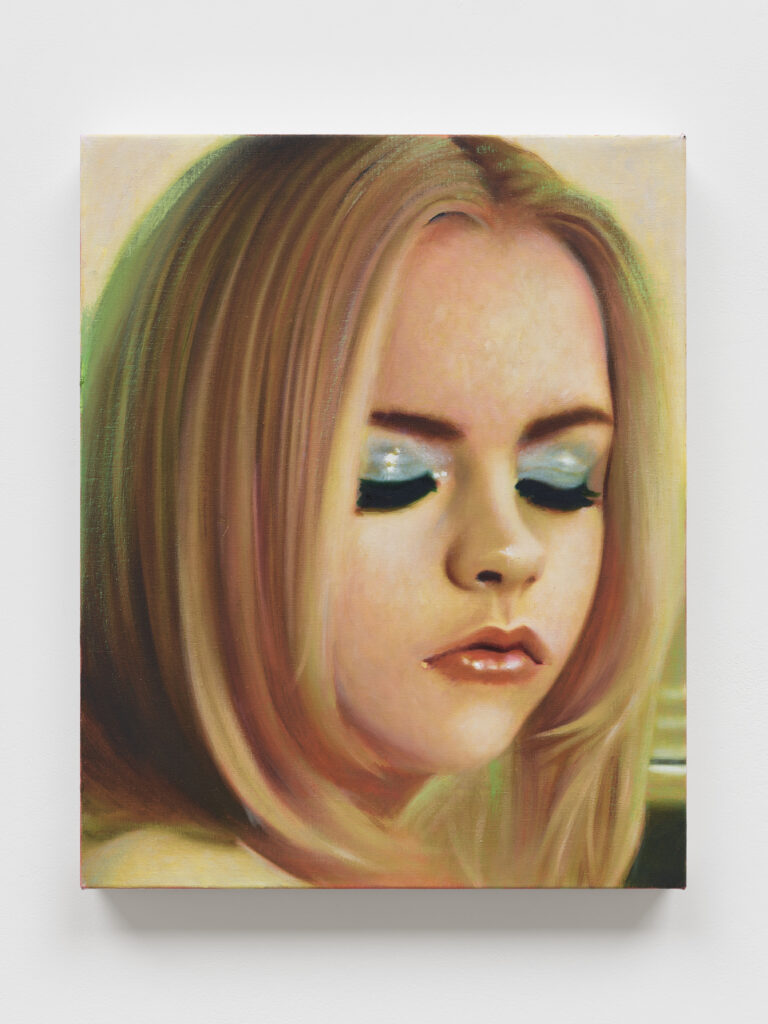
Louise Giovanelli works in a different register. The Manchester, England–based painter focuses on close-cropped faces, hair, and makeup drawn from film stills—moments that feel paused just before something happens. In Mea Domina and Kohl, both from 2025, she isolates Christina Ricci’s character from Buffalo ’66: heavy blue eyeshadow, a face that gives nothing away. Her women are polished and luminous but also distant, as if caught mid-gesture. Giovanelli’s tight framing removes all context, keeping everything pressed close to the surface. There’s no background to escape into, no wider scene to explain the image. Femininity appears here as something carefully composed and closely watched. Beautiful, but slightly uneasy. Her work suggests that femininity today operates through restraint and control, through surfaces so perfectly maintained that the effort disappears entirely.
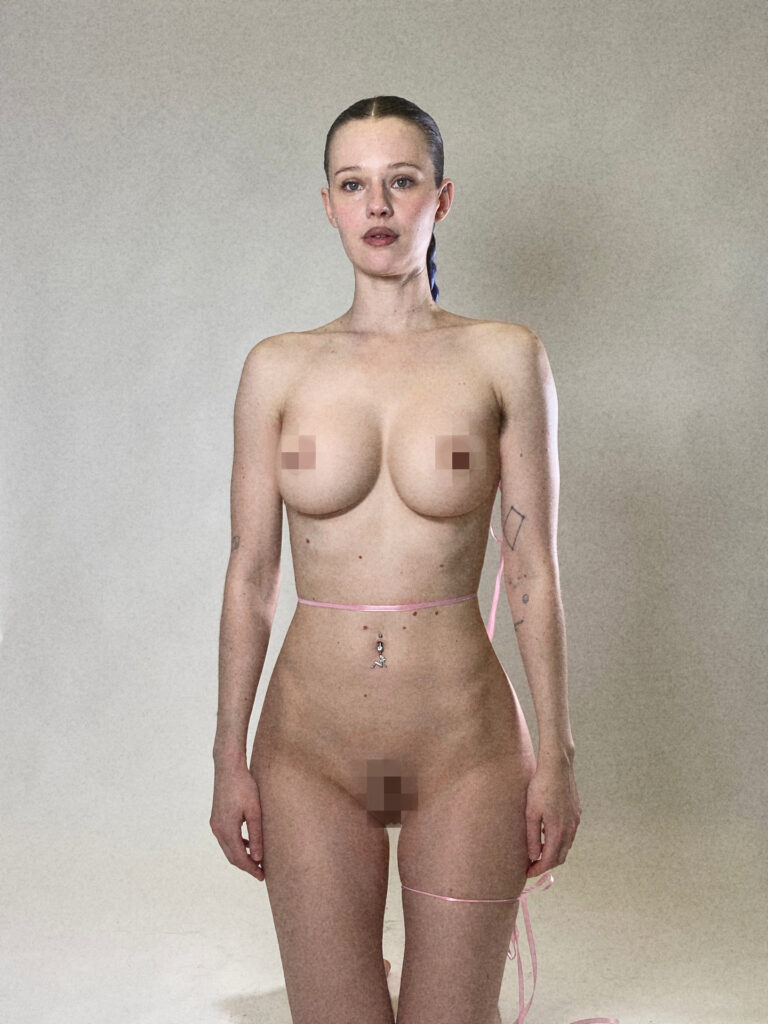
Arvida Byström goes the furthest into this rabbit hole. Rather than treating the internet as media, the Swedish artist presents it as a place where people actually live. In one project, Byström ran photos of herself through an AI undressing program and sold the results before revealing they were fake. The images were instantly believable. The proportions were familiar: larger breasts, narrower waist, smoothed skin, a standardized sexual ideal that viewers already recognize. The technology didn’t invent a fantasy. It reproduced one—the same idealized body circulating across porn, filters, and influencer culture. The viewer’s discomfort comes from how easily the template passes as real. If a machine can generate the ideal woman on command, the question of how women are represented online has become obsolete. Instead, we should be asking whether images are starting to replace the human beings behind them.

This way of understanding femininity did not begin online. Long before algorithms, Cindy Sherman, the photographer who spent the late ’70s turning herself into other women, exposed gender as costume, role, and visual code. Her photographs present no stable self beneath the styling, only a sequence of poses, outfits, and types. What has changed since Sherman is scale. She used performance deliberately. Today, performance is simply the baseline.
These artists trace the same cultural shift. They show how femininity has become standardized, less a personal expression than an erotic uniform: instantly recognizable, aspirational, and easily replicated. This form of female self-presentation delivers what the culture rewards: visibility, legibility, belonging. It can also be lucrative, converting desirability into attention, influence, and income. The risk is that the performance has become so smooth that it disappears.
What these artists offer is a way of noticing the seams. By pushing femininity to its limits, through avatars, algorithms, and excess, they make visible what the culture works hard to make look effortless. They’re showing us the system we’ve mistaken for nature.