Your bag is empty.
Caroline Polachek is fashionably late. The moment I meet her I know she’s a person of brutally good taste. She chooses the chic Chateau Marmont for lunch, orders the gazpacho and also the calamari. She washes both down with a cool iced tea. She excuses any imperfections, attributing it to a 14-hour flight from Paris last night. She was there to DJ for YSL Beauté’s latest fragrance. Fabulous. You can’t see jetlag. She simmers amid the actors and fashion folk inside this Sunset Strip landmark. “I’ve been to the Chateau twice in the past two years. I felt like I needed a dose,” she says, her eyes smiling, comfortably intimate, gazing from a tower of her own athletic shoulders. “We’re ladies who lunch!”
Polachek may emit a leisurely air, but she’s a relentless worker. Her first true solo LP, titled Pang, reflects the above traits, seemingly easy but meticulously put together. It’s driven by taut, often cold electronica that forms a fortress from which her lofty, delicate voice rings out, escaping like a light from a dark chasm. It’s some of this year’s most riveting pop; as adventurous and untethered to trends as FKA Twigs or Christine And The Queens, but no less singular for those comparisons. Executive produced by her and Danny Harle, it’s taken in three years, a move from New York to Los Angeles, the dissolution of her marriage, and the last chapter of her previous band, Chairlift.
Chairlift was the synthpop band she formed in 2006 at the University of Colorado. As they were in their final throes after the release of 2016’s third album “Moth”, Polachek began experimenting with solo musical endeavours. She had two monikors: Ramona Lisa (a more ambient project), and CEP (after her initials—her middle name is Elizabeth). They allowed her to work at a faster, more ambitious pace. Her creative partner in Chairlift, Patrick Wimberley, had become drawn to the world of production for others, lending less time for their duo. “Chairlift ended up being a Venn Diagram of the windmill of things that both of us were interested in,” she says. “The more romantic approach to electronic music wasn’t within Patrick’s realm so rather than trying to jam it into Chairlift I made my own pipeline for it. I took things into my own hands.”
The only thing to do is make what you like, follow your own voice.
Still it was an adjustment going by her full naked name. It seemed too loose. Polachek builds worlds around her art, like separate exhibits with their own parameters. She refers to it as “conceptualized brackets”. She was limiting herself. “Chairlift was constrained,” she says. “Everyone perceived us as an indie band from Brooklyn. Those expectations taint what you do for better or worse.” Chairlift belonged to a generation post Grizzly Bear and Yeah Yeah Yeahs—the last of the Brooklyn art rock scene—featuring DIY experimentalists MGMT and Yeasayer. They hijacked the same software used by chart hitmakers and harnessed it to be anti-establishment instead.
Twelve years into her career, Polachek doesn’t care for insurgent agendas. “In 2019 I’m not thinking about what’s pop and what’s not pop any more. It seems like a ridiculous endeavour actually,” she says. “The only thing to do is make what you like, follow your own voice. I felt ready to own my voice; to say that I am a writer with a capital W, I’m a singer with a capital S. I can base decisions off that faith.” To realize her full emancipation, Polachek sought collaboration in LA. The move was also inspired by a personal sense of flight. The urge to leave New York saw her boomeranging between London and LA and was eventually used as inspiration for her song, “Parachute”. “Here’s where I jumped from the airplane without questioning it,” she sings, airborne.
LA holds history for her, but she’s here for practical reasons. It was here that Chairlift went out on a high, following a hat-trick of praised albums. Their farewell tour ended at the Echoplex in April 2017. Polachek was “hyper present” onstage, she says. She glances back at the jacket draped over her chair today. “I was wearing this!” she laughs. “That also began my three-year obsession with penny loafers. I packed them as plane shoes, and then I thought, ‘Wait a minute, these are sick onstage.’”
With the creation of Pang, Polachek has had to see a different side to almost everything. Her body forced the change before her mind knew it had to. In the first few months of writing, she experienced adrenaline rushes. They came on in trivial scenarios. “It would hit me at night while I was going to bed. Or in the middle of dinner. Or in the studio,” she recalls. “My heart rate would go up, I’d lose my appetite. I’d feel kind of high for a while?” On a deeper level, Polachek now realizes it was about the stress that comes with liberation. “I was breaking out of a lot of systems I had been part of. On every level.”
Beyond the demise of her band, and the symbolism of turning 30 years old, Polachek’s four-year relationship with fellow artist went awry. “I wasn’t fully aware that I was drifting away from it but my body was sounding the alarm,” she says. She likens it to a second adolescence. It took a year to reorganize her life while she stayed at friends’ and lived out of a suitcase. “Probably the deepest, darkest moments were when I’d wake up in the night not remembering who I was. Or when I was having a nervous breakdown in my storage unit,” she offers, flippantly.
She found herself manically writing. “I had never written so much music in my life,” she says. “I was travelling compulsively. I couldn’t stay at home for more than a week. I needed velocity of movement.” One night in London she couldn’t sleep. Her heart was palpitating. She grabbed her phone to self-diagnose, desperate for a word to describe the feeling and silence the madness. “Panging!” she says, re-enacting when she landed upon it. “I’m panging for something. My body was feeling this hunger even though I was unable to eat. The word pang is so musical.” The title track’s chorus is comprised mostly from the rush of that word breaking out her mouth. “Pang! And I go into you. Pang! And you go into me,” she sings. “My whole life, I’d been drawn to songs that had a private longing. Not a bombastic floral display. A private twisting on the inside.” She moves her hands down her abdomen as though tightening her oesophagus like it’s a rope. “I knew in that moment that it was not only the album title but that I had to throw away all the music that didn’t pang prior to that.”
In the business of making pangers (not bangers, sorry), she drew from a life of influence. Polachek grew up influenced by the music of her classical musician father in Connecticut. She listened to opera: Puccini, Handel, selections from the Little Mermaid. “The Beach Boys’ catalogue pangs quite hard,” she says. Yet, it was alternative female vocalists that set her this challenge to unlock the extent of her own voice: Cocteau Twins, Bjork, Fiona Apple. “The highest echelon of beautiful pop. That was the bible,” she says. You hear it. There’s something Bjorkian about her enunciation in “Insomnia”. A touch of Enya’s etherealness tickles “Go As A Dream”. Liz Fraser’s incomprehensible mystique possesses “Hey Big Eyes”. Polachek is writing more directly. “I was more interested in emotional clarity,” she nods. “I’m a melodic communicator. Writing abstract lyrics is very easy. Writing direct lyrics is extremely difficult. I wanted to push myself.”
The resulting electronic palette was not the original plan. Polachek is a keen collaborator. Her biggest behind-the-scenes moment to date has been writing and producing “No Angel” for Beyonce’s self-titled LP in 2013. She’s delectable bait for LA’s finest studio rats. After Charlift’s last shows, she took many writing sessions. She guested on tracks by Charli XCX and Fischerspooner. “I felt like a kid in a candy store, calling up my heroes and getting in the room with them,” she says. The collaborators who were the biggest revelations to her, however, were unexpected. Danny L Harle of London electropop collective PC Music was the biggest surprise. Then again, it makes sense because Polachek isn’t an LA person, per se.
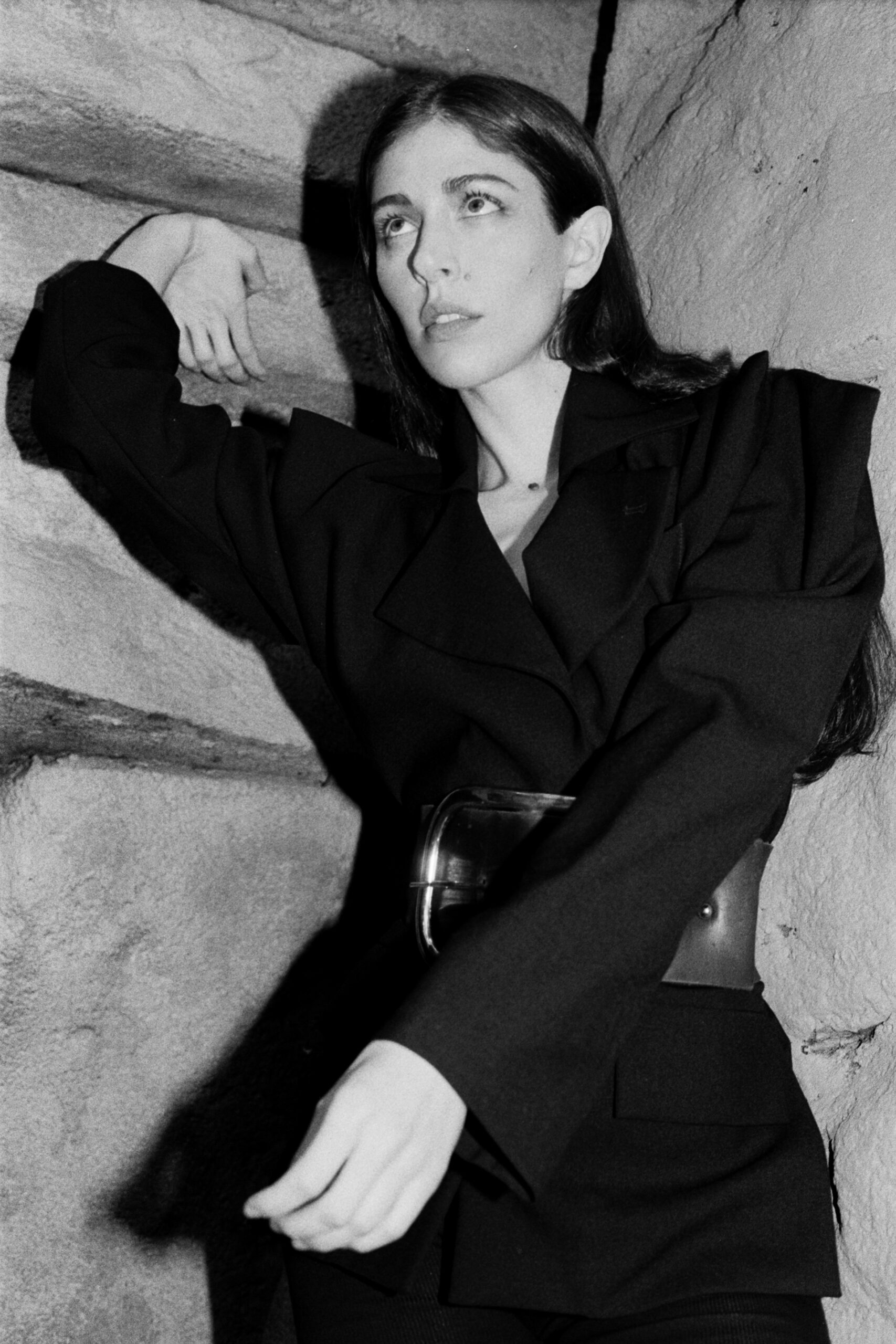
“I stuck a toe in the water here in Jan[uary],” she says, of her tentative relocation. Together with her artist boyfriend (from London), and British producer A.G. Cook and his girlfriend, she rented a house for three months as a trial. Cook is PC Music’s leader. The PC Music scene exploded around 2014 featuring early collaborations with SOPHIE. Cook was pivotal to the evolution of Charli XCX away from commercially-minded hit-making. “You have it on record here that A.G. Cook is very bad at doing dishes. But we forgive him.” By April, Polachek had got her own place in Hollywood and convinced her boyfriend to get a visa.
It wasn’t Cook, but Harle, however, who became her collaborator. “I first heard about PC when everyone else did. It seemed threateningly cool,” she says. For Polachek, who approached songwriting in a historically classical way, she was sceptical about her ability to gel with Harle. “This isn’t my neck of the woods!” she told her manager. But floored by Harle’s music’s harsh simplicity and corresponding tenderness, she agreed to a studio day. “I had this feeling like I’d known him for a long time. I rarely have that,” she recalls. They wrote 2016 single “Ashes Of Love”. “We became great friends in a day,” she says. Yet she still didn’t think of Harle for Pang. She wanted to write an album of standards on piano, guitar, maybe strings. It was to be her neo-folk moment.
As chance would have it she’d wind up doing another studio day with Harle and wrote the sparse melody to “Parachute” quickly. Polachek had written lyrics on the plane the day prior envisaging them as an acapella monologue. Once Harle and she were done in the studio she had an epiphany and realized it married with her text, got her laptop out and started singing into it until it fit. “I was shaken up by it. I didn’t feel like it was actually me writing it.” She called Harle. The two reconvened in the studio. Harle cried playing it back. “It changed everything fo us. He was this jewel that appeared out of nowhere. We had to pursue.”
The songs on Pang are imbued with a capriciousness despite often being struck by pain, confusion and the stress of new connections. There is struggle (“I Give Up”). There is humor (one song, inspired by doo-wop is titled “Caroline Shut Up”). There is gutting despair. “Ocean Of Tears”, in Polachek’s words, has “claws and teeth”. The vocal is so gorgeous but the production bites like a dog. What was she trying to evoke in the songs? “Mmm, that’s so interesting,” she wonders. “Passion.” She pauses. “And movement.”
Her latest single “So Hot You’re Hurting My Feelings” came out a few days before we dine. The video sees her cavorting in a miniskirt amid some theatrical hellscape. She’s a dead ringer for Liv Tyler dancing in ‘Empire Records’. Her label, Columbia, insisted the song was on Pang. “Full disclosure,” she says, chewing. “I didn’t want the song on the album. I wanted to give it its own EP.” She relented because she realized that the song’s lustiness does, in fact, pang. “It’s so ridiculous,” she says. “That kind of melodrama.”
My whole life, I’d been drawn to songs that had a private longing. Not a bombastic floral display. A private twisting on the inside.
Conversation turns to other albums, notably Lana Del Rey’s Norman Fucking Rockwell! “The unwavering consistency that Lana’s delivered across her whole career is the reason why she is where she is,” reasons Polachek. “Nobody’s talking about this but there aren’t many women with a capital W in pop. Lana is presenting as a woman. She’s filling that void. She has no competition.” Polachek looked up to Sarah McLachlan and Celine Dion as women popstars. At the age of 34 she’s thrilled to find her own approach.
Who does she think is making the most interesting pop now? “For me it’s The 1975,” she says. “They’re making the most interesting pop culture. Following them for the past three years has been to witness a fair amount of code switching and it’s one they’ve pulled off blindingly successfully. It’s been thrilling to watch them go from something that barely any of my friends knew about to potentially the biggest band in the world.”
With that she smirks. “Footnote: he followed me today on Instagram,” she says. Matthew Healy? “Uh-huh,” she smiles. They’ve never met in real life. She doesn’t think of Healy as a rockstar, but as a “culture DJ”. “That’s what being a pop artist is now,” she says. “He’s so shamelessly pretentious.” Again, she looks mischievous. “Okay, full disclosure,” she says, revealing that the earlier full disclosure was only partial. “I really wanted ‘So Hot You’re Hurting My Feelings’ to be a duet.” Now that you think of it, it does have an air of The 1975… “Yeah,” she nods. “I made a handful of enquiries and all I got back was an inaccessible fortress of ‘no’.” I can hear him on it, I say. “Same!” she cries. “Especially given it’s about a Transatlantic long-distance relationship with someone in England…”
Her English boyfriend is waiting on a couch in the hotel lobby. Before she’s whisked away, she says she’s writing new music. She’s just worked with someone in the studio who is very exciting and she cannot even offer a hint. Zero disclosure. She’s interested in Hollywood. “Absolutely,” she says. “I’d love to act. I’d love to dip into scoring. I’d like to write original songs for films. Sci-fi would be ideal. Could you imagine? The closing track for a sci-fi epic.” Caroline Polachek would make the most beautiful soundtrack to a world that is ending. She smiles, offering one last counterpoint. “Perhaps. Or a world that is just beginning.”