Your bag is empty.
One minute the president declares solidarity with peaceful protesters; the next, he has them forcefully removed
Monday wasn’t just another day of protest.
Every day for nearly the past week, hundreds and then thousands have gathered at Lafayette Square in Washington, D.C. to demonstrate against George Floyd’s death at the hands of Minneapolis police. The Friday protest in the public park, located just north of the White House and just south of the historic St. John’s Episcopal Church, forced Trump to temporarily flee to the White House bunker—a move he later said was strictly for inspection purposes.
On Saturday, D.C. Mayor Muriel Bowser called out the president for hiding and set a seven p.m. curfew for the city.
That day, crowds at the park swelled to around 5,000. Protesters occasionally became aggressive, tearing down barriers and tossing water bottles or bricks at the officers, who were armed with riot shields, clubs, tear gas canisters and more. For his part, the president—who would later make a day trip to Cape Canaveral to watch the launch of the first manned U.S. spaceflight in nearly a decade—had started his morning off by threatening protesters with violence, tweeting that anyone who breached the fences would be greeted with “vicious dogs” and “ominous weapons.” On Sunday, protests in the city turned riotous, with storefront windows shattered and fires set.
Then on Monday it happened.
D.C. resident Clarissa Taylor told me she was standing near Lafayette Park around 6:30 p.m. when she sensed something was wrong. “The police moved up on the protesters,” she said. “They [the police] hadn’t been that aggressive before. I got scared.”
I thought they were going to kill all of us.
At nearly the same time that was going on, Donald Trump spoke briefly in the Rose Garden. Loud, cannon-like sounds in the background punctuated his speech as Trump said he would use the full force of the military to combat the growing protests and riots across the country. He also mentioned that he supported peaceful nonviolent protest—forgetting that he lambasted then NFL quarterback Colin Kaepernick for taking a knee in protest during the national anthem.
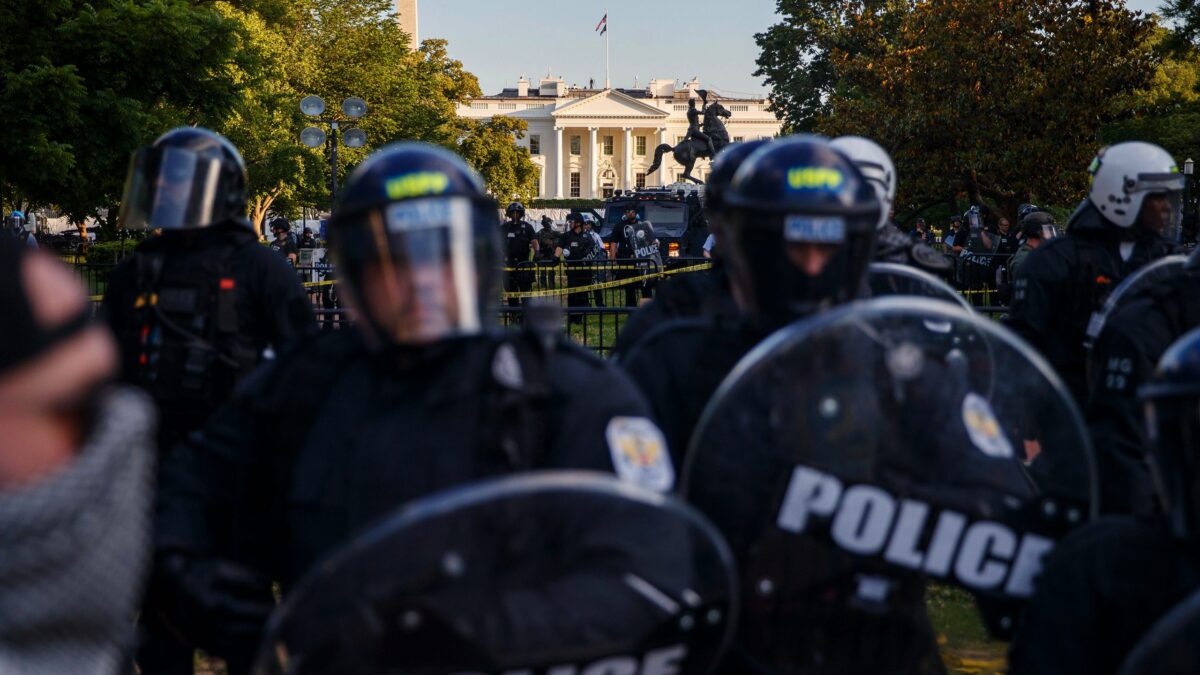
As Trump spoke, federal police moved in on Lafayette Square, apparently with the blessing of Attorney General William Barr. The booming sounds were the opening salvo against the crowd of peaceful protesters. A mere 25 minutes before the D.C. curfew took effect, federal law-enforcement officials cleared the Lafayette park area with chemical irritants similar to tear gas and with a show of force.
The reason why became clear half an hour later—Donald Trump wanted a photo opportunity with a Bible in front of St. John’s, the church that had been set on fire the night before. Trump stopped briefly outside the church and held up a Bible (upside down) and declared, “We have the greatest country in the world,” he said. “Keep it nice and safe.”
“I didn’t stop running until I got to I Street,” the 19-year-old Taylor told a group of reporters. “I was near the edge of the crowd. I saw the tear gas. I thought they were going to kill all of us.”
Mayor Bowser tweeted her own displeasure: “A full 25 minutes before the curfew & w/o provocation, federal police used munitions on peaceful protestors in front of the White House, an act that will make the job of @DCPoliceDept officers more difficult. Shameful!”
But the Trump administration defended its move to clear the area in front of the church. “The perimeter was expanded to help enforce the 7 p.m. curfew in the same area where rioters attempted to burn down one of our nation’s most historic churches the night before,” said deputy press secretary Judd Deere. “Protesters were given three warnings by the U.S. Park Police.”
After Trump had finished his photo-op and left, peaceful protesters again approached the area, some of them reclaiming space they’d been chased from. The local police did not respond with tear gas or excessive force; they allowed the protests to wind down until everyone left, around nine p.m., two hours after curfew.
“I’m tired of being treated like an animal,” Kevin Davis, a University of Maryland student, told me about why he was protesting. “I don’t want people taking a knee for me or observing a moment of silence for the black community. It’s more complicated than that. Everyone needs to be involved and recognize we have to treat each other with more compassion.”
Nearby, an African American woman approached the police line and accused an African American police officer of being a “traitor.”
Davis shook his head. “Would she prefer all police officers be white?” he asked rhetorically. “That’s what I’m talking about—compassion.”
He shook his head again, wiping the sweat from his forehead. He asked for a paper towel to wipe away the remnants of what the park police later insisted wasn’t tear gas, but “pepper balls,” a similar type of chemical irritant. Then he took a breath.
“It’s also sad to see white people getting violent. They get away with smashing windows. I don’t want to smash any windows. Why should they? It’s the worst kind of white privilege, posing as compassion. It isn’t compassion any more than a black person screaming at a black police officer is.”
The next morning, Trump cheered his own actions in an early tweet. “D.C. had no problems last night. Many arrests. Great job done by all. Overwhelming force. Domination. Likewise, Minneapolis was great (thank you President Trump!)”
Condemnation for the photo-op was widespread. Perhaps the loudest condemnation came from Bishop Mariann Edgar Budde of the Episcopal Diocese of Washington in a CNN interview. “Let me be clear,” she said. “The president just used a Bible, the most sacred text of the Judeo-Christian tradition, and one of the churches of my diocese, without permission, as the backdrop for a message antithetical to the teaching of Jesus and everything that our churches stand for. And to do so, he sanctioned the use of teargas by police officers in riot gear to clear the churchyard. I am outraged.”
Trump fans praised his latest stunt, but for those who smelled the gas and saw peaceful protesters fleeing the onslaught, it seemed anything but heroic.
You’re either for him or against him, and in his mind all the protesters are against him.
“He’s a coward,” Davis said. “He isn’t religious. He doesn’t care about the poor or the sick or even the rich. He only cares about himself, and he keeps the rest of us fighting while he gets away with it.”
After the incident Monday night, taller fencing was erected near Lafayette Park, further giving the impression that Trump is barricaded behind a fortress and afraid of his public.
Trump doesn’t care how it is seen, only how he can sell it. Before appearing outside the “Church of Presidents” to use a Bible as a prop for the cameras, he took a conference call with governors, reportedly scolding them for being “weak” by allowing demonstrations in their states. This, from the man who barricaded himself in the White House. One person on the call described Trump’s language and tone as “unhinged.”
Since the protests began, Trump’s responses have highlighted the disconnect that exists between him and most Americans, exposing his disdain and indeed revulsion of them. Former defense secretary Jim Mattis blasted Trump on Wednesday, accusing the president of trying to divide Americans. That matters little to Trump. If you’re not on Team Trump, then he doesn’t care about you. You’re either for him or against him, and in his mind all the protesters are against him.
Trump is Simon and Garfunkel’s “The Boxer”: running scared and laying low, seeking shelter in the White House bunker where the scared powerful people go. He only appears outside of the White House in sanitized (literally and metaphorically) situations that he can control, and only for the shortest length of time.
He doesn’t care. He doesn’t think. He doesn’t lead.
Fear is his main motivator. He’s scared of losing control. He’s scared of losing the November election. He’s scared of the people who profess their love and scared of those who declare their opposition. He’s scared of being indicted if he loses in the fall. He’s scared of Russia. He’s scared of China. He’s scared of the coronavirus, and he’s scared of everyday people.
Perhaps his biggest fear? Being discovered as the gigantic fraud he truly is.
“I don’t want my kids to grow up like this,” Taylor said after running three city blocks to escape being gassed. “I don’t want anyone to live like this.”
As I stood in Farragut Square on Monday night, a couple blocks north of Lafayette Square, surveying the busted-out storefronts, statues defaced with graffiti, military helicopters in the air and Humvees patrolling the streets, I was suddenly reminded of Kuwait City at the end of the Gulf War, as I had witnessed looting, riots and worse.
I got goose flesh thinking I was seeing the same thing in our nation’s capital, and thinking about how far we have fallen under Trump.