Your bag is empty.

The actor knows that scammers prey on our “best selves.”

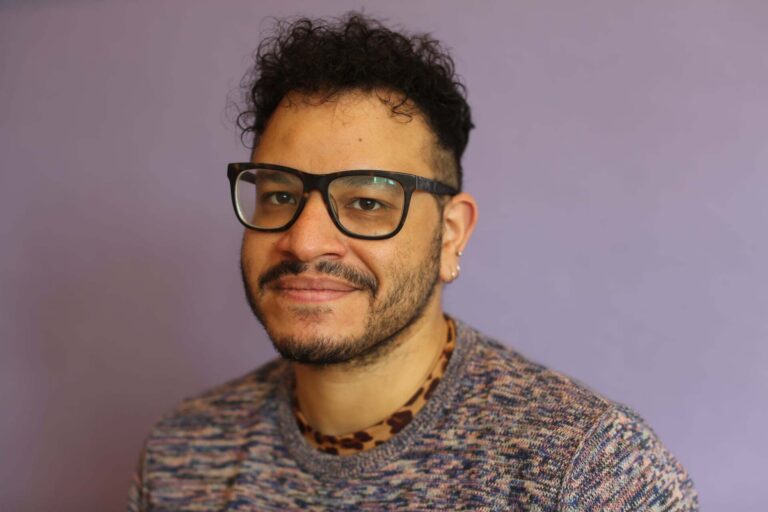
Far from just being an economic endeavor, cryptocurrency has drawn a following that Ben McKenzie likens to a cult. McKenzie, an actor best known for his appearances in The OC and Gotham, became obsessed with crypto during the pandemic, using his undergraduate economics degree to dig into the emerging market. What he found wasn’t the future of wealth, but an industry based on predatory scams that warp people’s value systems and prey on the fading mythology once known as the American dream.
So, McKenzie got the cameras up. His directorial debut, the documentary Everyone Is Lying to You for Money, which McKenzie directed, wrote, produced and starred in, follows the actor as he speaks to people who are deeply invested in cryptocurrency. That brings him to crypto-pilled conferences, as well as to El Savador, where he interviews locals who will be displaced to make room for the government’s proposed “Bitcoin City.” Along the way, he speaks to Americans who lost their investments when crypto company Celsius went belly up and even convicted crypto fraudster Sam Bankman-Fried, whose interview truly goes from cold DM request to awkward movie magic.
But despite all the hats he wore—and that his journey in understanding the cryptocurrency industry is the film’s arc—the film is not about McKenzie. It’s about us. McKenzie, who previously co-wrote the book Easy Money: Cryptocurrency Casino Capitalism and the Golden Age of Fraud, is not only deeply worried about the cryptocurrency industry’s predatory scams, but also what its proliferation says about American democracy. And, ultimately, as a father and someone who comes from a long lineage of people who stood up for the little guy, he feels protective.
“One of the most heartbreaking things to me about crypto is that these get-rich-quick schemes often prey on our best selves,” he told Playboy. “They prey on the part of us that’s trying to provide for others.”
McKenzie told Playboy about why people continue to put their faith in the blockchain even after being burned, how absurd it is that we’re still not taxing billionaires and why he felt validated upon Bankman-Fried’s arrest.
I had directed a couple of episodes of Gotham, but directing a documentary is sort of the polar opposite of directing network television. On network television, you have all of the money and none of the time. Directing an independent doc, you have all the time and none of the money.
It was a process of experimentation and I was working with a lot of different cameramen because to save money, I would hire based off of where we were shooting. It was quite a thrilling, sort of complicated, thing to figure out in post-production, because I had compiled a bunch of footage by the time I turned to the movie after finishing the book in the summer of 2023. I had to sort of backfill a narrative to make it all make sense, so just a completely different experience than directing network television, but creatively challenging and quite freeing in the sense that the story was whatever I wanted to make it.
It started off being, “What is it?” “How is it being used?” Because no one seemed to understand what “cryptocurrency” was. There was so much technobabble talk around it and so many people that clearly didn’t know what they were selling — and yes, I’m talking about the celebrities, amongst others — but it’s not actual money. It’s more like an investment. But it’s unclear what you’re investing in. It’s just lines of code stored on ledgers called blockchain.
Then that starts to sound an awful lot like a Ponzi scheme and even if it isn’t, it fits some sort of very specific definition of one. At a minimum, it felt like a bubble was building, a huge bubble that’s pulling in tens of millions of Americans, that was at some point going to pop.
I’d started to do this sort of macro analysis: The economy was going to crash from COVID-19, and the Fed and the powers [that] be injected an enormous amount of money into the economy to keep it from crashing, which is the right thing to do. We can argue over how well they did it, but the natural result of that is inflation. Inflation hits, then the Fed has to raise interest rates and if the Fed raises interest rates then the things that are most speculative fall the fastest and if crypto is only speculation, it’s going to crash.
If that’s the case, and I’m certainly not the only one seeing this, don’t I have a duty to speak up? Plus, why not go on an adventure? I was bored out of my mind, a middle-aged guy looking for something new to do; so it was kind of like, “Why not?”
There’s a sense that we have a lack of agency in our own lives. So many Americans are just trying to make ends meet, to provide for their families, feeling that pressure to continue to put in work and grind. Wouldn’t it be wonderful if there was this magical way out? This magical thing that I could put a little bit of money into and it could change my life? In the words of that one guy who I interviewed in Texas, just allow me to spend more time with my family?
Completely understandable, quite frankly noble intentions. One of the most heartbreaking things to me about crypto is that these get-rich-quick schemes often prey on our best selves. They prey on the part of us that’s trying to provide for others. I interviewed a reverend in North Carolina whose father went down a crypto rabbit hole, losing his money and taking his own life; his father was trying to provide for his grandsons. It’s important to point that out, so that we’re not judging these people. There’s a temptation, if you haven’t been scammed, to think, “I wouldn’t be that foolish.” You know, “There but for the grace of God go we.”
It’s sobering. It was nice to be able to put faces to the abstract concept of loss and to be able to talk to people and bond with them and realize … I was gonna say we’re on the same side, but they still believe in crypto. But we were all searching for a better world, a better economic system.
We’ve just gotten quite far afield from what the potential of our economy can be for people not for numbers on spreadsheets and certainly not for the creation of wealth, as though that’s a good unto itself, which I would push back quite strongly against. We live in the wealthiest society that’s ever existed in the history of the world and yet we have so many people who are not really benefiting.
One of my takeaways is—and I understand that they would not agree with this, but you’ll understand why —is that you’re really very far outside the framework of a quote-unquote rational investment decision and you’re really much more into a belief systems or, quite frankly cult-like behavior. There’s this paper, “When Prophecy Fails,” a sociological paper from the 1950s about what happens when the prophecy of a cult leader doesn’t come true. Do the members of the cult renounce the faith and come to this realization that they’ve been conned? No, they double down, they believe more, because they’ve been pressur[ed] into having to deal with this cognitive dissonance. The way they deal with it is to believe even more in the thing that has already hurt them, because it would actually be more painful to acknowledge that they’ve been had.
It’s a pro-democracy film. All of these social constructs are inherently flawed. There’s never gonna be a perfect money or a perfect government or, dare I say, a perfect religion. They’re all made up by humans and run by humans and are as flawed and as unique and as complicated as we all are.
The things that people are so mad about have to be addressed by making our democracy work better so that the will of the majority is actually expressed. How can it be that [the majority] of the country would like for billionaires to pay more taxes—which seems like a pretty rational thing—and yet billionaires are not paying more taxes? In fact, the parties fight tooth and nail to make sure that billionaires are not taxed more. If the gap between everyone and the billionaires gets bigger, it’s unlikely to stop getting bigger. The more power they have, the more ability they will have to corrupt our democracy unless we put rules and regulations behind it. It all actually comes back to democracy and putting the power back into the hands of the people.
I’m going through my notes trying to make sure that I have a response to the things that he’s saying. I had prepared by looking at other interviews. He was being interviewed all over the place and he would only have a few talking points that he would hit based on what question he was asked. So I prepared, as I would hope any journalist would prepare, certainly if they suspected that the person that they were interviewing was not on the up and up. You can’t just swallow the talking points uncritically. That’s your job to ask them follow up questions and try to understand what the truth is. And if they’re not giving you the truth, isn’t it your job to try to point that out and to get to a truth somehow?
Sure, yeah, all the time. The nice thing about being a skeptic is that you are skeptical because of fact patterns and you are only seeking the truth. I’m only interested in the truth and all of its complexity. When people ask, “Well, can’t you use crypto for good?” I say, “Of course you can, it’s a tool.” A woman in Afghanistan running her business on cryptocurrency because she can’t get banking from the Taliban? Fantastic, we love that. But if we’re being intellectually honest, if we accept the good, we have to accept the bad, too. We have to weigh those two things together. And so then we look at the crime and we look at the staggering amount of crime, the $154 billion of criminal activity in 2025 alone. That’s an estimate from a crypto company, Chainalysis. That’s a lot of criminal activity in one year. So how much do we think is good and how much do we think is bad?
If we’re being adults and we look at how much bad we’re talking about, it seems like there’s a lot more bad than good. Let’s try to figure out how to help the people who are struggling that we want to help, but crypto doesn’t seem to be the answer unless we accept a staggering level of criminal activity, including, quite frankly, inside the White House at this point. I mean, you’re talking about the corruption of the most powerful office in the world.
I’m a father of three children and I was raised with a sense of social justice. My grandfather, Robert Schenkkan, his parents were immigrants. He was the first person in his family to go to college. He started the public radio and television stations in my hometown of Austin. He helped pass the Public Radio and Television Act of 1967. My father is an attorney who has worked on behalf of Planned Parenthood and other noble causes. My mother was a reporter.
I was taught that what you do for your community is as important, if not more important, than what you do for yourself. Being around enough wealthy people in my other line of work — they’re not bad people, but there is a certain injustice that you see quite starkly. Sure those people have often worked hard and have a right to keep the money that they’ve made and provide for themselves, but no one really deserves wealth.
It’s a product of so many things, hard work, but also good fortune and being in the right place at the right time. So why can’t we create a better world for ourselves? What does it cost the people that have so much money, the billionaires? What does it cost them versus what does it gain for us in our democracy?
Through telling these stories, through speaking openly and honestly about both the challenges, but also the solutions and putting them in the form of stories that are comprehensible and digestible to the American public. And being brave about it, not being worried. People sometimes ask, “Are you worried about repercussions to your career?” Well, sure, but if I can’t speak out, — I’m a rich white college-educated dude — I have so much privilege, I’ve had so much good fortune in my life. If I can’t speak out, how can I ask someone else to, who has not been so fortunate in their lives?
This interview has been lightly edited for length and clarity.
Everyone Is Lying to You for Money is currently in theaters.