Your bag is empty.
This is no “erotic thriller.” It’s a fucking nightmare.
Obsession is the latest in state-of-the-art horror from Blumhouse, the studio behind sharp, socially-charged films like Get Out, The Purge, The Hunt, and other hits that turn cultural anxieties into visceral terror. But that this is the first such film to allude to an emotional-manipulation tactic from 2005’s pick-up bible The Game in its first 15 minutes tells you just which fraught sphere of modern existence Obsession exploits for its latent terrors—if not why its box-office sales exploded in the past two weekends and why debates continue to rage on message boards over whether its protagonist is villain or victim. As statistics show a continuing “sex recession” among young people, who are having significantly less—if more fraught and complicated—sex, maybe the most appropriate form to explore young love in 2026 is gory, grueling, paranoia-inducing relentless jump-scare horror.
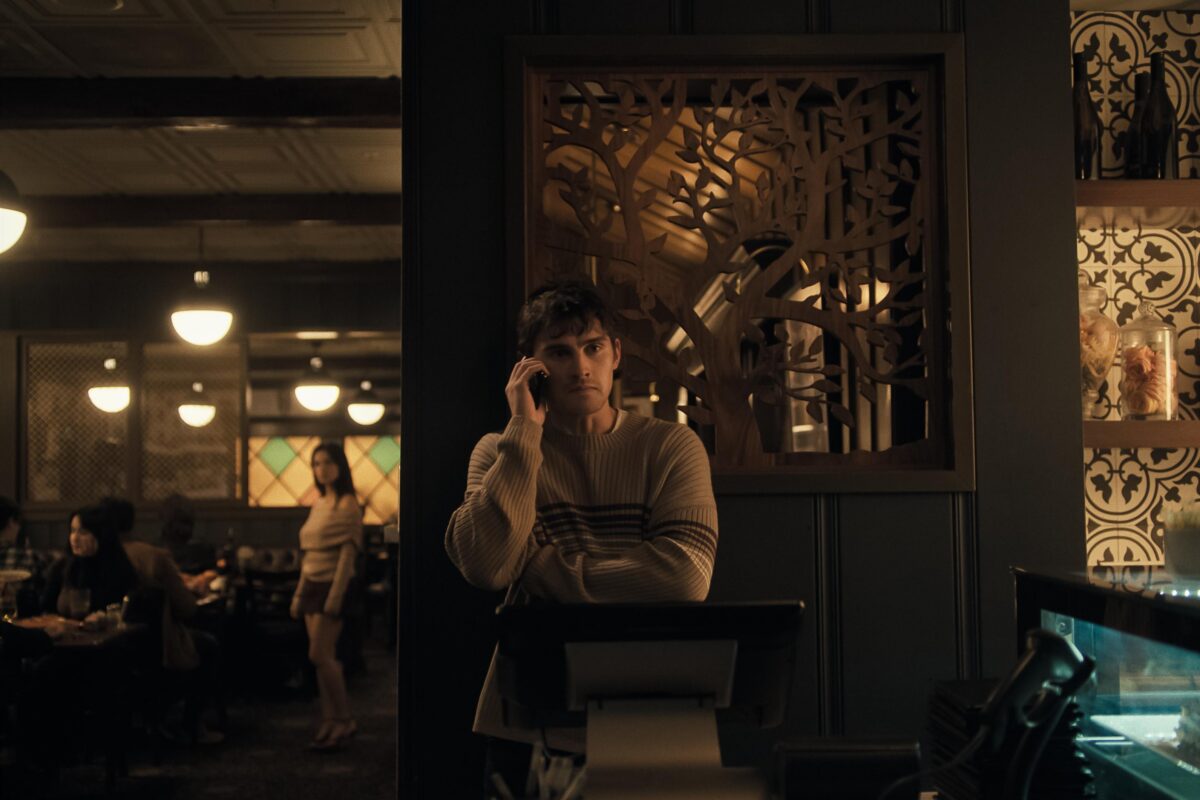
Prototypical “nice guy” Bear (Michael Johnston) has had it bad for Nikki (Inde Navarrette) since middle school and, as budding careers threaten to pull their friend group apart, he feels his chance to act on it slipping away. When he seeks a mutual friend’s guidance on escaping the friendzone, it doesn’t take long for the two Gen-Z bros to consider negging. “Girls like when you’re jokingly mean to them,” Ian (Cooper Tomlinson) tells Bear. “Just be jokingly mean.” When this and other hacks fail to deposit Nikki into Bear’s arms/bed, his desperate wish on an apparent tchotchke from a novelty store activates the “Monkey’s Paw” conceit of wishful fulfilment that Obsession—like the new Saccharine, 2024’s The Substance, and horror films going at least back to Pet Sematary—follows to harrowing ends. This is a genre film, and writer-director Curry Barker delivers the expected shocks, bad vibes, and gory ultraviolence. But its core device—a hack to make chicks really, really dig you—positively radiates with dark manospheric energies of the contemporary sex wars, with every specter from “nice guys” to incels, fuckboys, stalkers, and roofies wriggling somewhere in its wake.
This is no “erotic thriller.” It’s a fucking nightmare.
Barker, who’s 26, grounds his story in a recognizable Gen-Z reality: a quartet of friends and co-workers at a local music store, coping with post-graduation anomie, grief, ambition, and unformed identities. It’s a maddening stage for a timid and obscurely haunted guy like Bear, who’s either an incurable romantic, a creep, or so destabilized by the recent death of a parental grandma that he’s turned his hot, kind, artsy, wisecracking friend into his last chance for redemption.
Some of the more intense online debates concern the kind of guy that Bear is, whether even his half-assed gesture toward converting Nikki is a violation, and how he should have handled his relatable dilemma, which plants a lightning rod into the post-#metoo firmament. Bear’s dry run at a declaration of love sounds earnest or cringy depending who listens, and Ian’s warning is all too credible. “If you confess your feelings to her like you just did to me,” he tells Bear, “you won’t have a relationship with her in any capacity after that.”
So Ian says nothing and, after dropping Nikki off without even a peck on the cheek, he sits in his car, brooding and fiddling with the One-Wish Willow he picked up by the register in a New Age store—a gag gift that rather infringes on Aunt Gladys’s hex from last year’s Weapons by granting whatever wish, or curse, the bearer utters as they snap this twig-like totem in two. Bear’s being “I wish Nikki Freeman loved me more than anyone in the fucking world.”
Some critics have called Obsession a “next-gen Fatal Attraction,” which feels fundamentally off. Nikki isn’t an unstable woman scorned; she’s someone who’s been dosed, altered, and interfered with at the most basic level, solely to oblige one man’s needs. And if this is a cautionary tale, it’s about something more elemental in sex and love than mere infidelity.
Barker has a gift for low-key social realism developed as part of a sketch-comedy duo with Cooper Tomlinson, That’s a Bad Idea, making a series of winning YouTube shorts. He shows a commendable restraint and behavioral attentiveness in depicting the immediate aftermath of Bear’s fateful wish, at a moment when even the potentially fun segment of a ruinous affair feels instantly, pathologically, off. In a career-making performance, Inde Navarrette initially channel surfs from manic phase to Rohypnol fog to late-stage dementia: slipping in and out of coherence, scaring herself, apologizing for “acting weird,” briefly regaining composure, then getting stricken by the next unwelcome impulse. Rather than any recognizable version of sexy, the behavior soon recalls the initially confounding pantomimes of the Black characters in Get Out, some of whom briefly shrug off the controlling consciousness of the elderly white person that’s been downloaded into their brain to use them as a host body. When Nikki invites herself into Bear’s bedroom this first night, you’re ready to call it a day and run.
But Bear is either hopeful, scared, or fixated enough to roll with Nikki’s woozy mannerisms, buying her explanation of covert MDMA use, and, instead of driving her to psychiatric hospital, waits for this new Nikki to level out. The film narrates a honeymoon period—or early-stage love/sex addiction—as an indie-romcom montage dotted by ghastly harbingers that nod to Pet Sematary, The Babadook, and a few other standards from the canon, before settling firmly into The Exorcist. After which the film becomes an endurance test.
Terrifying public meltdowns, a vacant gaze during coitus, brutal, movie-seat-jolting acts of bloody self-harm—the horrors escalate quickly and punishingly while abandoning the promising areas Barker’s script hints at earlier on.
One is the ancient folk-horror that lurks behind the mass-produced “One-Wish Willow” that falls into Bear’s needy hands, a shadow world invoked by a grimly comic phone call to customer service, during which a lethargic rep tells Bear that he’s basically toast, the spell breakable only with his death. The other is the obliteration at the core of wish-fulfillment fantasies like this one and a thousand others filling luminous touchscreens right this second—Nikki as fuck-buddy, as trad-wife, as manic-pixie dream girl, as the face on an AI-generated partner. Nikki as the fulfillment of Mrs. Stephen Miller’s recent insistence that teenage women stop the woke bullshit and fulfill their biological destiny.
These are the tropes and images that haunt the underlit bedrooms and moody exteriors of this increasingly claustrophobic drama, and the sources of questions that it doesn’t quite dare to pose. Like: What if instead of turning Nikki into a zombie demon, the adjustment had been subtler? What if she were close enough to the original Nikki? Would Bear even clock what he’s done?
Barker’s dialogue is sharp, real, and suggestive enough to speak beyond horror, as it does when Bear learns how the magic charm actually works. Late one night, Nikki whispers to him from what looks like a deep sleep—then shocks him with a faint request that he kill her. Is she having a bad dream, or is this the real Nikki, breaking through some enslaving false consciousness?
Either way, Bear takes it personally.
He asks her, “What’s so bad about being with me?” And Nikki’s answer will haunt anyone trying to negotiate the hall of mirrors, filters, and mediated reality that surrounds romantic interactions between young humans. From some unknown depths she tells him, “I’ve never been with you.”