Your bag is empty.
Has the media highlighted instances of civil disobedience to delegitimize the Black Lives Matter movement?
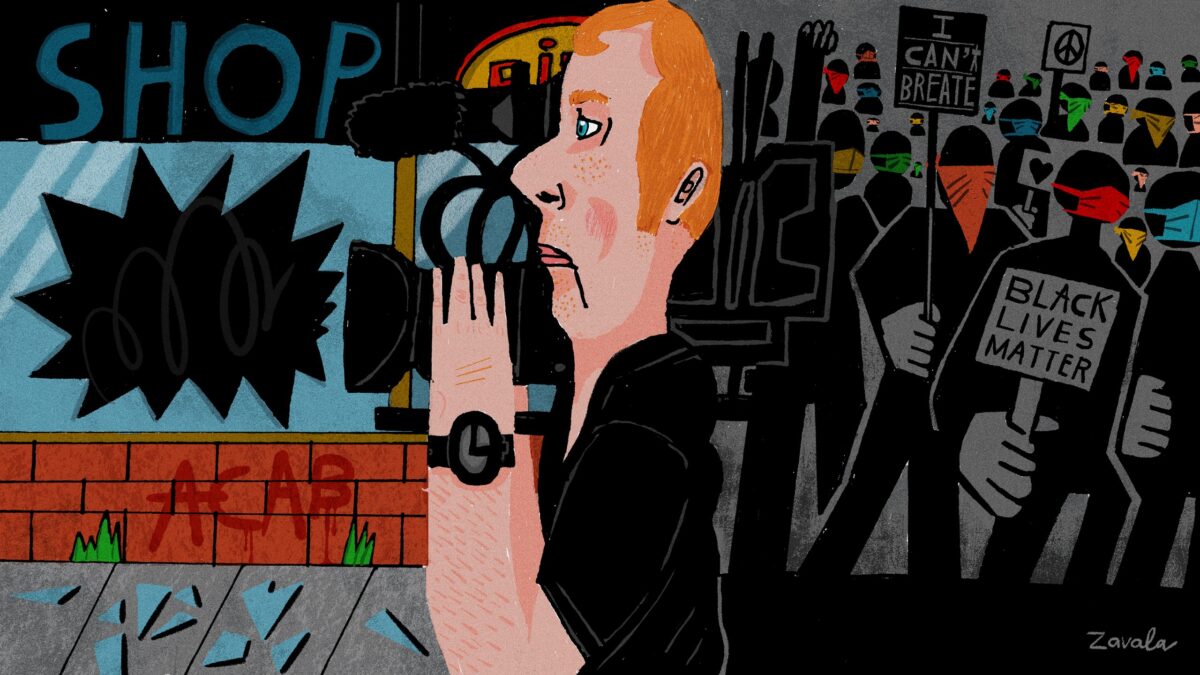
It was seven weeks ago that the haunting images of Minneapolis police officer Derek Chauvin kneeling on George Floyd’s neck surfaced online, yet the deluge of global anti-police brutality protests persists with unwavering tenacity. The demonstrations personify a collective exasperation at police who have killed enough Black people in the social media era to create a perpetual stream of trending hashtags out of their victims’ names.
Organizing in the name of Black lives certainly isn’t a novelty; names like Michael Brown, Sandra Bland and Tamir Rice are proof of that. However, a defining characteristic of the latest demonstrations is the mainstream documentation of events, along with the amount of violence meted out by white agitators and police who have participated in strategically fanning the flames of outrage from members of the Black community and its allies.
Lauren Rowello protested in Philadelphia and recounts the unwarrantedly violent crowd maintenance tactics she witnessed from local law enforcement.
“Marchers wanted to continue walking across a main road, but the police would not let anyone pass,” Rowello says in an email. “They blocked people marching with bikes, then used those bikes as weapons—shoving them into people and even lifting them to jab them into those who were at the front of the group. Multiple officers hit people with batons and fists, and I got hit in the chaos.”
I don’t think a water bottle being thrown toward an armed squad car warrants the police using tear gas on a crowd.
Rowello says the aggression from law enforcement intensified as the protests continued.
“Over the next few days, police met protesters with huge amounts of force each afternoon,” she says. “I witnessed (and have footage of) kneeling protesters being met with tear gas and rubber bullets. Legal observers told me that this is the worst police escalation they’ve ever seen all at once, and that it was unprovoked. Each time tear gas was used, it felt random and used as a way to assert control.”
At the inception of the protests, major media networks broadcast hours of live footage of looters and arsonists at work. Presenting only this small portion of the larger story fueled the false narrative that the protests were not respectable forms of resistance, which only served to delegitimize the movement. Meanwhile, various law enforcement agencies have apparently rejected diplomacy in response to attempts to hold them accountable.
In New York City and Richmond, Virginia, footage showed police officers driving their vehicles into crowds of protesters. Buffalo police shoved a 75-year-old nonviolent protester to the ground, leaving him to bleed on the pavement from his fractured skull. Police in Louisville, Kentucky are under investigation in the shooting death of a restaurant owner. Photojournalist Linda Tirado lost vision in her left eye after Minneapolis police allegedly fired a projectile into her face as she set up a shot. Police in Austin, Texas allegedly fired beanbags into the head and abdomen of a pregnant protester who sat on the ground. A 26-year-old Dallas man lost an eye and seven teeth and suffered a facial fracture after police reportedly shot him with less-lethal ammunition during a peaceful protest. U.S. Park Police used tear gas to clear demonstrators from Lafayette Square near the White House to allow for a presidential photo op.
If anything, it just solidified what I already know: The police don’t keep us safe.
In some cases, protesters reportedly attacked law enforcement, pelting officers with water bottles, bricks, rocks and fireworks. Dallas Police Chief Renee Hall defended her decision to order tear gas deployment in response to protesters assaulting officers with random items and damaging police vehicles.
“I don’t think a water bottle being thrown toward an armed squad car warrants the police using tear gas on a crowd,” says activist Mercedes Fulbright, a member of the Dallas chapter of Black Youth Project 100 who was among a large group of protesters assaulted with tear gas and threatened with arrest by local law enforcement.
“Folks have righteous anger. Our communities have been looted, destroyed and stolen from for decades, centuries,” she says, emphasizing how civil disobedience forces mainstream America to contend with racial injustices. “A few broken buildings don’t make up for the number of Black and brown lives that have been stolen.”
Fulbright says the violent tactics only strengthen her perception of law enforcement as a community hazard.
“It didn’t change anything,” she says. “If anything, it just solidified what I already know: The police don’t keep us safe.”
Additionally, mysterious white agitators dressed in all black have also taken part in incendiary behavior during the protests. From the man who was recorded breaking windows in a Minneapolis AutoZone to the suspect arrested for setting fire to a police precinct, the accounts are numerous. According to the Daily Beast, Black protesters in Denver, Oakland and Detroit intervened when white protesters attempted to loot, start fires and deface statues.
There are hundreds of thousands of people who understand the need to defund the police, and that is frightening to the very institutions that protect capitalism and white supremacy.
Sheree Lewis says an orderly protest in Richmond, Virginia eventually resulted in the toppling of a Confederate statue.
“There were definitely agitators there,” Lewis says. “They were called upon and knew their roles. These guys were dressed in black long-sleeve shirts, black pants, their masks were black. They weren’t regular masks; they were almost like bandannas to cover more of their faces. And it was 93 degrees. So, either you’re going to rob us or you’re part of the wrecking crew.”
Lewis confirmed a police presence near the United Daughters of the Confederacy Memorial Building just off Monument Avenue—a street lined with statues of Confederate figures—but she says they were nowhere near the crowd of protesters.
Tyler D. Parry, a professor of African American and African Diaspora Studies at University of Nevada, Las Vegas, says certain media organizations are complicit in misrepresenting the protests by “selectively” editing protest images.
“Consequently, many will then assume the protests have ‘devolved’ into anarchy, when the fact is that the vast majority of people are still marching peacefully and trying to maintain order in delivering their message for systemic and systematic change,” Parry says via email.
Despite the widespread condemnation of looting and rioting during the ongoing protests, Parry says property destruction isn’t exclusive to the latest demonstrations.
“Many Americans assume that the destruction of property is a new phenomenon instituted by Black Lives Matter protestors, when the historical record proves that is not at all the case,” he says.
Parry revisits slavery to put the role of property destruction during demonstrations into perspective.
“White slaveholders would never submit to the passive, gradual abolition promoted by white abolitionists in the North,” he says. “Enslaved people (and formerly enslaved people) knew that to destroy a racist system, the destruction of property was a prerequisite within a country that allots so much power to individual state governments.”
In recent weeks, major media coverage of the protests appears to have dwindled, a pivot that some have linked to the lack of disorderly conduct. The death of Rayshard Brooks—an Atlanta man police fatally shot after the world began to protest police brutality en masse—reignited legitimate concerns that police have zero intent to re-examine their use of violence against protesters or deadly force against Black people.
Fulbright offers a sobering prediction about police violence.
“There are hundreds of thousands of people who understand the need to defund the police, and that is frightening to the very institutions that protect capitalism and white supremacy,” she says. “Their tactics are going to become more aggressive because they’re starting to lose the public’s favor.”
Nevertheless, she offers a word of encouragement to fellow protesters: “Don’t back down. We’re winning.”