Your bag is empty.
A Pennsylvania native writes about how the tireless resistance of Black, Latinx and Muslim communities tilted the state toward Joe Biden
On a dark winter night in early 2016, my friends got into a bar fight with Trump supporters. I was a 20-year-old student at Temple, a public university in Philadelphia, and the bar was a regular haunt for students and local residents alike, embedded in the streets surrounding the decidedly urban campus. A place of safety, I would often step into the bar for a quick bite to eat or grab drinks with my roommate and her boyfriend at two in the morning. Trump had not yet been elected president, but he was leading the polls in the primaries, and the racist rhetoric we heard on television became real to me in that moment. My friends had been attacked by white boys in red MAGA baseball caps in a city that always voted Democrat and is populated mostly by people of color. We were no longer safe, and the fight signaled the looming fascist violence increasingly normalized by Trump’s ascent to power.
Even before he dropped executive orders banning certain immigrants or incited violence against Black Lives Matter protesters, Trump’s rhetoric fanned the flames of neo-Nazis that had previously been relegated to the anonymity of internet forums and paved the way for hate crimes and harassment against racial minorities. Although my friends had defended themselves, Amine Aouam, a Moroccan immigrant at my school, was hospitalized after being attacked in early 2016; he said the assault happened because he was speaking his native language of Arabic. More recently, white vigilantes terrorized Black Lives Matter protesters after George Floyd was murdered by Minneapolis police in May, circling around buildings nobody intended to loot and beating up protesters. On-duty police officers enabled their intimidation by defending or ignoring the vigilantes.
The emboldening of violent white vigilante groups became a signature of Trump’s presidency, particularly when Heather Heyer, a 32-year-old waitress and paralegal, was murdered while demonstrating against a neo-Nazi rally in Charlottesville, Virginia in 2017. Thus, it was no surprise when Trump supporters rolled into Philadelphia for the 2020 presidential election, and the city was pinned by experts as a site of potential election violence. Although Philadelphia is a stronghold for Democrats and hasn’t elected a Republican mayor since 1947, parts of rural and suburban Pennsylvania, disparagingly referred to as “Pennsyltucky” by locals, tend to favor Trump. Most Trump supporters appeared to come from out of town, poised to declare Biden’s lead a fraud and violently provoke activists, city residents and passersby. A bomb threat was issued near the Convention Center where votes were being counted.
There isn’t much that fazes someone from Philly, the poorest big city in America. We’re inured to almost everything, because we’ve seen it all. But sometimes, the cracks burst open.
Philadelphia hangs perpetually in a negative peace, a gritty city that cools the class and race tensions simmering underneath its surface with a hard, survivalist attitude. Philly people don’t cede any ground; they take it instead. And there isn’t much that fazes someone from Philly, the poorest big city in America with the highest incarceration rate of any large jurisdiction, which has had the country’s second most homicides, after Chicago, so far in 2020. We’re inured to almost everything, because we’ve seen it all. But sometimes the cracks burst open, spilling all the contradictions of American society like blood from a thinly bandaged wound. I’ve seen it before. Flash mobs of Black youth have taken to the streets, denigrating the gentrification that escalates police presence in their neighborhoods, and riots after George Floyd’s murder collectively expressed the city’s disdain for the everyday violence and injustice faced by its people.
Just a week before the election, Walter Wallace Jr., a 27-year-old Black man, was shot dead by police. Wallace, who was mentally ill, had been holding a knife, and instead of de-escalating the situation, the police opened fire.
Wallace hailed from West Philadelphia, where my parents lived when they first immigrated to America in the 1990s. It’s remained iconic for Will Smith’s “West Philadelphia born and raised” line in the Fresh Prince of Bel-Air theme song. Although West Philly has become gentrified over the past couple decades and encompasses the University of Pennsylvania and Drexel campuses, it is still a majority Black area with a unique history of activism. Paul Robeson, a star athlete and actor who was blacklisted during the McCarthy era for his socialist views, spent his final years in West Philly, and his house is preserved as a museum on Walnut Street. In 1985, just a few blocks from where Wallace was killed, the headquarters of MOVE, a Black liberation group committed to eco-justice, was fire-bombed by the Philadelphia police, killing 11 people, five of whom were children.
Just as the people of Philadelphia face routine oppression, resistance, too, is in the city’s bones and psyche. Hundreds of people marched demanding justice for Wallace, and the National Guard was called in for the second time this year, patrolling the streets like predators. I remember my days as a racial justice activist in 2014, not long after Mike Brown had been killed by police in Ferguson, Missouri, sparking the first wave of the Black Lives Matter movement. Helicopters circled the sky minutes before protests we’d planned weeks in advance. Cops drove for hours around my friends’ house when we gathered for an organizing meeting. Once, I exited a church where we held a town hall, only to come face to face with a cop leaning against the door, no less than 20 other police officers standing on the street behind him. Police intimidation was not spontaneously brutal; it strategically targeted organizers trying to change the system.
But this time, it was even worse. The blowback from Wallace’s killing paired with the impending threat of election violence fueled some of the most intense militarization residents had ever seen. “On my street in West Philly, I’d hear helicopters above, and every other minute or so I’d see and hear police cars driving past,” says Abbas Naqvi, an activist and research scientist. “We’d encounter military vehicles wherever we went, whether grocery shopping or going out to get food. It reminded me of the time I visited Iraq in 2010.”
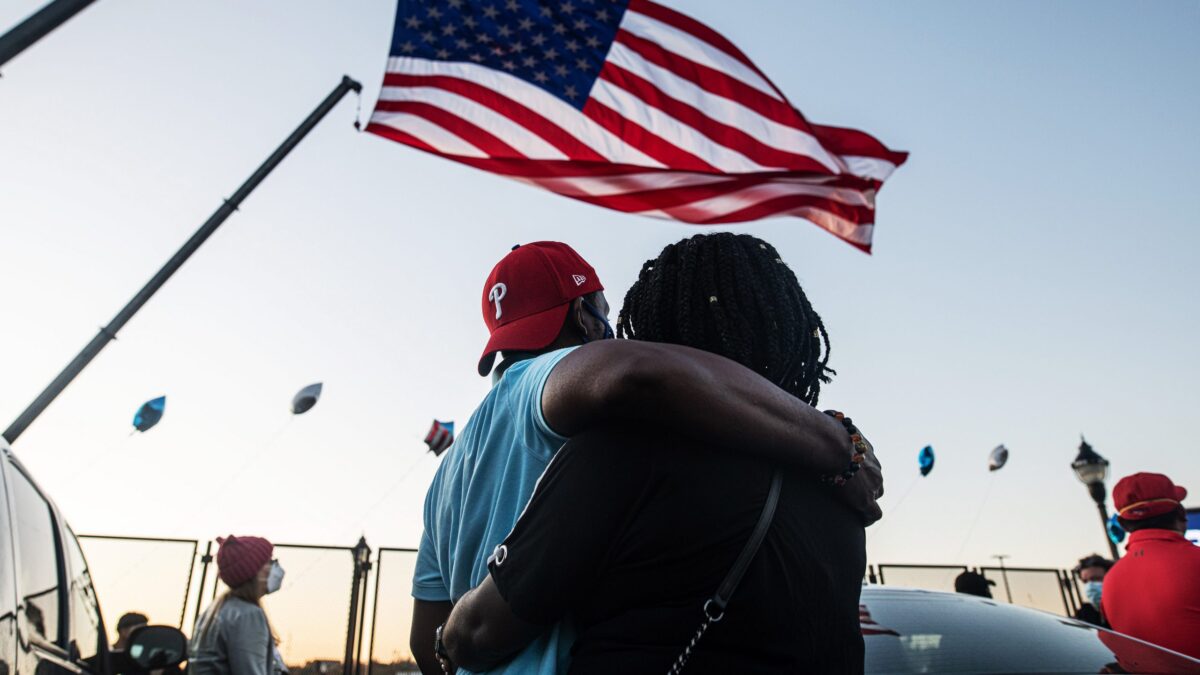
Outside the Convention Center downtown, Biden supporters faced off with Trump loyalists, who aggressively parroted Trump’s sensationalist claims that the election was a fraud. What started as a jeering confrontation transformed into a block party, as local residents, electoral volunteers and progressive activists celebrated love, resistance and the city. DJs blasted music, and the pro-Biden crowd jammed to “Uptown Funk” and other pop songs, dancing in the long, waiting hours of the night.
In an election filled with voter suppression and threats of violence from Trump supporters, the city’s victory for Biden resulted from the efforts of community organizers, grassroots activists and volunteers.
Not all the demonstrators necessarily favored Biden, but rather viewed a vote for the Democrats as a way to defeat Trump. The primary organizations coordinating the festive block party, such as the Working Families Party, Power Interfaith and Reclaim Philadelphia, are independent, community-based groups that aimed to protect the city from the threat of fascist violence and provocation. When Biden’s victory was announced, protestors popped bottles of wine and opened beer cans on the street in joy and relief. Passing cars honked in support, and YG and the late Nipsey Hussle’s “FDT (Fuck Donald Trump)” played on loop for hours.
In an election filled with voter suppression and threats of violence from Trump supporters, the city’s victory for Biden resulted from the efforts of community organizers, grassroots activists and volunteers. It isn’t a coincidence that the protests for Wallace funneled into defending the city against potential aggression from right-wingers, although supporting Biden triggered mixed feelings in many people who felt uncomfortable with the president-elect’s role in the 1994 crime bill. Nevertheless, native Philadelphians’ allegiance to the Democratic Party is a near guarantee every election. Hazim Hardeman, an academic who lives near 52nd street in West Philly, says: “The community [in which I live] is essentially all Black, and the majority lean heavily toward the Democrats.”
Philadelphia, after all, is the birthplace of America, home to the Liberty Bell and the Betsy Ross House and the site where the Declaration of Independence was signed, freeing the settler colonies from the reign of their British overbears. And yet the underbelly of America marginalized by the Founding Fathers has always existed parallel to the mythos of this country’s conception, even if it remains shadowed by the mainstream. It is fitting then that Philly should help swing an election against the 21st century’s fascist-in-chief. Just as Philadelphia anchored the beginning of America, any meaningful revolution in this country will start here too.