Your bag is empty.

If Saint Nick’s origin story ever seemed a bit trippy to you, there’s an explanation
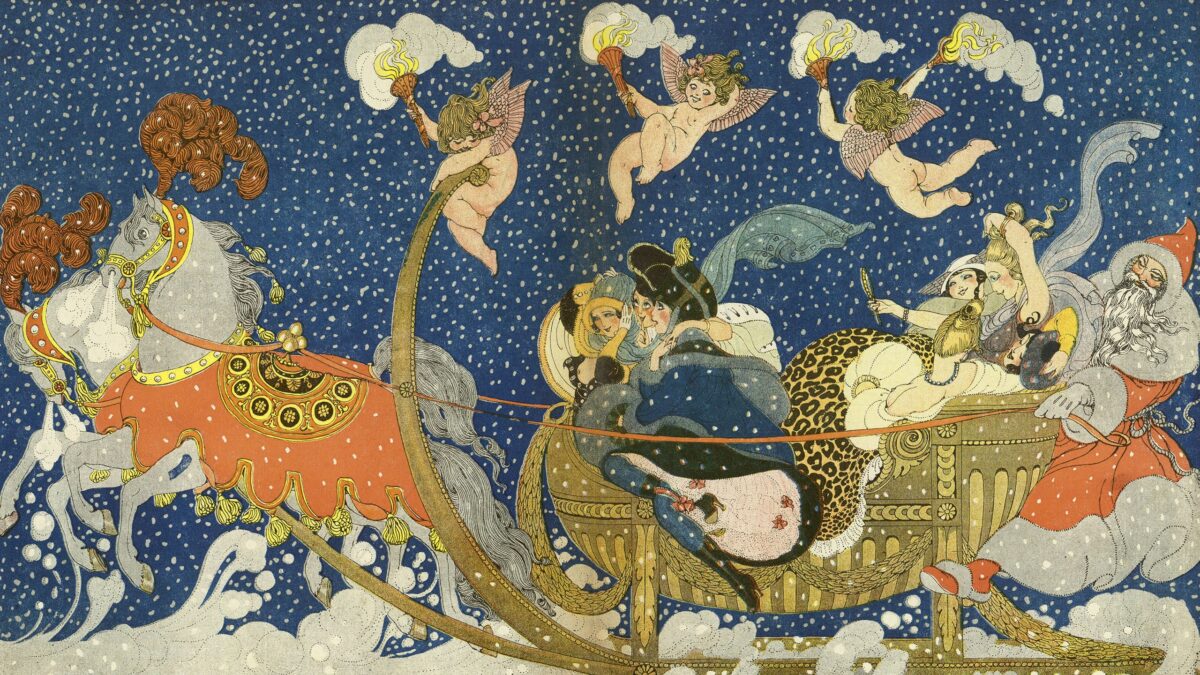
Few characters are as universally beloved as good old Saint Nick. For most, the jolly man conjures images of tradition and family. But like so much legend and lore from around the world, the roots of this mythic character are, surprisingly, psychedelic. Flying reindeer and a rotund old man squeezing down a chimney? You’ve gotta be tripping. Before looking at this hidden backstory, though, let’s start with what the history books tell us.
Although the Santa Claus we think of today may be mostly fictional, a fourth century Greek Christian bishop named Saint Nicholas really did live in Myra, a city on the Mediterranean coast of what is now Turkey. He was known for his charity, following Christ’s directive to “sell what you own and give the money to the poor.” Under Roman rule, Saint Nicholas was persecuted for his religion, spending jail time among other Christian holy men before he passed away on December 6, 343, now known as St. Nicholas Day. He was especially remembered as a protector of children, and became the inspiration for the Dutch folk tale of Sinterklaas.
The Dutch legend, who donned a big red coat, was known to record children’s behavior during the past year as naughty or nice. According to Dutch lore, he lives in Spain and travels to the Netherlands before Christmas to punish disobedient kinder—children—and leave charity for families. Thanks to 17th century Dutch immigrants to the New World, Sinterklaas evolved into the Americanized Santa Claus.
Flying reindeer and a rotund old man squeezing down a chimney? You’ve gotta be tripping.
But Santa has another backstory altogether. Those in the (mycological) know may recognize the suspicious similarities between the appearance of the Amanita muscaria mushroom, which is red with white dots, and Santa’s color palette. This fungus was a favorite among both Siberian healers and Sámi people in Lapland, the northernmost region of Finland bordering on Russia—and, of course, near the North Pole.
In a 2010 interview with NPR, Donald Pfister, a professor of systematic botany at Harvard, said both shamans and reindeer were known to munch on this psychedelic mushroom, which when consumed could produce the sensation of flying. Mycologist Lawrence Millman suggested in the documentary short Santa Is a Psychedelic Mushroom that Lapland’s indigenous Sámi shamans would eat the entheogenic—consciousness-altering—A. muscaria in order to navigate otherworldly realms and bring back healing wisdom.
Sierra College anthropologist John Rush contends that the shamans would collect these mushrooms from underneath pine trees, dry them and then distribute them as gifts. These “gifts” of knowledge and healing, so to speak, may have been delivered down people’s chimneys, Rush told LiveScience.com in 2012, because their front doors were often snowed in. The mushrooms were considered so holy that the shamans would even dress up as the mushrooms, in red and white, to deliver them, before departing in their reindeer-drawn sleds. Those gifted with the A. muscaria on the winter solstice would reward the shamans with food. (Some speculate that because the mushrooms were mildly poisonous, in order to more safely achieve the psychoactive effects, people may have drunk the urine of the reindeer—or the shaman—that had eaten the fungi.)
Although today’s Santa Claus may be a mashup of all these different legends, one thing is for certain: Evidence of humanity’s early psychedelic experimentation has been written out of many history books (see the Eleusinian Mysteries of Ancient Greece or the Israelites in biblical times). It’s not implausible that the same kind of erasure happened with our favorite Christmas tale.