Your bag is empty.

They said he wasn't American enough. So he offered a compelling vision for what America could be.

The show lasted 13 minutes. In that time, Bad Bunny—Benito Antonio Martínez Ocasio—elevated Puerto Rican culture, sang with one of his idols, and uplifted a viewership in desperate need of good news. He cemented his place as a global phenomenon, officially earning the most-watched Super Bowl halftime performance in history.
He also reminded us all what “America” means.
Bad Bunny’s performance opened with five Spanish words: “Qué rico es ser latino,” meaning “How great it is to be Latino.” It’s a sentiment that stands in stark contrast to our current reality in the U.S., where immigrants from Mexico, Central America, and other parts of Latin America are being targeted by ICE, despite no history of criminal wrongdoing.
The politically charged symbolism that followed illustrated exactly what it takes to make America—and the immigrants who keep it alive every day. In a birdseye view of the field, actors toiled across rows of sugarcane in homage to Puerto Rican jíbaros, the archipelago’s traditional farmers, or even to U.S. farmworkers, approximately 45 percent of whom are undocumented immigrants.
During the song “El Apagón,” meaning “The Blackout,” he perched atop a power line to represent Puerto Rico’s ongoing electricity issues. Battered by repeated and devastating hurricanes with little relief, widespread power outages have become especially dire in the archipelago since 2021, when privately-owned company LUMA Energy took control of electrical transmission and distribution.
In one interlude, Ricky Martin performed a moving rendition of “Lo Que Le Pasó a Hawaii” (“What Happened to Hawaii”). The song draws parallels between Puerto Rico’s status as a U.S. territory and Hawaii’s arrival to statehood, both of which occurred at their native populations’ expense.
Over his shoulder, Benito carried a light blue version of the Puerto Rican flag, which symbolizes independence from colonial rule (from 1948 to 1957, displaying that flag was illegal on U.S. soil). At the end of the show, in one of perhaps the most poignant moments, the singer proclaimed “God Bless America,” using the opportunity to remind viewers that America isn’t just the United States. “Chile, Argentina, Uruguay,” he started, listing countries and territories across the Americas as their flags blazed across the field
The political messages were plentiful, but so were the cultural references. Bad Bunny sang and danced his way through a nail salon, domino table, and a shadow-boxing match between two of the world’s fastest-rising boxers, Puerto Rican Xander Zayas and Mexican-American Emiliano Vargas. While performing “Nuevayol,” he entered a replica of Brooklyn’s legendary Puerto Rican Social Club. For over 50 years, the bar has served as a gathering space for New York’s Puerto Ricans and other Latinos; today, it’s better known to locals as “Toñita’s” after its 85-year-old owner. When Bad Bunny sang “Un shot de cañita en casa de Toñita,” or “A shot of cañita at Toñita’s house,” Toñita herself beamed from behind a makeshift bar.
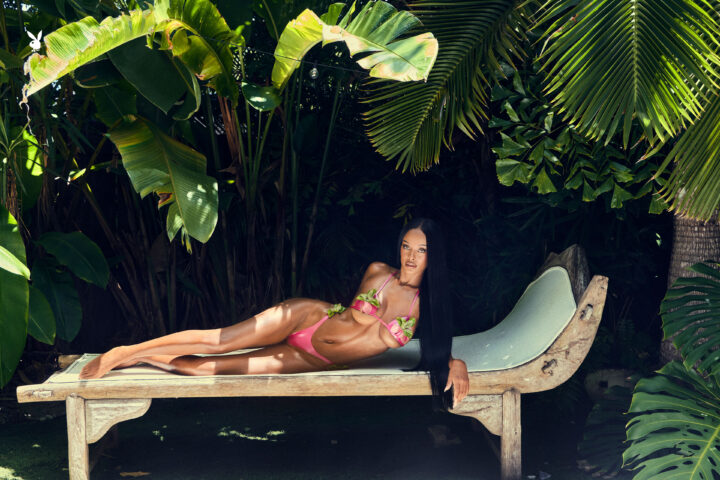
Other appearances came from Cardi B, Karol G, Young Miko, Pedro Pascal, and Jessica Alba, all of whom danced on the porch of the pink house, la casita, that has traveled with Bad Bunny from his Puerto Rico residency to his ongoing world tour. Among the set’s lush vegetation,
And of course, there was Lady Gaga. In a 2020 interview with E! Online, Bad Bunny professed his love for Gaga’s Chromatica, and even wore a Chromatica tee to the polls that year. In a dress from Dominican-American designer Luar — complete with a flor de maga, the national flower of Puerto Rico — she performed “Die With a Smile” with Bad Bunny’s backing band, the Puerto Rican group Los Sobrinos.
For all the critique of Bad Bunny’s presence and performance—mostly mounted by talking heads and pundits on the far-right—his booking was actually a sound economic decision. Groundbreaking as the artist may be, the NFL’s selection of the Puerto Rican musician likely had something to do with the spending power of Latino viewers. In 2024, Mexican, Brazilian, and other Latino subgroups were named the league’s fastest-growing fanbase, and in 2025, overall economic consumption from U.S.-based Latinos reached $2.7 trillion. Even with the backlash his performance drew (including a poorly-received counter performance sponsored by the right-wing group Turning Point USA), Bad Bunny means good business. Today, he’s occupying top spots on the Spotify charts and enjoying record numbers on Apple Music, who produces the Super Bowl’s Halftime Show.
But therein lies the point. In the months since his announcement as the performer for the show, there have been arguments in our polarized political climate about what it means to be an American. (Puerto Rico is, of course, a territory of the United States—though this fact has been conveniently overlooked by Bad Bunny’s critics.) Kid Rock’s answer to Bad Bunny’s performance was a concert of all white performers, who mostly stood on the stage by themselves, to little fanfare and dramatically less viewership than the history-making halftime show. Even President Trump was reportedly seen watching Bad Bunny’s performance from his estate at Mar a Lago.
Last night, Bad Bunny invited us not just to a political party, but a real party—where you don’t have to speak a certain language, have a particular skin tone, or behave a certain way to join the fun and dance. The words exploded on the billboard behind him: “The only thing more powerful than hate is love.” And if viewership was any indication, it may be hope that we’re finally reaching a turning point—not a Turning Point—as a nation.
And if not, at least Bad Bunny gave us an unforgettable dance.