Your bag is empty.

Ahmed has spent his career infiltrating popular culture like a covert operative. Now, he's taking on James Bond.
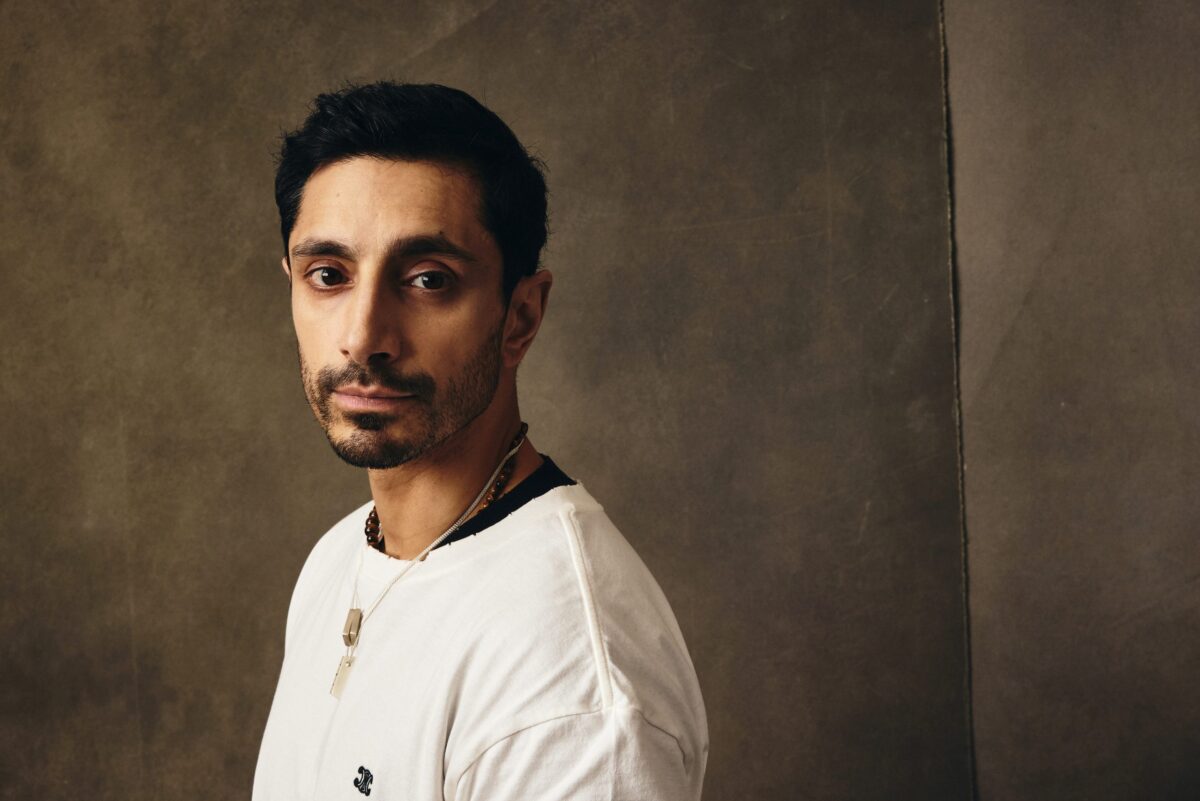
For the past 15-odd years, the actor and rapper Riz Ahmed has been infiltrating popular culture like a covert operative: now a radicalized Muslim Brit from South Yorkshire, now an unhoused Los Angeles drifter, a rebel star pilot, an avant-metal drummer—disappearing into each role like a decade-embedded sleeper agent, as convincing with a Queens accent as he is speaking the King’s, and never less than riveting onscreen. As he proved in last year’s espionage thriller Relay, this London-born British Pakistani may be the sole human being able to credibly move unnoticed through New York City’s streets and subways and be utterly magnetic to the viewer while doing so. His watchful eyes, wiry frame, and feline grace make the act of crossing a street look cool AF: a superstar secret agent. The question isn’t whether Ahmed could be the next James Bond, but whether that’d be just too on the nose.
So in a sense, Ahmed’s new Amazon Prime showbiz satire Bait springs from a premise that feels barely fictional: that Ahmed, as London-born actor Shah Latif, is under consideration as the new 007—much to the delight, panic, resentment, and even mortal peril of his extended family of London Muslims. In a sense, Bait is a look behind Ahmed’s “legend,” the fabricated bio a spy uses when undercover, one informed by the actor’s 20-year struggle toward global acclaim.
The show is very well made: full of hilariously believable intra-familial squabbles, brisk and punchy direction, public confrontations and private breakdowns, and a vivid sense of contemporary London. “Nobody needs a Muslim Uber, bro,” Shah tells his car-service entrepreneur brother Zulfi. “Uber in London is already Muslim.” Shah’s ex, a political journalist, asks, “Isn’t it more racist to be killing yourself to play a white neo-colonial MI6 agent?” to which he counters, “But if I played him, he wouldn’t be white, would he?” and she snaps back: “But you would be.”
Unlike his striving character Shah, Ahmed created, produced, and wrote Bait after rising to the summit of his profession, which he did through immersion and subversion, by being better than anyone else at being other people. The graduate of both Oxford and the prestigious Royal Central School of Speech and Drama has long shown a blazing intelligence in his acting and choice of roles, but his stroke of genius with this show is a premise that enables him to channel real-life experiences as a Wembley-raised Muslim actor, rapper, and rising star and point them all directly at a whole nexus of post-Brexit Trump-era anxieties about race, masculinity, religious freedom, and national identity.
As this magazine’s founder certainly understood (Playboy published several of Ian Fleming’s Bond short stories, beginning in 1960), James Bond was never just a remorseless civil servant, but a 20th-century model of maleness: chilly, potent, detached, a fussy connoisseur of consumer goods and women. Whether played by Sean Connery (who Fleming initially dismissed as a “Glaswegian lorry driver”) or Daniel Craig (“a microphoned bouncer in tight Tom Ford suits,” per British critic Luke Honey) Fleming’s hero retains a few core aspects. He’s elite, independent, violent, implicitly or explicitly misogynistic: meet the Ur-text of what the Manosphere would call a “sigma male,” a lone wolf non-conformist tactician outside the alpha-beta hierarchy of traditional roles.
“The show isn’t really about James Bond,” Ahmed told NPR’s Fresh Air on March 23. “But James Bond is a very important symbol because he is the ultimate symbol of success. As an actor, he is the pinnacle of cinematic achievement. And yet for any of us, he’s this archetype of decisiveness, desirability, of being in control, being unflappable, of being invulnerable. And so I wanted the character of James Bond to serve as this symbol of aspiration, this unattainable kind of self that Shah is hunting down almost.”
The show works because Ahmed is believable in both roles, the debonair figure in Bond drag and the insecure actor looking back at him in the mirror, the split personality that reveals how different the pinnacle of success still looks for people of color.
In his contribution to the 2016 anthology The Good Immigrant, Ahmed laid out the three stages of portraying ethnic minorities: 1) the two-dimensional stereotype (“minicab driver/terrorist/cornershop owner”); 2) the subversive portrayal intended to challenge stereotypes; and 3) the Promised Land, where a character isn’t defined by or linked to his race. As a classically trained and principled young actor, Ahmed steered clear of stage-one roles, and over the past 10 years or so, he seemed to rise past stage-two roles too.
Ten years ago, his portrayal of a falsely-imprisoned murder suspect in HBO’s eight-part crime drama The Night Of beat out Robert De Niro, Benedict Cumberbatch, Ewan McGregor, and John Turturro for an Emmy—becoming the first Asian and first Muslim to win in his category and the first South Asian male to ever win an acting Emmy. And this year, the superlative English actor is remaking his nation’s hottest malcontent, playing Hamlet in Aneil Karia’s austerely gritty film of the Shakespeare tragedy, which outclasses Joel Coen’s Expressionist treatment of Macbeth and out-edges Chalamet’s Henry IV Parts 1 and 2 by setting the thwarted revenge tale in a South Asian family’s West London world of business and corruption. “There’s a rigorous chill to this Hamlet,” said The Guardian, a verdict that applies to the star as well as his character.
As a presence, the Riz Ahmed of 2026 slides perfectly into the gen-z/alpha multicultural consciousness, his very name the expression of consummate style and attractiveness: riz. But just as Le Carre’s spies navigate the invisible schism between the secret world and ours, so must Ahmed negotiate between the separate worlds that people who look like him still face: one in which his gifts as a male film actor earn him the very pinnacle of success, another in which his very presence is deemed too “woke.”
An additional subgenre, Next James Bond, releases a new installment every few years as the names of certain film actors are sent out like weather balloons to monitor contemporary attitudes about race and gender: Idris Elba, Chiwetel Ejiofor, Daniel Kaluuya, Lashana Lynch, Dev Patel—each name sparking an ugly outburst from the same corners that produced Gamergate, Andrew Tate, Nick Fuentes, and their more mainstream adherents. Bait reproduces this when, after news leaks that he’s up for the role of 007, Shah looks at his phone and internet comments fill the screen behind him, the disses ranging from funny (“He looks like a baffled meerkat”) to shitty (“Why’s this random Uber driver 007!”) to scary (“Raghead,” “Fuck off and Die.”) The latter sentiments ratchet up when someone tosses a bloody pig’s head through his parents’ window, with paper scrawled “arse-salami. Fuck you 007.” (Like a good drama school alum, Ahmed turns this pig’s head into both Yorick’s skull and ruthless advisor, giving him the voice of a surly Patrick Stewart in their testy, unhinged exchanges.)
Ten years ago, Ahmed spoke to the bizarre countermyths that British and American film and TV project to the rest of the world. “The reality of Britain is vibrant multiculturalism, but the myth we export is an all-white world of lords and ladies. Conversely, American society is pretty segregated, but the myth it exports is of a racial melting-pot, everyone solving crimes and fighting aliens side by side.”
Today, both the myths and realities are theaters in a culture war. The people running the U.S. are trying to reshape American reality along the lines of England’s fictional lords and ladies. And MAGA’s counterparts in Reform are striving to turn England’s multicultural reality into a weapon, converting xenophobia and white resentment into political power.
These are the superpowers agent Riz Ahmed must navigate, and neither one is exactly new to him. In The Good Immigrant, Ahmed charted his own identity’s apparent evolution from “Black,” when he and his brother were assaulted by skinheads in the ’80s, to “Paki” when a fellow Brit-Asian put a knife to his throat in the ’90s, to “Muslim,” when he was pinned to a Luton airport wall in a painful wrist-lock by British intelligence officers in the early ’00s.
He addressed this emerging reality explicitly in his 2006 rap track “Post 9/11 Blues” and nodded to it last summer when Kareem Rahma took his viral video series “Subway Takes” to London’s Tube, and Ahmed sat beside Rahma one month after Zohran Mamdani, a fellow Muslim and erstwhile rapper, had appeared on the show to offer the subway take, “I should be mayor of New York City.” Dressed in a tux, Ahmed told Rahma his version: “I should be the next James Bond.” And again, it wasn’t entirely, or obviously, a joke.
“Do you want to know what it’s like doing the dirty work?” his Shah says in the opening Bond monologue, whose meaning deepens throughout the series. “Fighting everybody and being a nobody? The blood on my hands is mine. Cause I kill a part of myself every day. I don’t live with myself. I live with whoever you need me to be. If I don’t know who I am, it’s because you don’t want to know.”
That last “you” does quite a bit of work, conceivably referencing the security state, the nation, the gatekeeper, the cultural consumer, the hater—anyone who doesn’t want to know people of certain demographics. As his sinister countrymen exploit London’s change in appearance over the past 50 years for their own dubious corrupt ends, Ahmed’s appearance as British fiction’s Alpha Male should offend all the right people, and maybe give the rest of us a little hope.
But to those who bristle at the idea of Riz Ahmed representing their national interest, we offer consolation and suggest gratitude. Be thankful that the best actor of his generation at least still plays for England.