Your bag is empty.
Tuesday saw one of the most surreal exchanges in our correspondent's 30-plus years of White House reporting; here's how it went down
I have asked questions of every president since Ronald Reagan.
I have been told to be quiet on more than one occasion. I’ve been told I shouldn’t be allowed into a press briefing. But before Tuesday I had never made anyone threaten to leave his own news briefing.
Donald Trump did that.
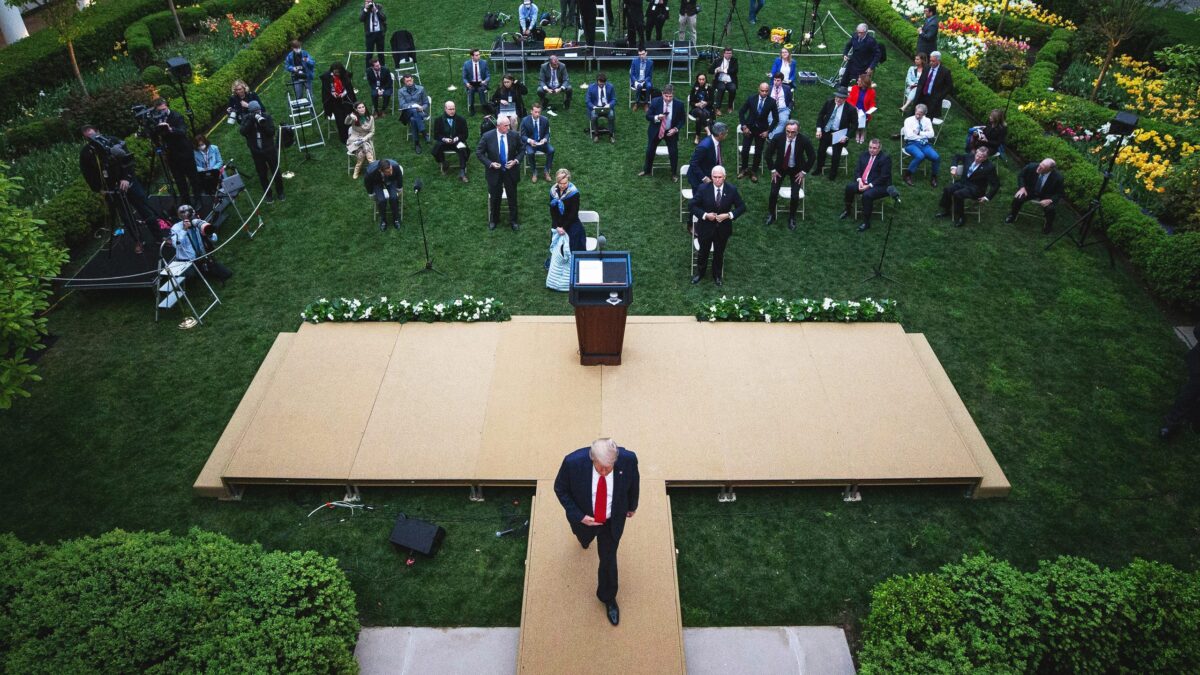
At a Rose Garden briefing on April 14, the president also called me a loudmouth and said I was “nothing but trouble” and a “showboat.” You can watch the full exchange here.
All this because he pointed to me, recognized me and took my question, only the first part of which I was able to get out:
“Mr. President, I’ve spoken to hundreds of people across the country in the last few weeks who say they still can’t get tested and that they aren’t social distancing because they saw you and your coronavirus team not practicing it while preaching it. What do you say to the millions who simply don’t believe you? Do you take any responsibility for those who may have gotten ill because of your actions?”
Okay, technically it’s two questions. But there it is. He couldn’t answer it. Instead, after several interruptions, he said, “If you keep talking, I’ll leave and you can have it out with the rest of these people.”
Maybe I should’ve just asked, “Why do you continue to lie to the American people, Mr. President?” I’ve asked that a couple of times. It always raises his ire.
To recap, in the recent past Trump has said he takes responsibility for nothing. Monday he said he has absolute authority. Tuesday he said it was all up to the governors. But he has never accepted responsibility for anything that has gone wrong as we’ve tried to battle the COVID-19 pandemic.
When I recently took an automobile trip across the United States it became increasingly apparent that what was being said in the White House bore little resemblance to what I saw on the road. And while I encountered plenty of people who still liked Trump, and I interviewed as many who loved him as hated him, every single one of those I interviewed believed our federal government had not been honest with us and had failed us—especially about testing. I also saw that many people I interviewed were not always engaged in social distancing. They blamed or credited the president for that.
Looking out at the 19 members of the media who were gathered, he smiled and acknowledged that he did like having fewer reporters questioning him.
Today it is a surreal exercise to be at the White House, no matter how the administration and to some extent the reporting pool have tried to normalize it. The beleaguered White House staff works on a two-week attendance rotation on and off campus. The press corps is reduced to a skeleton crew. The whole thing looks like something from a zombie apocalypse movie. Trump even addressed it in his presser Tuesday, saying he wants to get things back to normal so he doesn’t have to overhaul our nation’s ballparks. “You know, we’re not going to rip out every—every other seat in baseball stadiums and football stadiums,” he said. “We want to go back to where we were.”
Then, looking out at the 19 members of the media who were gathered, he smiled and acknowledged that he did like having fewer reporters questioning him.
It’s been a long, harrowing adventure in the past six weeks. Just a little more than a month ago, economic advisor Larry Kudlow promised us the virus was contained. He said so in a gaggle of maybe two dozen cameramen and reporters, including myself, packed closer than social distancing permits in the Brady Briefing Room. That came on the same day Kellyanne Conway said nearly the same thing and got testy with CBS’s Paula Reid when Reid asked her about the potential for widespread infection.
So I asked Kudlow Tuesday from six feet away in a short gaggle on the White House North Lawn driveway whether he regretted telling us the virus was contained. “No,” he said emphatically. His weakness, he said, was relying on facts, and the facts told him back then the virus was contained.
I just shook my head.
Then I walked upstairs into the White House and met Kayleigh McEnany, the new press secretary, who was meeting with the vice president’s press secretary. McEnany was cordial, all smiles. The VP’s secretary, who once admonished me for asking if the uninsured could get tested for the coronavirus without cost—and who once urged members of the coronavirus task force to stand closer than social distancing permitted while on the briefing room stage—wanted to know why I was at the White House and who let me in. Then she asked if I was in the pool and if I would be present for the press briefing later that afternoon. Apparently having a court order that allows me to be in the White House means nothing to those who routinely ignore the law.
But let’s get back to the briefing. It was probably the most surreal thing I’ve seen in close to 35 years of attending White House news conferences.
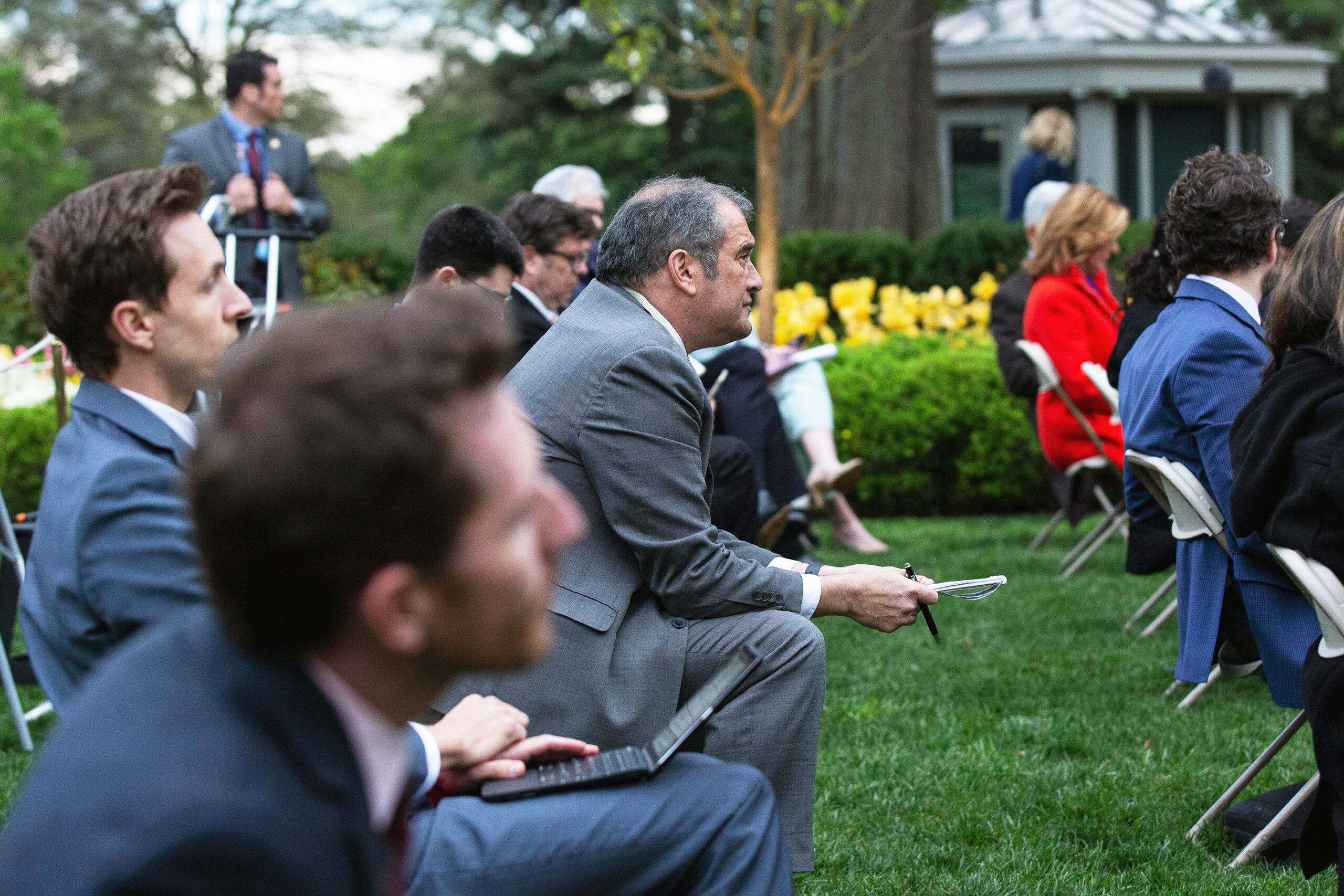
On an overcast, chilly afternoon 30 chairs were set out on the Rose Garden lawn. Eleven of them were for guests, which left 19 for the press. Reporters who had assigned seats and were also assigned Tuesday as their day for visiting the White House got first dibs. The seats left over went to News Max, OANN and another reporter I didn’t know. I got the final seat.
We all sat down, and then a press member who was in the pool arrived late, so we all had to stand up and wait as the White House staff and members of the White House Correspondents’ Association redistributed seat labels and assignments. It was a weird game of musical chairs that ended with all of us roughly where we began.
Then we waited. The briefing was originally called for five p.m., but at 5:21 Trump tweeted that it would instead begin at 5:45 p.m. We sat watching him inside the Oval Office as he paced back and forth, talking with his advisors. By six o’clock he still hadn’t showed up. Fox’s John Roberts mentioned we might have to bring out lights. We heard songbirds and the occasional siren and even a car alarm go off in the background as we waited. The clouds got thicker. Someone speculated it might rain.
Trump walked out at 6:14 p.m. and immediately blamed the pandemic’s seriousness on the World Health Organization. He said he was pulling funding from the WHO. Then for some reason he began reciting the names of American companies. “Maybe it’s a donors list,” I heard a photographer behind me mention with a chuckle.
He rambled on for a bit, tossed in a guest speaker, rambled some more and then opened it up for questions. He seemed to be spoiling for a fight from the get-go. I saw him earlier apparently wink at me and grin before he finally called on me.
Trump’s ensuing rage surprised no one, especially after I reminded him of the number of American COVID-19 cases (approximately 600,000) and the number of deaths (approximately 25,000). But threatening to leave his own press briefing if I didn’t shut up was unprecedented. I considered using the Tombstone line “Well…bye,” but I didn’t. Curly Bill didn’t do too well after that comment, as I remember. I considered probably a dozen other punch lines, but I decided to respect the office and said I was merely trying to ask him a question. Meanwhile my phone was exploding with people texting me with the sentiment “Oh dear God, please let him go.”
Trump may claim to have total authority, but in truth he loves to play the total victim.
We all know Trump loves the camera too much to exit until he’s ready—and he wasn’t ready. His threat to me was both curious and awkward. The president of the United States was playing victim to a reporter he knows from past exchanges is going to ask him a tough question and not back down even if the president tries to bully him. Suddenly I had the power to make him leave? Please. It’s part of the Trump plan. He has turned the daily briefings into mini Trump rallies, complete with a propaganda video in Monday’s episode. Demeaning the media is a recurring theme, as is blaming everyone else for his problems. Trump may claim to have total authority, but in truth he loves to play the total victim.
Some have suggested that reporters should modify their behavior to keep Donald Trump from getting angry. I firmly disagree. As Helen Thomas told me when I was younger, “Just ask the question.” We are not responsible for the reaction our question elicits; we are merely responsible for the questions we ask. Trump’s behavior is on him and no one else. He is petulant, angry and dismissive because that is who he is, not because he’s the victim of some rude reporter asking him pointed questions.
And to those reporters who are afraid of rocking the boat because they’ll lose access, I ask, “Access to what?”
At the end of the day, I walked into the sparse drizzle as I left the White House and had to arrange for someone to open the garage I’d parked in—as all D.C. garages close early these days.
I ran into a friend in the press corps who said it was a tough day for all of us. “Next time you should ask him something simple—like “What’s the airspeed velocity of an unladen swallow?”
I laughed, and we both said simultaneously, “He wouldn’t get it.”
But the country is getting it good. There still aren’t enough tests because of the president’s inaction. People are following his lead and not social distancing—pushing states and local governments to enact even more draconian measures to protect people from themselves. Trump is proving to be worse than the virus itself.
At the end of the day it all plays into his hands. Isolate, bully and scare the populace. Demons do such things. Despots rule in such a manner. Trump is both.