Your bag is empty.
From celebrity fashion staple to coronavirus essential
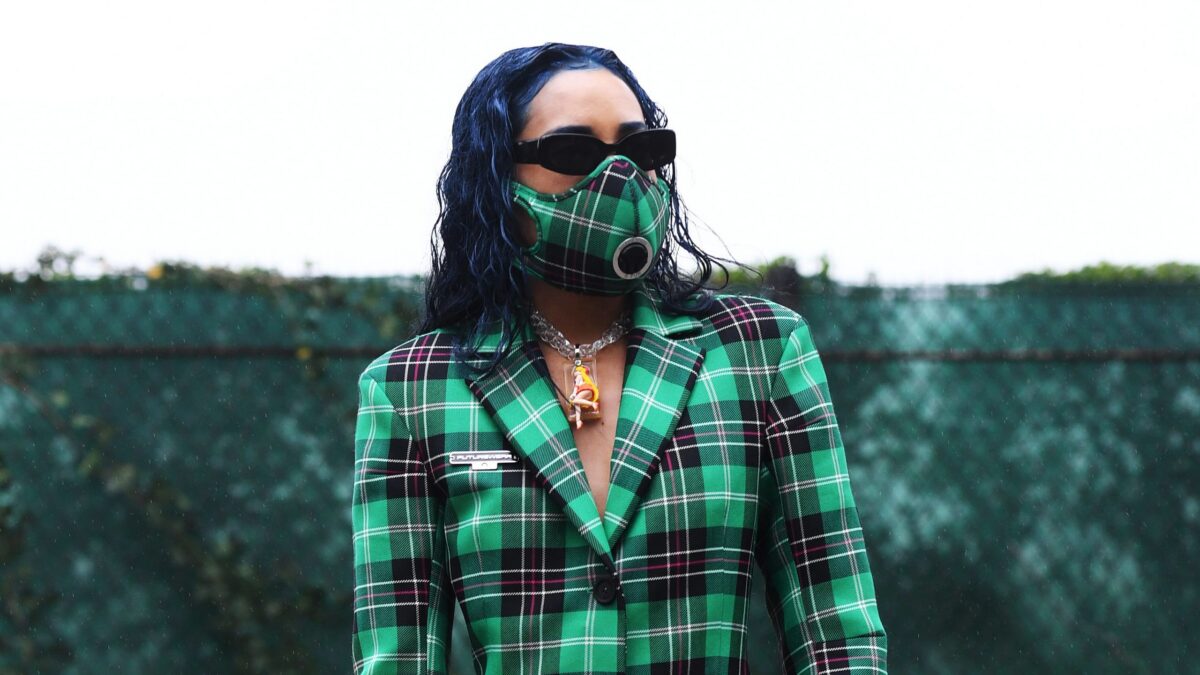
Two and a half months and 500 news cycles ago, five days after the first coronavirus case was confirmed in the United States, Billie Eilish wore a sheer Gucci face mask on the Grammys red carpet. Headlines praised the streetwear-inclined pop star’s “striking accessory.”
One month later, in late February, Gwyneth Paltrow, while traveling to Paris Fashion Week, posted a selfie in a black Swedish-design mask, her eyes pantomiming panic as if to say, “I am taking this seriously,” but also, “I am legitimately freaking out.” The Instagram caption reads, “En route to Paris. Paranoid? Prudent? Panicked? Placid? Pandemic? Propaganda? Paltrow’s just going to go ahead and sleep with this thing on the plane. I’ve already been in this movie” (referring to 2011’s Contagion, a pandemic-era talking point on Twitter).
That week, a photo of a man in a ripped surgical mask circulated throughout fashion reporting. It’s unclear whether his intended message—he was standing outside the Dior presentation in Paris—was political or stylish as the fashion world attempted to grasp the crisis unfolding in real time. Some shows were canceled; others handed out masks and offered hand sanitizer. Meanwhile, in Italy the number of coronavirus cases was just beginning to spike.
A few days later, medical-grade N95 masks were abruptly disappearing from retail shelves and online inventories as more cases rippled throughout the country and fear took hold. The consumer stockpiling left overrun hospitals ill-equipped, and the meaning of the mask transitioned from edgy statement to scoff-worthy overreaction to mandatory safety precaution and scarce commodity.
By the first week of April, the month we’re trudging through as I write this, the Centers for Disease Control and Prevention had recommended “cloth face coverings fashioned from household items or made at home from common materials…as an additional, voluntary public health measure.” (On Monday, the U.S. confirmed more than 580,000 coronavirus cases and 23,000 deaths.) Fashion brands of all ages, locations and sizes see an obligation to redirect production efforts into making and donating masks. The DIY designer works to maintain a business from the confines of quarantine, adapting to clients’ new priorities. The active Instagrammer feels the urge to document their chic safety accessory. The crying nurse pleads for more masks in a viral video.
The cloth face mask was first used by French surgeon Paul Berger in 1897, according to The Ulster Medical Journal. The Chinese imperial court introduced masks in 1910 to stop the spread of the pneumonic plague, inspiring mask usage during the 1918 Spanish flu pandemic. The presence of masks dwindled in America after World War I, but they continued to represent safety and communal responsibility in Chinese culture.
I am currently creating everything from my one-bedroom apartment only with the supplies I was able to gather from my studio before having to shelter at home.
After the 2002 SARS outbreak, many people in Asian societies began wearing masks to protect themselves and others from illness. Mask culture expanded in step with conversations around air quality and pollution in Asian cities. During China Fashion Week 2014, the Qiaodan Yin Peng Sportswear Collection featured smog masks. The same year, at Paris Fashion Week, Chinese designer Masha Ma’s show included futuristic crystal-embellished masks.
The look has been trickling into American fashion over the past few years, most prominently with hype brands such as Bape and Off-White. Hence Eilish’s pre-pandemic Gucci mask, Ariana Grande’s teardrop mask in 2019 (she also sold branded mask merchandise to promote her 2018 album Sweetener) and Future and his daughter’s matching Swarovski mouth covers at the 2017 BET awards.
One could argue that all fashion trends have evolved out of elevating the essentials: Brimmed hats protect against weather conditions; glasses help us see. Fashion is an industry and an art form based on making the practical exciting and unique. But for something dire to swiftly turn into a hot commodity is unsettling. Sending a bedazzled face mask down a 2021 runway could be a controversy-generating if not cancellable offense. How American to capitalize on a necessity, to raise the price of medication. Until everyone is properly protected, fashion masks will be an ethically iffy trend.
Amid a pandemic, the ways in which fashion brands—and all consumer companies, for that matter—can screw up their messaging are vast, and the stakes high. Panic has enveloped the industry with mass layoffs, store closings and slowed sales and production. According to a report from Business of Fashion and McKinsey & Company, fashion companies will see business fall by as much as 30 percent in 2020. Luxury sales are predicted to drop around 40 percent.
There have been practical and clumsy responses to this hit. Louis Vuitton and Chanel are making and donating masks to medical workers in need, while countless e-retailers are doubling down on work-from-home loungewear campaigns and sales as people quarantine to avoid spreading the virus. Much of this has to do, of course, with how much a company can afford to spend without return on investment. Chanel’s budget is larger than Anthropologie’s, for example.
Independent L.A.-based designer Mila Sullivan has been selling her avant patchwork clothing for about two years. She recently started sewing face masks from the few materials she has in lockdown. “I am currently creating everything from my one-bedroom apartment only with the supplies I was able to gather from my studio before having to shelter at home,” Sullivan tells Playboy. “I am actually not selling masks but distributing them for free to anyone in my community who needs them, as well as gifting them to friends, family and followers.”
Sullivan’s business is conducted mainly online, and she hasn’t experienced the drastic damage affecting traditional retailers and brands reliant on in-person sales. “Sales have actually been pretty good during the first few weeks of quarantine,” she says. “There’s been a lot of support around small independent businesses at the moment. I have been making a big effort to connect with people digitally. I recently hosted an interactive digital pop-up on my Instagram.”
Some struggling companies are seizing the opportunity that lies within the exploding mask market. They understand that a secret to a successful business is creating a must-have product, making your brand inextricable from your customers’ lives. Conveniently, the hottest must-have product has already been established and endorsed by the government.
Until everyone is masked and protected, fashion masks will be an ethically iffy trend.
Dov Charney, formerly of American Apparel, is producing cotton masks in a variety colors and patterns at his Los Angeles Apparel factory. A three-pack goes for $30 on the L.A. Apparel website. Denim label Citizens of Humanity is offering five assorted masks for $25. Reformation’s $25 face mask five-pack is currently out of stock. But these brands walk a thinning line: To treat masks as accessory rather than necessity is to cute-ify a crisis and obscure its severity.
Those working remotely are also looking for ways to enhance their newly homebound lifestyles, and people with steady incomes are in the market for cozy sweatpants. According to The Wall Street Journal, the number of sold-out tracksuits shot up 36 percent from the start of 2020 through March 16, compared with the same stretch in 2019. The count of out-of-stock sweatpants increased 39 percent, and the number of sold-out bathrobes rose 29 percent.
An emphasis on comfort and practicality could endure post-pandemic. And with fewer fresh offerings, as stores cancel spring-season orders and designers slow production and postpone resort lines, so could a sense of uniformity. Independent designers are the soul and spice of the American fashion industry, and many of them will lose a significant amount of business as retailers shut down and customers save their funds for essentials.
“Initially we thought we would be okay, because 95 percent of what we make is produced in New York in the garment district, so we had our spring orders completed. But now that’s all been shut down,” Carly Cushnie of Cushnie et Ochs told The New York Times.
“The biggest issue for us is retail. Stores were already having problems before the virus. Now they are canceling orders or reducing them, and lots of things are on sale. We have retailers who asked to return spring, but we had to say no. We paid for the fabrics, labor, warehouse, shipping. Then they wanted to return a portion of it, or pay later.”
Bargain-shopping culture and a post-pandemic recessionary market could turn fashion into a pay-to-play sphere where smaller brands are unable to survive. But there’s some hope in adapting to a direct-to-consumer model. People are making emotion-driven purchases—retail therapy, receiving gifts from the outside world, engaging in transactions for engagement’s sake—because it gives them some semblance of normalcy, a rush. Boutiques and designers, like Mila Sullivan, could thrive in an e-commerce environment as people seek out goods to fill the void—especially when those goods come with a mandatory accessory.