
Your bag is empty.

Neuroaesthetics sets out to understand what the human mind deems beautiful. Can we trust this new experimental field of science—and the corporations wielding it?

Imagine waking up in an apartment expertly curated by a voice-controlled intelligent personal assistant. Everything from the artwork on the walls to the cutlery in the kitchen has been selected based on what your brain perceives to be most beautiful. The lighting is custom designed. It soothes you by appealing to Homo sapiens’ earliest evolutionary memories: the tranquil hues of a savanna at sunrise. You are surrounded by verdant plants, of course, because humans find plants calming.
You walk into the bathroom and call up a playlist through a smart speaker that produces the crispest notes and zero white noise. The tunes excite you and prepare you for a productive day, and every time a new song plays, the reward center in your brain lights up. Your apartment’s smart speakers also tell you when to eat breakfast; your refrigerator is stocked with healthy meals that have been exquisitely plated and chemically hacked to derive the same response.
You scroll through a dating app that has already selected candidates based on the physical features a brain-imaging study determined you find most attractive.
Your virtual assistant records the space 24/7 to help you tweak your environment. It tells you when to reposition the chairs to increase the room’s feng shui. It tells you what you find interesting, what your brain finds beautiful, what is art.
Is this science fiction, or is life by design and hyperaesthetic curation a slightly exaggerated version of now? The term aesthetic, Greek in origin, entered the English language in the 1700s as philosophers grappled with how humans evaluate both beauty and art. As the field of psychology evolved, its tenets and the philosophical principles of aesthetics increasingly intertwined. When scientific understanding of the brain advanced—as when imaging technology allowed neuroscientists to observe brain activity—psychology and aesthetics were roiled. Suddenly, every human emotion had the potential to be triggered, mapped and recorded as data.
Neuroscience isn’t capable of perceiving the subjective meanings (or the universal meaning) in individual objects or works of art.
In 1999, neuroscientist Semir Zeki coined the term neuro-aesthetics, launching a new field of inquiry into the connections between science and art. In the information age, the study of neuro-aesthetics has boomed as academics apply what we know about the brain to centuries-old questions about how humans process beauty. Normally, the birth of a new academic discipline is cause for celebration—but some question the legitimacy of this nascent field.
“To suggest that the human brain responds in a particular way to art risks creating criteria of right or wrong,” wrote Philip Ball, a celebrated science journalist and longtime Nature editor, in 2013. Another critique comes from philosopher Alva Noë, who argued in a 2011 New York Times op-ed, “Neuroscience, which looks at events in the brains of individual people and can do no more than describe and analyze them, may just be the wrong kind of empirical science for understanding art.”
As the forefather of neuroaesthetics, Zeki hit back: “You will never have a complete theory of aesthetics unless you take account of the organ through which you have the aesthetic experience.”
Let’s take a step back and review the organ in question. We know that “our brains do not have a dedicated aesthetic or art module,” says neuroscientist Anjan Chatterjee, director of the Penn Center for Neuroaesthetics as well as ChatLab, which sets out to “explore beauty, language, cognition and the brain.” Rather, any aesthetic experience we have relies on a range of information collected by multiple senses.
A model developed by Chatterjee posits that the way we experience aesthetics is three-pronged: sensory, emotional and cognitive. When we see an object, the image of that object travels from our eyes to our brain’s occipital lobes. This is the sensory response. Our emotional response occurs in the limbic areas of the brain, where the pleasure or reward centers are located. The cognitive response occurs partly in our temporal lobe as we contextualize the object within our stores of memory and knowledge. Education, culture and language all have an impact on the way we perceive and evaluate any one object. These parts of the brain are some of the same structures that regulate our enjoyment of food and sex. And yet evolutionary theory can’t fully explain what we deem beautiful or why.

That brings us to what we don’t know about the brain. “The principles of mapping elemental and visual properties such as shape, color, movement and location onto their emotional tones have yet to be worked out,” Chatterjee writes in his book The Aesthetic Brain. Despite the ability of brain imaging to peer inside our heads and assign data points to our brain’s chemistry, “any kind of neuro-imaging study is very simplistic, really taking only one kind of task and acquiring some images of brain activity,” says Martin Skov, a researcher with the Danish Research Centre for Magnetic Resonance. “The depressing way that neuroscience works is that you can form a picture of what happens only if you have a lot of studies you can pull together.” In other words, neuroscience isn’t capable of perceiving the subjective meanings (or the universal meaning) in individual objects or works of art.
And yet, many neuroscientists like to say that beauty isn’t in the eye of the beholder; it’s in the brain. If you talk to them long enough, however, they’ll revise that statement. Indeed, every aesthetic experience we have is perceived with our entire body. “Your brain is not really for understanding art. The brain is for regulating metabolism and things that keep you alive,” Skov says.
In addition to the sensory, emotional and cognitive responses happening inside the brain, the current state of the body is also crucial. Is the body cold? Is it hungry? This information doesn’t show up on an fMRI.
“When you talk with people outside neuroscience, they can get quite annoyed that this is the criticism at the moment,” says Skov. A designer recently approached him, wanting to know what color to paint hospital rooms to ease patient recovery. As Skov relayed to the designer, “It’s not possible to predict on an individual basis how the individual person will respond to the same stimulus.” It isn’t sexy, but that’s the scientific reality.
That doesn’t mean we’ll never be able to predict which environments the human brain prefers. “Studies indicate that aesthetic qualities of architecture have an impact on our mood, cognitive functioning, behavior and even mental health,” states “Buildings, Beauty, and the Brain: A Neuroscience of Architectural Experience,” a 2017 white paper co-authored by Chatterjee. A 2015 study found that open rooms and rooms with higher ceilings are more likely to be judged as beautiful. A different study suggests that curvilinear spaces encourage cooperation among people. Another one investigated the ability of some buildings to induce a meditative or contemplative effect. These studies are based on subjects viewing 2D images. Neuroscientists suggest that the study of 3D spaces will require even more refined scientific methods to filter out irrelevant factors.

You might think neuroaesthetics would avoid the tendency of new sciences to breach the popular culture as fact, but it’s already happening. You may have heard that potted plants make apartment residents happier. This is part of the “biophilia hypothesis,” and it’s just that—a hypothesis. A 2011 paper co-authored by Chatterjee discusses “the hold that neuroscience has on the public imagination.” Much as the wellness industry now slaps such buzzwords as green, organic and sustainable on products, marketers have taken the prefix neuro and run with it. Think of the Neuro line of energy drinks (one flavor, Bliss, promises its “neural-focused nutrients” will reduce stress) or software programs for patients with dementia. “Brain-fitness programs are examples of products designed with plausible scientific rationales,” the paper states. “However, in these cases, commerce has moved ahead of the science. The marketing of these products often exaggerates or misrepresents the science motivating their production.”
It’s not only marketers who are gathering inspiration from the burgeoning field of neuroaesthetics; members of the traditional humanities have also played with its underlying principles. Ani Liu is an “experimental artist” and winner of this year’s Princeton Arts Fellowship. Her work “examines the reciprocal relationships between science, technology and their influence on human subjectivity, culture and identity.” This includes projects such as Affective Induction Spa: Experiments in Programmed Emotions, in which an art collective from the Massachusetts Institute of Technology “used findings from science to induce emotional experiences of pleasure and happiness” in visitors at the Museum of Fine Arts in Boston. Some were given a bone-conduction sound massage, while others were tickled with feathers by students in lab coats.
Liu is open about the purely representative nature of this “experiment”; it’s primarily meant to spur conversation about the possibilities of the field. “I think the placebo effect in and of itself was the most informative one. As soon as you sit down and we tell you this is scientific-induced happiness, you’re already in a really happy mood,” she says.
By comparison, Booker Prize–winning novelist A.S. Byatt was criticized for a 2006 piece in The Times Literary Supplement detailing her neuro-reading of John Donne’s poetry. Chris Power, a literary critic at The Guardian, disparaged Byatt’s theory that “Donne’s poems are so easy to memorize because of his unusual way with syntax,” which appeals to readers on a neural level. This “seems like the next ride in cultural theory’s funfair of scientific misappropriation,” Power wrote. Philosopher, poet and cultural critic Raymond Tallis was more blunt: “I find it impossible to make neuroscientific sense of this.”
I don’t think we can predict that people will use this kind of information in a completely ethical way.

At the 2019 Milan Furniture Fair, Google and architect Suchi Reddy created an installation that examined visitors’ experiences of built environments. According to a report in Fast Company, visitors wore bands with sensors that measured their biological responses to various room designs. Using an algorithm developed with Johns Hopkins University’s Arts + Mind Lab (“a research-to-practice initiative for accelerating the field of neuroaesthetics”) to graphically render biometric data such as heart rate and skin temperature, the creators were able to present participants with colorful postcards indicating which parts of the structure they found most appealing. But the technology around this is no more precise than photographs purporting to capture your aura.
Google’s interest in neuroaesthetics raises ethical questions about the field’s future applications being wielded by technology giants that traffic in data. The concerns are rooted in the rise of brain branding, or the use of neuroscience and neuroscientific data to design and sell products—a sort of commercialized hacking of the brain.
“I don’t even like the word neuroaesthetics; I prefer the phrase cognitive neuroscience of aesthetics, because it has turned into this brand for just selling stuff that seems to be scientific but is really pseudoscientific,” says psychologist Marcos Nadal. “It’s generally used to give a scientific gloss to any statement that anybody cares to mention about nature, design, buildings or art.”
Of note, there are now “neuroaesthetics consultants.” I ask Nadal about the handouts from the installation in Milan. “I think it’s as harmful or harmless as giving people flawed psychological reports on their personality,” he says, or giving Myers-Briggs Type Indicator personality tests to MBA students, which more psychologists have of late declared useless.
In 2008, a company called Mindlab International tracked customers’ brain activity as they shopped at a T.J. Maxx store. According to Business of Fashion, the company found “significant increase in brain activity” when discounted designer labels were discovered among nonluxury brands. “Armed with this information, T.J. Maxx could design its store layout to maximise this ‘treasure hunt’ effect and attempt to trigger more moments of positive, purchase-inducing feelings,” the article concludes. A design-research collaboration called Acclair Art Valuation Service proposes to upend the art market by assigning a “neuro-value” to artwork as determined by a viewer’s brain response.
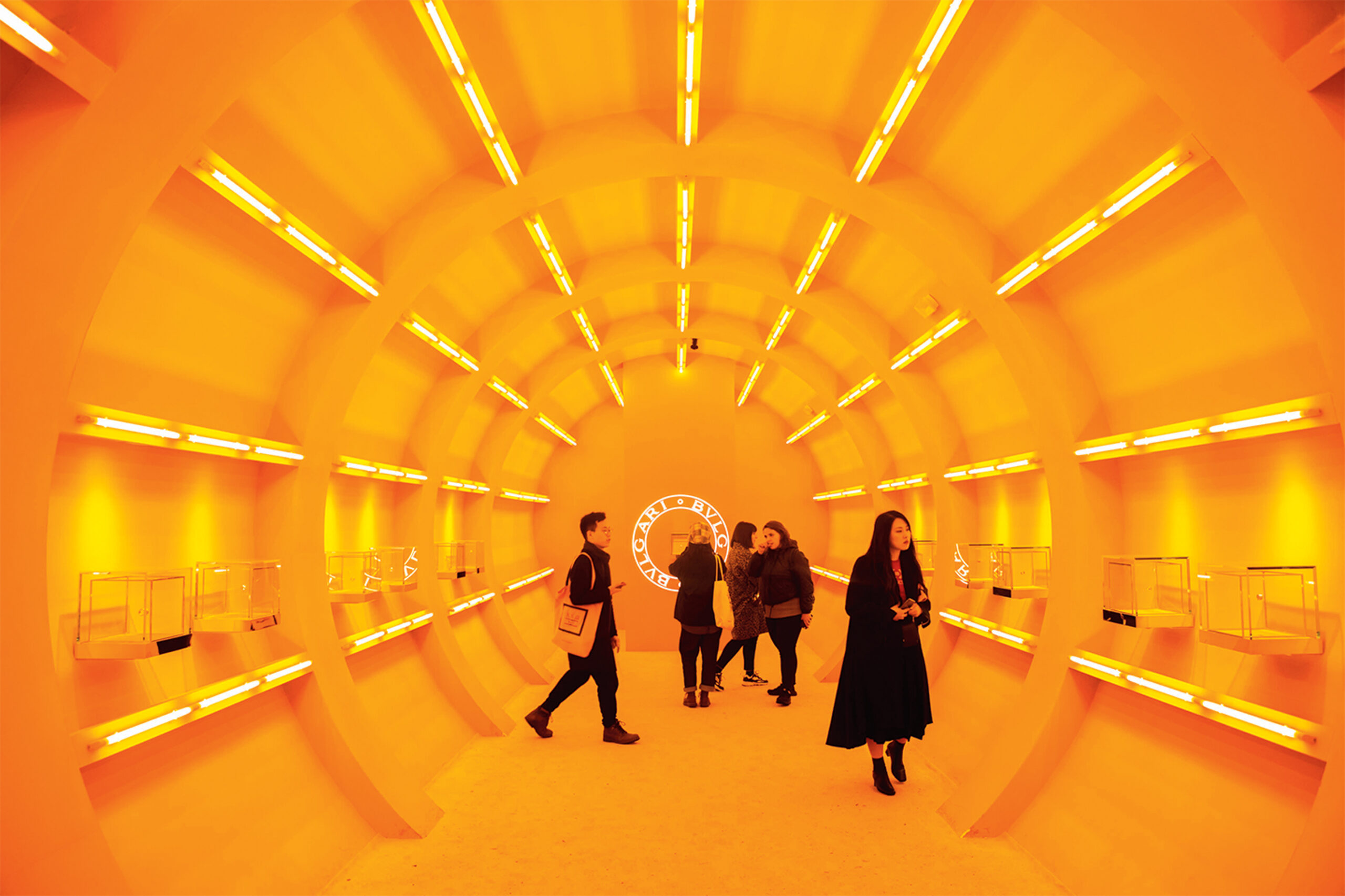
It’s not hard to foresee a scenario in which simply the promise of neuroaesthetic insight will be enough to get customers through the door. Companies can mine customers’ data while simultaneously marketing to them. The transition from baiting consumers with Insta-genic environments to running actual lab studies is so seamless as to be unnoticed by most people. We’re already primed to partake in these schemes as companies woo visitors to colorful pop-up “museums” or meditation retreats where every experience is sponsored by a wellness brand. Some already collect data—at Color Factory, visitors receive a QR-coded card that tracks the selfies they take in the environment—but they’re brands with a limited marketing agenda. Unlike Google, they don’t already hold the keys to our online identities. I asked each of the academics I interviewed this question: What would happen if companies used the allure of neuroaesthetics to learn more about customers than customers knew themselves?
“To my knowledge, nobody [in academia] is asking that,” Chatterjee says.
Adds Skov, “I don’t think we can predict that people will use this kind of information in a wholly, completely ethically sound way.”
*You wake up in an apartment that has been expertly curated by an intelligent personal assistant. Everything from the artwork on the walls to the cutlery in the kitchen has been selected by companies based on what they think your brain perceives to be most beautiful. You’ve been sold a life of pleasure.
Are you happy?*