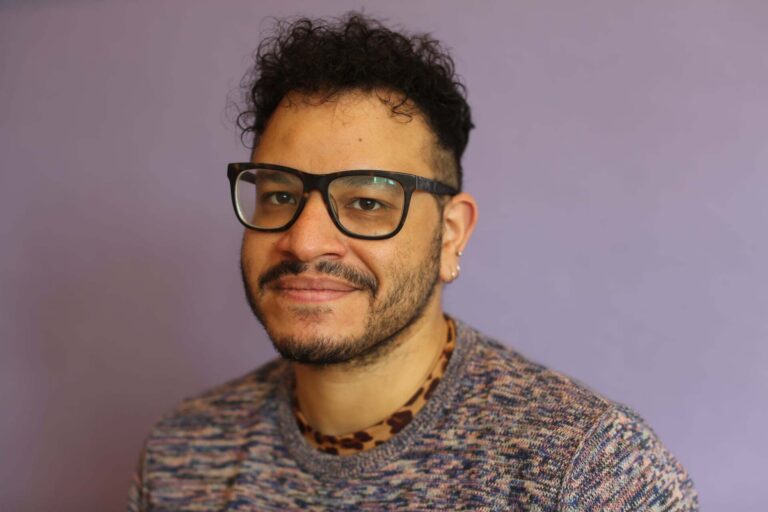
Few could have predicted that Santiago Campos’s speech at the 47th annual News Emmys would go viral. It’s not a high-profile event or appointment television. But the power of the high school senior’s words broke through the internet noise.
From the moment he heard that he had been awarded the Mike Wallace memorial scholarship, he knew he would use the opportunity to speak out against the direction at CBS News — the organization that funded his awards — and, more largely, the influence of money in journalism.
“I didn’t even think twice about it, to say something about that and to not be complicit,” the 18-year-old journalist, who has yet to graduate high school, told Playboy in an interview. “I needed to say the quiet part out loud and not be complicit in the same systems that got us here.”
CBS News has gotten some high-profile criticism since the takeover by Bari Weiss, especially after Weiss pulled a planned 60 Minutes story about allegations of abuse at an El Salvador detention center housing migrants deported by Trump. She said the segment couldn’t run without on-air comment from a senior official within the president’s administration. Following that news, Weiss and CBS endured many public blows against their journalism, including Nikki Glaser labelling it “See BS News” at the Golden Globes in January.
But Campos’s words were different. As an 18-year-old journalist, he told a room of career reporters words that he thought the profession needed to hear.
“I want to also acknowledge how the recent direction of the outlet stains the legacy of Mike Wallace, the namesake of this scholarship,” Campos said. Wallace was a well-respected American broadcaster and one of the original 60 Minutes correspondents. “As corporate elites take hold over the very pipes through which our information flows, journalism that serves the people becomes increasingly harder to come by, yet ever more crucial. And what the people want is the truth.”
He continued, “So if at any time you hesitate to utter the word ‘genocide’, or remain silent in the face of blatant lies, remember to ask yourself: ‘Who is this for?’ I hope you choose us.”
Later, in an Instagram post, Campos reflected on his viral speech and why he delivered it.
“My remarks aimed to shine light on the biggest threat to the news industry today: the influence of capital and power,” he wrote. “I believe in a media landscape that serves the masses, not the elites.”
Here, Campos reflects why he thinks his message resonated with people, how the Emmys supported him as he wrote his speech and his take on how we restore faith in the media. (Hint: it’s less corporate money.)
When did you first become interested in pursuing journalism?
I had always been interested in video production. In ninth grade, I took an intro to video class. I kept with it the next year, I went on to our advanced class where we do a high school TV production, a weekly news show. And that’s where I started getting more journalism, specific video production stuff. I did a few stories.
In 11th grade, I did a piece for PBS News Hour. That was my first dive into a political issue. I reported on my family’s history with deportations. My great grandmother was an undocumented migrant who came to the U.S. and her children were U.S. born. But together, they were all deported at least once in the 50s, during an immigration crackdown during that era. And so I told a story of U.S. immigration policy over the course of generations. I spoke to my grandpa, my father, and then a little bit just reflecting on the situation that we’re in now in my generation.
What got you interested in wanting to tell that type of family history?
Obviously it’s personal. I have always been generally tapped into politics. I had gotten more interested throughout high school. And with the direction things were going, I wanted to make some sort of contribution and tell a story that might be insightful for predicting what would happen under the Trump administration — because I started the story before he was elected in November — looking into the deportation of citizens and how immigration policy can affect beyond just the undocumented and it can really affect everyone, directly or indirectly.
When you first got word that you would receive the Mike Wallace award and have to be present on stage and give a speech, how long before you knew that you might want to say something about the current direction of CBS news?
The Mike Wallace scholarship is just one scholarship that I applied to among plenty of scholarships, just trying to fund my education. I wasn’t entirely familiar with what the scholarship was. I just knew it was $10,000 and it was journalism-related. So I thought I had the best shot at that.
It wasn’t until they had told me that I had won, until I started looking more into it, started researching who Mike Wallace was — because I didn’t know who he was before — started getting to know the scholarship a little bit more, and found out it was funded by CBS news. I had already known about the merger and its acquisition under [David] Ellison and Bari Weiss.
Immediately I knew that I needed to, it was my responsibility. I didn’t even think twice about it, to say something about that and to not be complicit. I needed to say the quiet part out loud and not be complicit in the same systems that got us here.
You said that you didn’t hesitate. Was there any time between when you were told you won and when you were on stage that you started to have reservations?
I was still going to criticize CBS, but that was not, um, the initial iteration of my speech. It was pretty different before. But the Academy gave me feedback. They wanted to make sure I knew who was going to be in the room, that it wasn’t going to be corporate executives and managers.
It’d be more the people that are on the ground doing the work producing stories. So I did change my speech a little bit, but I am happy how it turned out.
So you shared a version of the speech with the Academy before giving it?
Yeah. They had access to it the whole time. It was not necessarily like, “We’re going to monitor the way you’re writing.” They just need to have it ready for the teleprompter as soon as possible.
They were really supportive and there was not much friction with getting it through. I heard that there were internal discussions and they were just like, “Yeah, we let the scholarship winners say whatever they want to say. We don’t edit the speech.” It’s a first amendment thing.
Can you bring me back to the moment when you’re on stage and you’re about to deliver the speech that you’ve written? What’s going through your head as you see the teleprompter and the moment is about to happen?
I’m just thinking, “That’s a lot of people.” I wasn’t necessarily nervous about what I was going to say. I was just nervous about giving a speech in front of a lot of people, no matter what I would have said. I was trying to mentally prepare myself for the setting I was in. It was kind of white noise in my head for a little bit until I started going and people started giving me a good reception.
What happened after you got off stage?
I got escorted by [60 Minutes correspondent Scott] Pelley, who introduced me. We spoke a little bit. He was really supportive of what I had to say. We took a picture together. Everyone from the Emmys starts coming up to me saying they really enjoyed my speech. I didn’t see this myself, but someone told me Al Jazeera had given me a standing ovation. It just resonated with everyone at the Emmys. Everyone was just coming up to me and saying congratulations.
I think it resonated with a really large audience, too. I’m sure you felt that in the last 36 hours.
Yeah, my phone has been blowing up since I’ve given that speech.
What does it feel like to go viral for something that has engendered such a positive reaction?
It’s just surreal that it was me, I guess. I never expected myself to go viral. I never thought I would be the name in the headlines, I thought I would be the one writing them.
What do you think it is about the message or the sentiment that spoke to people?
People are fed up. They look at media and media people and they see that they’re not saying the quiet part out loud. A lot of them are afraid to speak out at the risk of losing their jobs. They’re afraid of the corporate power and the power of governments over their livelihood and their jobs. People have very little faith in the media right now. I think I gave a little bit of hope and I think I said what people were thinking which is not something that a lot of people in the room had done that night.
How do you think we restore faith in the media?
The core of my message is getting corporate influence and political power out of our media and out of our journalism, which starts with the people putting pressure on journalists, on corporations, and that starts also with people doing the work. They need to step up to the plate, recognize the situation that they’re in, and fight back every day against the corporate media or the corporate influence and the power that’s being used against them. And they need to resist that by all means possible in their work.
It was ironic that yesterday, as your footage was going viral, that CBS news announced that it would fire two correspondents and the executive producer of 60 Minutes. What were your initial thoughts when you saw that breaking as your story was also making the rounds?
I mean, I thought it tracked. It’s a big irony and it just further shows that we need to take action now before it’s too late.
Speaking journalist to journalist, I’m wondering if you have any reticence at all about entering the journalism profession, given the turmoil that is happening, the instability. Does that worry you at all?
I think for a lot of people, it can be a turn off. I didn’t think I was going to do journalism until like two years ago. It wasn’t really about job prospects or about a salary. It was more — this is what I have developed a passion for. And this is what I think I can do to contribute to the world, make it a better place. And I think that that’s a sentiment that’s shared across much of the youth that are going into journalism now. I think it’s less about fame, less about money, more about just doing the right thing.
This interview has been edited for length and clarity.
Mathew Rodriguez is an award-winning Puerto Rican writer based in Brooklyn. He has been a senior editor at The Atlantic and Them. His memoir, Tough Guy, is forthcoming from Abrams Books and his writing has appeared in The Nation, The Intercept, SELF, Teen Vogue and The Daily Beast.
More From Playboy
Sex & Relationships
Playboy Undercover: Diary of a Simp "I’m a simp. And that’s sort of a statement of fact, like 'I’m a nerd' or 'I have a very mild benzo problem.'”