Your bag is empty.
What happened when Playboy went to the "Coachella of UFO conferences."

“My name is Dan, and I’m a UFO addict,” podcaster Dan Cleary tells a packed ballroom from an electric blue stage, the tattooed wings of an owl creeping around the front of his head. “Anybody else?” Much of the few hundred strong crowd on Friday, May 29, whoop and clap. “This is ‘Weaponized,’” says Cleary, playing the hype man as he announces the beginning of a live podcast recording.
To Cleary’s right sits the campaigning ufologist and filmmaker Jeremy Corbell, wearing a camouflage cap and a t-shirt depicting a Cuban boxer. Veteran UFO journalist George Knapp is seated to his left, his floppy grey hair pushed backwards. On an art installation behind them, a spiralized galaxy twists itself into a wormhole. An astronaut kneels in a field. A Mayan temple stands resplendent.
“I suspect that there’s a technologically advanced civilization that has been in contact with humanity since the beginning of recorded human history,” alleges Corbell, overly enunciating each syllable as if he is speaking to primary school students. “And our government absolutely fucking knows about this.”
Evidence of ET contact “is being held back from you,” Corbell proclaims, “and it’s bullshit.”
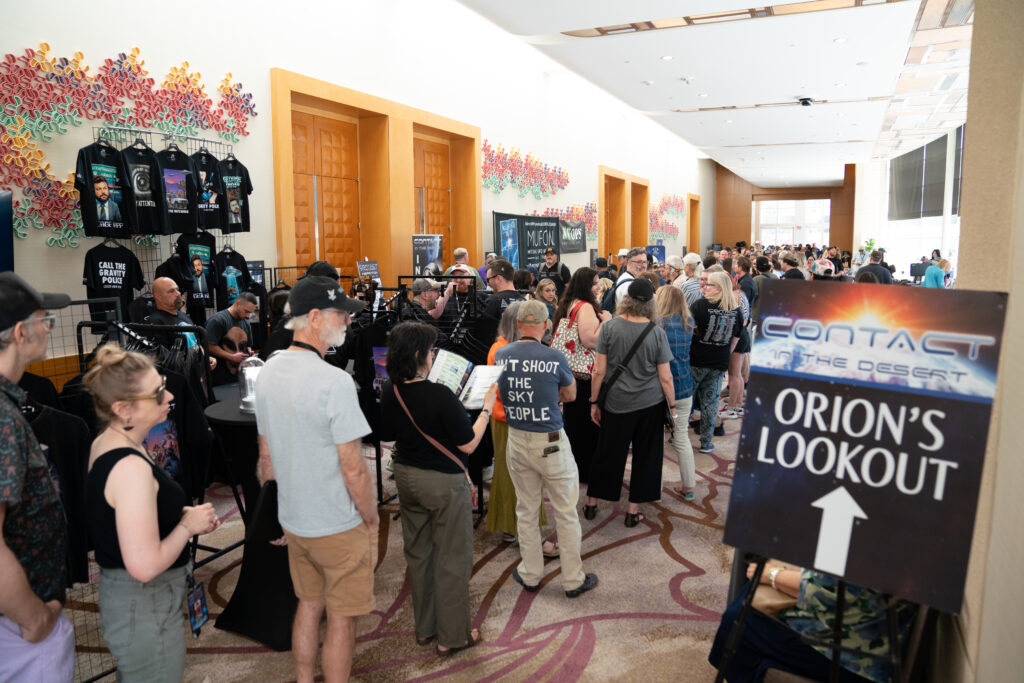
Welcome to Contact in the Desert in Indian Wells, California, the crown jewel of the flying saucer conference circuit. Also known as the Coachella of UFO conferences, since it takes place at the four-star Renaissance Esmerelda hotel that houses many of the artists and crew at Coachella, a record 3,000 people have each paid at least $500 to attend the event, with many paying far more to access the panoply of paid workshops and events. VIP queue-jump tickets go for $1,316. Brushing shoulders with so many believers, and some self-professed alien hybrids, the boundaries between science and faith — and evidence and belief — become increasingly difficult to distinguish.
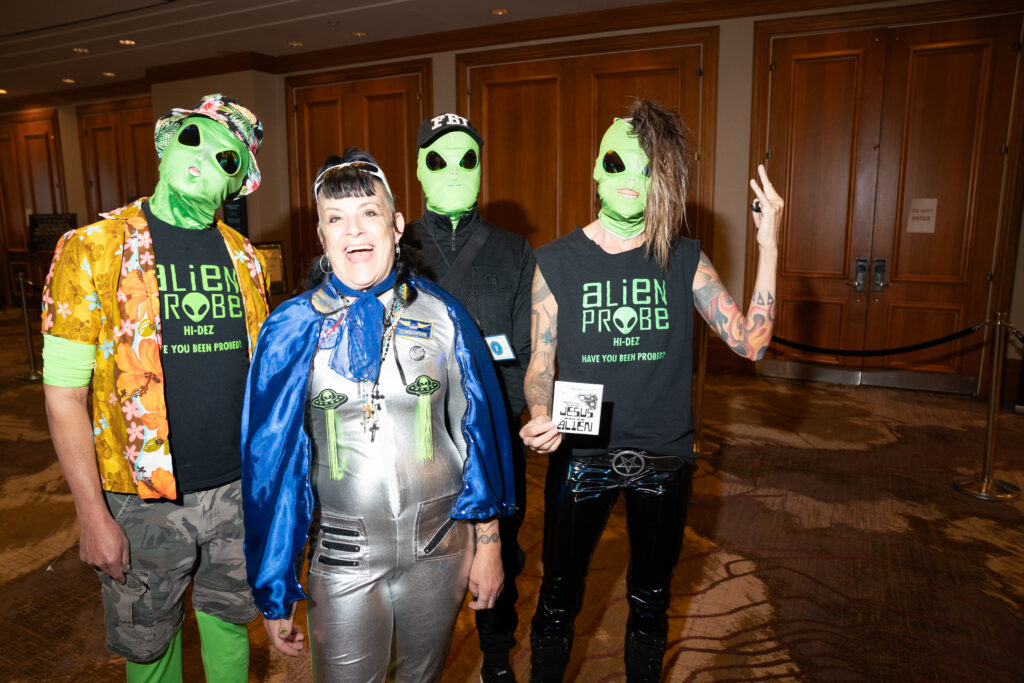
But despite the woo-woo whackiness, the long-maligned movement is at an all-time high-water mark, almost 80 years after reports that a “flying disc” had crashed near Roswell. Last month, the Trump Administration began releasing classified files held on suspected UFOs — a major step for the disclosure movement (disclosure generally means to reveal previously unknown information, but for this crowd it refers broadly to the governmental confirmation of extraterrestrial contact), even if none of the new evidence comes close to proving alien life.
At the Coachella of UFO conferences, church for the quasi-religion of UFO belief, the feeling that their cause could be on the verge of going mainstream is palpable. But if the expensive desert weekend is akin to church for this group of believers, it’s not necessarily the aliens they’re worshiping. The men on stage for that live podcast taping are somewhat of a holy trinity, and Corbell is in the top spot.
As someone who remains open-minded but is so far unconvinced that the U.S. government is in possession of recovered alien spaceships, I found myself in the unusual position of being one of the few people in the room who hadn’t already settled on an answer. Most attendees had. What they were principally there for was to see Corbell and their other heroes up close and personal, and to pay homage — quite literally, through buying t-shirts bearing their faces.
Corbell, a stocky jiu-jitsu black-belt, is unquestionably the star of the conference. He views the battle for disclosure very much as a fight and has been instrumental in brokering a number of whistleblower testimonies and the release of videos pertaining to alleged UFOs. For him, Contact in the Desert is about mobilizing the masses yet further to demand full disclosure of government files on suspected extraterrestrial life.
In 2023, former Pentagon official David Grusch claimed — without providing evidence — that his understanding was that recovered alien spacecrafts exist in a sworn congressional testimony with Corbell and Knapp sitting right behind him. In 2019, Corbell teamed up with Bob Lazar, a physicist who purports to have reverse engineered alien spacecraft, to direct the hit documentary Bob Lazar: Area 51 & Flying Saucers, which premiered on Netflix. Their subsequent episode on the “Joe Rogan Experience” accrued 66 million views on YouTube and sparked the “Storm Area 51” phenomenon.
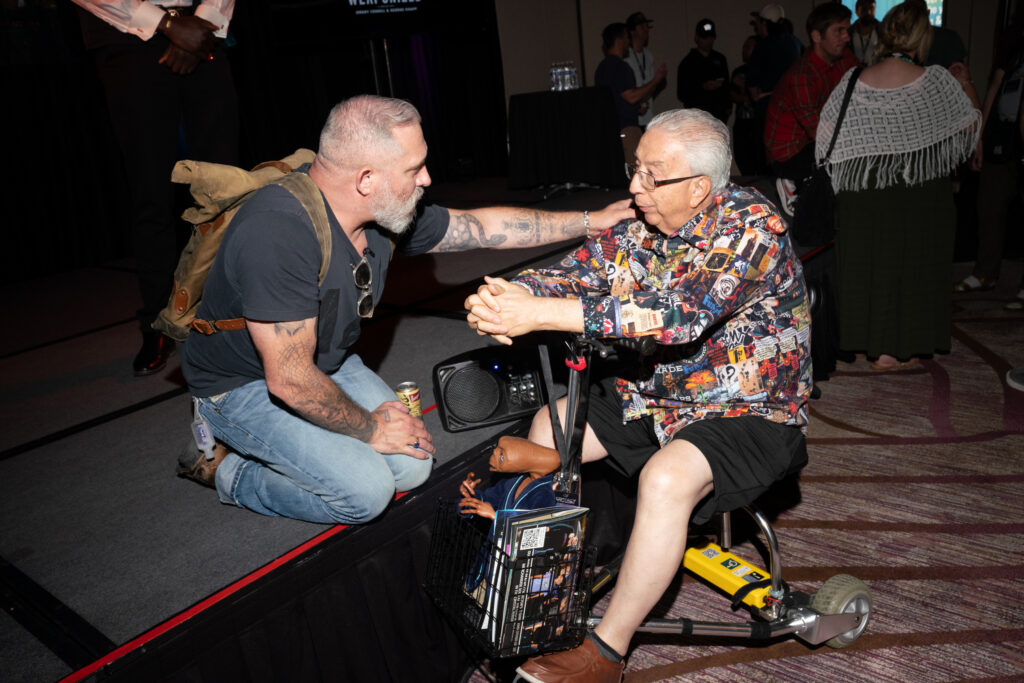
“We never asked Daddy to hold back the truth about the nature of reality,” Corbell says on-stage to rapturous applause, making up for his decided lack of evidential appraisal with bombast. By now Navy chief Alex Wiggins, who told Congress in September that he had witnessed a self-luminous tic-tac shaped UFO emerge smoothly from the ocean while working on USS Jackson, is also on the stage. They are mobbed by fans at the end.
I approach Corbell and inform him I am a journalist covering the event. “Hey, credentials motherfucker, show me something,” he barks, pointing in my face. I nervously show my ID. Corbell takes a cursory glance and continues issuing orders for his exit to his entourage, which includes a security guard. I ask to come along for the ride and to my surprise, Corbell says I’m in. We’re going to take a backstage route to avoid being swarmed by superfans.
“I got ambushed by a Playboy reporter who hopefully doesn’t do a bullshit disingenuous thing,” Corbell, a 49-year-old raised in Santa Monica, California, tells his friends loudly as we walk down a kitchen corridor that has an unpleasant odour of coffee and oily food. I laugh anxiously. “I ain’t joking, you’re going to have a huge missed opportunity,” he says.
Corbell’s volatile vibe vacillates between outright abrasiveness and extreme earnestness, and he swiftly begins calling me “my brother.” We step into the scorching 96-degree heat outside and now all I can smell is Corbell’s musky, vetiver-heavy cologne, beneath the slightly more pungent aroma of cannabis from what I presume to be a nearby joint. The burly security guard walks ahead of us, preventing a potential cascade of attention.
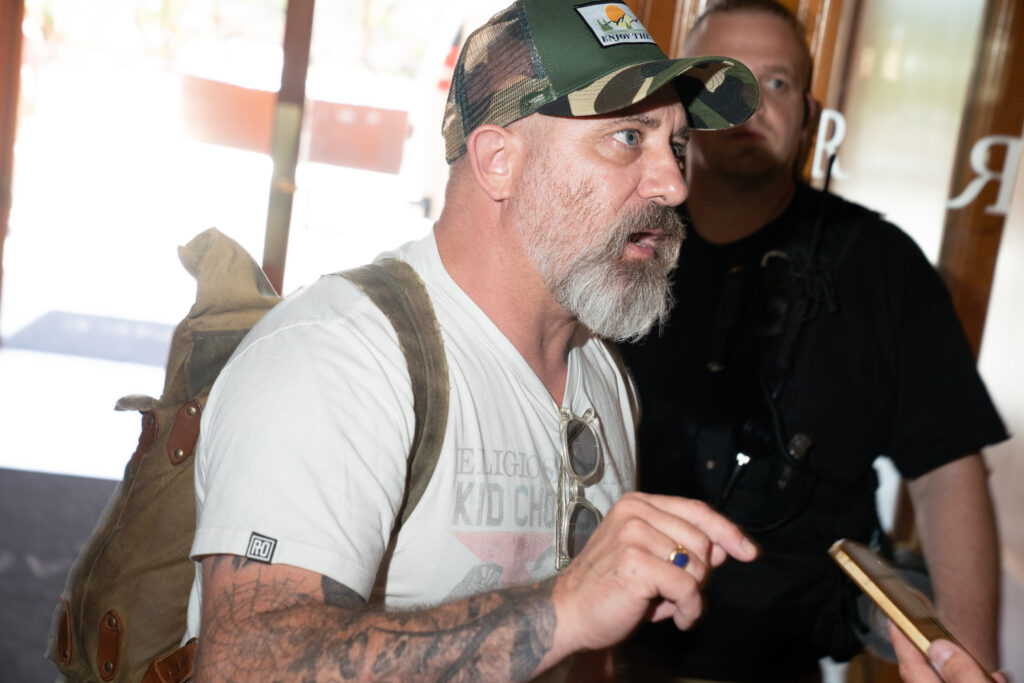
“You should be asking for the evidence of what [Grusch] said,” Corbell tells me. A female acquaintance passes us. “Hi darling,” Corbell says, before continuing: “Which is non-human intelligence craft being reverse engineered by the United States government. If that’s true, and there’s been contact, and we have bodies, show me the fucking autopsies.”
I mention that Corbell is treated like a celebrity in the UFO scene. “You don’t know me,” he retorts. “Look man, I’m like everybody else here. I just want to know the truth. What happened was I kept some dude’s secrets [who was] in the Navy, Commander Fravor in particular [who testified in 2021 about seeing a “tic-tac looking object”], and that told people that I can keep secrets. So people started telling me the secrets.”
Then the property developer turned UFO cause célèbre changes tack and pleads for favorable coverage just before we part ways: “I hope you are a good human,” he says.
If that’s true, and there’s been contact, and we have bodies, show me the fucking autopsies.
The rugged rogue Corbell’s most fervent fans clearly skew female — one retired schoolteacher tells me she “fell in love” with him after watching his new documentary, Sleeping Dog — even though Contact in the Desert is male-dominated. Think pension-aged Florida men in Hawaiian shirts with overhanging grey moustaches and knee braces. And there’s no end of nerdy guys dressed like call center workers, plus the odd LA hipster. I also meet a barefoot sovereign citizen and flat-earther who squeezes drops of the bitter pine needle tincture he is hawking onto the tongues of willing passersby. He has renounced his right to vote, but the conference offers Republicans and Democrats a rare moment of commonality: united in their belief that there could be something out there beyond God, and that not all UFO sightings are fabricated by the U.S. military as a psyop to distract from classified projects. (It also appears clear intelligence agencies are managing the drip-feed of disclosure as whistleblowers often refuse to discuss certain aspects.)
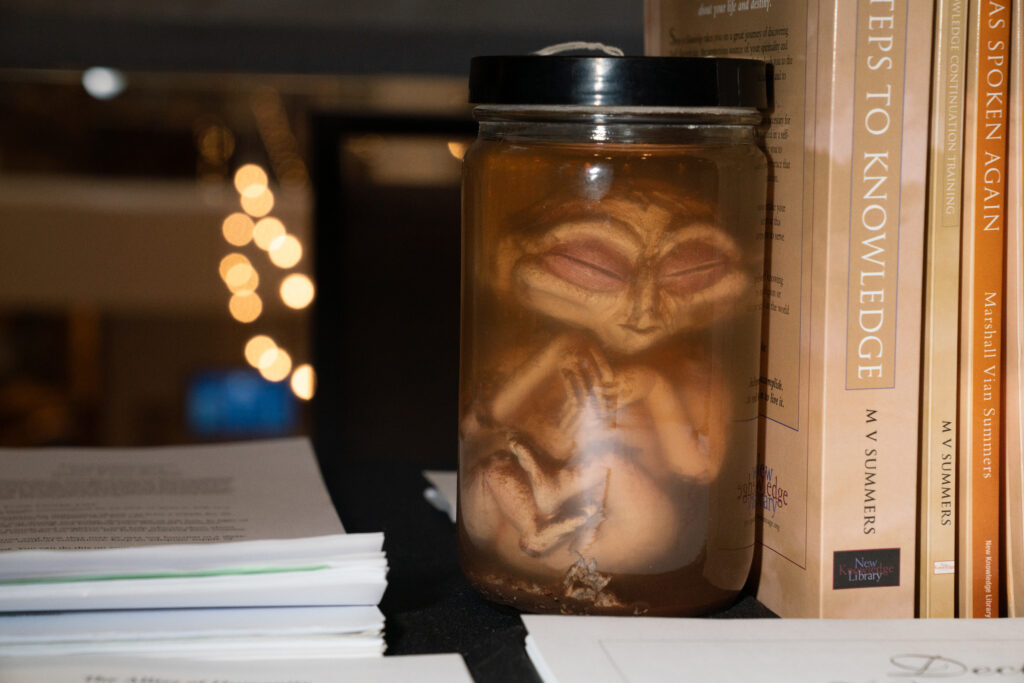
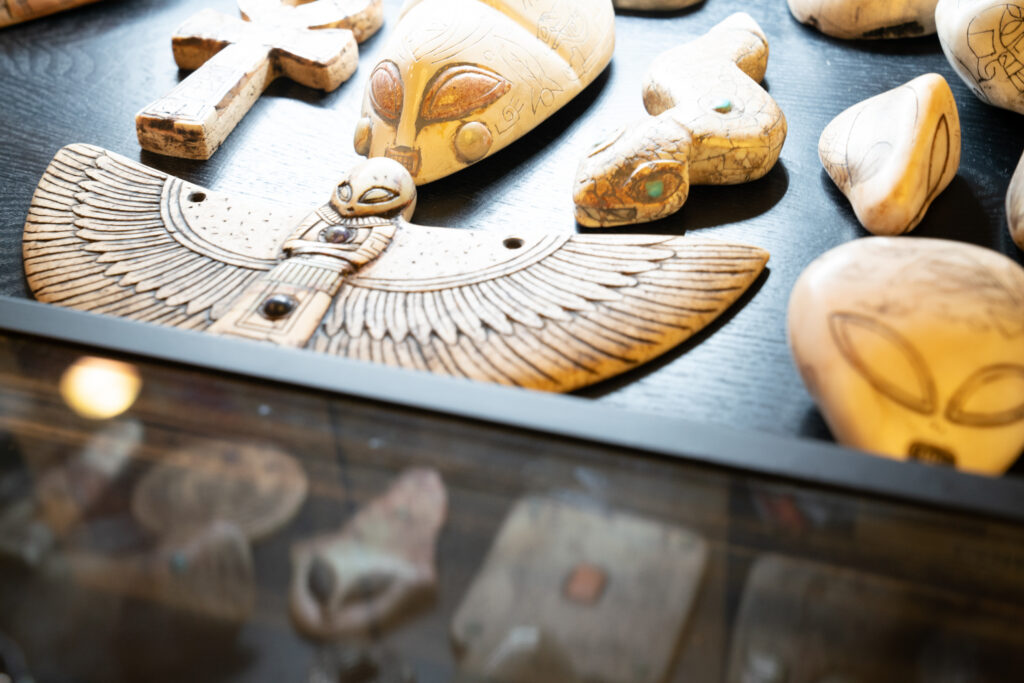
I may not be likely to purchase a crystal skull of dubious origin for $10,000 in the conference exhibition area for my mantelpiece, but I am quite open to the possibility that anthropomorphism and rational materialism clouds our collective vision, and that a little-understood form of higher intelligence could perhaps be seeking to make contact with us. So, after my encounter with Corbell, I join around 120 conference attendees travelling west on two coaches to the edge of Santa Rosa national park for a skywatch excursion under the stars with the promise that we will uncover some of the desert night sky’s mysteries. “I can’t wait to be abducted,” somebody jokes as we step off the bus.
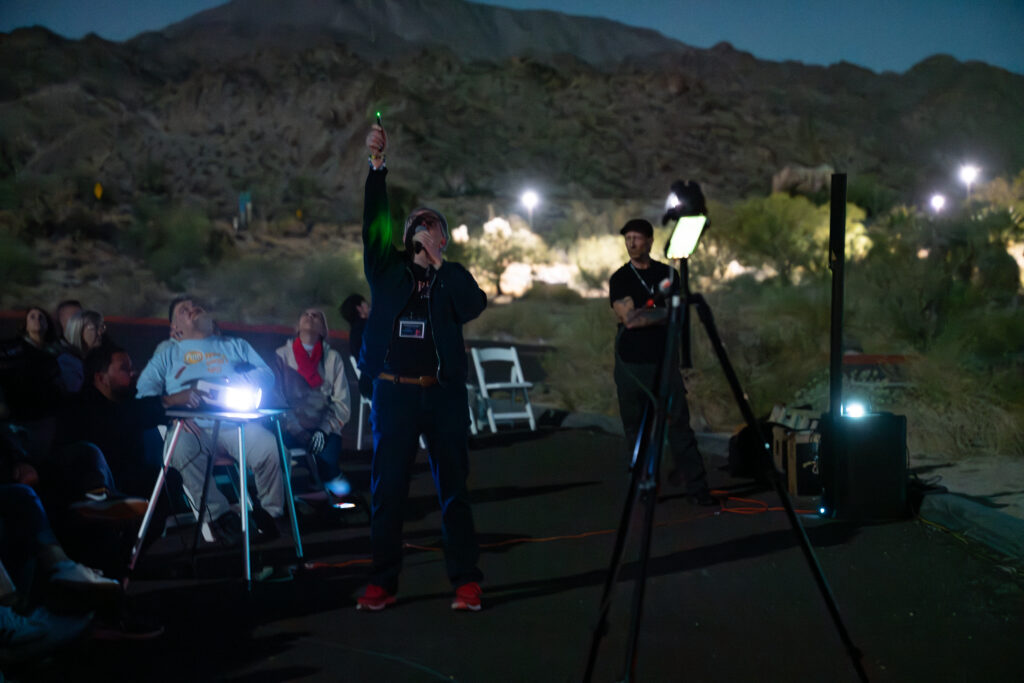
The excursion seemingly promised a break from the fan frenzy of the morning, a chance to connect with the intended celebrities of this conference: the aliens. It was a promise swiftly broken. At a dusty trailhead facing the granite San Jacinto mountains, our guides Ben Hansen, the host of “UFO Witness” on Discovery Plus, and astronomer Marc D’Antonio, take an excruciatingly long time to project onto a screen a display of the starlit sky from an iPhone 5 camera fitted with a night vision lens. Hansen uses the delay to purvey his final pair of $720 binoculars at the $80 per person sold out event, which must have brought in around $10,000. “If you’re interested, we can talk off to the side,” he says.
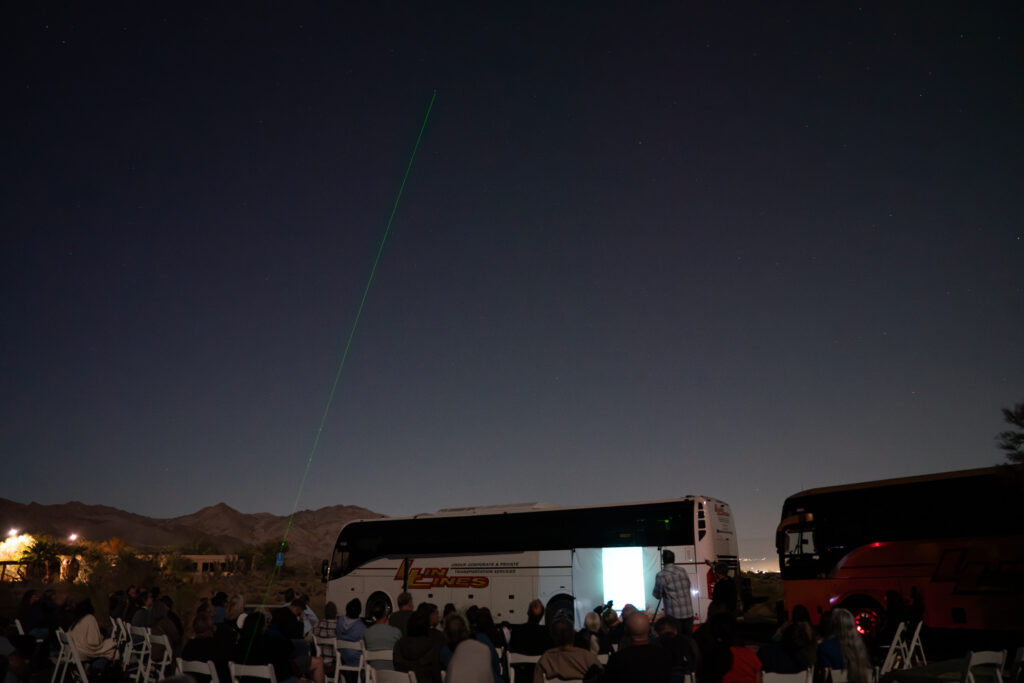
We hardly need to magnify our view of the sky. Festooned with stars and satellites, Venus and Jupiter can be seen in the distance in the luminous light of what is almost a full moon. We keep our eyes peeled searching for steady-moving unblinking lights. To their credit, our hosts are fairly circumspect and do not attempt to claim any of the many stars or rapidly-moving satellites are UFOs. “Sometimes nothing happens, and that’s okay, because it makes it that much more extraordinary when you have a sighting,” says Hansen, a regular contributor on NewsNation.
Uncomfortable in the chairs provided, I follow the lead of another stargazer and assume a prone position on the carpark asphalt. This is much better for my neck, but I soon fall asleep. About 15 minutes later, I’m told, the man sitting behind me nudges me on the shoulder and I stir. “You’re snoring,” he hisses with thinly-veiled annoyance.
The most compelling moment of the evening comes when the engine of one of the coaches suddenly fires up. Some of the group gasp in shock as if they automatically assumed an alien had seized control of the vehicle and put the key in the ignition. It turns out one of my fellow seekers went to the bus’ restroom and flushed the toilet. As we head back to Indian Wells, my abiding feeling is that the entire night has been a farcical anticlimax.
Corbell and Knapp’s workshop the next morning — The Voices They Tried to Silence — costs an additional $30 but the line stretches through the auditorium entrance and beyond. “This is the biggest conspiracy ever perpetrated on the American people,” one of Corbell’s foot soldiers, Peter Smith, a local film editor wearing all black, tells me.
I finally make it into the hall, though many are left disappointed outside. Rapper Greg Street’s catchy 2009 hit Good Day is playing loudly on the speakers, giving the event a carnivalesque feeling. But when it gets underway with a hero’s welcome from the crowd — and Corbell invites to the stage two UFO whistleblowing “superstars”, ex-US Air Force geospatial intelligence officer Dylan Borland and former national security official Matthew Brown — the mood turns darker.
Brown, who has a neatly trimmed beard and is wearing one of Corbell’s t-shirts, describes waking up one morning with his wife after blowing the whistle in 2023 on an alleged UFO crash retrieval program to find possessions in his home rearranged. “The only thing taken out of the house was my grandfather’s ashes,” he claims. Brown says he found the urn smashed in the street next to the garbage.
In September, Borland, a wiry man wearing a red plaid shirt and sharing the stage with Brown, emphasized what’s at risk for whistleblowers. He told Congress he endured a campaign of retaliation after making his complaint to the Intelligence Community Inspector General, and is now without work. “It’s been miserable,” he says. “But what we did needed to be done.” An audience member asks how she can help him get a job and he breaks into tears. “You really can’t trust anybody,” Borland says.
Corbell cracks open a can of Coor’s Banquet as soon as the panel concludes at midday. “I’ve met you before,” he tells me as I approach the stage, slapping me on the shoulder and demanding to know whether I’m writing a “smash” piece. “Yeah, we met yesterday,” I reply. “No, I met you before,” Corbell says. “You don’t remember?”
It takes Corbell about 10 minutes to greet all of the attendees who come to pay their respects. He signs posters with the phrase “UFOs ARE REAL.” Then we take off along the same route through the kitchens, leading his whistleblowers like a crusading disclosure prophet. They refuse to speak to me, saying they’d prefer to go through Corbell, appearing ill-at-ease with their new lives as UFO celebrities. That feeling may be justified. Once we reach our destination, Corbell tells me that he has moved homes twice because of direct threats to his life. “An intelligence agency sat down with me, my mom, and my wife,” he says, wagging his finger in my face aggressively. “They informed me of a credible and actionable threat to kill me and my family.”
So why doesn’t he give it a rest, even if the t-shirt sales (at least a few hundred over the weekend) would likely diminish? “It’s nobody’s right to keep away from human beings the fundamental nature of reality,” he says. “Ain’t gonna happen unless you push, fucker.” And push he and his friends are doing, Grusch and four members of Congress made a statement on Capitol Hill on June 9 urging the disclosure of more sensitive UFO files. “The plan is to hold accountable those in power and steal it from them,” Corbell says, “because nothing’s going to be given. We can’t be compliant with it anymore.”
But Corbell seems like the type of person who demands compliance with his every whim. To test the trustworthiness of a Rolling Stone reporter who reported on Corbell for weeks after the Storm Area 51 event in 2019, the ufologist “stuffed some fucking mushrooms in his mouth and I was like ‘Let’s go,’ because I wanted to see if he was telling the truth or not,” he tells me. (Corbell immediately clarifies, “I didn’t stuff them in. We both on our own cognitive [volition] decided to eat mushrooms many years ago.”) But he realised his charm offensive had all been to no avail when the article was published. “He tried to make me a jester,” Corbell laments angrily. “It made me sad.” I wonder if Corbell is subtly inviting me to trip with him, or threatening me with a mouthful of psychedelic fungi if I, also, state the obvious in this article, but I wisely do not inquire further, and steer the conversation to its conclusion.
Corbell kindly suggests we exchange contact information in case I have any follow up questions. But there’s always a curveball. He says we must take a photo together, which I should then send him so he knows it’s me. He shows me his phone to confirm he receives a text message a minute with all sorts of spam as part of what he describes as a doxxing campaign against him. “Big smiles,” he says as we pose together, and he invites me to the screening of his new biopic later. Only once I’ve seen it will I be able to understand his singular struggle, he makes clear.
While I wait for the film to start I reflect on how utterly strange figures like Corbell on the UFO conference track are treated like messiahs ushering in a brave new world of human-ET cooperation and perpetual peace. I wonder if they’re jockeying for planetary ambassadorial roles, and if their hubris could ironically see them melt, like Icarus. But for now they’re certainly making hay while the sun is shining.
Corbell is far from the only personality attracting devoted followers here, and some of them claim that UFOs are ubiquitous. Chris Bledsoe, a North Carolina skywatch guru in his early 70s, claims like a real-life Roy Neary from Close Encounters to have been visited by aliens during an extraordinary 2007 fishing trip that cured his Crohn’s. He is hosting a highly anticipated skywatch to close out the weekend on the hotel’s well-manicured lawn. In the shadow of half a dozen olive trees with gnarled trunks and lance-shaped leaves, several hundred of us gather beneath the stars in what is billed as an exercise in exploring “the dimensions of our own reality.”
I land a front row seat squarely opposite Bledsoe, whose goatee masks some of his leathery, wizened skin. The effort to persuade us that the sky above is teeming with spacecraft begins immediately, despite the nearby presence of several military bases. “We just confirmed that orb of light is not a satellite,” he says of something that looked very much like a satellite after a cursory check of a satellite-monitoring smartphone app. “Anyone doubting, I suggest you study up more.”
Bledsoe castigates his naysayers at every turn, evidently still haunted by the memories of social services allegedly threatening to remove him from his family after he appeared on a Mutual UFO Network DVD in 2008 spreading his alien gospel. “Too many people have doubt in their minds and are too ready to disprove things,” he says in his spacey southern drawl. “Let this thing manifest. If you’re skeptical, you’re going to harm or cut back what could really happen to this whole crowd.” After another two monotonous hours staring at the sky, we are told we have seen a few dozen alien crafts.
“It’s all about your thoughts,” Bledsoe insists. But then, just as the evening is coming to a close, a mysterious shining object flashes across the sky not as quickly as a shooting star but distinctively and faster than most satellites. Everyone cheers and claps wildly. “You saw the wings, I told y’all,” says Bledsoe, invoking his prediction that an angel might visit us. “I can tell y’all that was not a satellite. That was not an owl, it appeared and disappeared.” And with that, he is swept away by the conference staff and his entourage in a celestial blur. If we have any questions it seems we will have to attend his “intensive” tomorrow for an additional $50.
I was struck by what I saw, but heavily primed for revelation, and mindful that a more rational explanation may exist. For Corbell, the government is hiding reality, whereas Bledsoe believes that skepticism itself prevents us from experiencing it. Whatever the truth, there was no shortage of people offering answers — often for an additional fee. Whether aliens are seeking contact with humans remains a mystery. But at Contact in the Desert, the business of preparing for their arrival is booming.
This story previously misidentified Dylan Borland as the whistleblower who said he woke up to find his grandfather’s ashes taken from his home. It was Matthew Brown who recounted this story. The story has been updated accordingly. Playboy regrets the error.