Your bag is empty.
Aella takes us inside her sexual revolution.
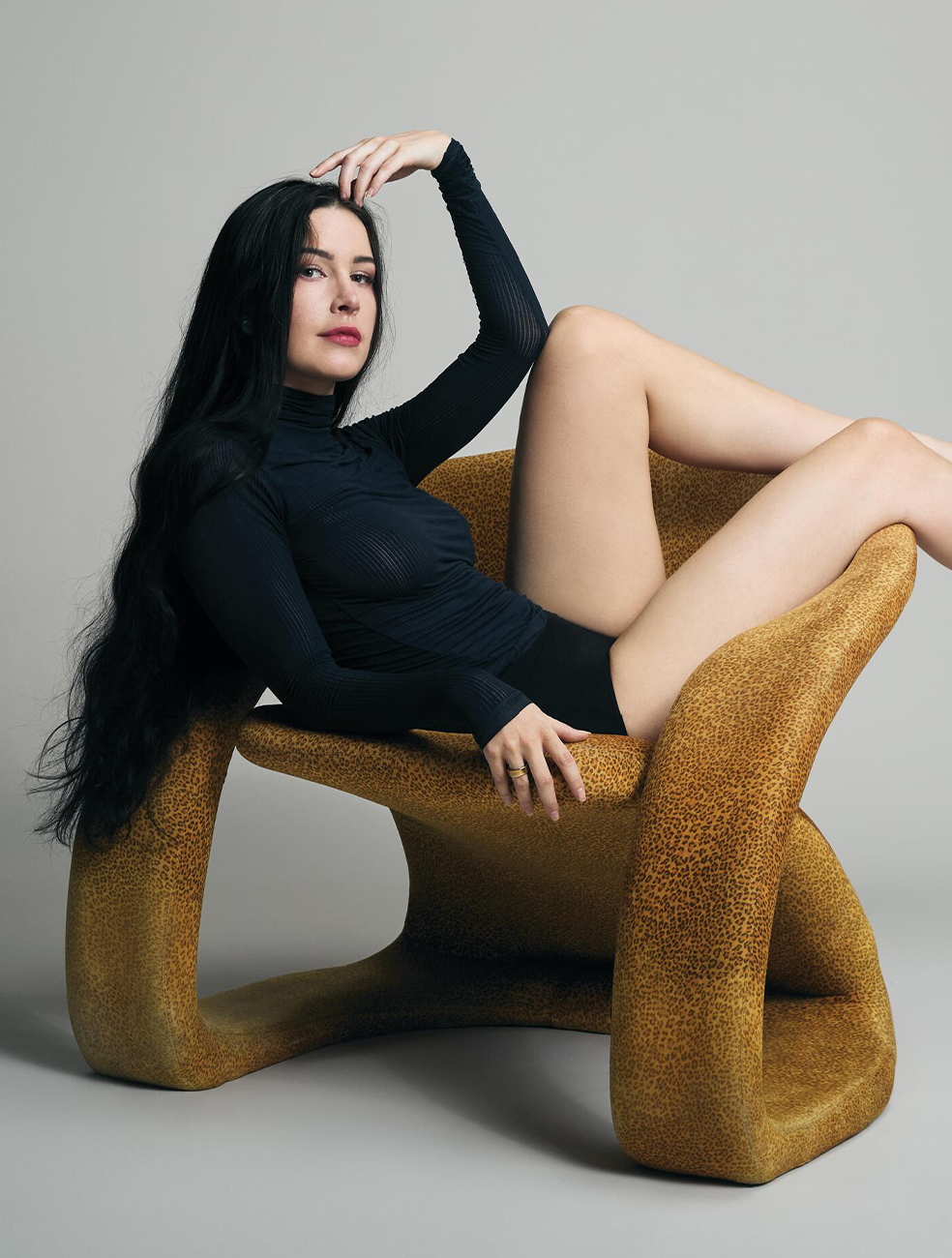
Among the people who know her name, there are many who reference it only as if it were a curse word. “A*lla,” they call her online, blocking out a letter to protect the innocent, to evade the algorithm, to avoid the possibility that she’d search her own name on X and see what they’ve written. But even still, they’re talking about her. They’re talking about her orgies, her views on motherhood and bestiality and polyamory, her place within the so-called rationalist community, her shower habits.
Aella, a camgirl turned OnlyFans model turned highest- paid escort turned Silicon Valley–brained writer—who is still very much all these things at once—has become an avatar of our sexual culture. The end point of 60 years of sexual liberation, a polyamorous sex worker who publicly details whether the 42 attendees of her birthday gang bang came inside of her or not in a Sankey diagram as though it were a quarterly revenue chart.
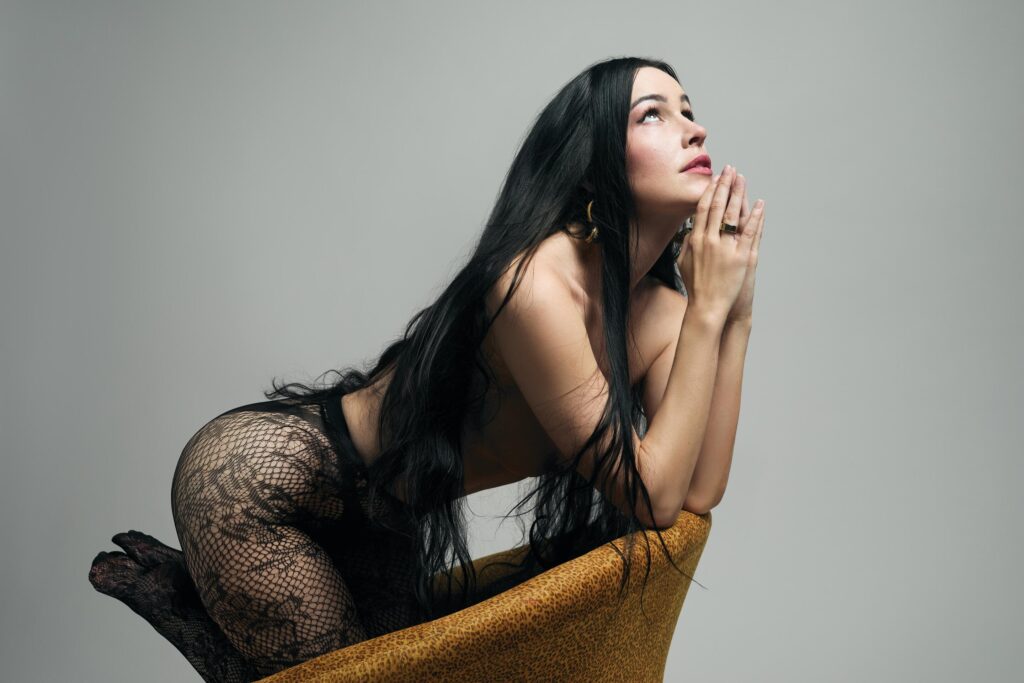
But what makes Aella (who, for her privacy, prefers exclusively to be known by this chosen name) a particularly unique case is that she herself is not a product of the sexual revolution. She is not the way she is because she was exposed to Girls Gone Wild or anything close to Pornhub in her youth. She was not fed a gospel of girlbossery or hookup culture or anything even hinting at feminism. She was hardly even allowed to watch I Love Lucy.
Much of the internet has already formed an opinion of Aella, and not necessarily a positive one. Whatever someone might think is wrong with sexuality and womanhood today, Aella probably embodies it. And isn’t that really a lot of pressure to put on one person? Why is it a woman who loves to fuck has to represent anything at all? Maybe that’s the last limit hat sexual liberation has yet to extricate: You may do as you please, but you will be expected to explain yourself.
It’s not as though this isn’t her whole point, though. Just as much as Aella likes to fuck, it seems she likes to share. The opinions people have formed about her are hardly even abstract at all: They’re based on years of chronic detailing that Aella herself has provided. It’d be easy to identify a direct through line here, summing up her inclination to data-viz her sex life as part of her sex life, pure exhibitionism. When I finally sat down to interview Aella at a French-ish restaurant off Sixth Avenue in New York City, I hoped she’d say something to that effect. She’d be so much easier to understand in that way.
But, no, Aella’s inclination to detail her personal life for the world, to upturn every private and embarrassing and even gross (to some) part of herself, comes from an even more basic place. At the end of the day, Aella wants to help people.
“I want to be as self-accepting as possible and broadcast that,” she says as she scoops heaps of steak tartare onto lightly toasted wedges of bread. “I feel very motivated, in a principled sense, to broadcast as much about myself in a completely shameless way as possible, so other people can see that it’s possible, and then maybe they could feel loved and accepted indirectly through that.”
In her childhood, the only thing Aella was told about sex was that she had a vagina and that she would bleed from it. When she first experienced arousal as a teenager, she thought she was broken. Still, she found mental loopholes: She could masturbate so long as she didn’t actually visualize anything and, therefore, did not experience lust. She could give her boyfriend a blow job as long as she did not fully open her mouth, instead performing an act she described as something like eating corn on the cob.
At 17, after working at a local library for $7.25 an hour, she saved up enough money to leave home and move into a room in a friend’s house for $200 a month. Very quickly, her life jumped from point A to point B to point C: She had sex for the first time, lost her faith, and rapidly found a new one. She eventually became a camgirl, later joined OnlyFans, and began writing and sharing her ideas on social media, and, over the last 16 years, she has grown into one of the internet’s most controversial figures.
“‘OK, wait, everything I learned was wrong,’” she remembers telling herself early on in this journey. “I’m just going to discharge it all and rebuild from first principles. And pretty rapidly, almost immediately, I stopped experiencing sexual shame for having sex with people.”
While Aella maintains some contact with her mother and remains close with her siblings, one of whom lives with her in Northern California, she has spoken to her father only twice in the last 15 years. He is a relatively prominent evangelical figure in a field known as Christian apologetics. Apologetics is a branch of theology that seeks to defend and explain the faith through reason and evidence-based arguments. On his website, he addresses an exhaustive list of hypotheticals pertaining to the complex intersections between life and biblical word: Is it a sin for married couples to engage in oral sex? Can women wear bikinis to the beach? Is masturbation OK?
“I believe that though masturbation under certain circumstances may not be sinful, the desire to be sexually pure and holy should move the Christian to avoid it,” he writes of the latter question, citing numerous Bible verses in his analysis.
It is so clear that Aella’s ethos of “just asking questions” was birthed from something of the same place, an aspect of herself carried down from her father, which she acknowledges. “I’m a lot like my dad, which is slightly unfortunate, because I think he’s narcissistic and terrible,” she says. “But I don’t think I’m a narcissist. I mean, I’m sure a narcissist would just say that, but I seem to have a lot of empathy in a way that he doesn’t. But besides that, we’re extremely similar. I don’t really talk to him, but once I saw his office when I was visiting my mom, and his office layout was exactly the way that I have mine. How do we just independently design our offices the same way? He’s an extremely weird person. He converted to Christianity late and then became hyper-obsessed with it and then is loud about it online.”
Aella is not a narcissist. She does have empathy for others. There is no doubt that Aella believes women should have sexual agency and be free to do as they wish. But is there some part of her, a vocal one, that believes we would all be happier as women if we just leaned in and let ourselves be the target in a fuckable version of capture the flag? Are those of us who don’t see the appeal of being a “human petting zoo” à la Bonnie Blue merely oppressed by our internalized shame? Or is some of the sexual liberation that Aella embodies just…not for everyone?

It’s here that sexual liberation can take on an oppression of its own. We are free to engage in libidinal splendor, but less free not to. It’s a concept posited by Mark Greif in his 2006 essay, “Afternoon of the Sex Children,” in the magazine n+1. Greif writes, “What has passed as liberation has often been liberalization.… Liberalization makes for a free traffic in goods formerly regulated and interdicted, creating markets in what you already possess for free. It has a way of making your possessions no longer native to you at the very moment that they’re freed for your enjoyment.”
Sexual liberation was a success in that it liberated women, especially, from the constraints of marriage and pregnancy in sex by making sex outside of marriage no longer illegal, embracing contraceptives, and untangling much of the shame associated with female pleasure. Here, Greif makes a crucial distinction: “But a test of liberation, as distinct from liberalization, must be whether you have also been freed to be free from sex, too—to ignore it, or to be asexual, without consequent social opprobrium or imputation of deficiency.”
And I believe that Aella would agree: We should all be free to not have birthday gang bangs if we so wish. Maybe, then, those feelings of unease or shock or even disgust that Aella has a tendency to evoke from the public are actually just the feeling of jealousy. Aella is a woman experiencing sex anew when the rest of us have lost the thrill. We’ve been jaded by sexual liberalization disguised as liberation, and when we look at her, we’re unable to avoid confronting it.
At the foundation of Aella’s philosophy is the assertion that sex is good, however you consensually have it. Shame is bad, unless you like shame. Still, the liberation she emphasizes is beyond that of the erotic realm. “I think I view sexual liberation as just another aspect of the general liberation of the self,” she says. “When I mean liberation, I mean liberation of all of you, including the ugly parts or the scared parts or the ‘I don’t want to do this’ parts—if you’re pushed to be something that you think you’re supposed to be, that’s not what I consider liberated.”
She knows, then, that her brand of sluttiness is not conducive to everyone’s happiness: “This thing can apply in both directions. It can make people dismiss discomfort in order to try to be more slutty. It can make people dismissive of being slutty because they’re trying to be monogamous. To me, sexual liberation means a complete self-acceptance, independent of what people are trying to tell you you’re supposed to do. It’s a process as opposed to a state. You don’t just reach sexual liberation and then stay there.”
Our broader culture has suggested that sexual liberation is not only a process but something that has ebbed and flowed in its six decades as a mainstream concept. “We’re seeing a lot of sexual regression in a way that I’m not used to,” Aella says. “There’s more sexual prudery, often in the name of feminism, which is really sad to me. I didn’t expect to be feeling sexual shame coming from the other side, right? I came from the Christian patriarchy side, and I didn’t expect the world that had told me that I could be so free to turn around and tell me I couldn’t, right?”
Some of this contemporary wave of puritanism, she suspects, is just a natural backlash toward the sex positivity and feminism of the last decade. “The backlash coming from men feels slightly more explainable, because I think feminism—while I extremely support it—has not done a very good job of giving men a clear purpose,” she says. “Any ideology that is championing the rights of others without giving other people an obvious role on how to support that is going to not end up well for people.”
On the side of the younger, more left-leaning generation that is avoiding sex both in real life and on-screen, she posits that their attitude is a result of the limits of sex positivity, rather than strictly an overabundance of it. “The rise of porn and sexual acceptance and sexual liberation has led to a visibility of everybody’s darkest fantasies in a way that, while people were identifying as sex positive, they weren’t prepared to accept,” she explains. “I think they sort of had an idea that sex positivity was very light-hearted, that sex is a clean and soft thing where everybody gives affirmative consent to every step of the way and they have nice, gentle, loving sex. I think a lot of people haven’t realized that sex is often very dark. It’s very dirty. It touches the parts of ourselves that we’re really ashamed about. It’s almost necessarily this taboo, transgressive, transversive thing.” The dominance of online pornography has made that apparent, but many of us, she thinks, have not been ready to accept that. Toward the end of our lunch, I ask if she perceives any downsides to sexual liberation, the thing that allowed her infamous gang bang to take place (and so publicly) to begin with. Immediately, she begins describing the difference between chimps and bonobos. Bonobos are matriarchal in their social structure and generally nonviolent among one another; female bonobos are somewhat promiscuous but selective of their male partners. Chimpanzees, meanwhile, are patriarchal and aggressive; males often kill one another, as well as chimpanzee babies. It’s thought that their evolutionary differences may stem from the formation of the Congo River and the varying access to food resources that came with it. Over the last few decades, humans have dealt with a variety of metaphorical river formations of our own.
“We fixed the part where men die in wars, and we didn’t fix the part where women have to go through childbirth,” she says. “We’re only gonna figure out our shit if we have a similar shift in incentives. Birth control over time will probably have this effect. We’re only a couple of generations into birth control—we haven’t had the time to let that deeply percolate into our primate consciousness.”
In other words, maybe some several thousand years from now, we’ll have evolved into a species that handles sex and gender through an entirely different dynamic. Maybe we’ll become increasingly violent. Maybe we’ll find calm and equality. Maybe we’ll all be having gang bangs and documenting them in spreadsheets.