Your bag is empty.

For comedian Steven Wright, being weird is perfectly normal
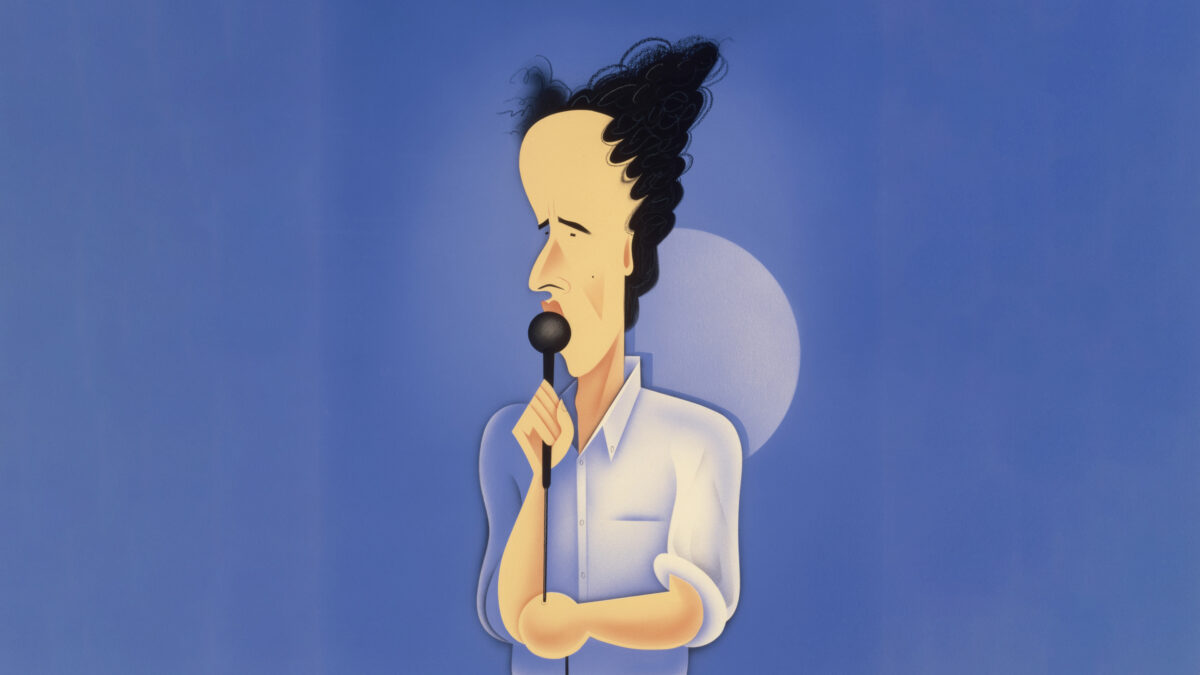
After Emmanuel Lewis, TV’s other diminutive child star, has reported in about being at Ronald Reagan’s Inauguration, and after George Hamilton has bragged for a while about his tan, Joan Rivers, guest hosting for you know who on The Tonight Show, introduces her next guest: “He’s funny, he’s terrific….” As he has done seven times before, 29-year-old Steven Wright walks through the parted curtains. He is wearing a red-and-black plaid flannel shirt, black Levi’s cords and work boots. His brown hair, receding in front, is long and curly everywhere else. Wright looks as though he is due back in the dorm immediately after the show.
“Thanks,” he says, eying the applauding audience suspiciously, but he says it in such a deadpan way, so devoid of emotion or energy, that it gets a sizable laugh. He edges cautiously into his first joke.
“I just got out of the hospital,” he tells the audience. “I was in a speed-reading accident.” Pause. “I hit a bookmark.”
The audience laughs tentatively, partly at the joke and partly at the morose, almost spacy delivery.
Wright continues, “Last summer, I drove cross-country with a friend. We split the driving. We switched every half mile.” Wright walks back and forth as the punch line, such as it is, sinks in. “The whole way across, we had only one cassette tape to listen to.” He rubs his head thoughtfully. “I can’t remember what it was.
“I was traveling with my friend George. Some people think George is weird ’cause he has sideburns behind his ears. I think he’s weird ’cause he has false teeth but he has braces on them.”
Wright paces nervously, as if he were in a psychiatrist’s office trying to come up with even more reasons he should be committed without a hearing.
“My friend George is a radio announcer,” he says. “And when he walks under a bridge, you can’t hear him talk.” By now the audience is catching on, laughing harder with each line and with each odd movement and strained expression.
“The thoughts Steven comes out with are totally original,” says Peter Lasally, producer of The Tonight Show and the man who discovered Wright working in an obscure Boston club. “They’re not jokes, they’re fresh, original thoughts that are just so wonderful and so off the wall that you say, ‘My God, how could anyone think of things like that?’ He’s brilliant. I’ve never seen anything like him.”
In Los Angeles, if you meet someone Wright’s age, you can safely assume he’s one of three things: an aspiring actor, an aspiring screenwriter or an aspiring comedian. Sometimes it seems as if there are comedy clubs every few inches and that people are falling in and out of improv troupes as often as they fall in and out of love. Wright’s act is unusual enough that within a few days of his hitting town, he was sought after by virtually every major agency and producer with an interest in comedy. Now, three years later, he has an album that will be released shortly by Warner Bros., a special in the works for HBO, a movie deal in development with Orion Pictures and several New York publishers courting him to do books. He turns down more TV work than most people are ever offered, and one can often hear him compared with Woody Allen—the reigning pinnacle of comedic achievement—as a likely candidate to cross over successfully from clubs to films.
Comparisons with Allen are frequent in Wright’s life. For one thing, that’s the standard showbiz way of complimenting a comedian, of telling him that he has potential. And for another, Allen is one of Wright’s idols—when he was younger, Wright listened over and over again to Allen’s albums, analyzing the way each joke was structured and delivered. But beyond that, the comparisons are limited. Allen’s humor is observational, drawn from the regular world that most of us inhabit. At least part of his appeal comes from the fact that the audience can recognize itself in his jokes and movies.
Wright’s jokes, on the other hand, seem as if they’ve been beamed down from a distant galaxy. Few people—at least, few people outside of mental hospitals—readily identify with Wright’s unique, twisted view of the world. As he tells his audiences, “I like to skate on the other side of the ice.” Instead of striking a familiar chord, Wright surprises his audiences with wordplay and unusual images, dragging them onto an unlikely, surrealistic planet where people make synthetic hair balls for ceramic cats and live in houses that run on static electricity. In a modest way, his act is a reinvention of the wheel, taking a hackneyed form—stand-up comedy—and doing something new and fresh.
“When I was little, in our back yard we had a quicksand box,” Wright is saying. “I was an only child…eventually.
“Last time I tried to commit suicide was about an hour ago. I was down the street on the roof of this very tall building. I ran, I leaped off the edge and accidentally did a triple back flip, landed standing on my feet. Nobody saw this but two little kittens, and one of them said to the other one, ‘See, that’s how you do that.’” The Tonight Show audience gives him an enthusiastic final round of applause.
When Wright joins the other guests, sitting between George Hamilton’s old-world elegance and Joan Rivers’ borrowed Perry Ellis original, he seems even more out of place than he had been onstage. And Rivers is uncharacteristically tongue-tied. In a world that operates on the decimal system, Steven Wright often seems to be talking in binary. He has a loyal following, but there are also those who don’t get the joke.
As Wright sits in his chair, Rivers cheerfully observes, “You’re just as vivacious in real life as you are on stage.”
Soon the crowd is thundering in anticipation, as if the Stones were about to jump on stage.
They spend some time chatting, but most of the time it appears that Rivers is simply looking at Wright or he is looking at her. There are long silences during which you can’t be sure exactly which of them is the one not talking. Finally, Wright says slowly, “Can I ask you something?”
“Sure, take your time,” says Rivers.
“No,” he answers, with a bewildered expression on his face. “I thought you were somebody else.”
• • •
Steven Wright is winding his way through a mammoth kitchen somewhere on the campus of the State University of New York at Albany. Even though it’s a Thursday night, more than 100 people are milling about outside in the 16-degree weather hoping to get a seat for his performance. They won’t make it. There are 850 other students already inside the Campus Center Ballroom, and Tom Mottolese, one of the show’s promoters, is grousing about how much money he could have made if only the university had let him put on a second show.
A kitchen worker with an apparently razor-sharp memory for two-week old Tonight Shows points to Wright and says, “Can I ask you something? …No, I thought you were somebody else.” His delivery is all wrong, of course, which proves that comedy, like medicine, was never meant to be practiced by the general public.
The kitchen, which has more twists and turns than an Elmore Leonard novel, leads to a series of back stairs and catacombs that go up and down so often that I can’t tell whether we’re on the third floor or in the basement. We’re searching for Wright’s “dressing room,” but when Mottolese finds what he thinks is it, it turns out to be a classroom full of students. Another door opens to a closet. Finally, we come upon the real dressing room—which is another classroom but without the class.
Mottolese is used to promoting rock shows and big names, so he had assumed that Wright would like something special in his dressing room, such as fresh kiwi fruit or champagne or Godiva chocolates. When asked, Wright’s booking agent didn’t know but volunteered to track the star down and find out. “Sometimes I like to have a beer before the show to relax,” Wright offered. “They could get me a six-pack of Budweiser if they want.”
A tub of ice with cans of Bud is dragged into the room, and with it come much commotion, dozens of people in and out and endless confusion about the appropriate introduction, where the bathrooms are or aren’t and, of course, just what is the quickest way to get to the stage. The opening act—a local acoustic-guitar duo—is already performing, and Wright has yet to prepare for his show. He never does the same set twice; he has a vast store of material, some of which logically goes toward the beginning of his act, some toward the end, but he puts it together on stage, fitting the pieces to match the audience and the situation. It requires enormous concentration.
“I think I’m going to take some time to prepare now,” he says very quietly. Wright sometimes speaks so softly that it jolts people. He calls it reverse yelling, and he accidentally discovered it as a useful way of getting attention. In the early days of his night-club career, he found that the more he lowered his voice, the quieter the audience became. Even with an unruly crowd, he discovered if he almost whispered, they’d snap to and pay attention.
Wright is left alone in the classroom with the tub of beer and his Sony Walkman with a broken plastic cover. He changes from one very casual, beat-up green pullover shirt to an equally casual striped one, puts on his earphones, turns out the lights and listens to Van Morrison’s “Beautiful Vision.”
As showtime approaches, Mottolese and his partner are pacing gingerly outside the darkened classroom, debating the proper way to rouse the star. Knocking doesn’t seem to work, thanks to the combined efforts of Sony and Van Morrison. Finally—and reluctantly—they walk in. Headphones still on his head, Wright is led through another series of dark passages and stair wells to the stage. It’s a large stage, big enough for a game of volleyball, and it’s flanked by towering speakers. When the first few rows of the audience get a glimpse of Wright, they start stomping their feet. In that weird way that mass psychology works, soon the rest of the crowd is thundering in anticipation, as if the Stones were about to jump on stage. It’s a high-energy response for a low-energy comedian.
“I got a new shadow,” he tells the appreciative audience. “I had to get rid of the other one. It wasn’t doing what I was doing.
“Once I was walking through the woods and saw a rabbit standing in front of a candle making shadows of people on a tree.” He pauses. “I said, ‘Don’t be so sarcastic.’
“Today I saw a subliminal advertising executive…but just for a second.
“I went to a place to eat. The menu said, ‘Breakfast any time,’ so I ordered French toast during the Renaissance.”
His 45-minute set is an obvious hit, with an almost electric response. All things considered, a college audience, even a conservative one, is tailor-made for Wright’s cerebral brand of weirdness. It’s an audience whose members were weaned on the old Saturday Night Live, and they expect humor to go beyond the usual boundaries. And Wright is young enough to be plugged into their concerns, mentioning SAT scores and telling them, “I went to Harvard…for carpentry. I build cabinets that cost $58,000.” The crowd loves it, but later, Wright will rate the show a mere six on a one-to-10 scale.
“The audience would be surprised to hear that,” I say.
“They have only one show to compare it with,” he says. “I have 3,000.”
Back in the classroom dressing room, the parade of well-wishers begins—students with their Kodak Instamatics and flash cubes, fledgling journalists asking strange, unanswerable questions; there’s even a familiar face from Wright’s Boston days, a portly comedian who proudly announces, “I’m getting a chance at all the roles John Candy turns down.”
Wright was so painfully shy and introverted that it was sometimes difficult to tell when he was awake.
Wright is good-natured about all the attention, though he appears slightly detached, as if his mind were off wandering in another dimension. He poses for pictures, answers questions, reminisces with the comic—in all, he’s being perfectly polite, and yet he’s still very much the character they watched on stage. Suddenly, a female student appears at the door and brazenly takes over the room.
“I’m not with any of these other people,” she announces. “I just came by because you never smile and I want to see you smile.”
Without so much as a second’s hesitation, Wright breaks into a gigantic, cheesy, showbiz grin.
“Thanks,” she says and walks out the door.
• • •
There’s nothing contrived about Wright’s smile—more accurately, the lack of it—or the bizarre nature of his act. He is simply unleashing the unusual thoughts that have always seemed to lurk in his head. Nor is his stage persona contrived to match his material. To a great extent, Steven Wright is just being himself when he’s on stage. He’s odd, very odd, and that’s the way he’s always been, as even his mother admits.
“Steven was the laziest of my four children,” explains Dolly Wright. “As an infant, he’d fall asleep when I breast-fed him. So I called the pediatrician and he said, ‘Well, snap the bottoms of his feet.’ I did that, but it didn’t work. I called the pediatrician again and he said, ‘Put him on a hard table’—now, believe me, it’s very hard to nurse a baby on a table. The others would be up and Steven would be falling asleep. And it’s followed him throughout his life. When he was three, I couldn’t find him, so I called the police. He’d fallen asleep downstairs in the middle of the afternoon. He just dozed off and I didn’t know it.”
“I was one mellow kid,” says Wright. He remembers being dragged off, with some regularity, for blood tests to see whether or not anything was wrong. He was normal—at least physically—but the symptoms never went away.
“He’s still like that,” complains his mother. “He came home for a week recently and slept the whole time. I hardly saw him.”
Wright was so painfully shy and introverted that it was sometimes difficult to tell when he was awake. He spent most of his few waking hours playing alone in the quiet Boston suburb of Burlington, where he grew up. To members of his family and a couple of friends, he would occasionally show flashes of his otherworldly humor, though neither Wright nor the jokes seemed like the type you might someday find on TV. Almost unnoticed, he was developing a passion for comedy, getting up early on Saturday mornings—which was, of course, no small accomplishment—to watch The Three Stooges and, when he was older, listening to Woody Allen’s albums and attending Marx Brothers films. To his family, he was a budding artist: By fourth grade, he was drawing outlines of The Flintstones for his classmates to color, and by high school, he had discovered surrealism and abstract painting. Everyone figured he’d go to art school.
Meanwhile, Wright was wondering if his twisted vision of the world—the joke about George with the sideburns behind his ears came to him in junior high school—would actually play on stage. But since he was paralyzed at the thought of giving an oral report in class, it seemed silly to mention it. Nor, for that matter, did he have many people to whom he could mention it.
“I kind of missed everything,” he says now of his pre-college days. “I didn’t go to any football games. I didn’t go to any proms. I was too shy to ask a girl out until I was 18. There were two or three guys I’d hang out with and I was funny with them, but if you weren’t close to me, I’d be nervous and wouldn’t say anything.”
He surprised everyone by not going to art school—“I thought if I tried to make a job of it, it would ruin the enthusiasm I had”—and instead enrolled at Emerson College in Boston. Emerson had a well-regarded radio department, and Wright was leaning toward becoming a disc jockey as a steppingstone to comedy. The other schools in the area were breeding grounds for preppies, but Emerson seemed comfortably lodged in the 1960s, with more than its share of eccentrics, free spirits and just plain weirdos. Wright began allowing the weirdness that had always existed inside him to emerge.
One of his best friends, Michael Armstrong, remembers those days: “He was a strange and bizarre character, sort of aloof. We didn’t become friends until later on, when I hired him to work on a paint crew at school. I remember his turning up every day in a pair of shorts, with no shirt and no shoes, with no paintbrush or anything. And he was probably one of the worst painters I’ve ever met, but he was the most fun to work with.”
So introverted was Wright that even as he came out of his shell, he was still largely unnoticed. “During graduation, people usually applaud their friends or people they know,” says Armstrong. “But when he came across the stage, there were about three people applauding in the crowd. It was almost a deathly silence. He just didn’t know anybody.”
Lacking any real desire to become a disc jockey, Wright took his degree and got a variety of odd jobs, such as parking cars and working in a warehouse, and then spent five months traveling across the country. When he returned to Boston, he discovered that a comedy club had opened and that it held open-mike auditions on Tuesdays. He decided to do it.
“I didn’t want to be 40 years old, selling insurance in Iowa, wondering what would have happened if I had tried to be a comedian,” Wright says. “The audience laughed at half of my stuff and didn’t laugh at the other half. I felt very disappointed because they hadn’t laughed at everything, but when I was walking back to my apartment I thought, Wait a minute, they did laugh at some things. And that was an incredible rush, because I had been fantasizing about it for so long.”
Wright tried again and was quickly offered a regular slot at the Ding Ho, a Chinese restaurant that also featured local comics. For three years, he was one of a small clique of Boston comics, making $300 a week under the table and occasionally working other New England clubs. “I felt like I had beaten the system, like I was a millionaire,” he says. “I was getting paid for telling jokes.” He had no agent, no plans to get one and only the vaguest notion of what direction his career should take. “We didn’t know the business side of things,” he says of the group at the Ding Ho. “We were just trying to be funny. It was like Woodstock, it was pure.”
It was like Woodstock when it came to fashion, too—at least for Wright. Dressed in old sandals and older clothes and frequently sporting an eight-day growth of beard, he quietly performed his act while leaning against a wall. “It was almost as if I wanted to be on stage without being noticed.”
One day, the Ding Ho got a phone call from Peter Lasally. Even Woodstock-pure comedians in Boston know who he is. And The Tonight Show is still the one show on TV that can take an unkempt, underfed and unknown comic and, overnight, turn him into a card-carrying member of the Hollywood establishment. Lasally was going to be in Boston scouting colleges with his kids, and as long as he was in the area, he thought he’d spend an evening checking out the local talent.
The local talent quickly struck a deal. Usually, four comics would do 20 minutes each. In honor of their special guest, everyone agreed to cut down his act to 10 minutes, so they all could have a shot.
“It was a Thursday and it was a noisy audience,” says Wright. “Usually, I can quiet them down, but I couldn’t this night. So I did my 10 minutes and got off.”
“How did you do?” I ask.
“A six. Just like Albany. I have a closetful of sixes. I was disappointed, but, surprisingly, I didn’t think it was the end of the world. I thought, Maybe next time I’ll do better, and then I’ll get on.”
Lasally remembers the evening differently. “I saw 12 to 15 comedians that night, and the one who stood out over everything I’d seen over the years was Steven. I couldn’t believe what I saw—it was that different, that fresh and that exciting. All these comics came to see me as I was in the parking lot, saying, ‘How did I do?’ The one guy who didn’t show up was Steven.” Lasally laughs at the memory. “Steven just went home.”
Home, at that time, was a sparsely furnished apartment Wright shared with a fellow comedian. It had a kitchen table and chairs, a couch and a TV set on a tree stump. One afternoon three weeks after Lasally’s visit, Wright was home alone watching cartoons when the phone rang.
On the other end was a talent coordinator asking, rather matter-of-factly, if Wright would like to guest on The Tonight Show or write for it, or both.
“The phone is on the floor; there’s not even a table to put it on,” says Wright. “There’s almost no furniture and there are cartoons on the stump. I said, ‘Wait a minute, you mean from seeing me for 10 minutes three weeks ago, that’s it? No more auditioning, nothing?’ And he said, ‘Yeah, just mail us a tape so we can go over it again, but other than that, you can go on if you want.’ We talked another 15 minutes, and then I hung up the phone and called all my friends and family and no one was home.”
Wright decided to pass on the offer to be a Tonight Show staff writer, but he did send in a videotape immediately. “It was the only one I had, 20 minutes of me on stage. I had half a beard, sandals and a flannel shirt hanging out.”
The Tonight Show still liked what it saw, but when the talent coordinator called back to set a date, he had a suggestion. “Don’t wear sandals,” he said. “Dress as if you were going to a nice place.”
Leaving his cartoons behind on the stump, Wright flew first-class to L.A. and was picked up by a limousine, and he and his girlfriend were given a room at the Sheraton Universal Hotel. Two other friends, including Michael Armstrong, showed up to provide moral support. Armstrong also provided a shirt, pants and a belt. Wright could contribute only underwear and shoes to the proceedings.
“They put make-up on me, which I never had—eyelashes, eyebrows; they even did my hands—and then I suddenly realized that I was really pissed off at women, because I looked 180 times better than when I’d walked in. The difference was unbelievable. It was like they had tricked us all these years. I’m talking to Peter while the guy is putting on my makeup and I feel someone standing beside me. Johnny was standing right there. He said, ‘Peter has told me a lot about you. Welcome to the show and I hope you have a good time out there.’ And I said, ‘Thank you very much.’ He could have said, ‘I’m going to kill you and your entire family and bury them at sea in less than an hour,’ and I would have said, ‘Thank you, thank you very much,’ because I was in shock.”
That was August 6, 1982. “He created an enormous stir,” says Lasally. “Word gets around very quickly when something as exciting as this happens.”
He doesn’t seem to want or need anything.
In fact, Wright got work immediately on a syndicated TV show called An Evening at the Improv and stuck around to tape that show. When he was done, Lasally had an unusual proposition for him. How would he like to do The Tonight Show again? The next night, in fact. His first show had been on a Friday. His second was less than a week later, on Thursday. It had been 10 years since a comic was brought back that quickly.
“Usually, we would have waited a couple of months before we booked him again,” says Lasally. “But Johnny was very impressed.”
Fortunately for Wright, Michael Armstrong had brought a second shirt.
• • •
A mere 12 hours after walking off stage in Albany, Steven Wright is checking into a Holiday Inn in Philadelphia for a two-night stint as the headliner at a club called the Comedy Works. To the clerk behind the desk, he’s apparently just another tourist in town to check out the Liberty Bell.
“Can I help you, sir?” she asks perkily.
“I’d like one room on the top floor with a window that opens,” he answers. “Could I have that for almost one night?”
The clerk smiles wanly. She thinks this may be a joke, but given Wright’s deadpan delivery, she’s not exactly sure. She gamely has us fill out the appropriate forms and starts handing out keys.
“We’ll need 11 keys to each room,” Wright tells her solemnly. “But I can’t tell you why until Monday.”
The clerk ignores him and gives us each one key—keys, as it turns out, to rooms on the top floor with windows that open. In fact, if you open one and lean out, you can see a gigantic bust of Benjamin Franklin made out of 80,000 pennies, all donated by school children. Wright eyes it suspiciously. “I didn’t know he was that big,” he says.
It’s one of the few sights he will see. In all, he’ll be in Philadelphia less than 48 hours, which is about three times as long as he was in Albany. The day before that, he played an 85-seat club in Northampton, Massachusetts. He’s on the road a lot—about half the time since he hit it big on The Tonight Show and moved to Los Angeles in 1982—and he doesn’t much like it. He travels alone, often crisscrossing time zones insanely, is picked up at the airport by a stranger from the club or school he’s playing and stays anywhere from half a day to a week. Sometimes, he’ll make friends with the other acts or the staff of the club. Other times, he’s pretty much on his own. Either way, he’s uprooted the minute it’s over and the whole process starts all over again in another strange city.
Of course, his life is not significantly saner when he’s at home—at least not at the moment. “I’m moving out of my apartment tomorrow and I’m going on the road,” he told Joan Rivers on The Tonight Show. “I’m going to have no place to live.” Rivers and the audience laughed—there’s something about his delivery that guaranteed that—but the statement was true. “I have no address” is how he explained it to me. As it turns out, that’s not all he doesn’t have. He doesn’t have a car, a stereo, a VCR, a phone, furniture, many clothes or much of anything. In the age of the Yuppie, Wright is a comedic monk.
“He’s a complete innocent,” maintains Lasally. “I’ve never seen it to this extent before. He remains the way he was when he started. He doesn’t have a place of his own or a car; but knowing Steve, you come to expect that. He barely copes with life.”
Michael Armstrong is still lending him clothes. “Every time he comes around, he’s in need of a shirt,” says Armstrong, who now lives in Aspen. “I don’t understand it, but I keep on growing out of my clothes and yet they always seem to fit him perfectly. Right now, I’m unemployed, and he’s got thousands in the bank, and I’m always giving this guy clothes.
“He doesn’t seem to want or need anything,” Armstrong says. Several years ago, when the pair was just out of college, Wright found them a place to share in Boston—a Beacon Hill condominium that was up for sale and available for rent on a week-to-week basis. “So we took it,” Armstrong recalls. “There were several large rooms with nothing in them but one bed and one mattress on the floor. I hated it, but he was so happy. I wanted to sit down on a couch, to turn on a radio or make a cup of coffee, but Steve would just lie there on that mattress with a glass of water beside him and his notebook—which was a few pieces of paper with jokes written on them—and say, ‘This is all that I want.’”
Friends such as Armstrong are constantly urging Wright to rent an apartment or buy a car, but he can’t even decide which city he wants to live in, let alone find an apartment. “I’ve ruled out Boston,” he announced two months after leaving his L.A. apartment. The fact that the choice was now down to L.A. or New York struck him as considerable progress. Meanwhile, he lives with friends or checks into a hotel and rents a car. His money—by now a substantial sum—is hidden away in a Los Angeles bank, where he can safely ignore it.
Wright’s first show at the Comedy Works brings out a rowdy table from the University of Pennsylvania. It isn’t really enough to harm the show—after six years in clubs, Wright has honed some deft put-downs—but he is still mad afterward, complaining as we walk back to the Holiday Inn, where, he promises, he will introduce me to the best bartender in Philadelphia.
The closest thing Wright has to a hobby is his never-ending search for interesting bars and good laundromats. He spends a considerable amount of time in one or the other, which means, among other things, that while he doesn’t own many clothes, the ones he does own are always clean.
Wright found himself in a trailer backstage, sitting on a couch between David Bowie and Bianca Jagger, making small talk with Bette Midler.
“People never understand why I don’t have my clothes done,” he says. “I like the machines, that hmmmmm noise. I even like the smell of the driers. It’s as if I go into meditation and space out.”
Bars serve much the same purpose. “I get relaxed there,” he explains. “It’s like a little rest station on the outside of society.”
The Wings Lounge is just such a place. It’s stamped out of the mold that’s used for all Holiday Inn lounges—a padded bar, tables, a stage for the obligatory lounge act and lots of mirrors. Tending the bar is Red, who I’d take to be nearing if not past retirement age, with thinning red hair and a nicely sarcastic sense of humor.
“Do you remember me?” asks Wright.
Red feigns boredom. “Yeah, sure. You were here about a year ago and sat right there and drank beer, and you were here about a year before that with a girlfriend and you sat down there and drank tequila.” Red tosses a cocktail napkin in front of each of us. “And I remember you’re a slow-talking son of a bitch.”
Wright laughs. The difference between Steven Wright on stage and Steven Wright off stage is not great, with one noticeable exception. “The important thing you need to know about Steven,” his agent, Marty Klein, once told me, “is that he likes to laugh.” On stage, he’s a bizarre, twisted guy who never smiles. Off stage, he’s a bizarre, twisted guy who not only smiles but laughs a lot and who appears, in his own odd, morose way, to be enjoying life immensely.
Red is buying the drinks and Wright is talking about a variety of subjects, ranging from Woody Allen and Kurt Vonnegut, Jr. (“I read his stuff and I feel boring, like an accountant”) to David Bowie. Bowie had seen Wright’s act and was impressed enough to invite him to the 1983 US Festival, where Wright, still something of an unknown, found himself in a trailer backstage, sitting on a couch between Bowie and Bianca Jagger, making small talk with Bette Midler, who sat across from him. Later, Bowie invited him to a party in L.A., where Wright, Bowie and a small group discussed movies for nearly three hours. “He rarely talked about music,” says Wright. “It was like music was something he did on the side.”
There’s a general commotion by the stage in the Wings Lounge as the musicians are taking their places. There’d be a buzz of anticipation in the audience, too, except that there’s not much of an audience to buzz. The lounge, which is a fraction of the size of the Comedy Works, is half empty. Right before the show begins, I count 17 heads—and a couple of them later turn out to be part of the act.
The headliner at Wings Lounge is Sonny Averona, a middle-aged auto wrecker who sounds enough like Frank Sinatra to have launched a minor career as a singer. Red beckons him to join us at the bar.
Wright, of course, is wearing his standard avant-hippie uniform—a faded shirt, black cords and work boots. Sonny is stretching a large, expensive tuxedo to its limits. He’s not wearing a tie, but he has enough gold jewelry on to match one of Wright’s bank accounts.
“This is Steve,” says Red. “He’s been on The Tonight Show.”
Sonny doesn’t quite hear him correctly. “You’re gonna do a Tonight Show?” he asks. “Good luck. I just did a Remington Steele myself.”
Red makes an attempt to set the record straight, but Sonny is distracted. Wright is just a scruffy kid to him, but since they are fellow show-business professionals, Sonny is willing to be benevolent.
“Red, write this kid’s name down on a piece of paper, and we’ll introduce him from the stage.”
He writes it down. “Jesus, Red, whattaya giving me such a big piece of paper for?” Sonny complains, ripping the edges off to make it a more manageable size. He punches Wright on the shoulder. “Don’t worry, kid, we’ll give you a plug.”
Red buys another round of drinks and Sonny, after the MC introduces him as “one of the most exciting voices to ever appear at the Holiday Inn,” takes the stage, backed by a seven-piece orchestra and accompanied by the lovely Charlotte Duber, a tall blonde singer decked out in sequins and a long white feather boa.
“It’s funny,” says Wright, scanning the meager audience. “I get pissed off because a tableful of people are talking during my show, yet he’s really into it. If I walked into this room, I’d blow my brains out.”
“It’s a small world,” he tells the crowd. “But I wouldn’t want to paint it.”
Meanwhile, Sonny is working the lounge as if it actually had people in it. It’s a polished show—Sonny reportedly has a loyal following in Atlantic City, where he often plays—but it’s the type of entertainment you most often see on a Jerry Lewis telethon, full of the bogus clichés that Bill Murray used to parody on Saturday Night Live.
“You know,” muses Wright, “he and I are in the same business.”
While Sonny throws himself into his show, I mention to Wright that some of the people around him seem concerned by his lackadaisical attitude toward his future. Marty Klein claims that he is often the one with his foot on the accelerator; and while other clients call him frequently to goad him into more action, Wright hardly calls at all. “I think success frightens him a bit,” says Klein.
Lasally echoes the same theme. “Steven is at the point in his career where concepts for specials and screenplays are going to overpower him. You have to be very disciplined and savvy to deal with that. He has to make the next step beyond just coming up with enough jokes to do in a club.”
Wright has heard it all before. “My ambition without drive,” he jokingly calls it. “I’m more of a dreamer,” he admits. “I’m not one of those people who are going to be doing eight things at once. Right now, I feel like I have my hands full. That’s why I don’t push.”
From the stage, you can sense that that logical break is coming, that lull when a performer like Sonny introduces some of his celebrity friends who might have dropped by. Wright, who has been squirming uncomfortably just thinking about this, decides that now is a good time to duck out and change for his second show.
He’s too late. Sonny has begun his speech. “You know, I’m lucky to have such great friends in show business, and I’m particularly thrilled that one of the best has come by to see me tonight.” There’s a look of amused horror in Wright’s eyes. “Ladies and gentlemen…Joey Reynolds.”
As Joey Reynolds, a local disc jockey who not only just happened to drop by but also just happens to be wearing a tuxedo, bounces on stage, Wright slips out, already late for his own second show. He’s due on stage at midnight, but he’s still in a cab inching through late-night Philadelphia traffic when the sound of church bells chiming 12 can be heard in the background. The club’s MC is vamping for time when Wright finally takes his place backstage to listen for his introduction.
Unlike his performance the night before in Albany, when the backstage distractions were so numerous that he escaped between headphones to prepare, this time he walks straight out on stage without time to catch his breath or get his customary glass of water. Something about the Wings Lounge has charged him, and it’s as if he hits the ground running. The audience, a fun-loving, heavy-drinking Friday crowd, is equally charged and, though smaller, is as responsive as the SUNY students 24 hours earlier.
“I’m doing a lot of painting,” he says, pacing the length of the small stage. “Abstract painting…extremely abstract—no brush and no canvas. I just think about it.
“It’s a small world,” he tells the crowd. “But I wouldn’t want to paint it.
“My house is made out of balsa wood. When no one’s home across the street except for little kids, I come out and I lift my house up over my head. I tell them to stay out of my yard or I’ll throw it at them.
“I have a three-year-old dog. I named him Stay. It was a lot of fun when he was a puppy, because I would call him and I’d say, ‘Come here, Stay. Come here, Stay.’ It’s different now, though. Now when I call him, he just ignores me and keeps on typing.
“I didn’t have much money, so I bought an irregular phone. It had no five on it. I was walking down the street and I bumped into a friend of mine who said, ‘How come you don’t call me anymore?’ I said, ‘I can’t. My phone has no five on it.’ He said, ‘That’s really weird. How long have you had it?’ I said, ‘I don’t know. My calendar has no sevens.’”
As the sold-out crowd roars its approval, Wright pauses, scratches his day’s growth of beard and ponders a rhetorical question, one that is probably on the minds of many in the audience.
“Can you imagine thinking like this all the time?”
From the August 1985 PLAYBOY.