Your bag is empty.

Chris Brickley has 4.2 million followers, a penthouse he pays for in exposure, and a bulletproof front door. He’s also the trainer every NBA star wants passing him the ball.

This story appears in our Fall 2026 issue featuring cover star Charli XCX, on newsstands September 28th. Want us to come to your place? Subscribe here to get it delivered to your door.
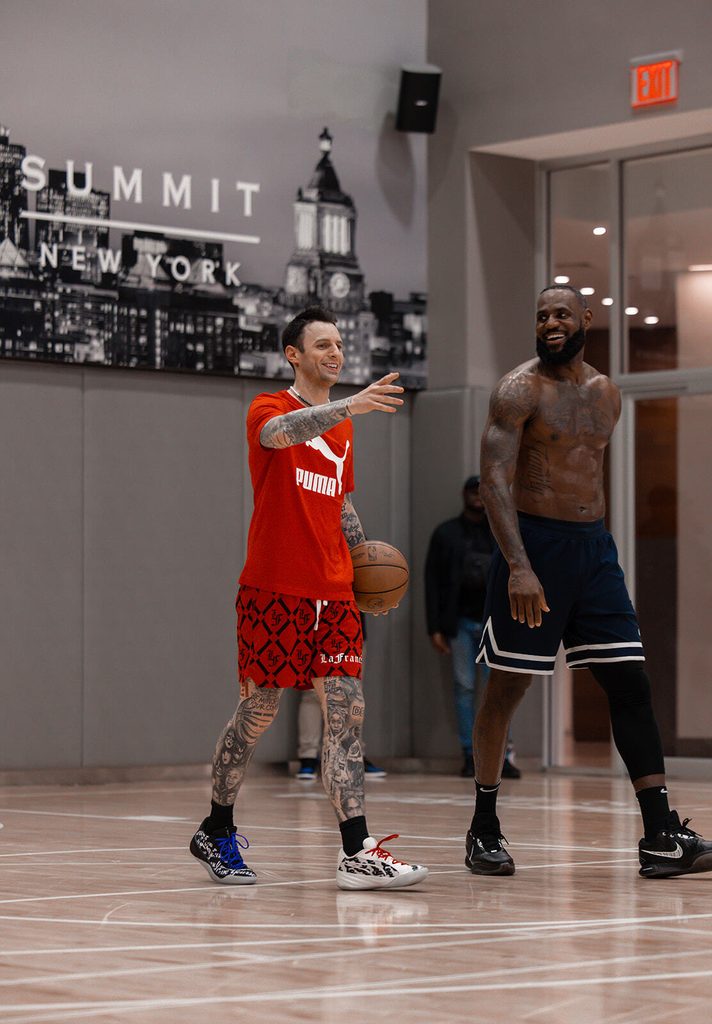
Getting to Chris Brickley’s midtown Manhattan penthouse at the Summit New York requires two phone calls and two key fobs: the first to take the elevator from the lobby to the 42nd floor, the second to unlock the bulletproof steel door that confronts you once you get there.
The door, Brickley explains, is a new addition. After Brickley, supertrainer to NBA superstars, moved to the Summit in 2019, the most ardent among his 4.2 million Instagram followers did so as well. These fans (some of them his new neighbors) lingered outside the fitness center as Brickley worked with future Hall of Famers like Carmelo Anthony, LeBron James, and Kevin Durant. Fans staked out the lobby; the boldest of the bunch marched right up to his front door. They wanted to work for him, to be the 40-year-old’s friend. And they still do—they just have to wait until he leaves his building before they can tell him.
“Just about every day, there are probably four or five people waiting outside the building,” Brickley says. “Yesterday, there was this dude with his girlfriend who said that this was the third weekend in a row he’d driven down from Boston to try to see me.”
What those people are waiting for happens on the Summit’s court, and it looks like not much at all. During a midafternoon late-July session, Minnesota Timberwolves guard Bones Hyland works on his floater (a specific request from the Timberwolves, Brickley says), scoring on Brickley’s interns while Brickley yells out certain constraints, such as having only five seconds or three dribbles to create a shot. Immediately after Hyland leaves, Jordan Clarkson, the New York Knicks combo guard, comes in, and Brickley runs him through a similar set of drills. Later that night, Tyler Kolek, a Knicks point guard and longtime client, dribbles the length of the court as he shoots pull-up three-pointers.
Over four hours with three different players, Brickley almost never intervenes, offering only a small note on the timing of Kolek’s footwork as he gathers his dribble and transitions into his shot. By and large, these sessions are things these players could do with any trainer—so why do so many of them want to do it with Brickley?
“During the 2023 playoffs, I was flying all over the country because Jimmy Butler wanted to work out the night before every game,” Brickley says. “But when I’d get there, we’d just do a light 20-minute session and I couldn’t understand what he was getting out of it. He explained that when he’s in the gym with me and I’m passing him the ball, he thinks of Carmelo Anthony and all the players that I’ve worked with, whom he used to look up to when he was younger, and that it puts him in the mindset he needs.”
More than what he has the players do, Brickley’s magic is how he makes them feel. His workouts are simple. “I’m not reinventing the wheel,” he says. “My job is to help the player become the best version of himself, and that usually happens when he’s working on the fundamentals.”
There’s a certain symbiosis between Brickley’s on-court work and his off-court celebrity. He has aura. For players who grew up watching Brickley’s content, training with Brickley is seen as a major milestone in itself. “This is the gym to work out in,” says Kolek. “Coming here has become a rite of passage for a lot of young guys.”
Granted, Brickley’s vision for the best version of a player doesn’t always line up with the opinions of his clients’ NBA teams. “Since trainers work for the players,” says one front-office member of an Eastern Conference team, “their main goal is to keep their clients happy. They work on what their clients want to work on, even if it doesn’t align with what the team needs.”
But what if the needs of a team don’t align with what’s best for the player? When NBA development staffs work with teams, Brickley explains, they center their drills around how the player fits within the offensive scheme. Brickley, on the other hand, sees himself as fulfilling a fundamentally different role. Coaching staffs want their players to be part of a successful season; Brickley wants his players to have successful careers.
“For most trainers, their livelihood depends on getting paid by their players. But if I don’t get a dollar from a player, I’m still living a very good life. I just tell players to pay me what they think I deserve.”
“When a player comes to me, we’re going to work on his overall game,” Brickley says. “There’s a different level of trust because they know that I’m not going to report back to their coach or general manager. I’ll talk to teams and incorporate their notes into the workouts, but I’m not just thinking of whatever role a guy has on his team at the moment.”
While the players buy discretion from Brickley, everyone else buys exposure. On Instagram, he has more followers than 15 NBA teams, and he was honored with a gold ring as one of the 25 most prominent accounts on the platform. In turn, this social media mastery has helped him secure partnerships with BMW, Bose, and a half-dozen other brands; a signature Puma shoe dropping this fall; an avatar in the NBA 2K series; and his own high school showcase, the Chris Brickley Invitational.
During Brickley’s search for a new apartment a few years ago, real estate developers waged a fierce bidding war to be his home and home base, hoping to fill their luxury high-rise gyms with Brickley’s endless supply of NBA stars. He landed at the Summit, where he helped design the basketball court and now works, films, and posts from the fitness center. The arrangement means Brickley doesn’t write the kind of five-figure monthly rent checks that his neighbors do. In New York real estate terms, he has effectively figured out how to pay in exposure.
“For most trainers, their livelihood depends on getting paid by their players,” Brickley says. “But if I don’t get a dollar from a player, I’m still living a very good life. I just tell players to pay me what they think I deserve.”
In addition to his roster of highly paid NBAers, Brickley saves time for the most promising local hoopers, regardless of what they’re able to afford. “I always make sure that I have one freshman or sophomore in high school who I’m slowly developing,” he says. Similarly, through the Brickley Invitational, he’s able to build relationships with some of the best boys’ and girls’ prep players in the country.
Since Brickley can’t work with everyone who wants to work with him, he prioritizes the clients who are most emotionally rewarding over the ones who would be the most financially lucrative. “If you look at my DMs,” he says, “there are thousands of kids whose parents would pay a lot. There’s a whole business in that and there are trainers who make that their life, but it’s not for me.”
Fame doesn’t go down easily for Brickley. When fans stop him on the street, he still feels slightly confused that a complete stranger knows his name. As his profile grows, he worries that people will think of him purely as a public persona, instead of as an actual person. “For 85 percent of my life, I was just a regular guy,” Brickley says. “I’m still getting used to all this.”
He grew up in Manchester, New Hampshire, playing on an AAU team that entered one tournament a year but practiced constantly. Brickley was six when his mother died by suicide. In high school and college, he also lost his four best friends—one in a car crash three weeks after another succumbed to cancer. Basketball, he says, sustained him. He walked on at Louisville under Rick Pitino, parlayed it into a graduate assistant job at Ole Miss, and then a full-time role at Fairleigh Dickinson, where at 25 he was the youngest assistant coach in college basketball. J. R. Smith, who trained at the school’s gym over the summer, got him in front of the Knicks in 2013. Four years later, he left a guaranteed contract and health insurance to train Carmelo Anthony full-time.
For a couple of months in 2017, Brickley was practically homeless, despite working with Anthony, LeBron James, and Kevin Durant. He squeezed hotel rooms from maxed-out credit cards—and, failing that, slept in his car or in a gym storage closet in Anthony’s building, which sympathetic security guards would conveniently leave unlocked.
That summer, as trade rumors swirled and Anthony’s career hung in the balance, Brickley posted highlights of Anthony, wearing a dark athletic hoodie, from a recent workout. Almost immediately, Hoodie Melo became a sensation.
Harry Krinsky, who cohosts Defector’s Nothing but Respect podcast, says the culture used to reward silence. “There used to be this idea that you should be grinding in silence and that drawing attention to yourself meant you were unserious,” he says. “Brickley was one of the first to realize that there’s huge value in this footage, especially when it’s paired with this striking Batman-playing-basketball aesthetic.”
Fans are interested in the private moments of their favorite players; players are interested in leveraging behind-the-scenes moments to gain fans. This supertrainer made himself the doorway between them, holding a phone.
If there’s a unified theory of Brickley, it’s that people can see in him whatever they need to see. For his fans, Brickley is an inspiration to follow their dreams. Bill Brickley, Chris’s dad, says he’s been approached by people who, tears in their eyes, tell him how much his son means to them. For his players, Brickley is a source of confidence but also a confidant. In him, they see themselves.
Sitting on his sofa with an abstract artwork repeating the word now dozens of times over his head, Brickley says that he has a hard time living in the present. For years, he has resisted hiring any support staff. His manager handles the business side, but Brickley does everything else. He doesn’t have an assistant to manage his schedule because he wants to be available to players at all times; he doesn’t have a social media manager because he doesn’t want someone speaking for him. The days are filled with workouts, the nights filled with sponsor events, and the weeks blur together.
Brickley pulls out his phone. “I was texting my girlfriend last night that I want to completely get back to being the person I was when I had no money,” he says. “I want to revert to that and have the same discipline and awareness that I did before I became a public figure.”
Back then, he says, his life used to have such clarity. His two goals: to become the best trainer he could be and to make $100,000 a year in the process. Even if he doesn’t miss living on the street, there’s a part of him that misses being able to walk down the street without somebody asking him for a job. As much as he tries to keep his on-court and off-court business separate, his time in the spotlight has taught him that every brand deal has a cost. Fame opens some doors, but it installs other bulletproof ones.
“I’m still trying to figure out,” he says, “what my privacy is worth.”