Your bag is empty.

The Arctic ice is melting, so Matt Rutherford is heading into the storm.

Matt Rutherford’s trip around the Arctic Ocean shouldn’t be possible. Ice should block his boat — a 42-foot long Valiant — from making the trip. But that’s not the case this year, when the amount of Arctic sea ice has fallen below last year’s record low. In fact, just as Rutherford was casting off from Aasiatt, Greenland, on June 25, a severe heatwave swathed much of Western, Central and Southern Europe, bringing the issue of climate change out of the North Pole and into millions of people’s homes.
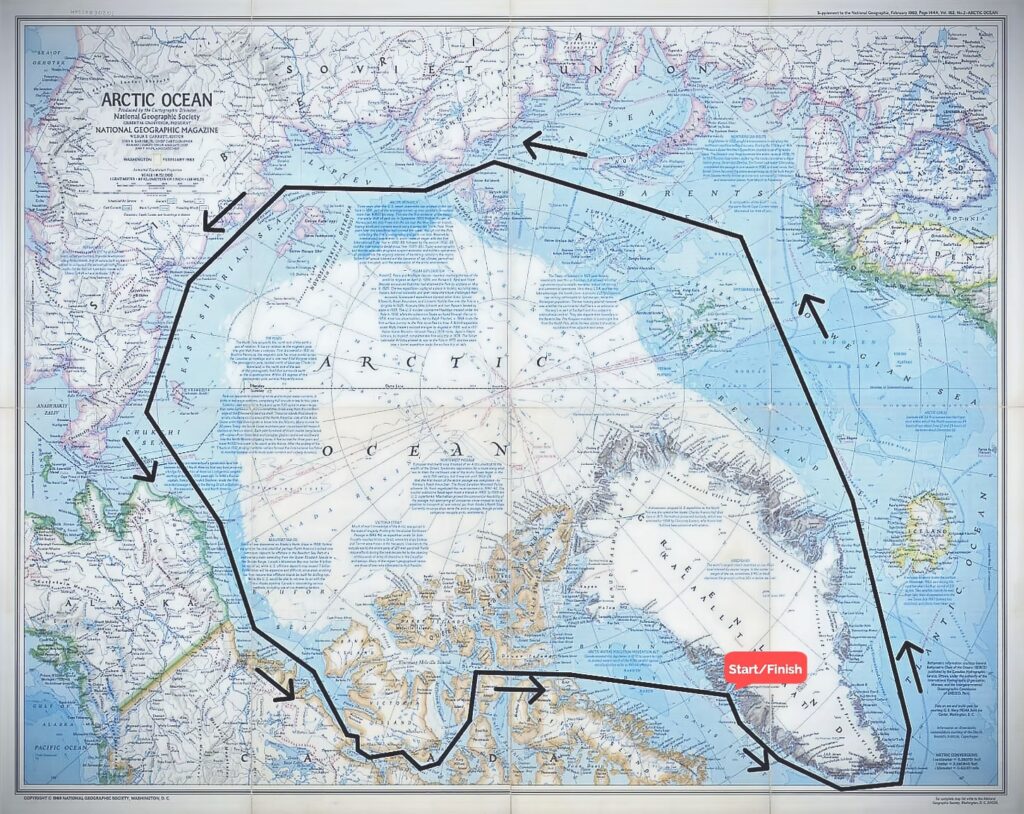
Rutherford, who already holds two Guinness World Records for sailing the Americas on a non-stop solo mission and for manning the smallest boat to make it through the treacherous Northwest Passage, is attempting the first nonstop, single-handed circumnavigation of the Arctic Ocean. The journey will take him from Greenland to the Russian border, then along the Northern Sea Route for a whole month, north of Alaska, through the Northwest Passage and back to Aasiaat. He hopes to finish by early October; by then, he will have sailed over 10,000 miles alone. He calculates his odds of finishing the challenge at 75%.
“I could be down there making a cup of coffee and hit an iceberg the size of a school bus that was hiding below the surface, and I’d sink,” he told Playboy in a Zoom call from onboard his seacraft. “That’s just a constant reality.” During his voyage, he is not allowed to anchor on land or receive outside assistance. Every bit of fuel and freeze-dried sustenance he’ll need is with him on board, the weight of which makes his chances of surviving a seastorm even worse.
Rutherford has lived a life that could fill several biographies; he grew up in a religious cult before breaking out and living on the streets. After finding sailing at 25, however, his life turned around. His current voyage is meant to raise funds for his nonprofit, the Ocean Research Project, which is dedicated to gaining insight into environmental sustainability and conservation. For the journey, he’s even set up a live tracker showing where in the world his boat is.
Of all the hardships associated with a solo boat mission, Rutherford says sleep deprivation is the worst; he often sleeps in short 25-minute bursts before waking up to check for ice. In this interview from his arctic boat, he spoke to us about the genesis of this specific voyage, what a typical day in the Arctic Ocean entails and why this political moment is not great for addressing climate change.
In 2018, I tried to get a permit to sail north of Russia. Russia is trying to claim all the water north of Siberia, north of their northern coast, all the way to the North Pole. Now, normally a country has something like 14 miles of national water. Every country has something called a 200-mile exclusive economic zone, which is for fishing rights and underwater mining, looking for oil. So they’re like, “Nah, it’s all the way to the North Pole.” That’s because they think roughly 40% of the natural gas left in the world is under there. If there weren’t some resources involved, why else would it matter?
At some point in the last couple of years, they differentiated merchant vessels from recreational vessels. So now you can get a permit. I’ve spent six months emailing this department in Russia called the NSRA, and eventually I got the permit. I’ve been working hard at it for the last eight or nine months.I had to redo everything on this boat, but it’s been going on for some years now that I’ve been trying to do it.
A couple different things. After going around the Americas during the nonstop single-handed circumnavigation of the Americas in 2011, I spent 309 days alone in the ocean, and I had to go through the Northwest Passage because that’s part of the Americas. You gotta go over the top of Canada essentially and around Argentina at the bottom. I fell in love with the Arctic. Even before that, I was obsessed with Arctic Explorers and Antarctic explorers, the Shackletons and Scots and Franklins and all the various guys who are trying to get to the North Pole and the South Pole in just brutal expeditions. I started a nonprofit, Ocean Research Project, in 2012. We started doing climate research up in the Arctic in 2015. The Arctic is the place that I go to most years.
The Arctic holds a special place in my heart. It’s a pain in the ass because of the ice; at the same time, I enjoy the challenge. Sailing alone in the Arctic is like putting a video game on the hardest setting. You only get one life. It’s hard to get harder than this. If you like a good challenge, it’s kind of hard to beat.
Sleep deprivation is the biggest, and that’s mostly related to ice. It can be related to storms. And if you combine storms and ice together, it becomes just mayhem. But it’s not uncommon to go 36 hours without sleep, and you’re just sitting here and you’re just looking for ice. If you hit the ice, you’re gonna die. Maybe you can get to the life raft quick enough, but it’s gonna be really bad. There’s a good chance you’re not gonna make it. And the water is so cold, you die in like 10 minutes of hypothermia. It’s literally ice water. So sleep deprivation is the number one challenge.
Trying to stay warm, I’m basically living in a fridge right now. There’s always a battle with numb fingers, numb toes, just trying to stay out of it. It was sleeting earlier today, it snowed a little bit yesterday.. Weather forecasts are pretty bad up here, so you can definitely get hit by weather a lot worse than expected. You always gotta be prepared for anything.
And of course, storms can be quite deadly. The boat is heavily overladen with extra fuel to try to get through Russia and the Northwest Passage. In the old days of sailing when they got in bad storms, they used to throw everything overboard, like cannons, to lighten a ship and I’m a heavy ship. A heavy ship in a storm is not a good thing.
I still have to get north of Iceland, the south tip of Greenland is one of the windiest places in the entire Atlantic. I’ve got that coming up in a couple of days. I’m gonna try to keep some distance from it. It’s also icy as hell. But if I can keep like a hundred miles off of it, it won’t be terrible.
I think about 55% of all science funding was cut [Editor’s note: Trump’s funding cuts to the National Science Foundation have resulted in the lowest science funding in decades.], doesn’t matter what you’re doing, you could be studying butterflies. About 88% of all the polar funding is cut, and they keep doing it. They’re just against climate change and anything having to do with it. I’m built for this a little better as an organization because I’m a smaller organization. If you think of something like Greenpeace, Greenpeace is a large elephant that needs to eat a lot of food. It needs a lot of funding, or else it struggles. I’m small and nimble, like a little rabbit. It’s easier for us to deal with this because we also don’t get as much government funding.
I wanted to do another big single-handed trip, and it’s been 15 years since I did that trip around the Americas. The funding sucks right now. I’ll do some big crazy trip and see if we can’t raise some awareness for the organization, because all of this goes through the nonprofits social media and YouTube.
I need to put a new engine in the research vessel. And we have a 100,000 pound steel schooner, and it’s got an old engine, and it’s every time I go up to the Arctic, I’m working on it. It seems like once a week I’m in there with tools in my hand. I’m not a great diesel mechanic, but I could do it, you know, if I have to. So we are trying to put a new engine in the boat, and that’s like $75,000 by itself, and it’d be nice to get some new equipment.
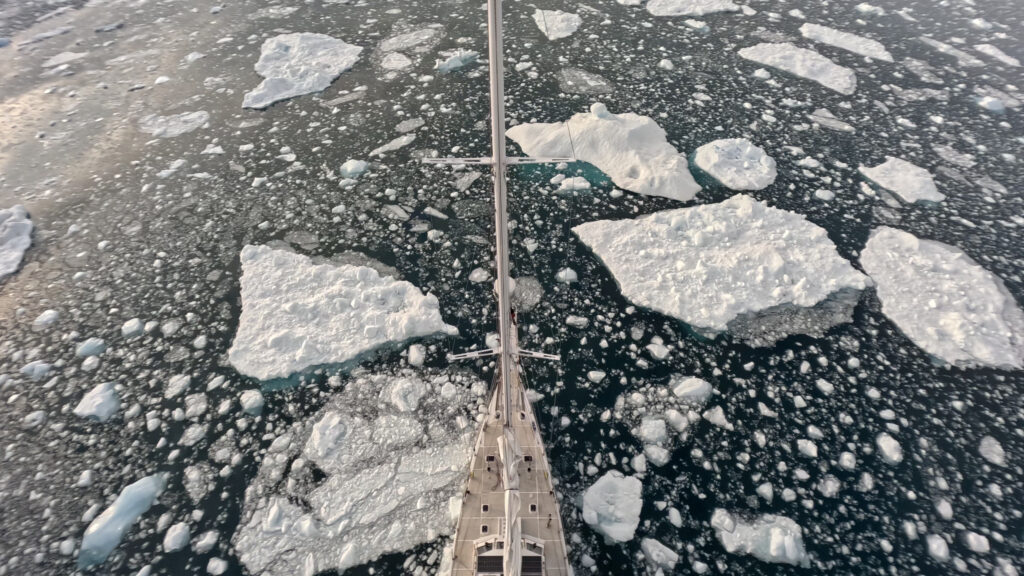
Well, the boat is from 1998, but everything was original, so we got it for a good price. I removed the engine, I removed the rigs. New rigging, all new wires, all new sails, new engine, new batteries, new electronics. I stripped the boat down in a boat yard all winter and replaced every important system on the boat. Everything is new, so theoretically I have a better chance of it not breaking, although it’s a boat, something’s gonna break.
There were some modifications specific to adding extra fuel for the 3,500 miles of northern sea route that’s above Russia and Northwest Passage. The average wind speed up there could be eight to ten miles an hour, which is super light. So when there’s no wind, you need to have the fuel to get moving. And then there’s a lot of freeze-dried food. I had a trainer in Annapolis that was giving me some sailing training. Kind of a super niche thing, but he basically just kicks your ass for an hour. You go in there and he has you work out so you can barely move anymore, so there was a physical part.
There’s no nighttime in the Arctic in the summer. It’s always daylight but I try to sleep in 25 minute increments. I put a cushion out and there’s just enough room for one person. I set an alarm clock for 25 minutes. The first 25 minutes you’re not gonna sleep. The second 25 minutes you’re probably not either but maybe by the third rotation you start getting a little more sleep and then every time the alarm goes off, I sit up, I scan for ice. If I don’t see anything, hit it for another 25, lay back down. I do that as long as I can. Maybe in that period you can get three, four or five hours of sleep.
When the weather’s not too bad I go out and check a lot of things on the boat, the different sails, the chafe, look at the lines. You will find something, some bolt that’s starting to work its way out you need to tighten.
It’s nice to read for a bit, I listen to music about an hour a day, try to read for about an hour a day. You’re basically busy all day. Some days where there’s a lot of ice you just kind of sit in here, which can suck. I like to cook. My freeze-dried food is individual ingredients, it’s not like pre-made, so I can make whatever I want and I enjoy cooking so even though it’s freeze dried I can make a hell of a soup. I have an iPad in there. A friend of mine put a ton of videos on there. Yesterday I watched Pluribus, I watched like two episodes of that sitting out here looking for ice.
I’m never bored because there’s always something I have to do. If I end up finding myself with nothing to do, I’m gonna take a nap, because you’re always trying to catch up on sleep.
Well, I figured the trip around the Americas was 50-50 because that was a much smaller boat, it was an older boat. I didn’t have a radar. This is definitely a better chance than that. But like I said, I could be down there making a cup of coffee and hit an iceberg the size of a schoolbus that was hiding below the surface, and I’d sink. That’s just a constant reality.
There’s all sorts of unknowns, some of it being geopolitical with Russia. The Northwest Passage is not a slouch, either. You know, more explorers have died trying to go through the Northwest Passage than anywhere else, all the rest of the Arctic and all of Antarctica combined.
If I could just get on the internet and look at their really good ice charts, none of that’s going to exist in Russia. That’s like this big unknown of the whole thing. If I can get through Russia, you know, and have a decent amount of fuel left, I should be able to finish this thing off. But who knows? I could get destroyed by a storm a week from now.
My family didn’t sail or anything like that. I’m the first person to have a boat. It was a $2,000 25-foot boat from the 1960s with an outboard engine. I mean, it was the most plastic fantastic piece of crap you can imagine. I didn’t know anything at all, so I didn’t know any better. I always liked adventure and I always liked the wilderness. I hiked the Grand Canyon when I was younger and the ocean is kind of the ultimate wilderness. I had a lot of adventures when I was younger, living a kind of a street life and getting locked up and stuff when I was a teenager. But that was an unhealthy adventure. I walked away from that life fully in my mid-20s, around my 25th birthday and went all in on sailing.
There’s a lot to learn. It’s kind of endless. It’s not just sailing the boat, but like how do you work on the diesel engine? I’m not a diesel mechanic. Now I gotta learn to be a diesel mechanic. That’s gonna take years. If you like the good challenge and you like being alone in the ocean.
Long-term trends are what really matters. A single hurricane, a single hot week or two weeks or whatever it is, is somewhat irrelevant. But what matters is we can look back over the last 10 years, 20 years, you know, 30 years, and see the loss of Arctic Sea ice plainly and easily with satellite information, or see that in Europe, these temperatures are trending higher and higher and higher and higher. When you have more and more data points, it becomes harder to refute. Eventually the arguments change. I think the argument’s already changing, honestly, from climate change being a hoax to climate change being real, but just not man-made.
We should be spending more time and money trying to figure out how this is gonna affect us, along with other species on this planet. You got 21 feet of sea level rise in Greenland, you got 260 in Antarctica. How many feet of sea level rising is it gonna take to become a problem? Two or three feet, and you’re flooding Manhattan, you’re flooding one third of Florida.
One which is obvious is that this really shouldn’t be possible, especially on a fiberglass boat. Regardless of what you think, the ice is melting. We have the lowest ice this year, we had the lowest ice last year.
Also, I want people to believe in themselves, to understand that we’re all capable of incredible things, each and every one of us. It doesn’t have to be something like this. I want people to be inspired to be able to push themselves towards the goals in their life and be able to have that sense of achievement when you finally get there. Now getting there is a long road, depending on your goal. It can be a lot of sacrifice in the process. But through hard work and sacrifice and dedication, you can accomplish just about anything. ‘
And obviously there’s less ice in the Arctic, and that’s gonna cause all sorts of problems. The biggest probably, as you melt the ice, you know, the ice reflects the sunlight. And the more ice you melt in the Arctic, the more sunlight gets absorbed by the Arctic Ocean, and the faster it melts. It becomes a snowball that turns into an avalanche. Last year a research vessel, the Odin, went to the North Pole. It did it back in like the late 90s and they ended up getting there like two weeks earlier than they thought. They’re like, “We can’t believe how thin the ice is.” It was so much harder when they did it before. So yeah, man, we need to start preparing ourselves for what the future is gonna be as things get warmer. What can we do now to kind of get ahead of this a little bit? How can we develop cleaner technologies? The ultimate solution is clean energy. Our government and other governments need to put a lot of money together and really work hard at creating clean energy.