Your bag is empty.

Michael Mohan and Ben York Jones on the joys of nostalgia
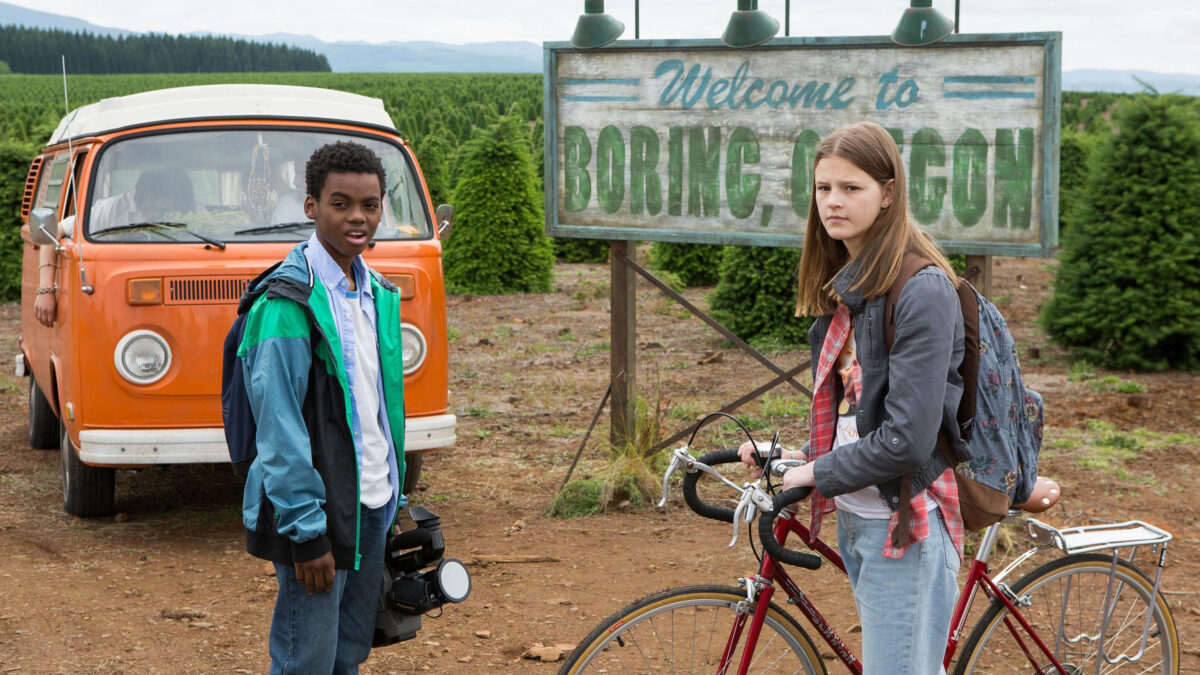
Netflix’s half-hour dramedy Everything Sucks! is woke nostalgia. The series overlays post-millennial sensibilities about race, sexuality and storytelling onto a 1990s world of rotary phones and mail-order CDs. It’s goofy enough to name a kid Scott Pocket, and earnest enough to stage an impromptu death-by-corn dog performance of Uncle Vanya in the cafeteria. The result is a warm, thoughtful take on coming of age in the ’90s.
“The most obvious influence for us was Freaks and Geeks, which we think is probably the greatest high school series of all time,” co-creator Michael Mohan says. “Growing up, we watched The Wonder Years and That ’70s Show and My So-Called Life, and I think you’ll find influence from those.” Co-creators Mohan (who directs seven of the 10 episodes) and Ben York Jones (who co-stars as the head of the AV club) sat down with Playboy to talk about setting aside the rose-colored glasses, and the importance of music—Oasis in particular—for Everything Sucks!
The kids on the show go to Boring High School, and there’s a lot of visual humor on a show that’s otherwise pretty naturalistic. How did you approach the tone?
Michael Mohan: We set the show in a town called Boring, Oregon, which is a real place. We actually shot there. When we were getting ready to pitch the show, we had googled “boring high school” to get pictures of a drab, boring high school, and we found an actual place called Boring.
Ben York Jones: Those elements are a little absurd, but there’s something about a name like Scott Pocket in a world that’s very grounded that’s really funny to us. There are absurd little tokens like that scattered all over the series.
“Jahi Winston, who’s one of the lead actors on the show, has to put a VHS tape into a VCR, and he had never seen a VCR.”
It’s very much a ’90s show. Was that your era?
Jones: We were both in high school in the ’90s, so setting it during that time felt authentic to us. We realized that if you’re a kid in the ’60s, ’70s, ’80s or ’90s, your life wasn’t radically different in any of those periods. It wasn’t until the age of the internet and smartphones that things became very different, and there was something about the days of analog that we really liked.
How did the kids in the show react to the ’90s culture?
Jones: It was very foreign to them. [Laughs] Most of them were born in the late ’90s or early 2000s. Jahi Winston, who’s one of the lead actors on the show, has to put a VHS tape into a VCR, and he had never seen a VCR.
How did you think about your own nostalgia as you were writing? Was high school a happy place, or something you built up in your head over the years as a happy place?
Mohan: There’s a version of the show that feels like a BuzzFeed list—just a list of all these ’90s details—with the characters styled to exaggerate those things. In order to make it feel truthful, though, we dialed that back a little bit. We tried not to think about it from the standpoint of our own nostalgia.
Jones: There were some things specific to the ’90s, and a lot of that had to do with the phones. There weren’t a lot of cell phones, and there weren’t any smartphones. If somebody was on a landline, and you called them, it was busy. That lent itself to some narrative drama.
Cafeteria scenes always make me think of The Breakfast Club and Heathers. Did you think about either of those for your cafeteria scenes?
Jones: We thought more about the conversations we had when we were in high school. There’s a character complaining about how the lyrics to Alanis Morissette’s “Ironic” are not ironic at all, and there’s a scene where they talk about how amazing Showgirls was. We remembered having conversations like those.
How long have you known each other?
Mohan: We met at the 2010 Sundance Film Festival. We had the two lowest-budget films at the festival and met each other at the cheapest place to eat on Main St. in Park City, Utah. We are both like, “What are we doing here?” [Laughs] We both tell relationship-based stories, and it made sense for us to partner up and try to navigate television together.
Most half-hour shows on streaming either watch like movies cut into six or eight or 10 pieces, or watch more like traditional episodic shows but with more of an indie vibe. Where do you fit Everything Sucks! between those two?
Mohan: I think we fall in between. Our showrunners, Jeff Pinkner and Scott Rosenberg, come from network-TV backgrounds, and we come from indie film, so we wanted to make sure season 1 was a complete story but that each episode still had a beginning, middle and end.
“That was a time when 9/11 or Columbine didn’t even seem possible.”
At the end of the first episode, the show leaves open a lot of possibility for where the story could go, which feels much more real-life than a traditional network pilot.
Jones: Our intention with the pilot—and even the first two episodes—was to create a welcoming entry into the series and then get more specific and more complicated from there.
There’s a lot of ’90s music in the series, and the licensing for that can get extremely expensive. Were you able to get most of what you wanted?
Mohan: We were flabbergasted at the number of needle drops we were able to get into the show. Every episode has four or five big songs from the ’90s, and that was really important to us as we were figuring out the budget.
How important was music to you when you were in high school?
Mohan: We had a different relationship with music then. When you bought an album, you spent money on it. It was finite, and our relationship with the music was so much deeper. One of the characters in the show gets the new Oasis record and listens to it over and over because that was the new CD she had. So many of our memories of the ’90s have a deep connection to those songs because of the value we ascribed to them.
Watching that character read through the liner notes for (What’s the Story) Morning Glory? gave me kind of an achy nostalgia. Is that misremembering things as being easier and simpler?
Mohan: That was a time when 9/11 or Columbine didn’t even seem possible. The summer of 1996 was when aliens blew up the White House in Independence Day. Things were a lot more simple.
Everything Sucks! is streaming on Netflix.