Your bag is empty.
Welcome to the dark side of sex and Star Wars
People are extremely serious about Star Wars. They get tattoos of characters, have Star Wars-themed weddings, even come up with sex acts inspired by the movies. Small wonder, then, that “nerdlesque,” the unique intersection of geek and sex, is particularly hot for performances involving lightsabers, droids, or anything resembling the Force.
Performers Cherie Sweetbottom and Maki Roll from Washington, D.C.’s Evil League of Ecdysiasts and Chop Shop burlesque troupes as well as Lily Allure and Xena Zeit-Geist from New Orleans’s Society of Sin created Star Wars-themed acts because they love the characters—but they’re also just so damn popular. Cherie and Maki’s “It’s a Strip” (fans get the Admiral Ackbar allusion) and Xena’s “The Mos Eisley Cantina Cabaret” usually sell out—fans are obsessed. “I recently did my Han Solo act for a packed house in Mobile, AL,” Lily says. “I made more than I had in the three weeks before.” What is it about Star Wars? “Everybody has that nostalgia,” Lily says. “Making it into new art is [exciting].”
That excitement was what prompted Cherie and Maki to take a go-go act at the pop-up Dark Side Bar in D.C. and spin it into a club event that ended up near capacity. “D.C. loves its nerdlesque,” Cherie says. Contrary to what you might expect in a town with such a straight-laced reputation, they’ve found that, in our nation’s capital, “the nerdy stuff does better than the traditional stuff.” She thinks it’s because fans like knowing what they’re getting. “They’re excited to see these characters reveal something new about themselves,” she says—even if the “something new” is a set of Rebel insignia pasties.
The feelings run deep: Google searches turn up Mobile, Alabama’s “The Tease Awakens,” Indianapolis’s “Bra Wars,” and similar shows from New York to Oregon. The love for all things Star Wars and stripping is not even confined to the U.S. Canada’s “The Force Is Shakin” sold out, and Australia’s “The Empire Strips Back” was so successful back home that it’s making its American debut this month.
Maybe the love comes from the universality of the story. “It’s an underdog [narrative],” Cherie says. “These Rebels fighting against a military that’s so well-organized and seems insurmountable, and they win.” Or maybe, as Xena says, the love is just the blissful connection of fandom and undress. “There are a lot of people who like to mix their nerdity and their nudity,” she observes.
Perhaps this is less than shocking in the city responsible for Mardi Gras. In fact, Xena’s Star Wars exploits grew out of a connection to one of that event’s krewes (social clubs that plan Mardi Gras parades). While the Krewe of Bacchus is a well-known organization, the Intergalactic Krewe of Chewbacchus is a little more niche.
![starwarsburlesque-EMBED1[1].jpg](https://www.playboy.com/wp-content/uploads/2026/05/starwarsburlesque-EMBED1_1_-scaled.jpg)
There are a lot of people who like to mix their nerdity and their nudity.
“It was a Star Wars krewe initially, and it’s become one of the most popular parades,” Xena says. “There was a lot of overlap, and we performed at that—go-go dancing—and we walked at that front with the banner. Because who doesn’t love Star Wars?” The parade proved that there was a big, enthusiastic, built-in audience. “There was nothing else in New Orleans like that, on that scale,” she says. “I wanted what would be accessible to people, something that a lot would be interested in.”
Four successful shows later, the approach has evolved from play to revue, largely to keep up with the wealth of new material. “I like having a different show with all the characters available,” Xena says. This allows for a wider range of both artistic expression and fandom. “Even for those who aren’t into sci fi, who don’t identify as nerds, people know Star Wars, they know who the characters are. If they haven’t seen burlesque before, it gives them a frame of reference going in. It’s something entirely different from classic burlesque, like Dita Von Teese. Like [they want to see] how does Yoda fit with Dita Von Teese?”
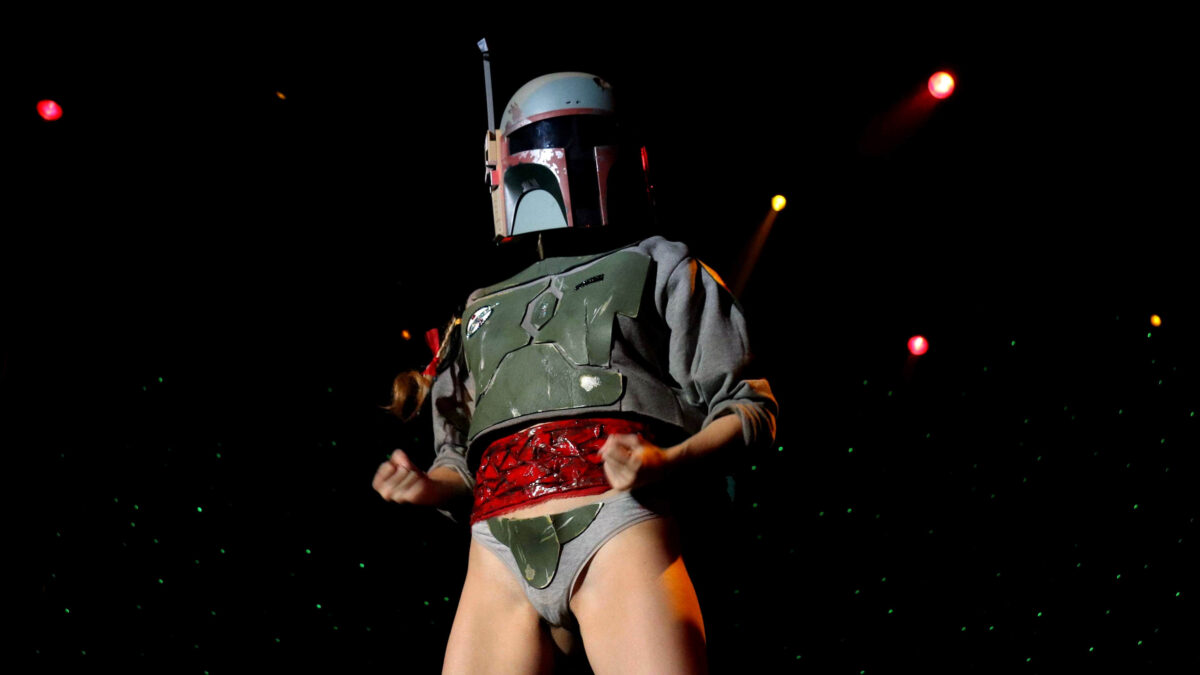
Indeed, the mix of favorites from Leia and Padme to other, less obvious homages—search Ewok burlesque if you’re skeptical—demonstrates that there’s something for everyone. Lily’s acts are Boba Fett—which she recently used to headline Phoenix Comic Con– and Han Solo. Boba Fett came from a cosplay idea. “I’ve always loved [the character],” she says, mostly for his unapologetic nature. After that, the choice of music was obvious: “Not Sorry” by Imagine Dragons. After she put together the music and the character, the precise, militaristic choreography developed from an unlikely source: years of marching band experience. Solo was inspired closer to home. “I pulled some ’60s music and asked my boyfriend to choreograph it because he dances like Solo would,” she says, describing the end result as a combination of space cowboy and Motown.
Her acts may not be the most obvious choices, but Lily says that she likes the contrast of hyper-masculine characters and blatant femininity. “I really enjoy playing men because I’m very feminine,” she says. “I am not believable as a dude, and it’s empowering [to take on that role]. I have fun playing this drag king. And then I turn it on its head again with boobs and a thong.”
Cherie also sees her acts as a combination of strength and fun. Her first act was based on the ubiquitous Leia in the bikini—with a twist. “In my Hut Slayer Leia act, Jabba makes me dance for him and smacks my ass. I have this ‘Oh, hell no’ moment, try to run away, decide to kill him, strangle him, and take off the bikini. I have the Rebel symbol on my pasties and [g-string]. Then I add [the camo] poncho and boots, and I’m off to fight on Endor.”
![starwarsburlesque-EMBED2[1].jpg](https://www.playboy.com/wp-content/uploads/2026/05/starwarsburlesque-EMBED2_1_-scaled.jpg)
A burlesque show might seem an unlikely source of messages of empowerment, growth, and enfranchisement—but that’s what Star Wars offers.
Her Poe Dameron act came out of more personal reasons: She had the costume, and she loved the actor. “I’d been go-go dancing in [the outfit],” she says. “And Oscar Isaac is just dreamy.” Naturally, her appreciation for the actor found its outlet in a new act. “It starts with ‘Don’t Stop Me Now’ by Queen. I climb over a chair like I’m climbing into my X-Wing. I land, jump out, and then it gets strippery. It’s the wild, reckless side he struggles with in the second movie,” she explains. The struggle looks a little different here than it does in The Last Jedi, however. “The helmet comes off and the hair starts flying around”—there’s also a lot more skin shown.
Xena’s Leia act was a hybrid of her admiration for Carrie Fisher and excitement about what the character represents. “Growing up I was often frustrated with how often women in movies (especially princesses) were just passive, pretty love interests and damsels in distress,” she says. “Leia was one of the first female characters that I remember who [was not only] a princess but was also a total badass with attitude and agency.” She chose her music and look accordingly: “Rebel Rebel,” with corresponding Bowie-inspired makeup. Cherie agrees that “Princess Leia has always been a big deal for nerdy women. She’s a leader, not a sidekick. She’s unapologetic in her strength, which isn’t always common in sci fi.”
Maki is one of the super fans who wove the movie into her wedding. She explains her acts as also manifestations of transformation and independence, even if they might not be as immediately apparent as Leia. “I was drawn to Boba Fett because Star Wars is about defined sides, good and evil, light and dark,” she says. “He’s on the outskirts—not neutral, but an opportunist, doing what’s best for him. The Mandalorians are kind of separate, their own thing. They don’t really delve into who he is, besides working for the highest bidder.” Presumably, Maki will be first in line for the recently announced Boba Fett stand-alone.
Her acts, she says, grow out of music. “Stormtrooper” by Pepper inspired her new Finn act. “The music makes it for me,” she says. “It’s my aha moment.” The character was motivating as well. “As a person of color, it meant a lot to me to see a [black] protagonist. I really connect to his character—he’s there for his friends, but he doesn’t take any shit.” She sees Finn’s story as that of someone who is “sold into this life and figures out that he could be stronger.” She loves that burlesque allows her to approach a story in a way that’s personally meaningful, a narrative that can change along with her. “The great thing about burlesque is that there are no rules,” she says. “It can be anything you want, as long as you have a connection to the crowd, and it means something.”
A burlesque show might seem like an unlikely source of messages of empowerment, growth and enfranchisement—but that’s what Star Wars offers. Along with rhinestones and rock anthems, it means a love that’s shared between artists and audiences of this galaxy far, far away. Yes, it’s sexy. But the performance is also unifying, a common experience that transcends the world outside the theatre. “Some people [who came to the show] had lined up for the first movie,” Cherie says. “There is such passion in the Star Wars fandom. So much love.”