Your bag is empty.

The most powerful woman in D.C. politics maintains a steady grip on her party
On the night before the Democrats on the House Judiciary Committee introduced two articles of impeachment against President Trump, I was in the basement of the Capitol with Congressman Jamie Raskin of Maryland, who is one of those Democrats. Raskin is small with dark hair that once fuzzed around his head, but he now slicks it back. Raskin is also a vegan and a former professor of Constitutional Law at American University, which made the lawmaker an instrumental figure in the impeachment of Donald Trump.
I was with Raskin in the basement of the House because sources within the Judiciary Committee pointed me to him when I asked who might actually author the articles of impeachment. On the evening before those articles were introduced, Raskin told Playboy “there’s a profusion of ideas about how to organize [the articles of impeachment], what should be in it.”
When the articles of impeachment appeared on December 10, they were only nine pages long, charging Donald Trump with “high crimes and misdemeanors.” These high crimes and misdemeanors were separated into two categories: abuse of power and obstruction of Congress. The articles claimed that Trump “will remain a threat to national security and the Constitution if allowed to remain in office.”
The report from the House Permanent Select Committee on Intelligence was more detailed—a 300-page-long document that cited phone records and witness testimonies and was divided into subsections labeled as “the president’s misconduct” and “the president’s obstruction of the House of Representatives’ impeachment inquiry.”
As we moved through the tunnels snaking under the basements of the Capitol, Raskin said, “the challenge is just how to synthesize hundreds of pages of the report and overwhelming and voluminous evidence, and it all adds up to irrefutable evidence that the President engaged in this shakedown of a foreign government to come and get involved in our election on his behalf.”
Pelosi seems to always be leaving somewhere, or at least that has become the aura of her presence in the Washington consciousness.
Nine days after Raskin and I walked through the Capitol tunnels together, the House impeached Trump on both articles.
During those nine days, so much happened and yet so little changed. There were marathon hearings in which Democrats and Republicans yelled at each other in chilly rooms, hearings carried live on national television. There were protests across the nation and Senate Majority Leader Mitch McConnell said during a Fox News interview that he would coordinate the Senate trial with the White House.
On December 10, the day that the articles were introduced, I saw Speaker of the House Nancy Pelosi at two events. The first was at her annual Christmas party for the press, held in a room just feet from the floor of the House of Representatives, which obeys the thunder of Pelosi’s gavel. The Speaker, who does not drink, raised a glass of water and toasted the press and introduced a military band who played while she moved slowly through the room. Even some reporters are starstruck by the most powerful woman in the history of American politics, they crowded her and touched her hand and introduced themselves and said the names of their outlets.
Hours later, I was at an event for Pelosi’s daughter, Christine, when a pack of suited bodyguards emerged along the wall, and Nancy Pelosi appeared in the back of the room. She listened to her daughter’s speech and took selfies and smiled and was gone.
Pelosi seems to always be leaving somewhere, or at least that has become the aura of her presence in the Washington consciousness. The Speaker leaving the White House, wearing sunglasses and a now-iconic, burnt orange MaxMara coat. The Speaker, a lone woman at a table of grey-haired men, pointing a jagged finger at Trump before she disappears from the meeting. If you are a tourist lucky enough to spot her in the Capitol, you will see her crossing the black-and-white marble floors of Statuary Hall, from her office to the floor of the House; her security detail gathered around her like a quickening stormcloud.
The nine days during which the House of Representatives formally introduced the articles of impeachment and the evening on which they adopted those articles are about a lot of figures. They are not very much about Donald Trump because Donald Trump was helpless during that period, trapped on the other side of Pennsylvania Avenue with a toothless party protecting him in the House. They are about Minority Leader Kevin McCarthy, who despite being a clumsy principal, was able to keep Republicans united.
But they are mostly about Pelosi, who dealt with impeachment in the most serious tone and only after guiding it for months. During the private meeting in which Pelosi informed her party that they were going to impeach the president, she said that she would be directing the chairs of the committees “under the impeachment inquiry umbrella.” Donald Trump is only the third president to be impeached in the House. Pelosi is only the third Speaker of the House to oversee an impeachment.
The framers insisted that we have impeachment in the Constitution precisely to protect ourselves from a president becoming a tyrant and a despot.
There are some moments that serve as useful footnotes through those few days in which impeachment was argued but barely reshaped. Among the notable is Jamie Raskin before the Rules Committee, an appearance in which Raskin spoke as a professor fascinated by the dusty topic of constitutional law. In his opening statement before that committee, Raskin said that the impeachment process “is the people’s last instrument of constitutional self defence against a sitting president who behaves like a king and tramples the rule of law.” He added later, “the framers insisted that we have impeachment in the Constitution precisely to protect ourselves from a president becoming a tyrant and a despot.”
There is the battle within the House Judiciary Committee, where the articles of impeachment were approved along a party line vote on December 13. The process in the committee took three days and was characterized mostly by elected officials bellowing at each other across the dais. The Republicans’ leader on the Judiciary Committee is a fast-talking Georgia congressman named Chris Collins who wears thin spectacles and speaks in a Southern drawl but one delivered at the frequency of machine gun fire. Collins complained about the proceedings but was powerless to move them in any direction favorable to his party or the president that it serves.
After the vote, Judiciary Chairman Jerrold Nadler told reporters, “for the third time in a little over a century and half, the House Judiciary Committee has voted articles of impeachment against the president, for abuse of power and obstruction of Congress. The House will act expeditiously.”
There is little doubt that Donald Trump should have been impeached. The Democrats see it as an obvious truth, and many of the Republicans see it as an uncomfortable one. Sarah Ferris, a congressional reporter for Politico, said that she was told by a member of Congress that Republicans were “twisting arms until they came out of the socket” to keep their party together on a vote against impeachment.
On the night they impeached the president, I was in the gallery above the chamber where the members cast their votes. The House of Representatives spent six hours debating impeachment before the votes finally fell. The final speech delivered by a Democrat was delivered by Intelligence Committee Chairman Adam Schiff of California who declared, to applause from Democrats, “we used to care about democracy, we used to care about our allies, we used to stand up to Putin and Russia, we used to. I know the party of Ronald Reagan used to.”
But before Schiff’s speech, I was outside the chamber with freshman Congresswoman Alexandria Ocasio-Cortez, who told Playboy “we didn’t run on impeaching this president, we didn’t run on him at all—even myself—I come from a very progressive district and I didn’t run on Trump at all.”
This vote is about whether we’re going to allow two different sets of rule of law in this country. I represent Riker’s Island, 16-year-olds get sent to jail when they jump a turnstile for $2.75 and don’t have cash bail.
The young congresswoman added, “ultimately for me, this vote is about whether we’re going to allow two different sets of rule of law in this country, if everyday people are accountable and the wealthy and the powerful and the corrupt are not or whether we are going to have a radical rule of law in which everyone is accountable to the same standard, and I think that for me, at its core is a very personal meaning of impeachment. I represent Riker’s Island, 16-year-olds get sent to jail when they jump a turnstile for $2.75 and don’t have cash bail. Impeachment in effect like a grand jury, it’s an indictment and to act as though all of this behavior doesn’t even merit an indictment, I think it would just be such an abdication of our responsibility.”
When Pelosi announced that impeachment had passed and let the gavel fall, she cut a glare at Democrats to stifle any rumbles of applause. She was determined to paint this as a solemn moment. She wore a black outfit with a brooch fashioned after the mace of the House of Representatives pinned to her chest. The Washington Post’s fashion critic, Robin Givhan, would later write, “Pelosi dressed for a funeral and her tone was dire. But her glittery brooch made clear that it was not the republic she had come to bury.”
And there are the footnotes even in the moment of impeachment. Congresswoman and Democratic presidential candidate Tulsi Gabbard appearing late in the chamber only to vote ‘present’ on both articles of impeachment. The flamboyantly-outfitted Congressman Jeff Van Drew of New Jersey—who was elected as a Democrat—switching to the other side of the aisle to vote with the Republicans. Members of Congress from both parties proudly holding up the green and red cards that they used to vote on the articles of impeachment.
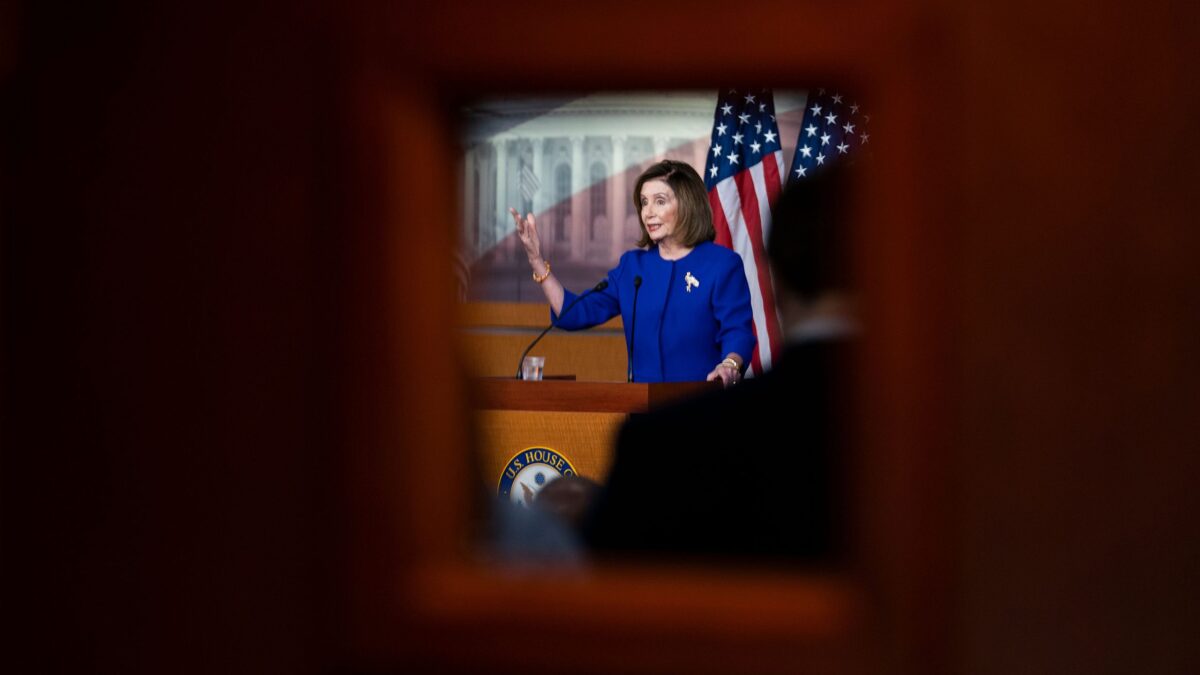
As we sat in the gallery overlooking the vote, there was no real moment of clarity. Instead, the moment of clarity seemed to come minutes later, when Pelosi and her top Democrats gave a press conference. The Speaker thanked the chairs of the committees that conducted the impeachment inquiry before adding, “I could not be prouder or more inspired than by the moral courage of the House Democrats. We never asked one of them how they were going to vote, we never whipped this vote.”
After Pelosi’s press conference, there were still reporters and members of Congress lingering in the halls of Capitol Hill. I sat for a while in the empty and shadowy balcony that overlooks those black-and-white marble floors of Statuary Hall and watched as the lawmakers and their aides moved slowly along. In one corner, CNN’s Dana Bash was recording her show but above the hall, it was quiet. The voices didn’t carry and from that angle, it seemed that Pelosi had succeeded in her determination to make it a solemn evening.
Hours after the vote, there were still some lawmakers in the hallways, and I caught myself beside Congresswoman Jackie Speier, a Californian who sits on the Intelligence Committee. It was cold on the night that impeachment was adopted, the weather in Washington lingered just above freezing and Speier was wrapped in a dark coat. Asked what the epilogue for the night would be, Speier told me, “I think the epilogue is that the Constitution works” before ducking into a car and, along with all of the other members of Congress, leaving Washington for the holiday recess.