Your bag is empty.

Less than 300 geisha remain. We visit Japan and to find out why the enduring tradition is fading

It’s an early evening in August and a group of sweaty American tourists are peering through heavy wooden slats covering the window of an ochaya in Kyoto’s Gion district. Japan’s ancient former capital city is home to 132 of these traditional tea houses, which are deceptively named because ochaya customers don’t pay hundreds of dollars for an evening of tea service. They come to drink expensive sake, eat fine food and, above all, be entertained by maiko and geiko*—*what geisha are called in the local dialect.
On the other side of the cracked, coffee-colored wooden slats is a glimpse of what the tourists are desperate to see but is off-limits to those who aren’t both wealthy and connected: a middle-aged geiko, beautifully dressed in an elegant kimono, plucks the strings of a shamisen while two young maiko—geiko-in-training—dance for a small group of well-dressed businessmen. Another geiko, moving in time with the slow, plaintive sounds of the shamisen, pour the men’s drinks, laugh at their bad jokes and make polite conversation in a refined Kyoto dialect that suggests she’d been born and raised in Gion, long been considered the center of Japan’s geisha culture. It’s even possible she was born into the profession and that her mother had worked in the same ochaya.
Just down the hall, a beautiful 18-year-old maiko tells me about her decision to come here from Miyazaki, on Japan’s southern island of Kyushu, when she was just 15. “I came to Kyoto during a class trip when I was a young girl, and I fell in love with it,” she says. “And since maiko are a symbol of Kyoto, I decided that’s what I wanted to be.”She trained for three years under the strict supervision of the retired geiko who runs this ochaya and it will be another two years before she’s ready to debut as a geiko. If she’s successful, she can make a fortune and perhaps even run her own ochaya one day. But until her debut, she must live on a modest allowance provided by her ochaya “mother.” It had been a hard road, she says, harder even than she imagined, with shamisen lessons in the morning, grueling hours of dance lessons in the afternoon and the work of an apprentice all evening. But the arts are what drew her to Kyoto in the first place and the grueling apprenticeship and training are, in a way, their own reward. The truly difficult part of the job is something that isn’t discussed in polite company: sex work.
“I can’t really say,” is the maiko’s only comment on the subject, which causes her to blush through her thick white make up. Her embarrassment brings to mind a scandal from the previous decade, when one of Japan’s more lascivious tabloid magazines published an article about the famed kabuki actor Sakata Tôjûrô, who the Japanese government had named a “Living National Treasure.” Its headline: “The Treasure’s Golden Jewels.” The article featured photographs, secretly taken, that showed the star exposing himself to a teenage maiko as she left his hotel room one evening.Tôjûrô’s wife, who then held a position in Prime Minister Junichiro Koizumi’s cabinet, quelled the scandal by laughing off questions from reporters and telling them her nonagenarian husband was “harmless to man or beast.”
“It’s very embarrassing,” Tôjûrô said at the time. “I was just so flattered that a pretty young woman wanted to spend time with an old man like me.” Walking out of the ochaya, I can hear the small group of businessmen become drunker and louder. Like Tôjûrô, they seem to enjoy, as much as the music, dancing and conversation, the flattery that comes with the attention of a beautiful woman, even if it costs them thousands of dollars.
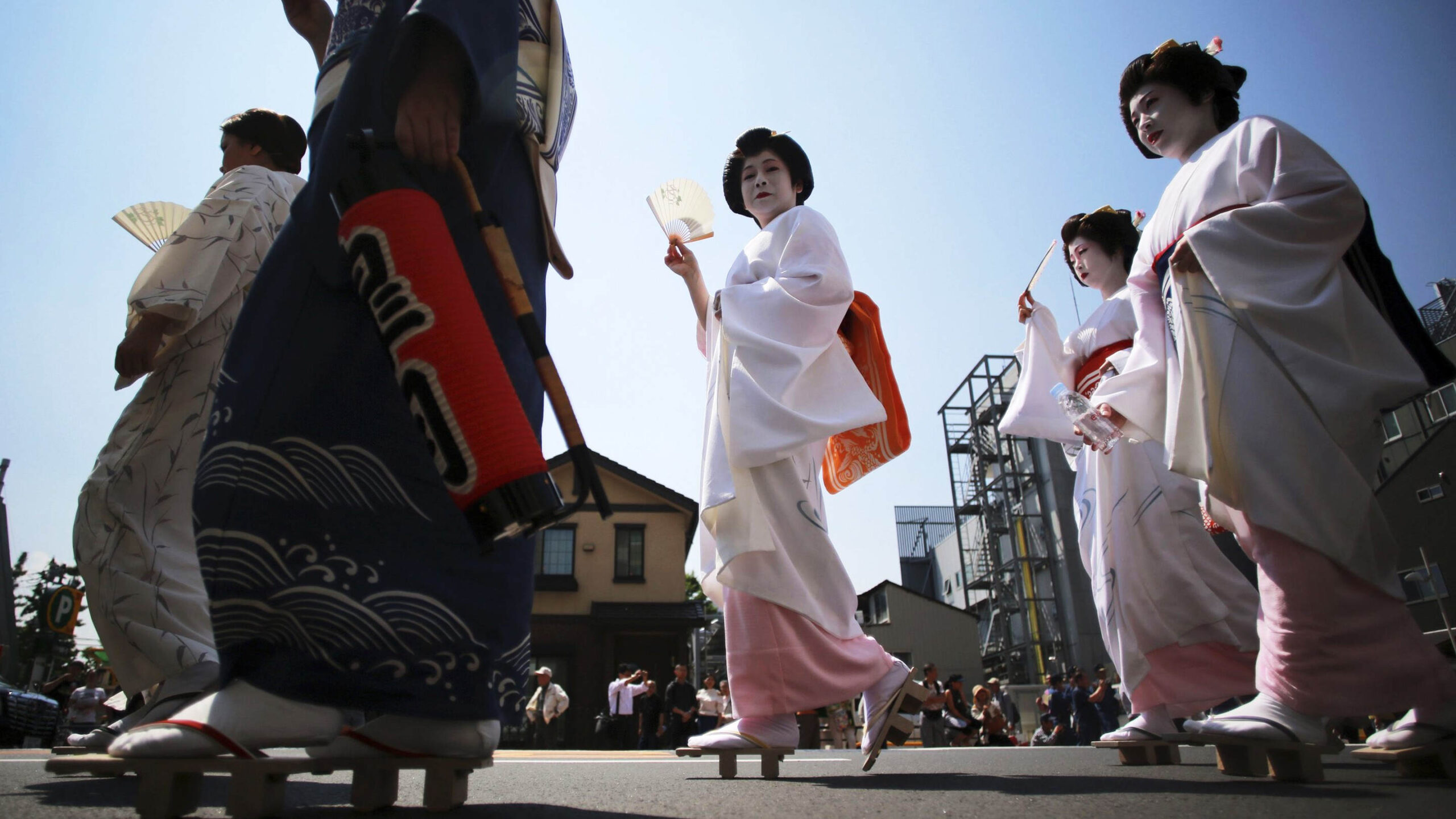
Today, the dwindling number of geisha are increasingly coming from outside of Kyoto. There are now just 186 geiko working in Japan’s ancient capital, and 73 maiko, according to the Kyoto Musical Art Foundation. In the past, it didn’t matter if the number of girls wanting to become geisha was insufficient. Plenty of young girls were sold into the trade to pay off family debts while others were simply born into it. Now, perhaps for the first time in history, the dwindling number of women preserving Japan’s geisha culture are choosing this life for themselves. And often, it’s for the same reasons that have brought tourists to Kyoto for years: the artistic tradition remains exotic and sexy. Teruka Yoshida, a third-generation, Gion-born geiko, says that some of today’s maiko may as well have come from a foreign country for all that they have to learn about Kyoto’s dialect, vocabulary and manners. “They come from Hiroshima, Osaka, Shikoku, Akita, because they want to be beautiful and because they want to experience the excitement of being involved with these Kyoto traditions,” she says. “But this means they begin their training at 15 or 16, at the earliest, while Kyoto-born maiko began dance lessons at the age of 5 or 6. And on top of that it can take years for them to perfect the Kyoto dialect. They don’t know Kyoto words, and their manners are very rough.”
“These are not things one can pick up in a few lessons,” she says. “They must be learned from a young age.” If girls come to her, she teaches them what she can about the insular Gion “system,” and she does what she can to help them improve their manners. Still, she feels a certain sense of hopelessness about this work. That’s because Japan’s remaining geisha are not just shrinking in number, but also becoming less geisha-like—at least from the perspective of Yoshida, who owns a bar in Gion but does not train her own stable of young maiko like other retired geiko do.
What it means to be a geisha has changed tremendously throughout the centuries, and for now, representing a sort of national landmark personified is part of the job.
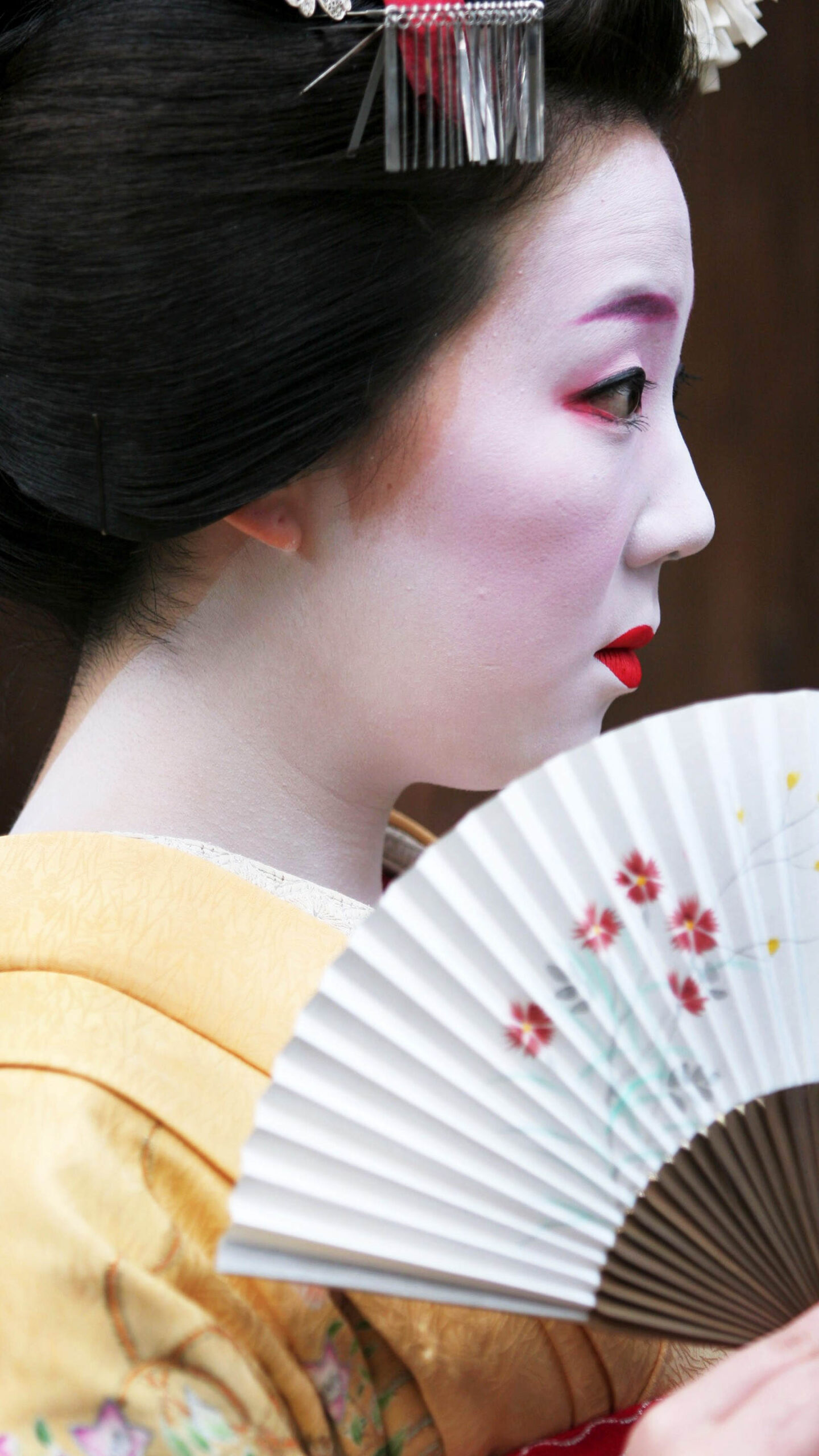
If you walk the quiet side streets of Gion in the late morning, you’ll faintly hear the sound of shamisen music pouring through the tea-colored wooden walls of centuries-old ochaya like Ichiriki, which has been operating for more than 300 years and hosts an exclusive clientele of corporate executives and political leaders. Later in the afternoon, when the maiko have finished practicing shamisen and traditional buyo dancing, they put away their instruments and prepare to entertain their customers, who arrive as early as five or six o’clock. This gives the performers just enough time to get their hair done up into the bulbous, signature maiko style before applying their own make-up and visit someone like Otokoshi-san, a burly middle-aged man who makes his living as a professional kimono dresser. “The obi need to be tied very tight,” one young maiko says of the thick, six-meter long cloth ribbon that belts her layered purple and white kimono firmly against her body. “So the best kimono dressers are usually very strong.”
Otokoshi-san practically lifts the tiny girl off her feet as he cinches one obi tightly around her waist and midriff. He then proceeds to wrap another layer of kimono over the top of it. When they finish entertaining guests, who sometimes stay past midnight, the maiko and geiko will spend hours delicately undoing their expensive kimono, letting down their hair—geiko wear wigs, but tradition dictates that maiko must have their own natural hair styled—and removing layers of white make-up, red lipstick and pink eyeliner. “I sometimes don’t get to sleep until three o’clock in the morning,” one maiko tells me. When walking the streets of Gion, a maiko or geiko travels between worlds, from their home to the theater where they train, or from training to the ochaya. During these transitions is when they are most accessible—and vulnerable—to the throngs of foreign tourists that flock to Kyoto from China, Europe and the United States in growing numbers each year.
Today, two geiko are assailed by a selfie-seeking mob as they struggle to exit a taxi on Gion’s famed Hanamachi street. The mob ignores the signs posted all over town in Chinese, English and Korean forbidding them from snapping photos of geisha without permission. But because foreign tourism has played a critical role in pulling Japan out of a recession, and because the geisha are a symbol of Kyoto’s history and culture, they must politely endure all of this. What it means to be a geisha has changed tremendously throughout the centuries, and for now, representing a sort of national landmark personified is part of the job.
Before geisha. there were odoriko, or “dancing girls,” who provided chaste entertainment for the upper-class samurai of the late 17th century. Eventually, some of the odoriko who continued to perform after their teenage years began calling themselves geisha, including a mid-18th century prostitute named Kikuya, who was famous throughout Fukugawa for her singing and shamisen playing. There were, for a time, male geisha as well, but by 1800 it was considered a female profession. Since the late 8th century, when Japan’s imperial court moved to Kyoto, the city has nurtured an aristocratic obsession with feminine beauty, manners and artistry. So it was only natural that the city became the beating heart of geisha culture. A ranking system was developed and at any given time there were more modern geisha competing with more traditional geisha, conservative geisha competing with gaudier ones.
Because prostitution remained legal in Japan until 1900, this aspect of the geisha’s work was not as unusual as it is in modern times. Kabuki actors, for instance, were also known to engage in prostitution regularly up until this time. Kyoto’s Gion district began its transformation into Japan’s geisha capital early in the 20th century, with tea houses springing up around Yasaka Shrine to serve the many pilgrims traveling there. Kojiro Sakai is a 5th-generation owner of Ikuokaya, which specializes in making fans and ornaments that maiko and geiko use to decorate their hair and kimono. He has watched Gion’s transformation unfold over the past nine decades. “Once there were places to drink tea, customers asked not only for tea but sake, and with sake came the demand for dancing,” he says. “And that was the beginning of the maiko.”
The 18-year-old maiko I speak to is still enamored of the lifestyle, despite her embarrassment over being asked about sex work.
During those early decades, before World War II, maiko were often sold to okaya—geisha houses—to pay off family debt. In the 2009 documentary Real Geisha, a retired geiko named Mieko explained how she’d come to begin training as a maiko in 1936. “I was nine and in the third grade when I started,” she said. “I was sold and because of this I could not leave or go home. No matter what happened, I would be in Miyagawa-cho [near Gion] until I died—this is what I wrote in a letter to my parents.”
Things are different these days. The 18-year-old maiko I speak to at an ochaya in Gion is still very much enamored of the lifestyle, despite her embarrassment over being asked about sex work. Rather than being sold into bondage by her parents like Mieko, it was she who had to talk her parents into letting her move to Kyoto at 15 to begin training as a maiko. That was not the future they’d imagined for her. One day, she tells me, she would like to get married and raise a family, which means her career as a geiko may last less than a decade. Until her training as a maiko is complete, she must only sleep in quarters provided by her ochaya and wear kimonos owned by the retired geiko who oversees her apprenticeship.
It says something about the geisha tradition that its dissolution is coming into view just as it has reached a point when its practitioners comprise women who have chosen the career freely and for their own reasons. While the required five years of apprenticeship and training ensures a at least some long-term commitment, dwindling numbers signal less commitment overall than the previous generation. “I want to get married and have children before I’m thirty,” one maiko tells me. “So of course I can’t do this forever.” Members of the previous generation tend to deride this kind of talk, but for now, these are the girls who are keeping the tradition alive in the backrooms of ochaya in Gion and Miyagawa-cho; these are the girls who occasionally do things they won’t talk about, but mostly do the things they once only dreamed about; and these are the girls who are helping local businesses thrive by walking the streets of Kyoto long enough each day to satisfy the throngs of selfie-hungry tourists. They are not just symbols, but career women turned local celebrities—at least until they decide to take off their make-up and become something else.