
Your bag is empty.
There are countless ways to look at a body, but few artists are as interested in the act of looking itself as Drea Cofield. Her paintings begin with moments of trust: nude selfies voluntarily submitted by friends and strangers, transformed through the slow, tactile language of oil paint into intimate portraits that linger long after the original image might have disappeared. In Cofield’s hands, eroticism is less about spectacle than sustained attention—something rapidly diminished in the social media economy.
At a moment when images are produced, filtered, and consumed faster than ever, Cofield’s paintings of her friends’ selfies insist on something slower: the possibility that looking carefully—and allowing yourself to be seen—can itself become an intimate act. While Cofield’s recent work expands beyond the digital window toward direct observation, she takes our rapid online ecosystem, in which photos feel transient and bodies are readily available, and invites sensuality back into the conversation. Her work requires more than a quick scroll—and that’s what makes it sexy.
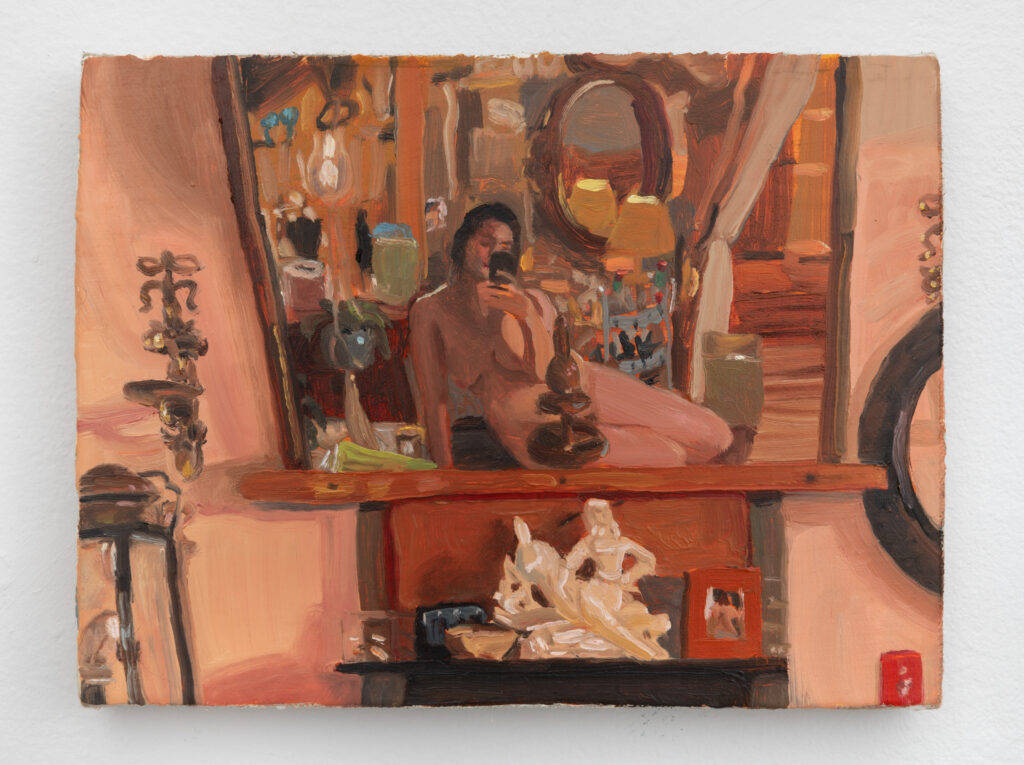
“When I spend days translating a selfie into paint, I’m forced to notice everything that speed normally erases – the strange color shifts in skin, the architecture of a room, awkward gestures, emotional hesitation, little accidents that suddenly become meaningful,” Cofield says. And that time breeds intimacy.
Here, Cofield talks to Playboy about the eroticism in a long look, the spaces our desires inhabit, and why she uses selfies in her work.
As images of bodies become increasingly filtered, edited, and generated by algorithms, has painting become a way for you to reclaim something more human—or does it simply ask different questions about authenticity?
I’m suspicious of the idea that painting is somehow inherently more authentic than digital images. Every image is constructed. What painting offers isn’t authenticity so much as evidence of attention. You can see the labor. The revisions. The hesitations. The decisions. The accumulated touch of another person’s body trying to understand yours. Ironically, the rise of AI has made me even more aware that what moves me isn’t perfection. It’s responsiveness. It’s another human consciousness spending time with the world. Painting doesn’t rescue us from mediation, but it makes the act of mediation visible, and that is so important.
Your early Send Nudes paintings began with images people intentionally shared with you, while your recent work often comes from direct observation. How has your understanding of intimacy changed as the distance between you and your subjects has narrowed?
I’ve always worked from both observation and photographs, and some of the most intimate encounters I’ve had as an artist have happened through images. The Selfie Project has made me realize that intimacy isn’t necessarily connected to physical proximity. People aren’t simply sending me nude selfies, they’re entrusting me with images connected to heartbreak, recovery, celebration, grief, transition, parenthood, illness, or reclaiming their own bodies. Many tell me why they chose that particular image, and that trust is an incredible gift. What interests me most is that the relationship is entirely consensual. The people I paint aren’t passive subjects; they’re active collaborators with agency over how they choose to be seen. That creates a different kind of intimacy; one rooted less in sex than in permission, trust, and sustained attention. I think it also complicates the position of the viewer. Suddenly everyone becomes more aware of their own role in looking.
A selfie is already a performance—someone deciding exactly how they want to be seen. What does painting reveal about those images that photography alone can’t?
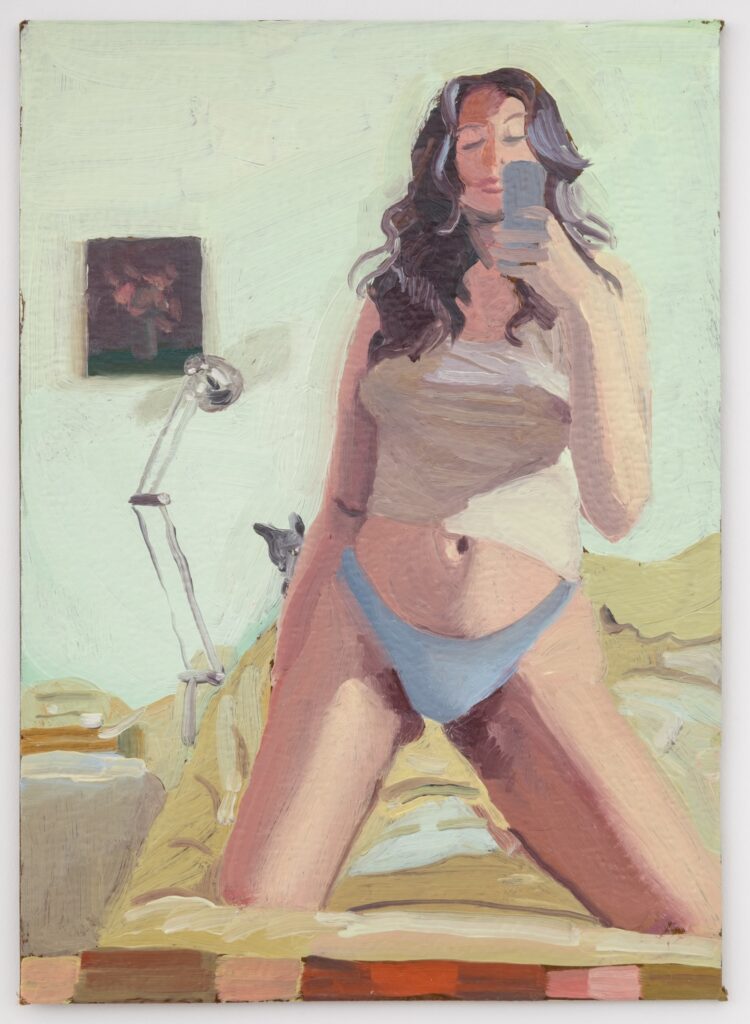
What painting adds is touch. Not literally, of course, but materially. I touch every square inch of the image through paint. I’m not just painting the body. I’m painting the wrinkle in a bedsheet, the toothpaste on the sink, the strange green reflection bouncing off a bathroom wall. My attention spreads across the entire world of the photograph. I don’t think painting is inherently more authentic than photography, but it creates a fundamentally different relationship. The people who submit images understand that I’ll spend hours or days looking carefully at them, responding, making decisions, taking care. The finished painting becomes a record of that sustained attention. To me that’s deeply erotic not because it’s about sex, but because it’s about tenderness, care, and the desire to look closely enough that another person becomes more complicated rather than less.
Your paintings often make the viewer unusually aware of their own role as an observer. Do you think looking at another person’s body can ever be neutral, or is every act of looking charged in some way?
I don’t think looking–or choosing not to look–is ever neutral. What I love about this project is that it quietly destabilizes everyone’s role. The submitter has already looked at themselves. I’ve spent weeks looking at them through paint. Then the viewer enters that chain of looking and suddenly realizes they’re participating too. That’s the part that seems to unsettle people in the best possible way. The paintings raise questions about desire, agency, voyeurism, consent, authorship, projection, and power without assigning clean moral positions. They simply make visible that looking is always relational. I work very hard to make the people who submit images feel safe and cared for. I hope viewers sense that these aren’t conventional portraits. They arrive at the end of a consensual exchange — and then become the final voyeuristic moment that charges the whole thing.
What interests you about locating desire somewhere as ordinary as a bedroom, a bathroom, or a mirror?
Because that’s where we actually live. The bedroom, the bathroom, the hallway mirror– these aren’t just settings. They’re places where we negotiate who we are. They’re where we rehearse confidence, doubt ourselves, flirt with ourselves, take care of ourselves, grieve, celebrate, send risky selfies, or simply catch ourselves existing for a moment. I think the everyday is sexy as hell. Not because it’s polished, but because it’s usually the opposite. It’s messy, lived-in, specific, awkward, funny, vulnerable, and deeply familiar. Many of these images weren’t originally intended to become paintings. They existed for another person– or sometimes just for the maker themselves. That accidental intimacy gives them an emotional charge that’s much harder to manufacture than overt eroticism.
Your work resists simple distinctions between observer and participant, public and private, interior and exterior. Do you think those boundaries have become more fluid in the digital age, or were they always unstable?
I think they’ve always been unstable. Mirrors, windows, doorways, paintings – they’ve always complicated the relationship between inside and outside, self and other, observer and participant. Social media didn’t invent those questions. It just gave us new technologies for performing them. The selfie is fascinating because it’s simultaneously private and public. You’re alone in a bathroom looking at yourself while imagining a person who isn’t there or an audience that doesn’t yet exist. That threshold has become one of the central subjects of my work. I’m less interested in resolving those contradictions than in letting them remain productively unstable.
Many conversations around erotic imagery focus on censorship or provocation. Your paintings seem more interested in permission—permission to look, to be seen, to construct oneself. Is freedom something your work is trying to depict, or something it actively creates?
I hope it actively creates a sense of freedom. Agency is incredibly important to me. The people I paint aren’t simply being looked at– they’ve chosen to participate. They’ve chosen how they want to be seen, and they’ve entrusted me to respond. That changes the entire dynamic. I’m much less interested in provocation than in permission. Permission to look carefully. Permission to construct yourself. Permission to desire being seen without immediately collapsing that desire into sex. For me, freedom isn’t the absence of limits. It’s the possibility of entering a relationship built on consent, trust, curiosity, and mutual participation.
You’ve described painting as an act of faith, sometimes releasing a work before fully understanding it yourself. How important is uncertainty to your practice? Are you hoping viewers arrive at answers, or remain inside the questions?
Honestly, I probably thrive on uncertainty. I like not knowing where a painting is going or how it will turn out – I trust that more. It feels much closer to authentic-looking than certainty ever has. If I already understood exactly what a painting meant before I made it, I don’t think I’d bother making it. Painting is one of the ways I think. I have structures and routines that help me stay responsive rather than performative, but doubt is always part of faith. That’s true in painting just as much as life. I’m not hoping viewers leave with answers. I hope they leave more curious than when they arrived. Curious enough to keep looking. Curious enough to question their own assumptions. Maybe even curious enough to submit a selfie themselves.
If someone leaves your exhibition thinking less about the bodies in your paintings and more about their own habits of looking, would that feel like the work has succeeded?
Absolutely. I don’t want people to leave feeling scolded or morally corrected. I’m much more interested in activating awareness than prescribing behavior. If someone walks away thinking differently about how they look at images, why they linger on certain bodies, what they project onto strangers, or how they themselves want to be seen, then the work has continued beyond the gallery. Ultimately, I don’t think my paintings are about bodies. They’re about looking. The bodies are simply generous enough to help us notice ourselves looking.
You can submit and watch me paint selfies on my OnlyFans @sendmeyourselfies. You can also submit selfies through my instagram @dreacofield.