Your bag is empty.
Just five years ago, Greg Shahade admits that he probably couldn’t have identified the Mona Lisa from her signature enigmatic smile. Fast forward a few years and he’s now a two-time Jeopardy! champion, clinching his first victory on Monday and ending a 31-game win streak from New Jersey’s Jamie Ding.
But aside from disrupting Ding’s historic run with a now-encyclopedic trivia knowledge, Shahade is making headlines for a more personal reason: the new champ is polyamorous. In his Jeopardy! game and his numerous other competitive pursuits (chess and CrossFit among them), Shahade is all about control. He’s meticulous in studying and strategy, then plays a killer game based on his plan. But in his personal life, Shahade practices “relationship anarchy,” in which his relationships don’t have a structure.
“I just don’t like control and telling people what they can and can’t do,” he said. “I want everyone I’m close to, I want them to do the things that make them happy all the time. If they meet somebody they really like and they want to spend time with that person, that’s fine with me.”
In an interview with Playboy, Shahade, whose two-day winnings so far total $44,000, spoke about the stamina that competitive chess requires, what it was like to hear that he had beat Ding, and the tension between control in his game and lack of it in love.
Can you tell me just a little bit about your history with Jeopardy!?
Some friends kind of convinced me to join a trivia league. I have a little competitive streak, so I started to study everything pretty aggressively. I started making flashcards, looking at old Jeopardy! games.
I was very bad at general knowledge before five years ago. People would make fun of me a little bit. I have chess skills, but when it comes to history or art, I knew almost nothing. If you really try, if you’re very systematic at it, you can learn that stuff in a few years. About two or three years ago, it was obvious that if I made it to Jeopardy!, I would be a decent player, so I decided to give it a shot. It was my mom’s favorite show. She passed away 13 years ago. I wasn’t really into it when she was alive and now suddenly here I am on the show.
You said you watched old Jeopardy! But how else do you learn trivia?
I looked at Final Jeopardy. I would see an art question and the answer would be Leonardo da Vinci, some painting he did. And then I’m like, “OK, I need to know about artists.” I looked up who are the 10 most famous artists and I decided I was going to just learn about them. I would then learn their two or three most famous paintings, and I would make little flashcards. So it’d be Da Vinci, Michelangelo, Raphael, and then some more modern people like Picasso, Dali. And I would just repeat that process. So later I’m getting to the 30th most important artist. I would do that with literature. I would do that with poetry. For history, I would do deep dives on World War II, the Revolutionary War.
It never hurts to learn more about the world. If I quit doing this and it’s too much, at least I’ll have become more cultured. But I really got into it and it was fun just seeing myself improve so quickly.
There is a lot of strategy that goes into winning Jeopardy! How did you prepare?
Jeopardy is a pretty brutal game because you get one chance in your life. If you lose that game, you’ll never get to play again. And I’m playing this guy, Jamie, he’s very good. In a different universe, or on a different day, I could have easily just lost that game and you wouldn’t be talking to me right now. There’s a little luck involved. I found the Daily Doubles. The fact that I knew them, I could have not known the answer and just lost all my money—that happens sometimes.
I was also a professional poker player for eight years. That’s really helpful, with all the betting and the risk. Being immune to risk—or being willing to risk it all—say I’m going to go all in. You just have to make the right strategic bet. With poker, of course, betting strategy really comes into play.
What made you want to jump from just doing CrossFit into competing?
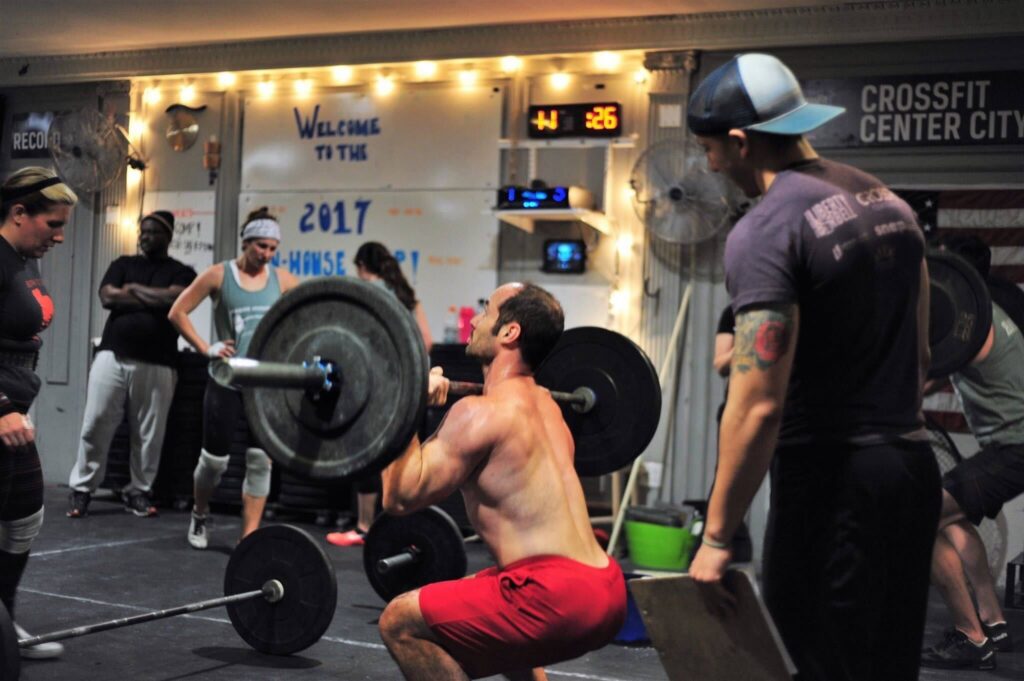
I’m in between competitively and totally recreational. I’m not like the people you see on TV if you’re watching CrossFit Games. I got into it in 2012 and at almost every gym, there’s this CrossFit open and it’s for people of all different levels and abilities. So I entered it maybe after a year of doing CrossFit and you know, it was tough, but as I got more experienced, I started to do better. And if you did good enough, you would qualify for the next stage. Maybe 10% of people could do that. Then there’s the semifinals. I’ve never been good enough to get to the next stage past that.
How long have you been a competitive chess player? What do people not understand about chess as a competitive sport?
My dad was a four-time state champion. My sister is also a two-time US Women’s Champion. My dad was so into it and he was the best player in the city. So everyone kind of congregated. I started playing at a young age, some high school championships, junior high championships.
It’s physically grueling, which is surprising because you’re just sitting there, but if you’re playing a really serious chess tournament, especially in the USA, often you’re playing two games a day for three or four days, but those two games can last five to six hours each. Imagine you wake up and then you spend five hours—and it’s not relaxed hours. You’re racking your brain the whole time and then maybe you eat lunch and do that again. It can take a lot of stamina.
So, your dad played chess very well. Did you grow up in a house that emphasized or encouraged competition?
My mom was also really into games. When I was in third grade, my teacher had this game that she would have the kids play. There were these circles—it’s called 15 Circles—and you would cross out some circles and then she would cross out one, two or three. Whoever left the other person with one circle was the champion. And I didn’t know anything about this game, but I told my parents about it. They were like, “OK, we’re going to figure out how to win this game.” And they basically solved the game. They figured out how to win by force if you went first. They taught it to me. I go back and then the teacher calls on me to play her and I win because I already know how to win the game. Then everyone else in the class gets to play against me and I beat them all. My parents were teaching me deep competitive strategies at a very young age. That’s kind of what they lived for, that kind of intellectual challenge.
I’m more chill now. I’m more zen. I always try to do my best and put on my best performance. But I am also very aware that I’m not always going to win. The only thing that really matters to me is just doing my best and doing all the things that are in my control. When I lose, I don’t beat myself up about it.
Are there games that you play that you know you’re not good at?
I’m not that good at pool or bowling. I’ll play them with people. It’s tough because I have that spark where, if I really like a game, I just naturally want to get good at it. Usually I can figure out what those are. If I wanted to get better at pool—like really really wanted to— ‘m sure I could. I’m not saying I’d be the best in the world, but I’m sure there’s a process involved for improving at pool.
Are there methods from chess that transfer over to Jeopardy!?
I had a big lead of $15,000 to $4,000 and then I found the last Daily Double. So now I have an opportunity to really put them away. I can get all my money and go from $15,000 to $30,000 if I get it. If that happens, he’s basically as good as dead. I bet $7,000. If I get it right I have $22,000—still a very good scenario—and if I get it wrong I have $8,000 instead of zero.
Humans are not good with tension and not knowing the outcome, so there’s situations in chess where you want to make a really aggressive move. Your body just wants to do it, your mind wants to do it, because if that move works, you’re just gonna win right away. And if it doesn’t, you’re just gonna lose right away. But at least the tension and everything is resolved. In my game I had actually already decided before the game that I wasn’t going to do that very very big bet in that scenario, because the penalty for getting it wrong is pretty severe and I thought I’m skilled enough to keep the game murky and $22,000 is also still like a pretty good lead.
On your social media, you talk about many parts of yourself, including playing chess and loving donuts, as well as being poly. How long have you embraced being poly?
In my heart, for a long time, but in actually living it, maybe about eight years. People have a lot of very strong opinions about nonmonogamy and polyamory, so it’s a little distracting to put it out there, because people will make judgments. But I feel it’s really important to represent. There [are] a lot of people who are nonmonogamous who don’t feel comfortable saying it and I feel I owe that to the world to be like, “Hey, here I am.” So many people are just really nasty about polyamory.
Did you delay embracing that part of yourself because of the nastiness?
I don’t know if it was the nastiness. It was just more that monogamy is a default culture. I think I was wrong. I think I could have done it a lot earlier and been very very happy. But it takes time to figure that stuff out.
And have you been with both of your partners for eight years?
Do you know relationship anarchy? That’s probably the most specific thing that I feel like I am, but it’s like it’s a really weird word to put out there, so I don’t I don’t bother saying that. One of my partners, one of the partners that you’re probably mentioning, we’re still very close but like our relationship has changed and has become a little less sexual and romantic, but still very very loving and caring. Me and my other partner, it’s still going strong. I met one of them in 2020 The other I met in 2015-17, but we started dating in 2021.
I just don’t like control and telling people what they can and can’t do. I want everyone I’m close to, I want them to do the things that make them happy all the time. If they meet somebody they really like and they want to spend time with that person, that’s fine with me.
You ended someone’s 31-win streak, so can you bring me back to that moment? Did you know going into Final Jeopardy that numbers-wise, you couldn’t lose?
I did know, so I’m standing there being like, “Oh my god, I can’t believe it. I just won.” It was very close; he almost had enough to catch me, but not quite. I did lots of math, but I was still paranoid that I was miscounting.
I had this huge rush of adrenaline coursing through my veins. I just did this thing that I’m really proud of and excited about, but I have to be ready to play again very soon and everybody there is dangerous. I wanted to keep winning, so I had to shift my mindset away from “I beat the giant,” to defending my title, really focus, and try to survive as many games as I can.