

Your bag is empty.
A month after JFK was shot dead in Dallas, the Smiley Face was birthed into the world. Within a decade it would become one of the most iconic and recognizable pieces of pop culture ephemera to exist. Everyone knows it, and in multiple forms: “Forrest Gump,” Walmart, Nirvana, “Watchmen,” the emoji keyboard. It’s on billboards and T-shirts and bumper stickers and plastic bags snagged on storm drain grates. Its resonance is such that it hits equally as an affirmation and as a critique. Culture and counter-culture.
The people who invented the smiley face didn’t have such lofty goals for it, of course. The common telling is that the management of the Massachusets-based insurance company, Worcester Mutual Fire Insurance, wanted to bring cheer to their workplace, so they commissioned an artist to draw that happiness into being. But perhaps the reason the smiley face can be taken as both an expression of content and contempt is because its origin was filled with both those things. The smiley face was intended to bring cheer, but if you look at the totality of the record, the goal seems more sinister. In effect, the smiley face became a plain old corporate humiliation ritual.
The reason Worcester Mutual Fire Assurance, a small insurance company, wanted to bring cheer is because they had just cut a tenth of their staff and relocated the rest to the gleaming new offices of the ritzier State Mutual Life Insurance of Worcester, as part of a deal brokered to “affiliate.” Not a merger, the CEOs jointly explained to the press, nor an acquisition. Instead, they proclaimed that the not-a-merger was a historic step into the future of insurance, which just so happened to be affiliation-based. The remaining workers were made to decipher “consolidating sales operations,” in an unfamiliar office with new coworkers.
The year was 1963, and the groundwork was being laid for the “Shareholder Revolution” that would redefine American life over the next several decades. And it so happened the larger insurance company was headed up by a titan in the budding free market fundamentalist intellectual scene, one that would soon swallow the Republican Party. Morale was low, and low morale, management inferred, was affecting sales. An ambitious upstart in marketing named Joy Young—can’t make this stuff up!—pitched a smile button, to make employees smile. Instant greenlight. For $45, she commissioned local commercial artist Harvey Ball to draw a smile-shaped line on an otherwise blank canvas (an idea Amazon would rock with decades later). Ball found it too easy to turn the thing into a frown. Suspecting people would do so, he added dashes for eyes. Voila!
Soon after, the first box of buttons arrived on the sales floor. Employees were asked to put them on. The box of pins was accompanied by posters on office walls bearing the slogan “Smile—it’s our agents who feed us.” The company told employees the buttons were meant to symbolize “the purpose of insurance: freedom from worry about loss.”
We don’t know exactly what the remaining employees, who likely returned to their cubicles to find a double portion of responsibilities now on their desk, thought about the pins. But it seems reasonable that the little happy faces sent a message: Grin and bear it. The enduring cultural presence of the smiley face rippled out from this one specific instance of corporate dismantling in the early days of an economic order we remain under to this day—a humiliation ritual so wildly successful you could argue it never ended.
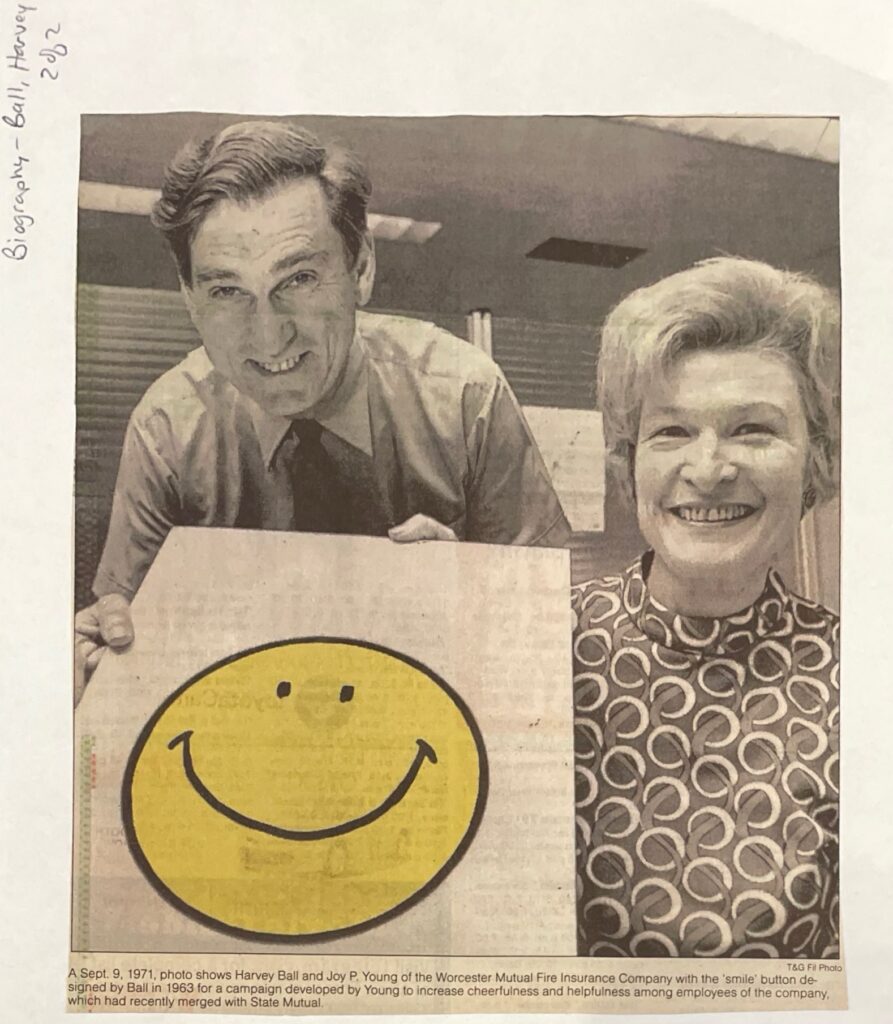
A 1966 article in the Telegram and Gazette, Worcester’s paper of record, is likely the earliest public reference to the Smiley Face, meaning that for its first three years, it went largely unremarked upon outside of the company. The article is headlined “Unique smile button catches public fancy.” It opens with a vignette of a receptionist who’s become accustomed to passing out “smile pins” to the many people who come to reception for the sole reason of asking for one—a glimpse at how the contagion first spread out from State Mutual’s “home office” into the wider world.
The article is a series of slice-of-life anecdotes, saving best for last: the one worker who “made widest use of the smile.” “Rather than sign her name on memos, she’d taken to drawing a smiley instead,” the reporter writes. “A circle, two slashes for eyes, a heavier slash for a mouth, and lots of lines at the top of the circle do the job just as well.”
As the popularity of the image grew, the new conglomerate, rolling with the budding trend, did a soft relaunch, branding itself as the “Smile Group.” With a new corporate office in Ohio, the smiley tapped into a new region, where local reporters would start picking up on it in a fashion similar to the Telegram.
For a 1974 feature in the Columbus Dispatch, a reporter got Ball and Young’s thoughts on the Smiley, now that millions of pins had been sold over a decade. Young was basking in it. “No matter where you looked, there was that little round face smiling back at you. You just couldn’t escape it.”
But its uncomfortable corporate start isn’t the only secret of the smiley face.
To look at the smiley’s inception in context, to track its rise from obscurity to “life of its own” sensation, is a funhouse mirror held to the neoliberal project. In the heady days of the early sixties, the disciples of Milton Friedman were just beginning to branch out into the public and private sector. It just so happens the company that contracted the smiley was headed by one of the most effective and also little known free market cheerleaders: H. Ladd Plumley, the head of the U.S. Chamber of Commerce in the years leading up to Kennedy’s assassination, a Republican Party operative who rubbed elbows with Reagan and Bush (who may have personally brokered the 1980 presidential ticket), and the president and chairman of the insurance company that turned the mid-sized working class city of Worcester Massachusetts into a defacto company town.
Before he took over Worcester, Plumley was the Army’s head life insurance guy during World War II. He then moved from D.C. to Worcester to make a small and unambitious insurance company called State Mutual hungry for growth. In 1947, he wrote an impactful industry whitepaper titled “Budgeting The Cost of Illness.” He founded the members-only Worcester Club that remains exclusive to a jacket-owning set to this day and he sat on the Redevelopment Authority that cleared the Black and Polish neighborhoods for the highway that now bisects the city, with an exit conveniently next to the corporate headquarters he constructed.
Amid all of this, he was president of the US Chamber of Commerce, presenting himself in speaking engagement after speaking engagement, sometimes multiple in a week, as the bulwark against John F. Kennedy’s big government designs. His personal archives in the Museum of Worcester are stuffed with speaking notes and bounded speech transcriptions—always to either Republican groups or business lobbyists, as he traveled the country by “aircade” (which is exactly what it sounds like).
In effect, the smiley face became a plain old corporate humiliation ritual.
In these speeches, he had his roster of reliable hits: deregulation, tax breaks for venture capital, opening up new terrain for the free market in the Global South and Europe, and what he called “individual initiative.” His reasoning went: with the gold standard eroding, confidence was the only thing backing the power of the US Dollar. Confidence in the dollar was primarily reinforced by the “soundness of decisions our people make.” In this brave new world, everyone would be called on to “be their own economists.”
At an August, 1962 meeting of the Advertising Club of Washington, he articulated the theory bluntly. “We need a pervasive mood of confidence, of reward, if we are to have a healthy economy.” In advocating for tax cuts, he argued it would stave off a recession by sheer force of confidence alone. Recessions are psychological, he argued. A tax cut would “prevent the mushrooming of recession psychosis.”
By May of 1963, he’d refined the message for a broader audience. “The development of our economic life in the United States depends upon the increasing development of our people in the process of individual decision making.” His theory was the equivalent of a smiley face pin. Absent from these speeches was any word what he obviously stood to gain, as the chairman of a life insurance company.
In “A Brief History of Neoliberalism” geographer David Harvey positioned the theory that the high-minded sounding free market orthodoxy spewed in the 1960s and 1970s before taking total control in the 1980s, carefully concealed a “consolidation of class power,” bringing the supremacy of elites back from a historic low point in the mid 1960s. The wealth disparity between the 1 percent and the rest was the lowest it’d been in decades. “The restoration or formation of class power occurs, as always, at the expense of labour.” This restoration was carried out by privatizing, slashing and burning, consolidating and financializing bits and pieces of the social safety net in the name of freedom. “The social safety net is reduced to a bare minimum in favour of a system that emphasizes personal responsibility. Personal failure is generally attributed to personal failings, and the victim is all too often blamed.”
While Plumley was taking his aircade across the country preaching to business communities far and wide, his company was gobbling up other companies at a similar clip—the first of which was Worcester Mutual Fire Insurance, home of the smiley face. Plumley worked around and then had changed a state law that prevented life insurance companies from investing capital in other insurance companies. Some 21 other insurance companies would follow. Plumley renamed State Mutual “The America Group.” Central to his “affiliation” strategy was the “consolidation” of “operational costs” i.e. labor costs. The preacher of personal responsibility was personally responsible for the erasure of an unknowable amount of good middle class jobs.
It was in this man’s wake that the smiley was introduced. To a world just beginning to perceive this new slash-and-burn edict, the Smiley slid into a new hole conventional language hadn’t yet filled. The prototype for the “soft skills” and “personal branding” of the contemporary professional world. In “The Age of Surveillance Capitalism” Shoshana Zuboff describes the 1960s into the 70s as a violent collision between a second modernity that centers the self, and the exploitative tendencies of a new free market economic regime. In other words, the smiley marks the introduction of the broad new social contract we still live under. A radiant yellow reminder of the ongoing humiliation.
The smiley only grew in popularity as the collision became more violent. By the time generally accepted as the start of the neoliberal era—the Thatcher and Reagan elections of 1979 and 1980—the smiley was worldwide. But the connection runs deeper than symbolism. Tucked in H. Ladd Plumley’s personal archive is a letter from George H.W. Bush dated July 22, 1980. “Dear Ladd,” Bush wrote, “Your letter to Governor Reagan must have done the trick.” Five days prior, Bush became Reagan’s vice presidential candidate, ending a competitive primary between the two candidates.
“I am honored to have been placed on the ticket and Bar and I will work our hearts out to insure [sic] his election,” Bush wrote. “Jimmy Carter must go for the good of the country.”
And “insure” it they did. The man atop the insurance empire—who pioneered an approach to corporate workforce reduction that, in turn, produced the smiley face—also, apparently, secured the vice presidential candidacy of his friend George Bush, setting in motion not just the Reagan-Bush victory in 1980 but the Bush family’s three-decade residency in the White House.
In 2002, the year after Bush’s son won his first presidential election, Plumley’s empire of affiliate insurance companies collapsed. By then rebranded to the Allmerica Group, its share price fell 81 percent on the year. Its CEO abruptly resigned. It sold off buildings and attempted to hedge the investor panic by pivoting to “added emphasis” on its property-and-casualty insurance offerings. What remained of State Mutual Life Insurance was sold off, most of it to Goldman Sachs.
The smiley, on the other hand, was thriving, well along a process of digital transformation. In 2007, it rose to the status of language, when a set of emojis were first standardized by the Unicode Technical Committee.
It also outlived the artist who drew it. In 2001, Harvey Ball succumbed to liver failure at the age of 79. In his brief New York Times obituary two facts are noted side by side: that he fought in the Battle of Okinowa, and that he worked until he died.