

Your bag is empty.
This story appears in our Summer 2026 issue, on newsstands July 28. Want us to come to your place? Become a member to get digital access to the issue and early access to paywalled content.
Most wars begin with a set of questions: What do we fear? What is possible? What will they do to us? What will we do to them? Unfortunately, prewar imaginings are rarely very accurate. Any sustained study of human conflict becomes a shadow study of mistaken assumptions, magical thinking, and hubristic overconfidence. Thus, every war is fought three times: first in the imagination, then in reality, and finally in memory.
It typically takes citizens a long time to turn against wars launched in their name. It’s largely a myth, for instance, that the American war in Vietnam was undone by public opinion. On January 31, 1968, North Vietnam and the Viet Cong launched the Tet Offensive, a tactically brilliant but militarily doomed operation that saw virtually every city across South Vietnam suffer a coordinated surprise attack. For years, American officials had claimed their demoralized enemies were on the ropes. The moment at which the final, decisive blow would fall was so anticipated that it became known as “the light at the end of the tunnel.”
Tet exposed this cheerleading as either ruinously wishful or outright deceptive. And yet, in Tet’s immediate aftermath, many Americans did not abandon the war, support for which reached 61 percent, according to a Gallup poll conducted at the time. For these citizens, the offensive proved that more American elbow grease (and blood) was needed. Only in the months and years that followed Tet did public confidence erode. The abyss between what America had imagined was possible and the grim reality it occupied had become impossible for average citizens to ignore.
Every war will have its opponents and defenders. What binds them is the socio-imaginative context in which all wars are fought, only part of which involves the battlefield. In time, these contexts often harden into national mythology. Sometimes that mythology aligns with where a war sits in our collective imagination, as with the holy meat grinders of the U.S. Civil War and World War II. When imagination and mythology diverge, however—as in Vietnam, Iraq, and Afghanistan—the myth ruptures, often messily and always painfully. In Vietnam, the scale of that rupture took years to fully register. Even when it did, Americans and Vietnamese went on fighting and dying for another half decade.
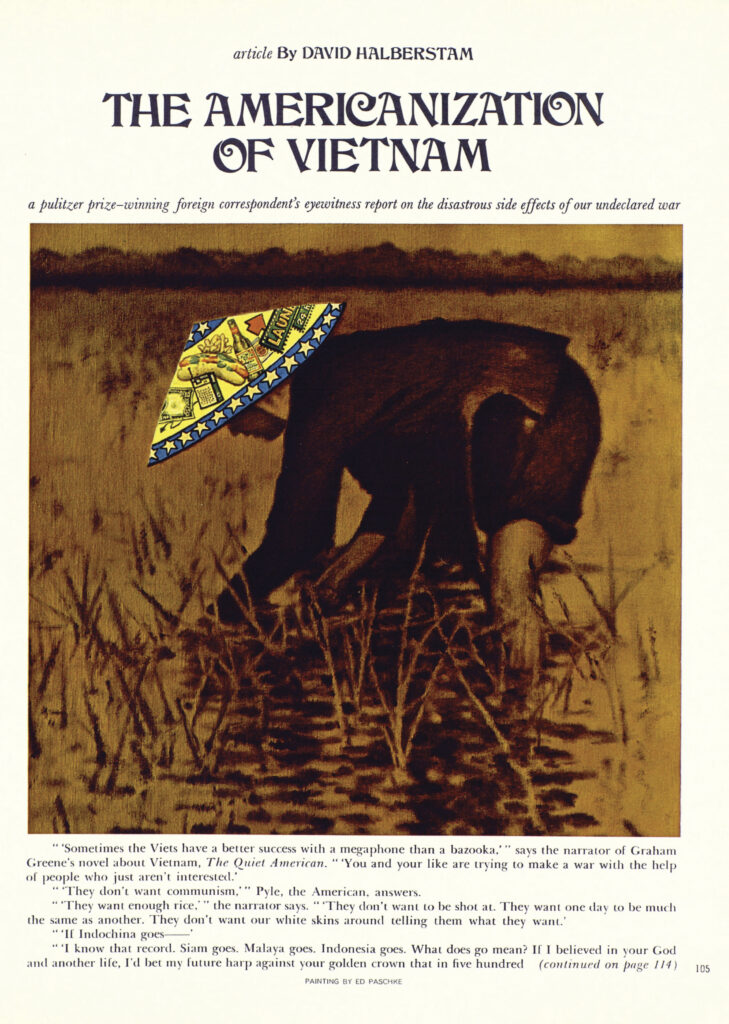
David Halberstam’s “The Americanization of Vietnam,” one of the most powerful critiques of America’s divergent presence in Southeast Asia, was published by this magazine in January 1970. It was the culmination of a series of antiwar articles run by Playboy, a magazine widely read by the young men fighting in Vietnam. (“One of the things that made my Vietnam tour endurable was seeing Playboy every month,” a soldier wrote the magazine upon returning home.) Halberstam had been in and out of South Vietnam since the early 1960s, back when only a few thousand American military advisers were trying, and mostly failing, to turn the tide against the country’s Communist insurgency. “Now,” Halberstam writes, “we are both the initiator and the victim of a hopeless, bitter war that has ripped aside so many of our more comfortable illusions about ourselves. … Where once we had few doubts about American capacity, American intentions, American achievement, now we have more doubts about that capacity to deal with social problems, not just in Southeast Asia or Latin America, but at home.” It was almost as if the American experience in Vietnam removed our very ability to imagine.
Few who start a war expect to lose, and no one losing a war can be expected to admit it, especially in a politically divided country. It’s thus important for leaders about to wage war to set the imaginative parameters—to develop and communicate a firm idea of what they’re trying to accomplish and why. The more abstract and formless the goal, the likelier it is that their war will become unrecognizably mutant even to its supporters, or, worse, transform into a cruelly revealing mirror. Halberstam again: “Now we have blanketed [South Vietnam] with our men, our ideas, our institutions and our failures. We have learned, I think, more about ourselves than the Vietnamese.”
War, especially in democratic societies, is rarely presented as destruction. Citizens are instead asked to envision a better world just beyond the bomb crater: stabilized regions, liberated peoples, humbled enemies. With the rise of modern media, selling a war under these auspices has never been easier. Even brutal military campaigns can be portrayed as heroic bids for renewal. The architects of war narrate, transforming uncertainty into inevitability, violence into authorship. This is a storytelling exercise with one subject: how history itself can be bent through force. But delusion is a subspecies of imagination. The tragedy isn’t that these stories so often fail. It’s rather that war possesses an unparalleled ability to make fantasies appear temporarily plausible. Only later, after insurgencies form and body counts accumulate and the promised future refuses to arrive, does the original act of war reveal itself as the vandalism it was.
The United States attacked Vietnam, Iraq, and Afghanistan under different pretexts and with different goals, but in every instance, the delusion was identical: the belief that violence, skillfully wielded, can change hearts. As Halberstam writes, the major accomplishment of the war in Vietnam was to create “a generation of cynical Vietnamese who smelled where the money was—in the ports, in the construction business, in the selling of draft deferments. … The Americans talked about [Vietnamese] corruption but could do nothing. Their presence, after all, had created it.”
The simple fact is that few wars—even just wars, even successful wars—give a nation the results it sought. Instead, war unveils a prismatic set of outcomes few expected and fewer still would have chosen. This harsh reality has, if nothing else, made the leaders of most modern democracies highly circumspect about sending their warriors into danger, to say nothing of inflicting horrific violence on combatants and noncombatants alike.
Whatever shape America’s current struggle with the Islamic Republic of Iran ultimately takes, it represents something new in our national experience. Nothing was concocted to preemptively justify it. No final goal has been consistently put forth to explain why it’s happening. Its complications were, by all available evidence, neither contemplated nor anticipated despite their abundant predictability. As most unpopular wars grind on, imagination often gives way to desperation: The things we could achieve if only we landed warheads here and here and here! This war is different—a war of no imagination, of null imagination. While previous wars were sold as fantasies of transformation, this one barely pretends to promise anything at all, unless you’re unusually stirred by the prospect of Iran’s navy collecting barnacles at the bottom of the Red Sea.
Consider George W. Bush’s Iraq War, the most emblematically imaginative war America has waged—less a war, in many ways, than a series of failed marketing campaigns. First came the New Coke of Weapons of Mass Destruction, then the Crystal Pepsi of Middle Eastern Democracy, followed by the Classic Coke of Avoiding National Humiliation. One would think that Donald Trump and Pete Hegseth, as highly lacquered television creatures, would have understood the necessity of presenting their nation with the usual imaginative aspirations while the bombs and rockets were prepped for Iran. Apparently, they did not. For the first time in its history, the United States embarked on a consequential war with virtually no warning or lead-up. During Vietnam, Iraq, and Afghanistan, American citizens were forced to swallow the snake oil of wartime optimism, but this war has given us something more insidious: a Defense Department so keen to emphasize its “lethality” that it might as well be standing on a street corner, in a trench coat, selling snuff films.
The Iranian government, with its Lego memes and insult-comic tweets, doesn’t have this problem. A war designed to prevent its mullahcracy from developing nuclear weapons has instead established for that same mullahcracy the absolute tactical necessity of developing nuclear weapons, if only to ensure it will never be similarly humiliated. To reaffirm every enemy aspiration you sought to disrupt while also accomplishing nothing is itself an inversely impressive achievement.
The American experiment, whatever it is or was, has long operated on one imaginative override: an unwavering belief in itself—and in its capacity. The misbegotten wars of our past broke and traumatized us because of the very intensity of that collective belief. At some point during every botched, unwise war we’ve waged, the punch-drunk realization eventually dawned: This is not who we are. Now we’re stuck in a conflict that literally no one believes in—not the people waging it, not the people defending it, not the people fighting it. And soon the time will come to rip away, yet again, our comfortable illusions about ourselves. Maybe this is who we are. Maybe it’s who we’ve always been.