Your bag is empty.

The co-creator of the Teeter-Totter Wall challenges us to reconsider our perspective
On July 28, I set out with a team of collaborators, friends and members of the El Paso and Juárez communities to install three pink teeter-totters on the 18-foot-tall steel wall that divides the United States and Mexico in Anapra, a colonia on the outskirts of Ciudad Juarez. That afternoon, a humble gathering comprised of mothers and children, artists, designers and curators from both sides of the divide, congregated at the border and shared a moment of convivencia. This word, convivir, doesn’t have a direct translation in English. “Coexist” or “fellowship” come close, but one seems too scientific and the other, too religious. In this case, the closest translation is probably simply “hanging out and having fun.”
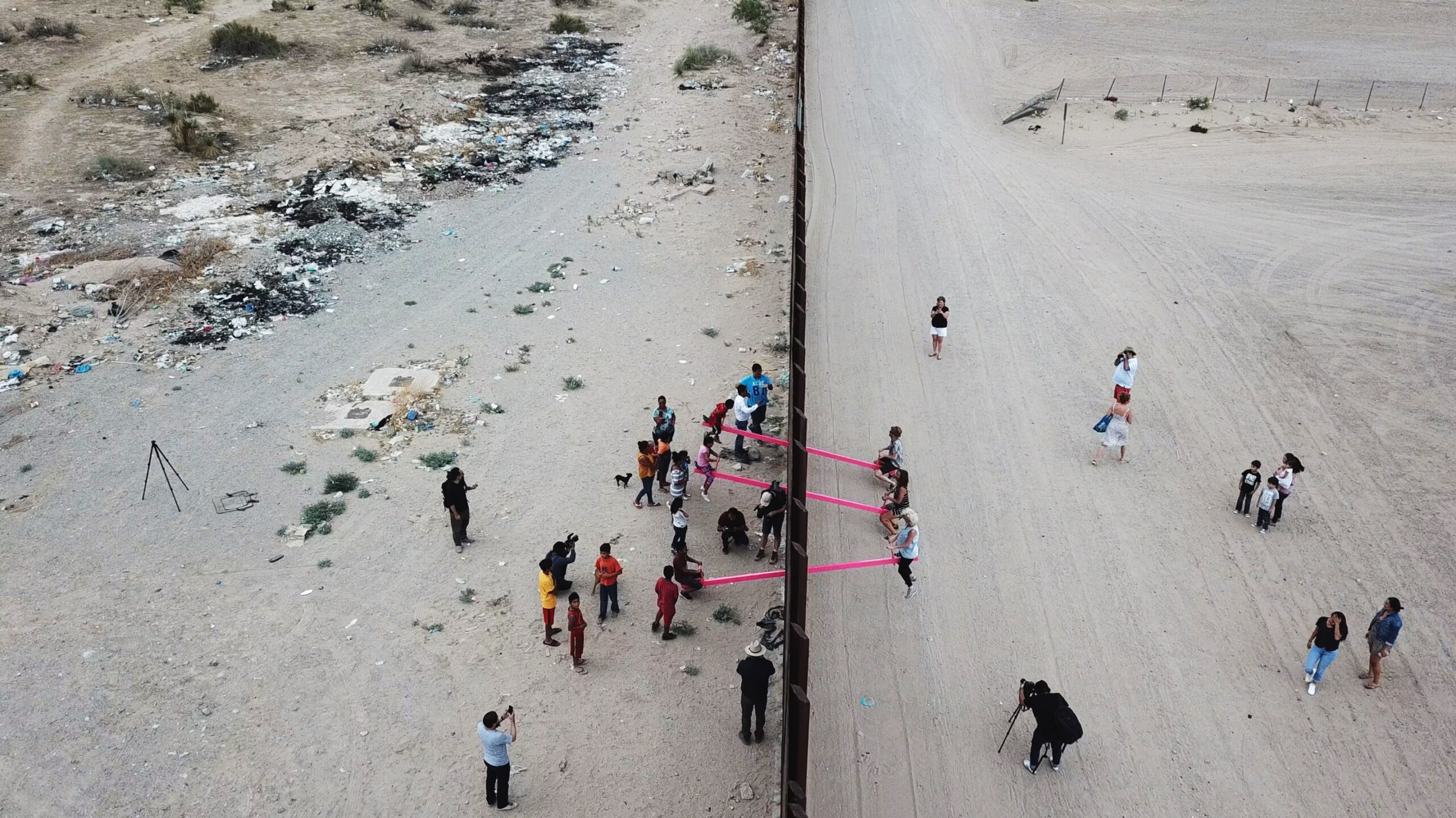
For 40 minutes that afternoon, dozens of children in Mexico and the United States were see-sawing together. Unexpectedly, the event was shared by millions across social media, and many noted that it was an important moment of release from the tensions fueled by continued media coverage of family separation at the border, as well as the never-ending quest by the current administration to acquire funds for more wall construction. For me, the work also demonstrated something that we don’t often talk about when we talk about borders, which is that there is a borderland that exists outside of the white gaze—a border that is not simply a barren desert landscape comprised of dangerous men with nefarious intentions—“bad hombres”—as President Trump proclaims, but rather, a place where intelligent and caring families live with their children in communities where they laugh and play and take pictures with their cell phones despite the hardships of poverty and xenophobia, and oppression that the wall represents.
My family has lived along the Rio Grande watershed for centuries, in the region that extends from where the Rio Grande currently ends, in El Paso, Texas and Juárez, Chihuahua, to where it begins, in the San Luis Valley in southern Colorado. As an artist sharing my work in my own land, I did not have to contort my own understanding of the borderlands in response to the vantage point of the white gaze. I had the opportunity to demonstrate who borderland people are, rather than who others think they are. Working outside the lens of the white gaze is what I believe defines the contemporary art of the borderlands today, and there are a number of artists working consciously or unconsciously within this zeitgeist.
As we know, “border art” is nothing new. It has existed for decades, and it is not a phenomenon exclusive to the U.S.-Mexico borderlands. One might even consider the walls that have sprung up along borders throughout history as a horrific form of art in and of themselves. The Great Wall of China is an example of this. Millions of visitors have traveled to Asia to see the artistic wonder as a touristic attraction, now historically distanced from its role as an “architecture of violence,” as Noam Chomsky has described borders.
Recently, Christoph Büchel, a Swiss-Icelandic artist and creator of the non-profit MAGA, attempted to inspire a movement to classify Trump’s eight border-wall prototypes, which were constructed along the border near Tijuana, Mexico in 2017, as “land art” deserving of National Monument status. In addition to leading the charge to preserve the prototypes, (which have since been demolished), Büchel’s organization gave public tours of the walls, essentially transforming the spectacle of wall construction into a form of performance art.
As controversial as this might seem, the artifacts that have been used to define borders have always been a type of border art. As Michael Dear, a geographer and the author of Why Walls Won’t Work, points out, the first survey maps authorized by the Treaty of Guadalupe Hidalgo are “masterpieces of the pen executed by individual artists who stamped their personalities onto cartographic representations of immensely varied topographies.”
No doubt this could also be said of the stone cairns that originally defined the U.S.-Mexico border before the wall, and later, the 276 border monuments that divided El Paso and Juarez, and Tijuana and San Diego. The monuments—obelisks of carved stone and cast iron—were famously documented by photographer D. R. Payne in the early 1890s, and again by photographer David Taylor, who began mirroring Payne’s work in 2007.
Working outside the lens of the white gaze is what defines the contemporary art of the borderlands today.
Just as the definition of “border art” as a genre is ever-evolving, “borderwall art” is an increasingly present phenomenon. The Annenberg Space for Photography tackles this subject in its current exhibition, W|ALLS: Defend, Divide, and the Divine, to, as curator Dr. Jennifer Sudul Edwards explains, “present as many positions as possible for all the reasons people put up barriers.”
Border art with overtly political connotations appears in a measured amount in the exhibition, but it is difficult to separate the political dimension of walls from the aesthetic dimension of art. Acccording to Edwards, even the exhibition’s title, W|ALLS, “acknowledges how a slim addition of ink, in the case of the title, or steel, can disrupt unity and the concept of ALL.”
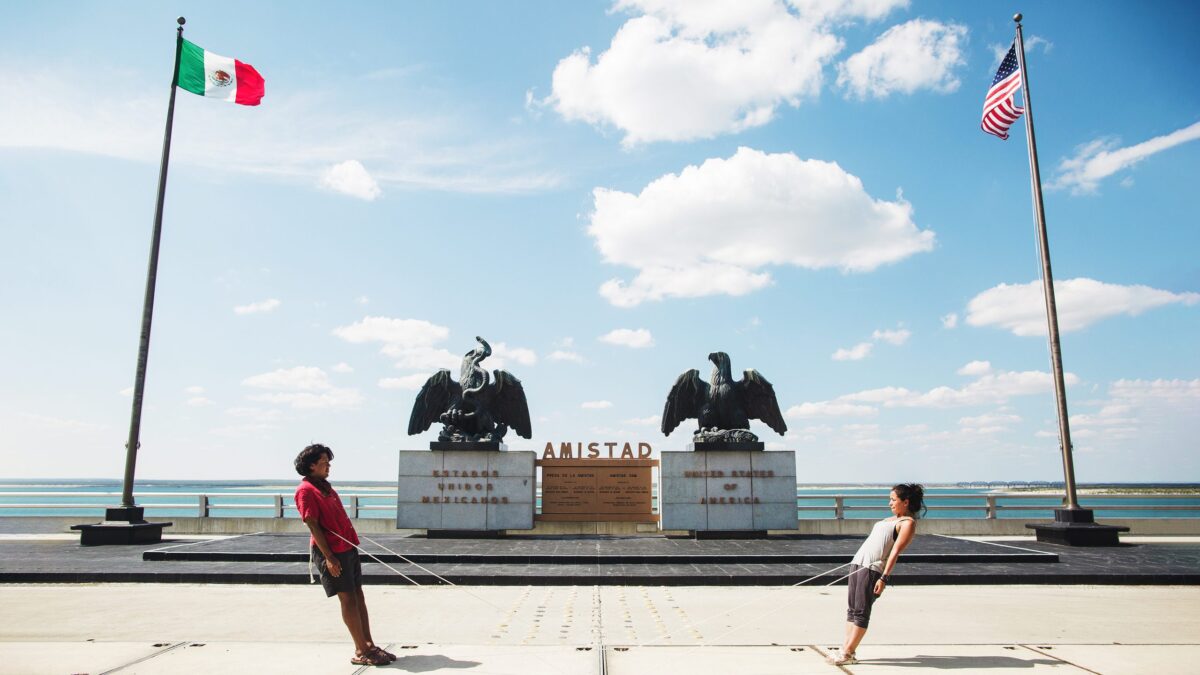
Among the artists participating in the exhibition is Tanya Aguiñiga, who grew up moving back and forth between Tijuana and San Diego. Aguiñiga’s work is an example of the emerging body of contemporary border art that is defined by redirecting the white gaze while addressing the problems of the wall, and the people that it intrudes upon emotionally and physically. Aguiñiga’s ongoing project AMBOS, (literally, “both”), asserts her perspective as a woman, mother and bi-national borderland citizen. It also captures an accurate representation of communities along the border and seeks to strengthen connections, often using rope and textiles to make literal connections across the wall—between people, but also between communities and governmental bodies to “humanize the act of border crossing,” as the artist describes.
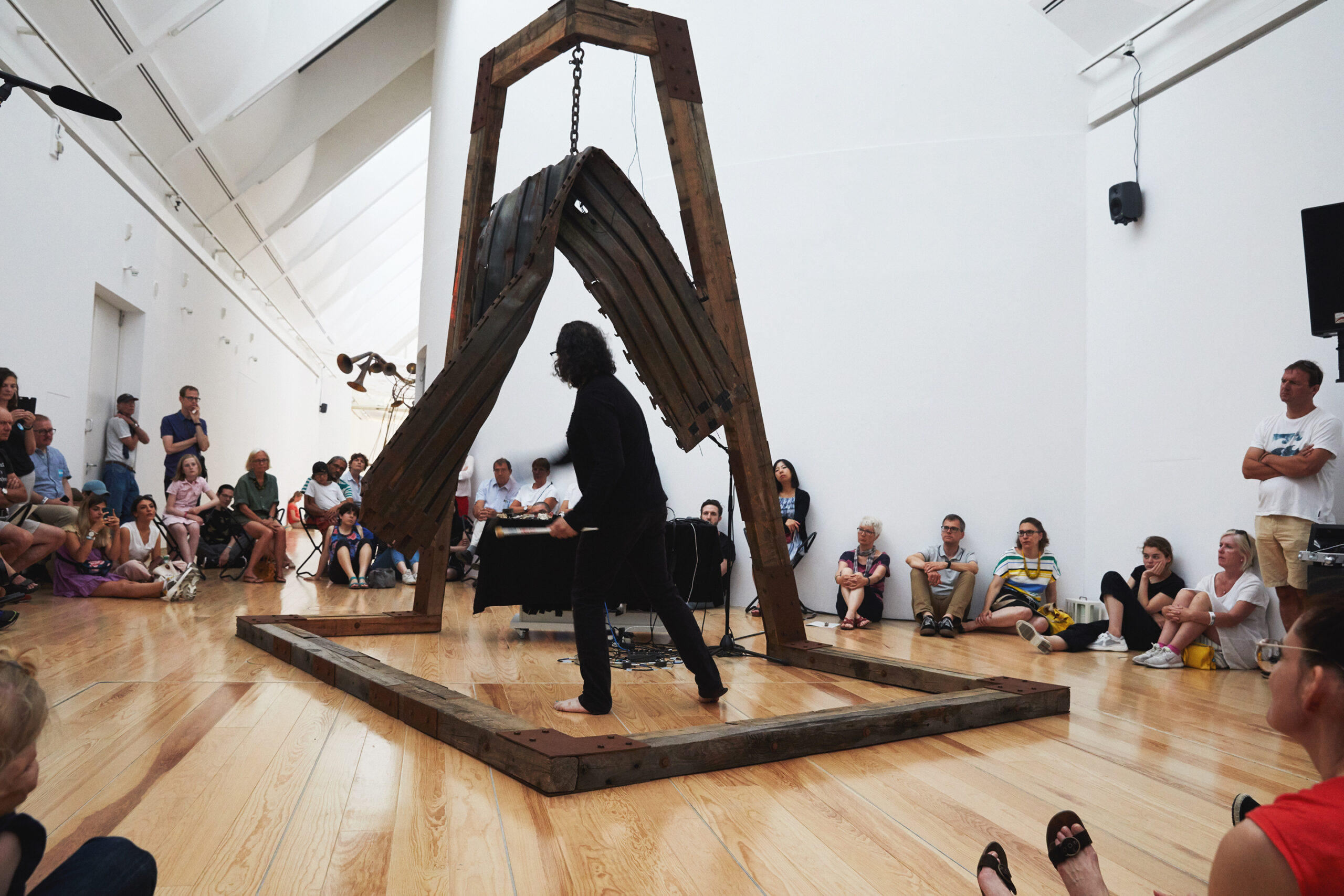
While the dehumanization of migrants is an increasingly alarming consequence of border policies, the smuggling of humanity into border art is increasingly an essential counterpoint. For Border Cantos, a collaboration between Mexican-American sculptor and composer Guillermo Galindo and American photographer Richard Misrach, artifacts of migration, such as water bottles, shotgun shells, ladders and pieces of the wall itself, are transformed into sound-generating instruments. In many cases, the instruments are fabricated of objects that were clearly related to the personal experiences of the journey, such as a bible, or weathered flags found at the border by Water Stations, a humanitarian organization that uses the flags to help migrants find water stations in the desert. The ritualistic ceremonies the instruments are used to perform pay homage to those who have experienced the hardships of migration, and perhaps even lost their lives. The objects Galindo creates become memorials to these sacrifices.
Galindo’s other collaborations include experimental sonic performances with Cristobal Martinez, a Nuevo Méjicano and a member of the interdisciplinary arts collective, Postcommodity. Martinez and his collaborators, Kade L. Twist and Raven Chacon, are best known for Repellent Fence, a temporary land art installation that utilized 26 ten-foot-diameter balloons floating 100 feet above the ground to create an aerial bridge that crossed over the wall. Interestingly, each balloon depicted an image that had appeared on an ineffective bird repellent product and was visually similar to indigenous Mexican iconography. Interconnectedness, historical patterns of human movement, and a form that connects us to past and present cultural objects are all referenced in the monumental work, which diminished the power of the wall it intersected.
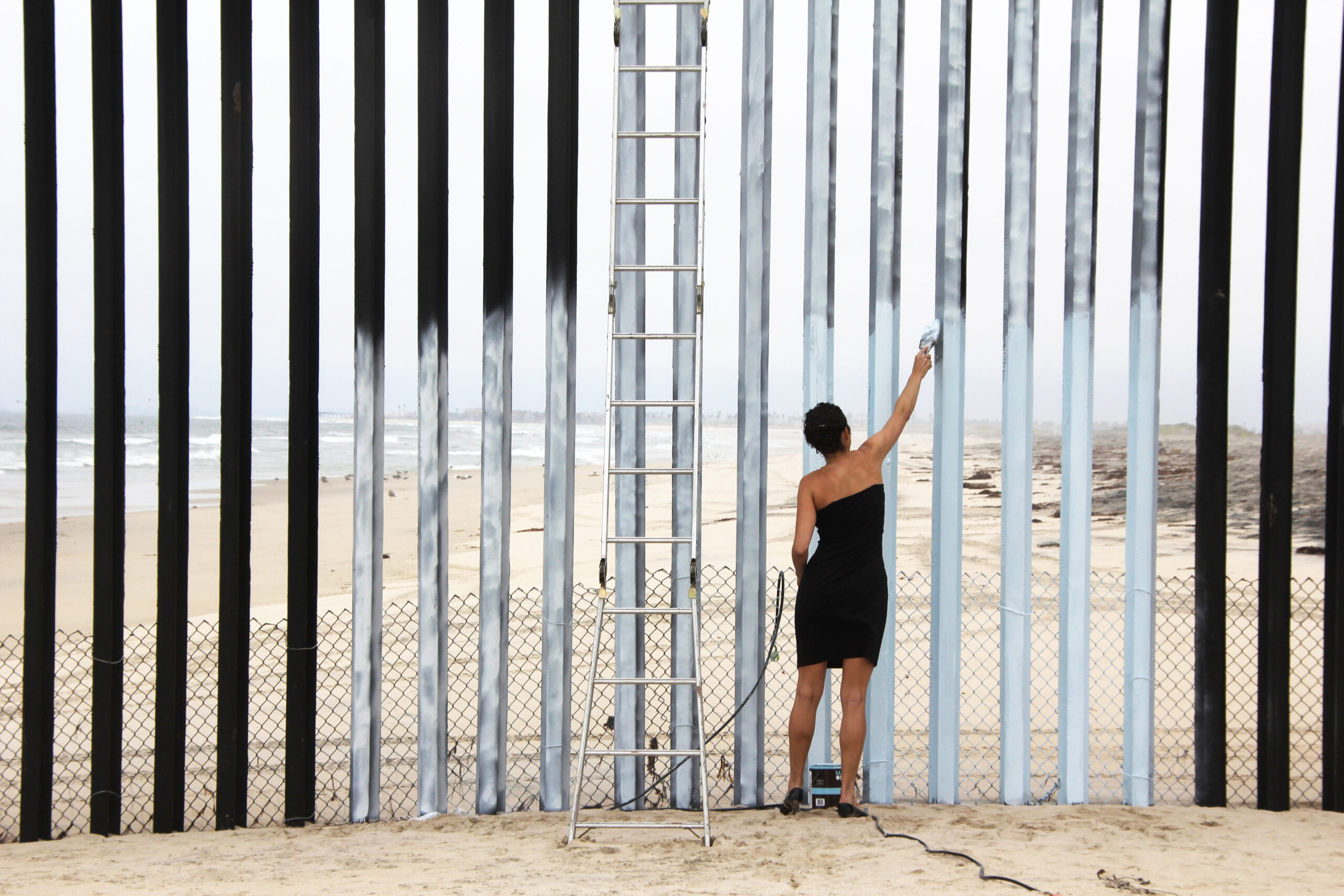
A more literal “erasure” is reflected in the work of Ana Teresa Fernandez, who questions patriarchal power structures by leveraging and subverting the traditional gender roles those structures create, (and which have been perpetuated by the media, including magazines such as PLAYBOY). For her project Borrando la Frontera (Erasing the Wall), Fernandez arrived at the wall that dives into the ocean at Playas de Tijuana in a black cocktail dress and black pumps to paint a large section of the borderwall a reflective blue with Martha Stewart paint (Coincidentally, Martha was serving prison time at the time of the installation). Fernandez’ clothing confused the Mexican authorities. When they asked the artist what she was doing and Fernandez told them that she was painting the ugly wall, they deferred to her femininity, and respectfully allowed her to continue.
Fernandez writes of that experience: “Los hombres quieren a una dama en la mesa, y a una puta en la cama” (“Men want a lady at the table, and a whore in the bed”)—a statement I first heard at fifteen that still lingers in my ears. For contemporary women, it is often difficult to reconcile the ubiquitous images of virgin and whore in our culture. However, by pushing the boundaries of those stereotypes, Fernandez was able to push through the wall itself. The sky-blue paint that she used created the illusion that a section of the wall was gone, erased. It demonstrated that the transformative power of border art today comes from those who are invested most in this landscape, and whose voices are often those we hear from the least.