Your bag is empty.
Queer BDSM practitioner Sara Elise talks to PLAYBOY about how bondage can be a space of calm in a hostile society
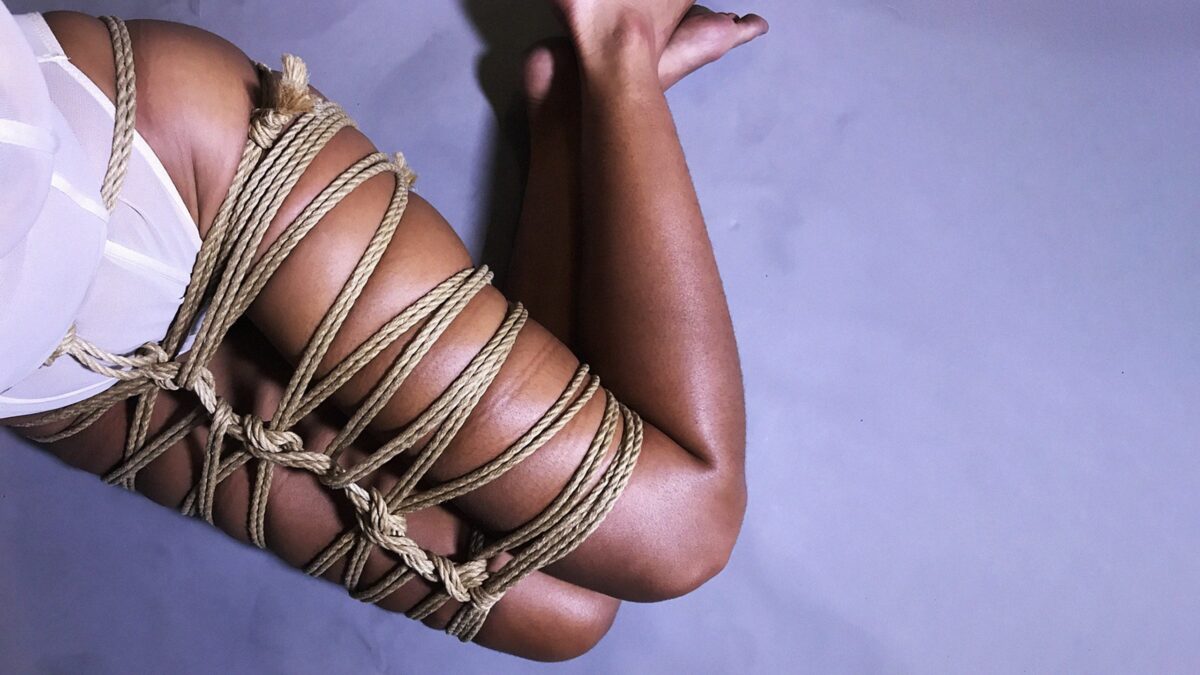
Sara Elise is determined to be visible under her own terms. The Brooklyn-based entrepreneur behind the organically sourced catering company Harvest & Revel has dedicated time and resources toward making accessibility an intentional part of her life. This holds true whether she’s creating spaces where people of color can eat and source healthy, fair-priced goods, or planning wellness events through Blind Seed, or hosting pop-up bed & breakfast experiences for POC and LGBTQIA+ members to relax without fear of violence with Apogeo Collective.
“My wife [Amber] and I travel a lot, and we noticed that whenever we were somewhere new we would always have to check and see if we could kiss or hold hands like heternormative presenting couples,” she says during a Skype call from their pop-up Apogeo experience in Nicaragua. “In creating this space (Apogeo), we wanted to create something that seems to be missing in our community.” This investment in the care practices available to marginalized people is a common thread in Elise’s life, and for the past six years she’s been actively involved in a particular self-care ritual that’s helped her heal and exist in a deeply holistic way.
“I first got into BDSM through Amber who was more into kink and would want to do kinky things or watch films with a kinky storyline, which I thought was really cool.” Prior to this, Elise had navigated relationships, sex and intimacy with feelings of shame because her desires went against the grain of what was generally regarded as socially acceptable. “Before BDSM, I thought that I craved abuse and that I was destined for neglect. After I was exposed to it, I realized that I have a very particular kind of brain that has a lot of difficulty existing in this world as we know it, and pain happens to be a really huge silencer for my mind.”
After meeting her first Dom with her wife, Elise’s understanding of BDSM expanded as she became more in tune with her physical and mental needs. “I think as a highly sensitive person I walk through the world gathering a lot of emotions and anxieties. A lot of the time it’s scary, and so when I’m in a Sub (Submissive) space all of that’s gone, and it’s just me being fully present with how my body feels versus everything that’s happening in my mind or things I’ve experienced during the day.”
When I was first researching BDSM, I didn’t see anyone that looked like me. I knew that I had to create the imagery I wanted to see.
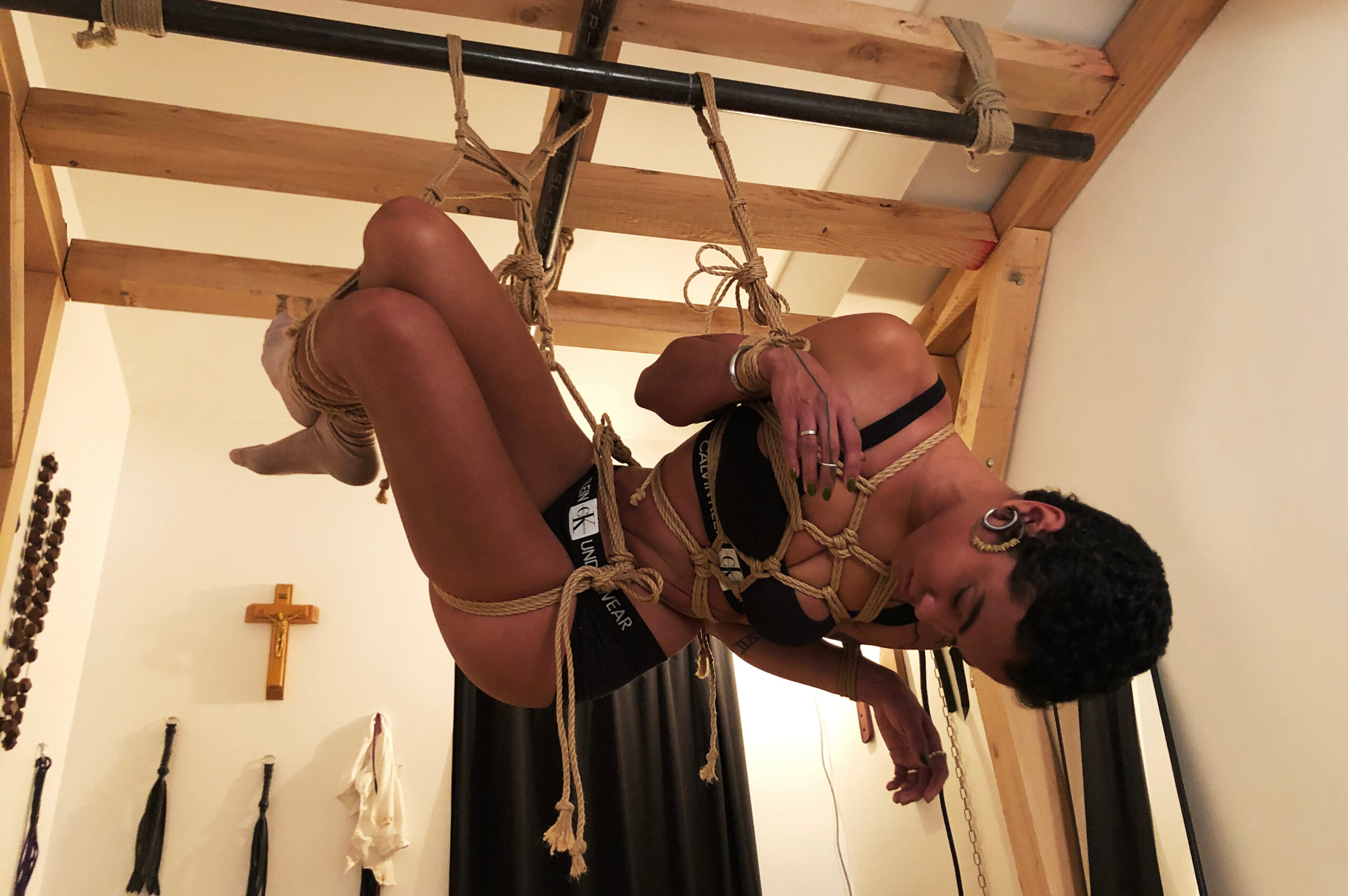
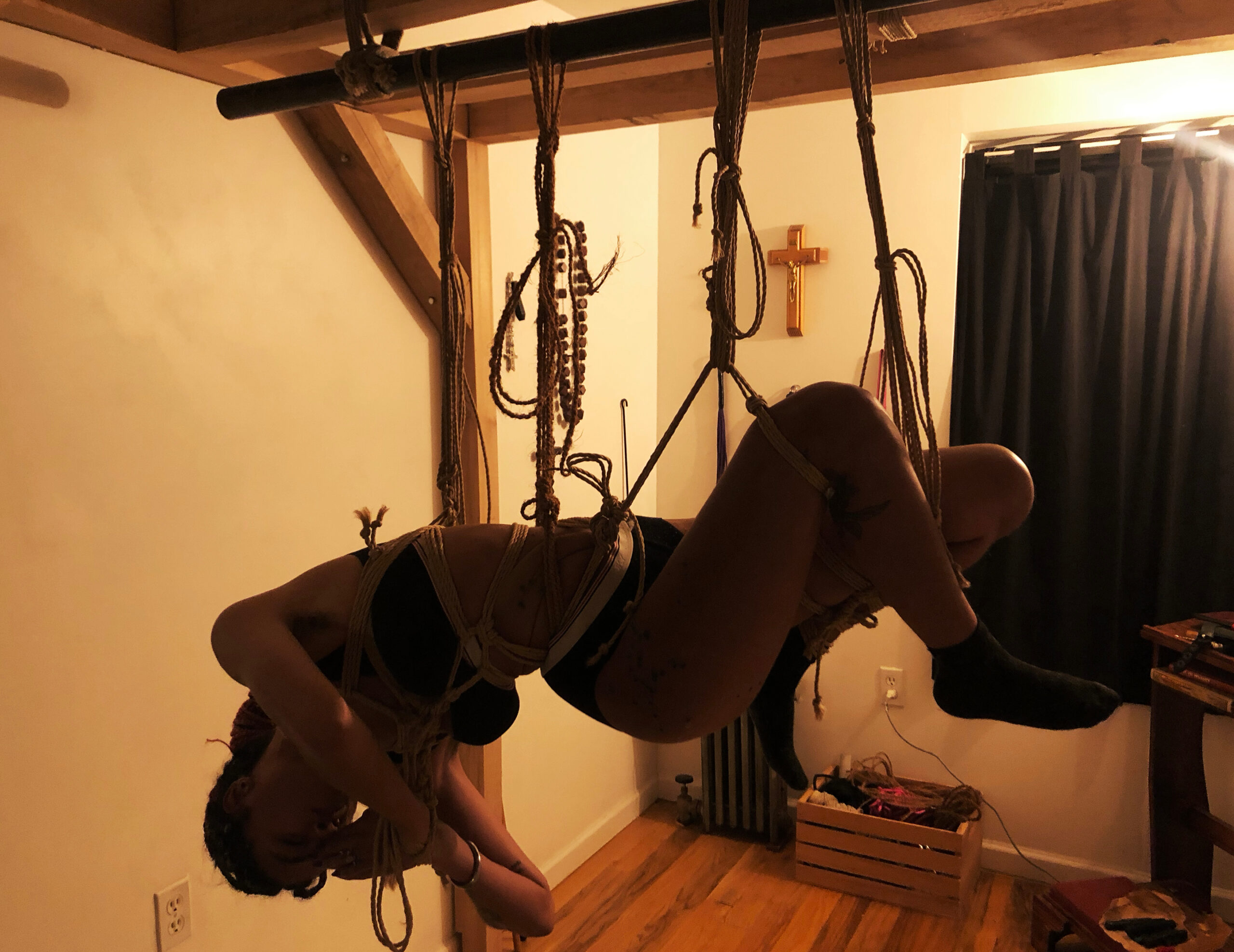
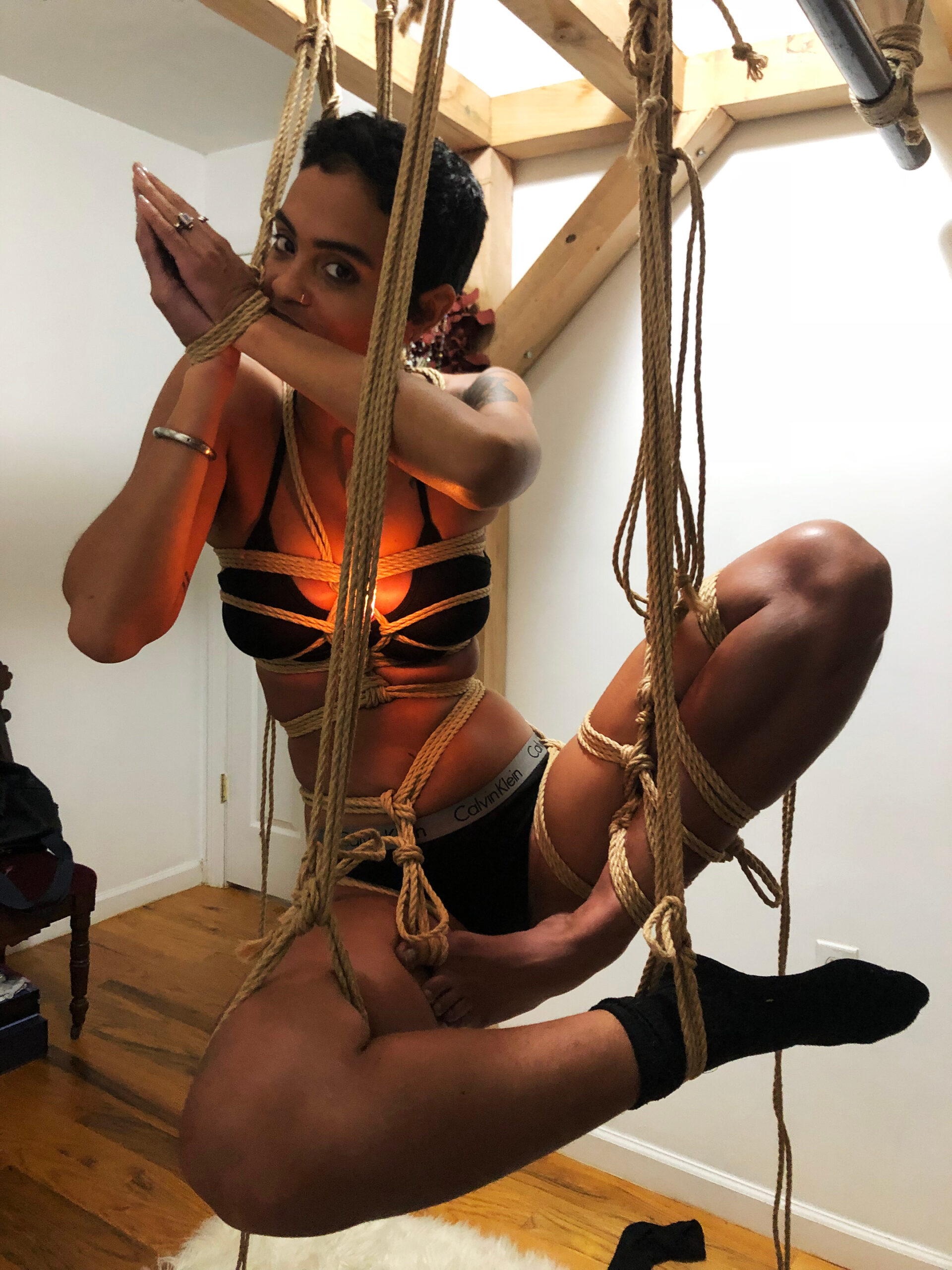
When I came across Elise’s page while distractedly scrolling through Instagram’s visual overload, I didn’t instantly recognize that this was the first black woman I had ever seen publicly claiming her place in the BDSM scene. Looking at images where she was suspended, bound with rope and her body contorted in various positions was a type of representation I didn’t know was lacking until I was presented with it.
When I was first researching BDSM because my first Dom gave me films and articles to learn more, I really wasn’t seeing anyone that looked like me. I knew that POC players existed in the community, but there was not heavy representation of us in the media. And when I did see images of queer, black, differently-abled, fat, gender-fluid bodies that I didn’t see in regular BDSM representation, the images made me feel uneasy. Oftentimes it looked like the person had been stripped of their power rather than empowered by their desires.” Elise says. “So I knew that I had to create the imagery I wanted to see and dig deeper to find the communities I knew were out there.”
Acts of bondage, discipline, sadism and masochism exist in layers that are often shrouded in sensationalism and prohibition. But BDSM, like all consensual sex acts is about trust, comfort, safety and fulfilled desires. For some, it’s about being tied up and engaging in hyper-communication where the Dom will constantly check in and the submissive offers guiding responses. For others, it’s sensory deprivation with the use of hoods, acts of humiliation, knifeplay and whippings. Because BDSM lies outside mainstream reflections of sex and intimacy, misconceptions continue to exist making the power and healing to be found in the practice often viewed as illegitimate and ill-advised.
For Elise, BDSM opened up various avenues to understanding the role of intimacy in her interactions with those she chose for play, romance and sex. “I used to think that I could only be vulnerable with the person I was having sex with or I could only be romantic with the person I was having sex with,” she says. “I was very focused on sex and intimacy being together, and I wasn’t understanding that the thing I crave the most and which is one of the reasons I do BDSM, is erotic energy. That’s the thing that’s so electrifying for me.”
A lot of people, especially when it comes to black women, think they have access to us all the time.
In the years that she’s become what she calls a heavy-player in the BDSM scene, literature and films have emerged attempting to make the topic less taboo and more alluring. It would be somewhat impossible to talk about BDSM in the last decade and not include Fifty Shades of Grey, which became a pop culture phenom after its release. The power dynamics between the compliant, lovestruck university student and the tortured yet irresistible billionaire forced conversations on BDSM in ways that brought forward both detractors and supporters. There were those who praised it for spotlighting kink into the mainstream and those who found the series to be one-dimensional and problematic, only showing a singular facet of BDSM play where the dominant is in charge not simply during scenes, but in the submissive’s life as well.
For Elise, there is a clear line between her submissive role with her partners and the way she moves through her life outside of this intimacy. “I’m very submissive in BDSM and kink, but I’m not submissive in life.” This nuance is one that’s lost in the information surrounding BDSM leading to conclusions that power and control is the goal for all those who participate as Doms. “I think to be a good submissive you have to have a certain level of confidence and assertion of your needs and desires so that dominants can understand you, learn about you and also don’t take advantage of you,” Elise continued.
It’s this strength of character that’s allowed her to steadfastly wade through the complexities of race in BDSM and what the physical legacy and visual representations of enslavement mean for her as a black woman who chooses to be bound and consents to pain. “When I discovered BDSM I felt relief, not shame. But I do sometimes feel some type of self-judgement when I play with white partners,” she says. The history and contemporary reality of anti-blackness and white supremacy is one that requires radical self-interrogation so that BDSM boundaries are clearly laid out for all participants in ways that foster trust and certainty, something Elise is hyper-aware of. ““My first Dom was black and she did not have consensual non-consent, which is me consenting to her making decisions without always having to check in. But my current girlfriend and rope-top, who is white, does have consensual non-consent within the boundaries we’ve discussed. It’s really important to be communicative and upfront about your boundaries and desires with every partner, regardless of race.””
Recent conversations on the Broadway hit, Slave Play have focused on the space for role-play in interracial relationships and what this might look like as a tool for self-awareness and transparency for those involved. Critics and viewers have delivered a wide range of takes, ranging from all-consuming discomfort to ecstatic appreciation. There is tangible, visceral hurt to be felt when Antebellum imagery is invoked as a tool to tackle interracial intimacy and romance, even more, when the idea of consent is complicated by the power dynamics of slave and master, which left little room for choice. It’s this that makes BDSM a representation of autonomy for Elise as she’s the one who chooses the partners that can see her vulnerable in those spaces. “For me, it’s been about deciding what I feel comfortable with. This looks different with a black partner or a white partner, and I also have to be very forthcoming about my desires and my extreme nos.”
Everything about living and breathing as a black woman is politicized, making it an act of self-deception to believe that the bodies we are in do not determine the ways we perceive and are perceived by others.
During the times she plays, visible marks will often be left on her body, which usually draw questions from curious, and sometimes intrusive minds. “A lot of people, especially when it comes to black women, think they have access to us all the time.” The unceasing surveillance of black women’s bodies makes any inquiries, even well meaning, unwarranted and exhausting. “If people from my community ask, and it’s a moment for engagement then I explain and I’m very open. But if it’s some random white dude from the coffee shop in Brooklyn, then I sometimes make things up. Not everyone deserves that part of me.”
Elise’s visible scarring is something she finds beautiful and a marker of both her black and Indigenous heritage where scarification in certain communities is symbolic of a life lived, traumas survived and earned positions in society. “I find I am often expected to act “lady-like,” meek, and shy. But having scars makes me feel strong. It’s when I feel most like my outsides match with what my insides feel like.”
As a queer, black woman who is a vocal proponent of BDSM, Elise has had to negotiate and consciously shape and reshape how kink fits into her life. Everything about living and breathing as a black woman is politicized, making it an act of self-deception to believe that the bodies we are in do not determine the ways we perceive and are perceived by others, even in our most personal and sacred moments. “Being a black woman in this world is definitely a very tough embodiment. One of the most beautiful things to me is looking at my black body and seeing it in rope or seeing the marks that the rope, knives or impact tools have made on my body. When I play, I feel like the fullest embodiment of myself.”