Your bag is empty.
Have you ever felt like you were tripping after taking a hit of a joint?
“Cannabis is a psychedelic,” Zoe Helene, Cosmic Sister Founder tells me. My mind flashes back to a 6 A.M. bus ride I took from New York to Portland, Maine. I ate a strong edible to fall asleep and ended up tripping out every time I closed my eyes. “Hmm,” I respond. She goes on to tell me about her first time smoking the drug at the age of 21, a bong hit threw her into a full-on psychedelic experience. Sure, I also never tripped as hard on cannabis as my first few times, but still I’m skeptical. How could this plant that’s been my closest ally for more than 10 years be a potent psychedelic substance?
The more I look into it over the next few months, the more I see Helene isn’t the only one advocating for cannabis’s hallucinogenic possibilities. The word “psychedelic” itself was an invention of one of the original psychedelic therapists in the 1950s, Humphry Osmond, in a letter to Aldous Huxley. A combination of the Greek words psyche and delos, it means “mind manifesting” or “soul revealing”. The definition reminds me of the feeling I get after I smoke a joint: I can have a shift in perspective and see things a bit clearer, a reason I occasionally use psychedelics like mushrooms or LSD. My cannabis perspective shift is less drastic and frankly, weird than with classic psychedelics, but it can still help me step back and realize when I’m being a jerk or too hard on myself. But I’m not tripping, am I?
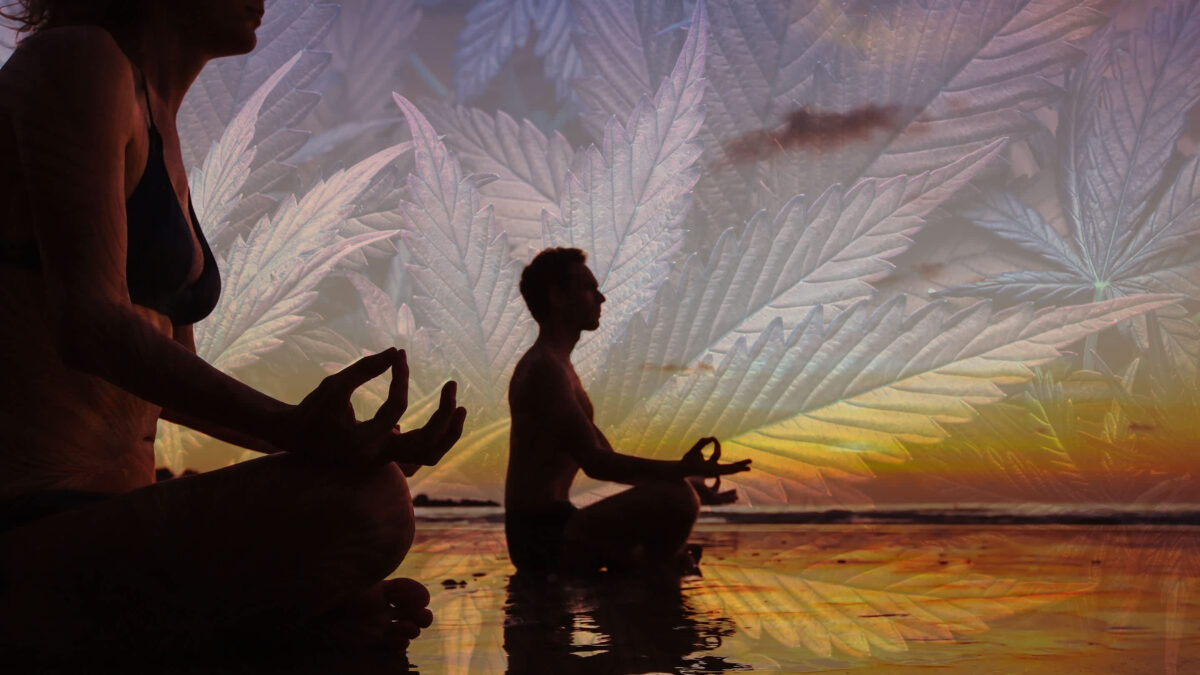
Some in the experimental field, like Javiera Köstner and Sebastian Beca, are saying in the right “container,” like a ceremony or therapy session, and with the right blend of herb, simply smoking or vaping cannabis can produce psychedelic experiences for even those who consume the plant regularly. Köstner and Beca are a married couple who run “conscious cannabis circles” in northern California and started a conscious cannabis network to connect practitioners in this budding field. “Conscious cannabis circles are safe psychedelic experiences with cannabis,” Köstner explains. They look much like other “plant medicine” ceremonies, like ayashuasca or psilocybin mushrooms, with an altar, music, and prays to the seven directions. But instead of drinking an ayahuasca brew or mushroom tea, these ceremonies begin by setting intentions and then, as part of a prayer, smoking cannabis in unison out of pipes, joints, vapes, bongs—whatever people prefer.
It’s not uncommon for people to reach DMT level experiences with full body, full visuals, unity consciousness, a connection with spirits and the divine, and deep realizations about the self, the soul and what their life purpose is.
During these sessions, participants are encouraged to sit back on yoga mats in a circle, heads facing inward with feet out like the spokes of a wheel. The lighting is dim and there’s carefully curated music, perhaps sage burning or other ceremonial plants. But instead of a shaman singing, Köstner tells me they were trained to provide gentle mindfulness techniques—like guided breathwork and meditations, body scans, and positive affirmations. According to Beca, because smoking cannabis is immediate and strong, it’s the best time to connect people with their bodies and their breath. “We meet people with reassurance,” explains Beca. “We say affirmations we learned from Daniel that are helpful like: ‘You’re in your body. We’re just lying down and breathing and it’s okay…. You’re so safe here… It’s okay to relax into this.’ Then they drift and go into the experience much more gently.”
The ceremony continues like this for about three hours, with sober trip sitters in the room to come sit with folks struggling through tough experiences, or to help them go to the bathroom or get a drink. Then at the end, the smoke lifts and everyone sits up for the last hour to “integrate” their experience. That could look like sharing their trip with the group, or journaling, drawing, playing with playdough, or simply listening. And of course, because this is cannabis, snacks are also provided during the last hour before packing up and going home.
Köstner and Beca were trained by Daniel McQueen at his Medicinal Mindfulness Center in Boulder, Colorado. McQueen is considered the founder of conscious cannabis circles and tells Playboy it started as a stroke of luck—or perhaps intuition—in 2014 right around when Colorado was legalizing cannabis for adult use. “I’ve been trained by MAPS as a MDMA psychedelic therapist. I have training as an apprentice with an underground psychedelic therapist. So I approached it coming from a psychedelic orientation, instead of just a cannabis one,” says McQueen. “I just switched the medicine.”
McQueen explains at first he was “totally surprised what they stumbled upon.” He used cannabis before, but not as a psychedelic medicine. Yet, as soon as he incorporated it into his “psychedelic therapeutic container” for journeying, “People were having full blown psychedelic trips that are just as evocative as psilocybin, MDMA and ayahuasca,” says McQueen. “It’s not uncommon for people to reach DMT level experiences with full body, full visuals, unity consciousness, a connection with spirits and the divine, and deep realizations about the self, the soul and what their life purpose is. Everything that you would normally associate with other psychedelics is possible with this medicine [cannabis] when used the right way.”
I still wonder. Beca, Köstner and McQueen all believe the ceremonial container they set up and the mindfulness work they guide participants through plays a large part. But it’s also the blend of cannabis they use. For their circles, they all like to prepare a psychedelic blend of different strains. “We want the creative, uplifting nature of sativas… and deep body awareness of indicas. But we also want the heart opening experience of a hybrid,” explains McQueen when describing his blend. He says after he and friends had their first ceremony with cannabis around five years ago, one of them said, “Daniel, if I didn’t trust you, I would swear you put DMT in that!” Köstner explains her and Beca create a similar blend of 12 different strains that are all grown organically to provide the perfect high for a psychedelic cannabis experience. They even seek out specific terpenes, and age certain strains themselves for a higher CBN content, a cannabinoid known for its body relaxation qualities. Plus, both Beca and McQueen mention cannabis in legal states like California and Colorado is stronger than ever before, and perhaps that’s part of the reason this work has developed so recently. “A couple of decades ago this didn’t seem as obvious because THC levels were lower,” says Beca.
It interrupts our capacity to cope. And I think most importantly, it interrupts our capacity to disassociate.
In 2019 alone, interest in psychedelic cannabis practices has grown drastically, especially because psychedelics have gone so mainstream. All three practitioners tell Playboy there are all types of people coming to these ceremonies, from the psychedelic-naïve yet curious to those looking for transformational healing, and even seasoned psychonauts. Because cannabis is legal in states like California and Colorado while mushrooms and other psychedelics are not, people see it as a safe, legal way to dip their toes into a psychedelic experience.
At McQueen’s center, he and his wife, Alison McQueen, host conscious cannabis events for the public, as well as private 1:1 cannabis-assisted psychedelic therapy sessions, and training for trip sitters. McQueen says this work is spreading too, he’s trained facilitators who have brought this practice around the country and to Canada as well. He says there’s folks coming to his training soon from Guatemala and he’s hosted others from Brazil and England. Köstner and Beca plan to start hosting training in the Bay Area to reach even more people, and McQueen says folks in LA are also getting ready to start training more ceremony leaders. He’s even recently published a book, Psychedelic Cannabis: Breaking the Gate, that teaches people how to use cannabis psychedelically at home. “I hold nothing back” he says, explaining it’s really meant to make this work accessible to everyone, even those out of state or who can’t afford this kind of work.
Over in Denver, Colorado, there’s another center offering cannabis-assisted psychotherapy, Innate Path, which opened in 2018. Co-Founder and Director of Education, Saj Razvi explains their therapy modality is also influenced by the Multidisciplinary Association for Psychedelic Studies (MAPS) MDMA for PTSD work; he himself was a therapist on MAPS phase 2 clinical trials, and he’s used his experience to inform his cannabis psychedelic therapy modality. Innate Path will also begin to train folks in providing cannabis and ketamine-assisted therapy in early 2020. Unlike Medicinal Mindfulness, their training program is only open to licensed clinicians and graduate students. Razvi says it’s two-thirds training on their somatic, body-centered therapy modality, first and foremost, and then incorporates how legal psychedelics like cannabis and ketamine can enhance that work.
Razvi explains it’s a little different than psychedelic therapy with a substance like psilocybin, where you come out of a trip session with all sorts of deep insights that you then have to act on by making changes in your life. “With cannabis, you don’t have to take notes,” says Razvi. He explains, often people with trauma and complex PTSD have all sorts of coping mechanisms to help them get by, and not all of them are healthy or productive. “One of the most important things that cannabis does is it really interrupts our capacity to cope. It’s kind of the opposite of how many people use cannabis to work with anxiety. They’ll take it to take the edge off, but when you bring cannabis into therapy, it interrupts our capacity to compartmentalize. It interrupts our capacity to cope. And I think most importantly, it interrupts our capacity to disassociate.”
And so, when working with cannabis alongside somatic, body-centered therapy, folks are no longer compartmentalizing their traumas, and instead working through them. Both McQueen and Razvi say this often looks like people’s bodies shaking uncontrollably as a way to finally process their trauma rather than compartmentalize it. Razvi says they completed a pilot study with combat veterans at Innate Path where after twelve cannabis-assisted therapy sessions participants “got about 65% through their core trauma.”
The process of how cannabis works for therapeutic release reminds me of why many people say they don’t like the drug—it makes them feel anxious, vulnerable, or out of control. But perhaps those feelings are part of the plant’s coping mechanism interruption, which makes folks uncomfortable when smoking with friends. It’s like their guard coming down, and who wants all their emotional baggage hanging out when sharing a joint? At the same time, it seems like working with those feelings in the right therapeutic container could be very healing. Plus, compared to other psychedelic medicines, cannabis does seem like a good entry level substance. “People still have agency,” both Köstner and McQueen say, unlike a substance like psilocybin or ayahuasca, where folks’ sense of self and reality can be greatly altered until the medicine fully wears off. Cannabis in general is a much shorter acting substance, only lasting two to three hours rather than six to twelve like other psychedelics.
Unlike psilocybin and MDMA, there’s no peer reviewed studies on the efficacy or protocol for cannabis-assisted therapy—yet. However, Innate Path is looking to change that. Razvi says his team worked with Alan Davis, a psychedelic researcher at Johns Hopkins University, to design a set of psychometric tests to give to participants, which is what they do in studies with psilocybin. Innate Path is now giving clients these psychometric tests at specific times in their treatment to determine the efficacy of their cannabis-assisted therapy modality. They aim to test 90 participants and publish the findings in the first half of 2020. Razvi believes that will really help to legitimize this work. Because even though cannabis is legal in many states and participants have to bring their own greenery to cannabis-assisted therapy and ceremonies to avoid legal conflicts, licensed therapists are still weary of practicing this work with clients. That’s because they don’t want to lose their licenses for providing clients with an unproven therapy modality – and of course, letting them use a federally Schedule I substance like cannabis in their offices. However, if there are clinical studies proving this works, it could give therapists a lot more security, and therefore, spread psychedelic therapy to more people.
While McQueen says a high dose edible trip like the one I had on my bus ride was more likely a cannabis overdose than the type of psychedelic experience he facilitates for clients, I’m starting to see the light. It’s looking more and more like cannabis won’t only go psychedelic in 2020, but this is how psychedelics reach more people than ever before this year, in a therapeutic or ceremonial setting…with cannabis.