Your bag is empty.

With a new art exhibition, Leiva is changing how we see fossils.
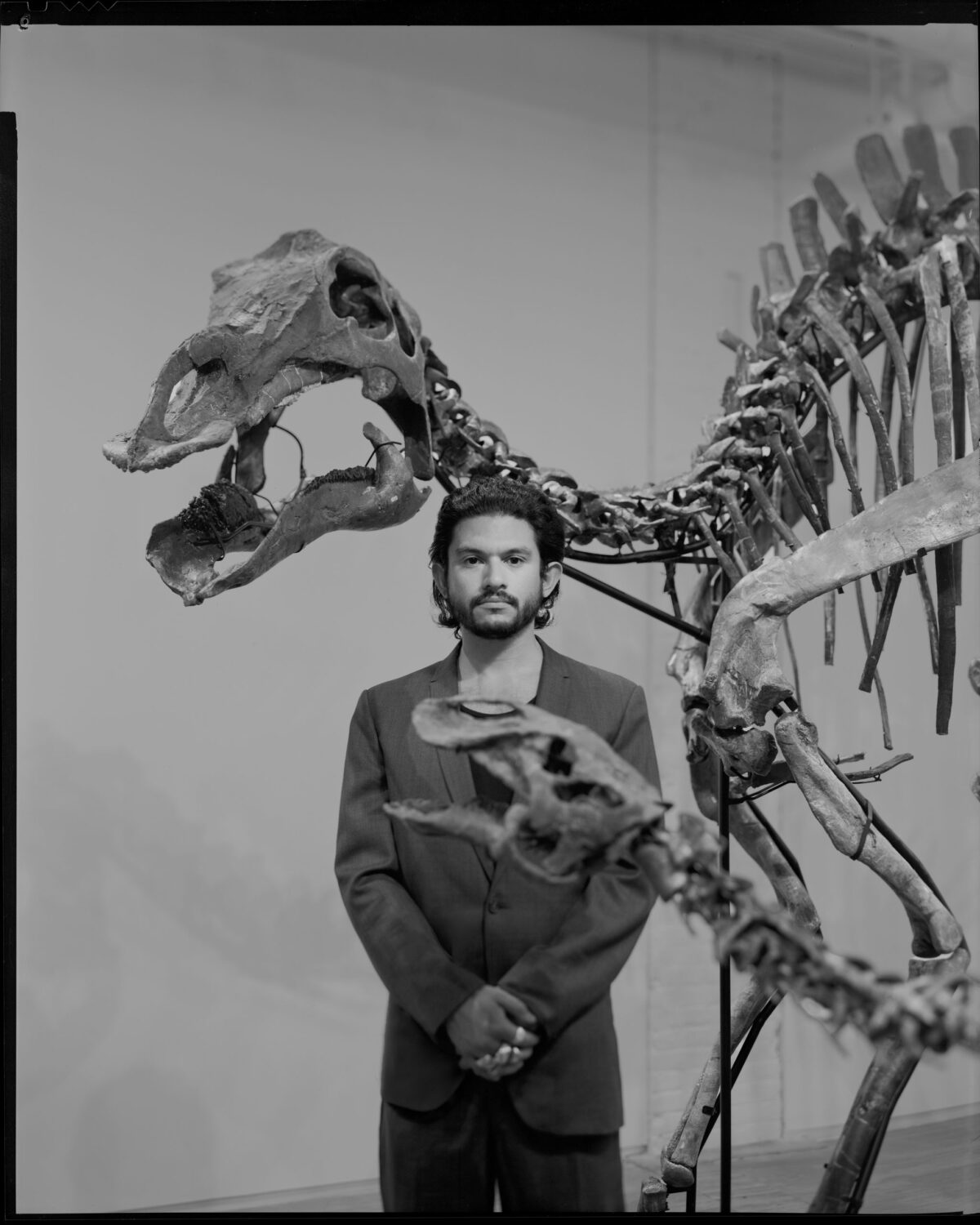
Typically, you’d stumble upon fossils in a natural history museum, under sterile fluorescent lights, next to a plaque detailing its history and bone structure. Not very sexy. But one New York curator is ditching the textbook tropes and giving these prehistoric giants a new look.
“I had this vision that the dinosaurs should be placed in a setting that was elevated, elegant, sexy, and cool,” says Freddy Leiva, the facilitator and broker of the exhibit “Three Dinosaurs and a Gondola” at Amanita Gallery. “I thought that a chic contemporary art gallery in downtown New York was a perfect way to experiment with that thesis.”
Leiva is forging ground by exhibiting dinosaur fossils in a commercial gallery, offering a new lens on a part of our past. Considering dinosaur bones through an artist’s eye makes perfect sense, Leiva says, because the enormity of our prehistoric friends triggers the same response that a really fantastic work of art would.
“Something that’s so important to think about also is that when anyone is confronted with a dinosaur specimen, it doesn’t matter who it is,” he says. “There’s really no thinking that needs to happen. It’s just a very visceral experience, very physical. It immediately takes you outside of time to the unknown.”
Leiva sat down with Playboy to talk about the cost of dino bones, making fossils art, and how looking into the past can provide a new context for our always-online lives.
My background has been quite diverse. I started working for Chef David Bouley [as a restaurant manager], then went on to manage the legendary Donald Baechler Studio. Later, I became part of the founding team of a startup in Singapore called Co-Museum, started by Wei Yang.
I’ve loved dinosaurs since I was a child. Being exposed to the reality of being able to engage with them has been a dream come true. As I started to understand the market overall, I realized that they were so highly undervalued, not just in how they’re perceived culturally, but also financially in comparison to the art market.
After developing a deeper understanding of dinosaur fossils and where they’re currently shown, I was inspired to elevate their positioning. I felt that a chic contemporary art gallery in downtown New York was a perfect way to experiment with that thesis.
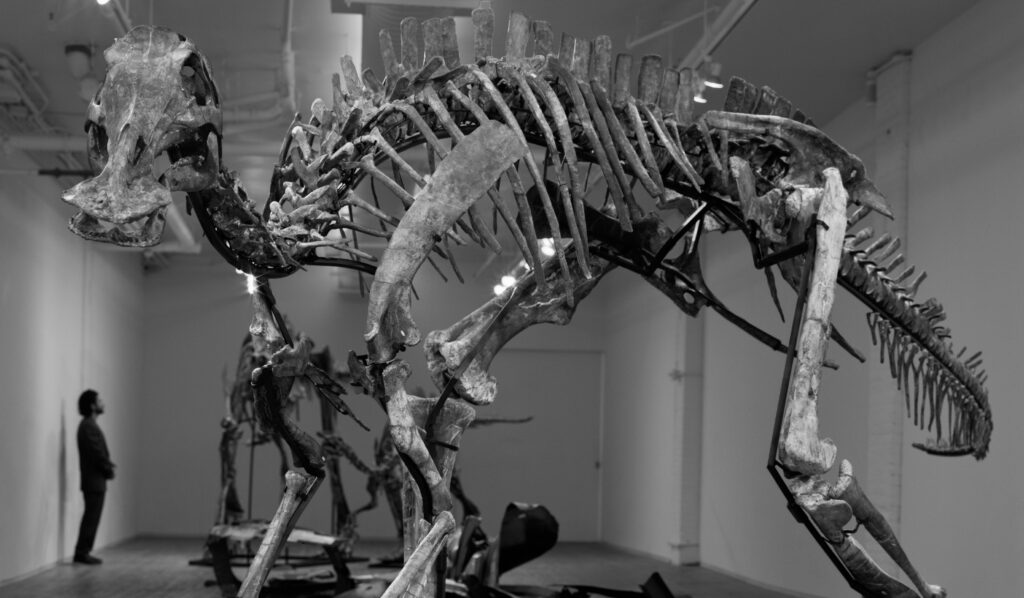
I had been speaking to the founders of both Amanita and Granada [a high-end fossil gallery in Arizona], who own the fossils, about a recontextualizing gallery style exhibition for over a year. Eventually they both understood the vision and I introduced both parties, resulting in “The Land Before Time: Three Dinosaurs and a Gondola“: an exhibition of never-before-exhibited Maiasaura dinosaur fossils, alongside a rare sculpture by John Chamberlain.
They are called Maiasaura, herbivorous, duck-billed dinosaurs from the Late-Cretaceous that lived about 75 million years ago. Maiasaura stands for “good mother lizard” because through this species, paleontologists discovered that dinosaurs take care of their young.
In the exhibition there are three different growth stages. There’s a juvenile, a subadult, and an adult. It’s extremely rare and precious to have an exhibition in which we’re able to see three different growth stages of one species.
For most of us, including myself, it is so abstract to be able to place a financial value on an object that is 66 million years old.
There was Apex the Stegosaurus, which was sold for about $44.6 million. Beyond that there was Trey the Triceratops, which was the priciest fossil ever sold in an online-only auction, via JOOPITER, at over $5 million and Cera, …a juvenile Triceratops, sold at a live auction via Phillips for $5.37 million.
Not necessarily. When there is an extremely rare specimen, it often happens that a museum or a cultural institution reaches out to a top collector and asks them if they could acquire the specimen on their behalf.
But the market is changing. There is greater collector appetite for the specimens in more intimate settings. It’s the first time that these sales are becoming really public and reaching audiences that they never had before.
Up until now the association has always been: if you want to see a dinosaur, where do you go? A natural history museum. And that’s a very different experience than going to a contemporary art gallery.
Part of this vision has always been to make the dinosaurs sexy, cool and elegant in a way that they’ve never been presented before. We’re thinking about recontextualizing them through popular culture, music, fashion, etc. It’s really about being able to present them to new audiences while changing the perception, elevating them, and celebrating them for their aesthetic value beyond just the scientific dimension.
Everyone seems to be a little bit numbed out and overstimulated by all the aesthetic information of the current existing contemporary art world. We have endless art fairs to travel to and so much information to consume. The fossils create a deep sense of awe and wonder in a way that very few other objects in the world can create. What did they look like? How did they live?
When anyone is confronted with a dinosaur specimen, there’s really no thinking that needs to happen. It’s just a very visceral experience. It immediately takes you outside of time, to the unknown.
We’re at a point in our society where we are so inundated by technology and information on our phones and screens..there’s always something new that’s asking for our attention one way or another or trying to get our focus. And the dinosaur specimens are in many ways the complete opposite of that experience.
It’s exciting because it expands the trajectory of contemporary art, challenging the definition of it. It grants cultural value to objects that are relegated to a scientific context that often overlooks aesthetics. This perception became apparent to me through my involvement with “Trey” the triceratops and Co-Museum, a Singapore based art and tech start-up. Trey was ultimately auctioned through Pharell William’s online auction house JOOPITER, in a landmark sale for $5.5 million. It was an abstract experience to assign a numerical value to an object that is over 66 million years old.