Your bag is empty.
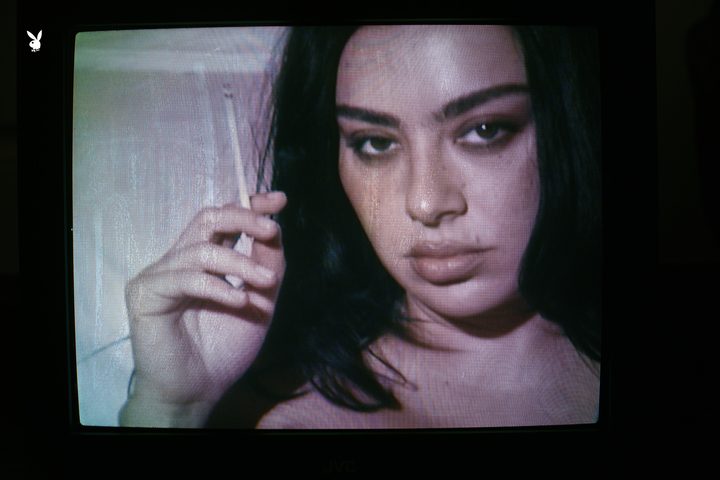
Playboy talks to the New Orleans rapper about the rebirth of his city.

By the time I sat down with Rob49, his flight had been delayed nearly a day, and I overheard the rapper had only slept two hours since landing back in his hometown of New Orleans. Our interview was squeezed in just three hours before his sold-out Vulture Island Experience, a star-studded celebration of music and culture. Stylists zipped garment bags, managers checked clocks, phones buzzed, family wandered in and out. Amidst the chaos, he stayed locked in, eyes on me, fully present.
Rob wore a black ski mask the whole time, a classic hip-hop disguise, more menace than mystery. But what stuck with me wasn’t the mask. It was how much he smiled. The fabric bunched at his temples, his eyes crinkled, and that warmth filled the space between us.
I don’t usually write about rappers. I spend most of my time writing about Black women. But when Playboy called, saying yes to Rob49 felt like saying yes to New Orleans.
Years ago, I taught high school students who survived Hurricane Katrina as children. In 2022, we gathered for the screening of Katrina Babies, a documentary chronicling the trauma of their displacement. But what I remember most from that night was the after-party. The moment “Vulture Island V2” dropped, my former students, now grown-ups, surrounded me on the dance floor, gleefully shouting: “I’m a real trap star from Vulture Island!” For three minutes, they moved in perfect sync. Rob49, fresh on the scene and exactly their age, had become their collective voice.
Rob49 gave us that joyous moment, so I wanted to hear about his. Hoping, to understand the man who had become the voice of New Orleans I asked him about growing up in the Iberville Projects. I bypassed the typical questions about the poverty and violence often asked of those from the trenches. Instead, I wanted to know about his fondest memory.
Behind the mask, his eyes softened.
“Everybody was outside,” he told me. “Everybody was on one accord.” Then he said something I haven’t stopped thinking about since: He still dreams about it.
That answer unlocked everything. When I asked about Hurricane Katrina, he didn’t just describe a storm; he mourned what came after. The city, he said, became “like everywhere else.” He missed the feeling of the old New Orleans, the version where people knew each other, lingered outside, and truly belonged to one another.
Backstage, I realized he had recreated that missing ecosystem for himself. Even before we sat down, I could feel the protective warmth radiating from his inner circle, each of them a Black woman. Surrounded by this close-knit crew, I was welcomed like family, and what could have been a high-pressure arena show felt instead like a true homecoming.
When I brought them up to Rob, noting how intentional it felt to surround himself with that kind of care, he leaned forward. “They be on they shit,” he said, dead serious. “Choosing a team of Black women is probably the most intentional thing I’ve done. People think men get it done, no. It’s the women.”
That same intentionality runs through his music. Millions recognize Rob’s voice, a slow gravelly drawl, dripping with Casanova energy. His sound is pure Black New Orleans: romance wrapped in raunch. It’s the energy you catch at a second line, when Gerald LeVert’s “Casanova” morphs from a silky R&B hook, “Ohhh Casanova,” to the brass band street chant, “Ohhh girl bend ova!” Rob does it too: on tracks like “I Need Us,” he’ll rap about falling in love, then pivot, “I can’t be the one you love on, baby, I just gotta be the one you fuck on, baby.”
It’s no wonder both Cash Money and No Limit, the royalty of New Orleans rap, have already crowned him the future of the city’s sound.
That tension, romance and raunch, tenderness and bravado, drives women wild. Which made it all the more surprising when he admitted his own voice used to make him cringe. When I laughed and told him his voice was perfect, he bashfully smiled behind his mask.
But don’t get it twisted, Rob knows exactly how to work his set. When I ask how he nails what women want, he grins and admits he takes notes from his girlfriend on what to say.
“Ahhhh she’s stunning!” I said of his partner, remembering photographs of her on his Instagram. He quickly responded, “Mannnn, fuck stunning, she’s an angel to me.” I beamed and leaned in, “What does being loved by a Black woman feel like?”
“It’s healing,” he said. A pause. “It’s heaven.”
That commitment to partnership lines up perfectly with how he sees himself in the game. One of his favorite movies is the hood classic, Paid in Full. When I asked if he relates more to Ace or Rico, one might expect him to pick Rico, the flashy, impossible-to-ignore ladies’ man. But Rob chose Ace, the reserved, loyal one. He’d rather be lowkey. “The people in front catch the most heat,” he explained. His goal is simple: get the money and take care of his loved ones.
While he fiercely guards his personal life, he is equally about protecting the joy in his music. Right now, his mission is simple: shepherd an era where hip-hop finally feels fun again.
He wants to experiment and escape the rigid boxes that so often trap artists. He describes a fascination with sonic minimalism, looping a single, specific sound or word over an entire track just to see what happens. When I point to his hit, “WTHELLY,” as a prime example of this, he nods, flashing a knowing grin. For Rob, the studio isn’t a factory floor; it’s a playground.
I asked him if he knew about the writer bell hooks. He said no. I smiled and told him he’d probably love her seminal book, All About Love. But it was actually something the artist Camille Billops said, in an interview with hooks, that reminded me of him: “Put all your friends in your art, everybody you loved, so one day they will find you and know that you were all here together.”
“You could have sold out this experience by yourself,” I said, “but Sexyy Red is here, GloRilla, Loe Shimmy, the togetherness is beautiful.”
“We are together almost everyday,” he replied. “Like, we’re a real life family. This only makes sense.”
Again, it was the same philosophy: it wasn’t just about being seen, but about building something that would last for generations.
“Have you seen my outfit for tonight?” he asked, eyes sparkling. When I shook my head, someone flashed a shirt with Karmelo Anthony’s face, a young man whose case has drawn national attention after he received a lengthy sentence for the fatal stabbing of a teammate. Rob sees Anthony’s story as part of a larger pattern of systemic injustice. “He could be any of us,” Rob said quietly, aware of how quickly a young Black man’s life can change. For him, fame isn’t simply about vanity; it’s a platform to speak out for justice.
We both pause as a brown beauty steps into the room, catching her reflection in the mirror. “Awwww, my sister’s here!” he exclaims, and for the first time, his focus shifts. I slip in one last question as he gets up: “Out of all the New Orleans dances, the beanie weenie, the dip, which is your favorite?” He laughs. “Definitely the 6th Ward Dumaine,” he says, cranking his arms to show off the move. I laugh, too.
And just like that, our time is up. His entourage forms, hustling through the concrete maze of the arena. His publicist grabs my hand, pulling me safely through the rush so I won’t get lost in the crowd.
When we reached stage left, the lights dropped. The design looked like a fever dream of New Orleans, lush green lighting, oversized tropical ferns sprawling the screen, and flashes of neon cutting through the haze. The crowd roared before he even appeared.
Right next to me, the women on his team started making hearts with their hands, throwing them up into the air toward the stage. Rob spotted them immediately. He smiled, and that connection instantly turned his energy up.
One of the women said, “You know he’ll always find us.”
Another scanned the completely sold-out arena, watching the sea of thousands of people locked into his every word, and admitted she might cry. She was beaming with the kind of pride that only family can hold for family.
The audience was just as locked in. They sang the older tracks with the exact same vigor as the new ones. When the bass for “I Need Us” shook the floor, I found myself thinking less about the music and more about the literal definition of the title. Devotion was everywhere in the building.
All night, Rob turned the concert into a collective victory. He kept bringing out his peers and collaborators: Sexyy Red, G Herbo, YTB Fatt, YK Niece, and Loe Shimmy. Before the show, he had spoken so warmly about Shimmy, insisting that I meet him, celebrating his success on Drake’s new album as if it were his own.
Watching him embrace artist after artist, yelling “I love you” over the roar of the crowd, hugging them deeply before they vanished back into the wings, it became impossible to separate the performance from the person.
He still dreams about everybody being outside, on one accord. Maybe that’s why he keeps building spaces where they can be.
Rob ended his set with “Vulture Island V2,” the same song I once watched my former students scream at the top of their lungs. The sold-out arena lost its mind. Rob disappeared backstage, the moshpit still thrashing for a closer look. Some people build careers out of spite, chasing what everyone said they couldn’t have. But Rob’s running on love, and it hits different.