Your bag is empty.
Five years after he broke the Edward Snowden story, reporter Glenn Greenwald is speaking truth to power again—whether you want to hear it or not
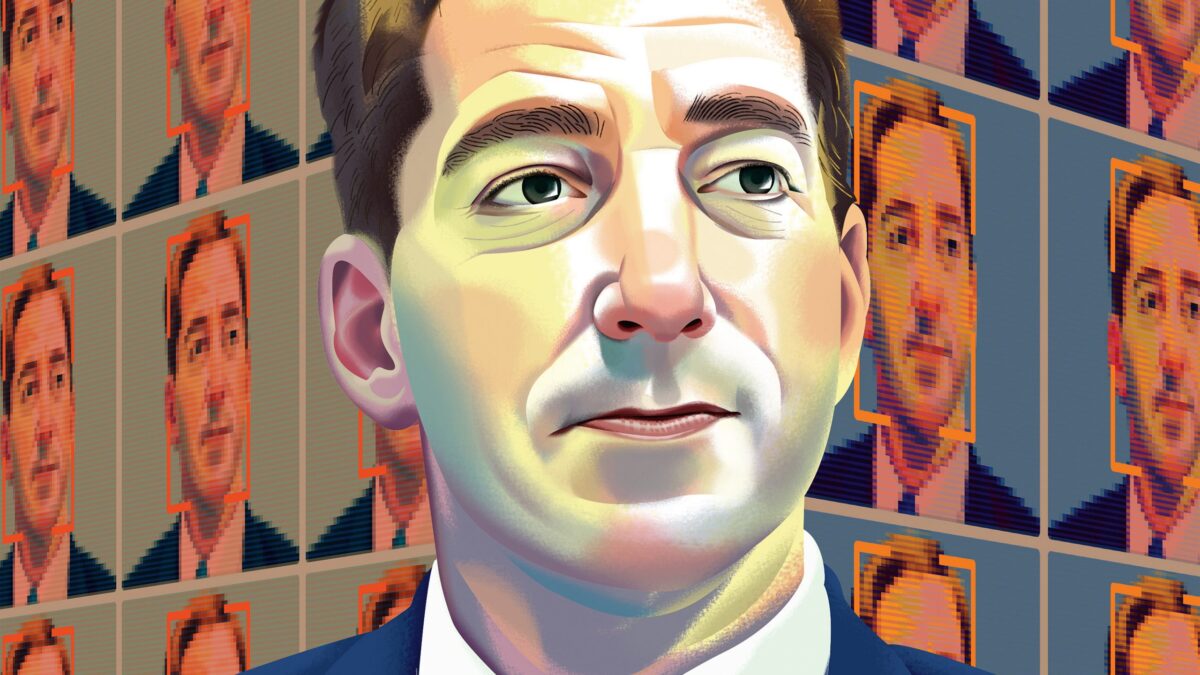
Just before President Donald J. Trump met with Russian president Vladimir Putin in Helsinki in July, Glenn Greenwald flew to Moscow. The investigative journalist and former lawyer, in town to participate in a cybersecurity conference, was on his own audacious mission: to challenge the Trump-era tendency among politicians and mainstream media outlets to characterize anyone who engages with Russians—let alone visits the country—as suspicious, if not downright treacherous.
“The panel itself didn’t generate controversy,” says Greenwald, speaking from his adoptive home of Rio de Janeiro. (In this context at least, he projects unflappable calm whether he’s talking about tennis or Trump.) “That started afterward, when I gave an interview to RT,” Russia’s 24-hour English-language news channel. Greenwald told RT that Americans on both sides of the political spectrum are obsessed with “viewing Russia not just as an adversary but as an actual enemy.” He added: “There’s actually talk a lot now about how what they regard as the interference in the 2016 election is similar to Pearl Harbor…or Al Qaeda and 9/11.” Greenwald continued: “Despite all the claims that…Trump is a puppet of Russia, in many ways Obama was more cooperative with the Russian government than Trump was.”
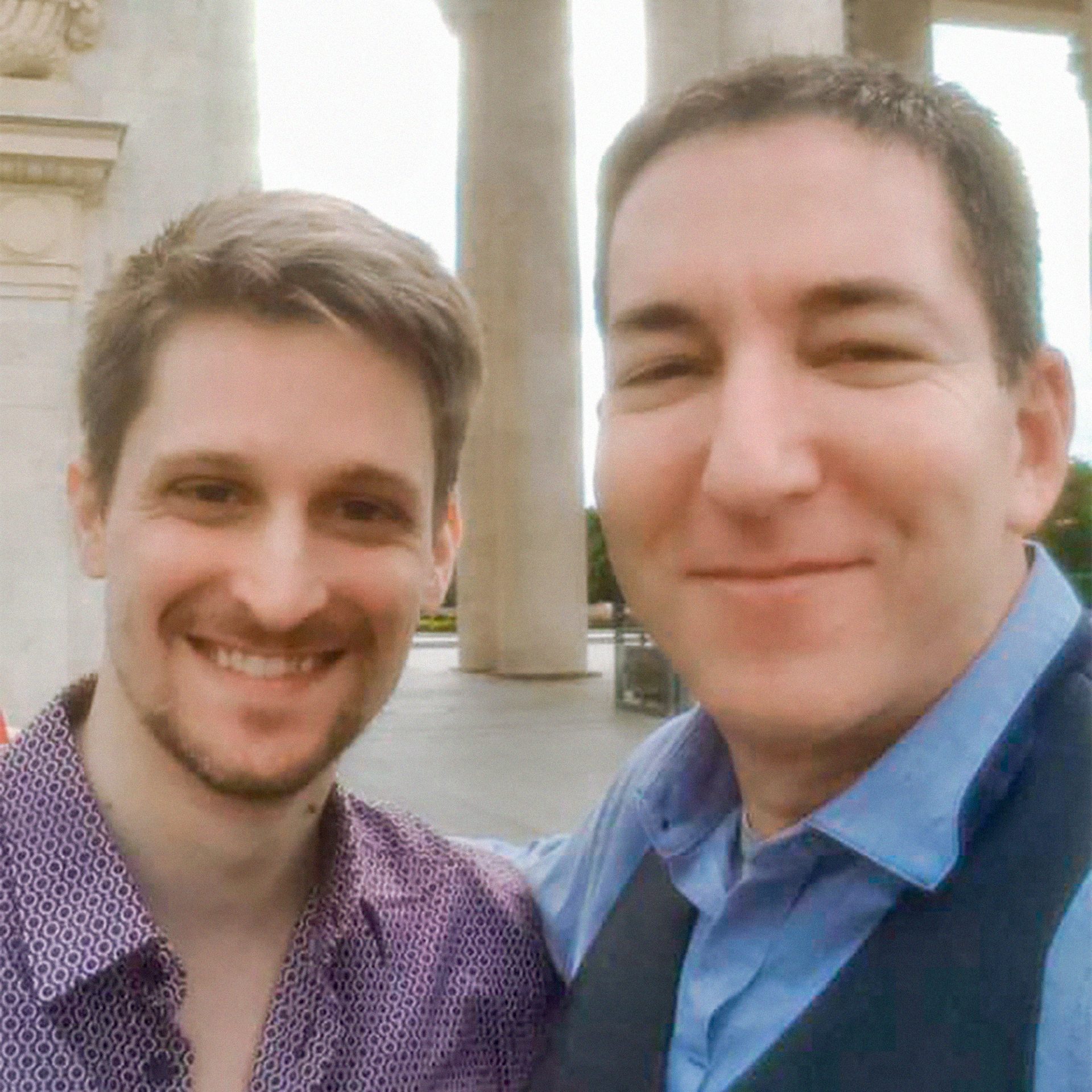
On the same trip, Greenwald met with Edward Snowden, the former CIA analyst and NSA contractor who leaked top-secret documents exposing mass surveillance of U.S. citizens—and whose whistle-blowing Greenwald helped facilitate via The Guardian, launching both men onto the global stage. Greenwald posted multiple smiling selfies of the two on Instagram.
Soon after the RT interview, retired naval intelligence officer and MSNBC analyst Malcolm Nance suggested to his 420,000-plus Twitter followers that Greenwald was “an agent of Trump & Moscow” who “helped Snowden defect.” Nance later added, “#KissPutinforUs.”
“I’ve been attacked since I began writing about politics,” Greenwald says, “but this is different.”
Nance’s assertions are “outright lies.” When a serious fabrication is made by “somebody who’s presented as part of a journalistic organization, that becomes grave,” he says. Greenwald has thought of suing Nance, but, he says, “I don’t want to be one of those people who go around using lawsuits to prevent or suppress criticism. On the other hand, there are limits on what you can say about people.” (Nance did not return calls for comment.)
Greenwald got a preview of this kind of attention a few years ago when prominent Democrats began to suggest that Trump was conspiring with Putin during the presidential campaign. Greenwald doubted this claim because, he says, there was no evidence. When Hillary Clinton began losing primaries to Senator Bernie Sanders, her operatives and allies used the same “smear tactic,” as Greenwald calls it, to try to align Sanders with Russia. This approach also surfaced in TV news. “You honeymooned in the Soviet Union,” said CNN’s Anderson Cooper, addressing Sanders during the primaries.
Greenwald’s position, summed up in his 2016 headline DEMOCRATS’ TACTIC OF ACCUSING CRITICS OF KREMLIN ALLEGIANCE HAS LONG, UGLY HISTORY IN U.S., drew loud denunciations. Former Vermont governor Howard Dean, who ran for the Democratic presidential nomination in 2004, tweeted about the news site Greenwald co-founded: “Would be interesting to find out if the intercept gets money from Russia or Iran.” Robert Shrum, Democratic campaign operative and chief strategist for John Kerry’s failed 2004 campaign, tweeted, “You are a criminal agent of Putin conspiracy.”
“Democrats were so disoriented, shocked and outraged by Trump’s victory that they looked for culprits, for villains, that they could blame instead of themselves,” says Greenwald. “I became one of those villains because I was doubtful of what became a religion for a lot of liberals.”
Whether or not you agree with his views, it’s hard to deny that, roughly five years after the peak of his Snowden coverage, Glenn Greenwald still knows how to confound our deepest assumptions about politics, the media and what it means to be American.
Raised in a suburb of Fort Lauderdale, the now 51-year-old Greenwald has been taking on hot-button issues since Snowden was a teen. His track record is nothing if not wide-ranging; he is, after all, a gay man of Jewish descent who represented white supremacist Matthew Hale in a series of First Amendment cases. He also brought lawsuits alleging disability, race and age discrimination in cases against large corporate employers defended by major law firms. “I knew that I didn’t want to be representing rich people,” he said in a 2013 interview. “I wanted to be suing them.”
Having launched his own firm at the age of 28, Greenwald abandoned law for journalism in the years following 9/11. His Snowden coverage won The Guardian a Pulitzer Prize, and he played a key role in Laura Poitras’s Oscar-winning documentary Citizenfour. Director Oliver Stone recognized that story’s dramatic potential and put together a Snowden biopic—a study in unintentional surrealism: “John Cusack is a friend of mine, and he asked Oliver if he could play me. Oliver said, ‘Glenn has this unique combination of extreme femininity and extreme masculinity, and I don’t think you can capture that. We need a gay actor.’ That was more the by-product of some weird psychological issue in Oliver’s head, as opposed to an accurate reflection of me,” says Greenwald, laughing. “I thought he might cast Nathan Lane. Instead, he got Zachary Quinto—and he played me as an overwrought queen.”
Greenwald prefers Citizenfour, which shows him reporting the Snowden story in real time along with Poitras and fellow reporter Ewen MacAskill. “I find that to be the more enduring record of what I did,” he says.
Today, Greenwald is involved in another documentary—one whose outwardly apolitical milieu obscures the through line that connects all his endeavors. For starters, he’s producing this time, in collaboration with Reese Witherspoon’s Hello Sunshine company. And this one is something of a labor of love: During the tennis craze of the late 1970s and early 1980s, while Greenwald’s father cheered for the sun-kissed neighborhood champion Chris Evert, Greenwald found a hero in Martina Navratilova. She, not an exiled hacker, is at the center of his new project.
Journalists didn’t used to send their kids to the same private schools as oligarchs and generals.
“She was just so deviant of the societal norms,” he says. While Evert’s tournament guests were her boyfriend and Catholic nuclear family, Navratilova’s were “a bunch of dykes, her lover and her trans coach, Dr. Renée Richards, at a time when there was no vocabulary to even talk about these things,” Greenwald says. “She made everybody uncomfortable.”
Compare that with Greenwald’s take on Billie Jean King, another tennis legend who has reappeared on the big screen, portrayed by Emma Stone in last year’s Battle of the Sexes. “King was very self-consciously a political pioneer who regarded herself as a leading feminist cause. But she didn’t come out voluntarily; she was dragged out of the closet in a cloud of scandal and shame. And when she got outed, she just said she was bisexual. She was kind of apologetic about what happened and made it seem like a phase. There was nothing affirming about it.”
Apparently King lands somewhere near President Obama on Greenwald’s ever-growing list of left-leaning sacred cows.
After his Snowden stories, Greenwald was looking for a unique platform to continue what he calls “adversarial journalism.” The idea attracted the attention and funding of billionaire eBay founder Pierre Omidyar, and out of that partnership came The Intercept. Omidyar has no active editorial role, and the site’s nonprofit backing means it doesn’t rely on clicks or advertising. Greenwald is free to focus full force on afflicting the comfortable—an ethos he finds lacking in the national press.
“Journalists didn’t used to go to cocktail parties and send their kids to the same private schools as oligarchs and generals,” he says. “They were just schlubby, middle-class or lower-middle-class people who said, ‘Let’s poke these powerful people in the side.’ Then, with the proliferation of television, journalism became owned by the biggest corporations, and media outlets became divisions of huge conglomerates. Instead of being outsiders, journalists are very much a part of the elite culture and don’t want to do anything to disturb it. That’s changed how journalists think about state security agencies.”
Being this kind of contrarian is a quintessentially American choice. Ironically, it’s a choice Greenwald might not have made if he hadn’t relocated to Rio.
“I was kind of forced to live in Brazil,” he says. His Brazilian husband, David Miranda, couldn’t get a visa in large part because the U.S. wouldn’t recognize their marriage. “We’ve built a life here now,” Greenwald says. Miranda is on the ballot for Brazil’s Congress this October, and they’ve adopted two children. Besides, Greenwald is in no hurry to re-enter the American media bubble.
“Its assumptions, belief systems and mentality would shape the way I see the world,” he says. “The distance I have from the East Coast media and political culture—and the fact that I’m not in any way dependent on it—gives me the mental space to think more critically about it. I don’t rely on them for anything.”
Nothing about Greenwald has ever been neutral.
That distance may account for Greenwald’s take on Robert Mueller, James Comey and other recently minted stars of the U.S. intelligence firmament. “It’s always true that in a time of war, people unite behind the government, especially military intelligence authorities,” he says. But the post-9/11 years have eroded our skepticism of all things militaristic and nationalistic: “Remember, we’ve been at war for 17 years—bombing multiple countries, constantly being warned of great national security threats.” With Watergate, reporters and the commentariat became dubious of our intelligence agencies. “The old CIA tradition” of openly lying, as former top spy Tom Braden once explained it to me, became obvious in the wake of congressional investigations and hearings in the 1970s. Today, those agencies are granted saintly status in the press. Intelligence veterans and loyalists are a news staple: In addition to Nance, MSNBC employed former CIA director John Brennan, and CBS hired former CIA acting director Michael Morell as an on-air contributor in 2014.
“I think one of the untold stories of the 2016 election is the extent to which the CIA intervened,” Greenwald says. “CIA directors from both Republican and Democratic administrations wrote op-eds in The Washington Post and The New York Times, accusing Trump of being a Russian asset controlled by Putin, and they endorsed Hillary Clinton. The CIA has been opposed to Trump from the start.”
With Greenwald’s distance comes a sobering view of what happened after that election. “In a lot of ways, Trump’s primary opposition has become these security state agencies, so anybody who hates Trump, as the Democrats do, and wants to see him gone at any cost, has aligned themselves with the military and intelligence community,” he says.
Views like these don’t play well at MSNBC, where Greenwald used to be a frequent guest. “I’m never invited anymore,” he says. “My suspicion is that I’m banned.”
I asked Tucker Carlson, the Fox News commentator who often uses Greenwald as a source for his show, for his take. “I doubt Glenn’s core views have changed much in the past 10 years,” he says. “The world has changed around him. He’s still an absolutist on civil liberties.” What does Carlson think about Nance and others accusing Greenwald of being an agent of Trump and Moscow? “Glenn’s commitment to principle embarrasses them, so they try to silence his voice by baselessly accusing him of loyalty to a foreign power. It’s completely disgusting.”
What, then, does Greenwald think of the current case against Russia or the country’s shaky human-rights record? He’s “willing to accept that there was Russian meddling.” Regarding its leadership, “I don’t argue that Putin’s government is freedom-loving, has a propensity to tell the truth or anything like that.” But he adds that even if you believe all the evidence, Russia’s chicanery is not much different from “what the United States and Russia have been doing to other countries, and to one another, for many decades. Having countries interfere with one another’s domestic affairs is something that’s been going on for a long time—and it’s still going on.”
General Michael Hayden may call him more “activist than journalist,” but then nothing about Greenwald has ever been neutral. Like his hero of the tennis court, he sees the power that lies in making us uncomfortable. With Trump dominating the headlines, a little discomfort amid the outrage might do us good.