Your bag is empty.

Many top-level athletes turn to cannabis for pain relief, despite the fact not all leagues permit its use. That could change soon
Sitting behind a desk covered in hemp rolling papers and glass jars full of bud, Al Harrington is explaining that he never thought he’d grow up to be a stoner. As a teenager in New Jersey, the six-foot-nine power forward had his heart set on an NBA career. Back then, before he was leading the line for teams including the Indiana Pacers, the Golden State Warriors and the New York Knicks, his grandmother would constantly remind him that chasing his basketball dream meant staying well away from illegal drugs.
“I remember my grandma kicking my aunts and uncles out of the house for even smelling like weed,” says Harrington, now 40 years old and the founder and CEO of his own Los Angeles–based cannabis brand, Viola. “I was taught it was a gateway drug. I’d see guys strung out on the corner, and they’d tell you that cannabis is what started them down that path. I was smart enough to know I didn’t want no part of that.”
It was a surprise, then, when Harrington made it to the NBA and realized that many of his teammates—70 to 80 percent, by his estimation—were using cannabis in secret. “I saw professional athletes smoking weed and being productive,” he says, raising his eyebrows. “We’re talking about the best players on my team.”
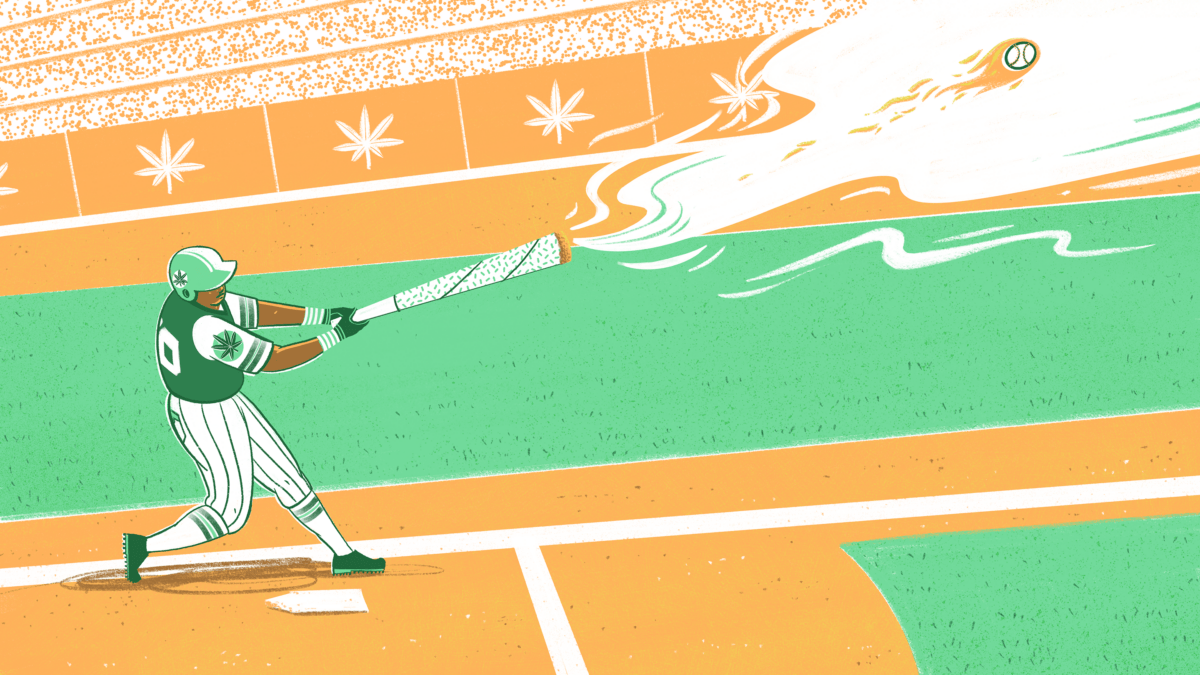
Cannabis remains on the NBA’s list of banned substances, but perceptions surrounding the drug are changing across professional sports. At the end of 2019, the MLB announced that it would be removing cannabis from baseball’s list of “drugs of abuse.” The NHL also no longer classifies cannabis as a banned substance. This March, the NFL followed suit when, as part of a new collective-bargaining agreement, the league agreed to do away with suspensions for football players who test positive for cannabis. Harrington believes the NBA won’t be far behind. “I think they’ll wait to see how it affects the NFL, and I don’t think it will affect the NFL at all,” he says. “The NBA can’t be the only league that doesn’t change their rules. They’ll look kinda crazy.”
Ironically, Harrington’s own cannabis awakening came thanks to the same person who’d first warned him away from it—his grandmother Viola, from whom his company takes its name. In 2010 Harrington signed with the Denver Nuggets, which meant he and his family were living in Colorado at a time when cannabis had been legalized for medicinal use. His grandmother was suffering from severe glaucoma, and after pharmaceutical treatments proved useless, Harrington read that she might have better results with the drug she still referred to as “reefer.”
“She was always in pain, and she couldn’t see,” remembers Harrington. “Cannabis literally cleared her eyesight up. The first thing she did was read her Bible. For me that meant a lot, because my grandmother was so hard on any of her children using any kind of drugs. For her to be open enough to try it, and then to have that relief, and then the first thing she does is pick up her Bible? Those were signs being thrown my way.”
But it wasn’t until 2012, when Harrington went in for knee surgery and ended up with a staph infection, that he began to understand that “reefer” might benefit him as well. “I had to have four surgeries in a two-week span,” he says. “I was on all kinds of pain meds, and obviously it wasn’t agreeing with the way I felt. I’d be constipated, all kinds of shit. Somebody introduced me to CBD first. The next year, I started smoking. For me, it was about managing pain, but it was also because when I get high it allows me to deal with a lot of stuff mentally. Anything that goes wrong, the first thing I reach for is cannabis. I believe the plant can heal everything.”
For many professional athletes, cannabis is more than just a lifestyle choice—it’s a way of managing pain and inflammation that some feel is healthier than the truckload of pain meds they’re usually prescribed. Eugene Monroe spent seven seasons in the NFL as an offensive tackle for the Jacksonville Jaguars and the Baltimore Ravens and became used to riding what pros jokingly refer to as “the T train”—a line of players waiting to drop their pants before each game so they can get the powerful painkiller Toradol injected into their backsides.
Monroe became the first active NFL player to challenge the league’s ban on cannabis.
“We laughed and joked about it as players, but many of us were gonna get that injection because it essentially made you Superman,” explains Monroe. “It masked all the pain.” If that sounds like a good thing, Monroe points out the lack of feeling could be terrifying. “Back in college, I tore my labrum [the cartilage that lines the shoulder joint] in a game versus UConn at home in Virginia,” he says. “I could tell that something was wrong with my shoulder. It really wasn’t functioning like I needed it to, but there was no pain because I’d already had a Toradol shot for my knees. I just got wrapped up and went back out there.”
Like Harrington, in his early days as a player Monroe avoided cannabis because of the stigma around it and the threat of punishment for using a banned substance. However, as his injuries mounted, so too did the number of prescription pills he had to take each day. Monroe says it got to the point where he was taking pills just to deal with the side-effects of other pills, so he started to look for alternative forms of treatment. “For me, the major benefits of cannabis are as an anti-inflammatory and the relief from pain, headaches and other concussion symptoms that I still have years after suffering a bunch of them,” he says. “I went from scheduling X amount of pills throughout each day to eliminating all of them. Now that I use cannabis, the only pills I take are vitamins and minerals. There’s no more pharmaceuticals.”
In March 2016, Monroe became the first active NFL player to challenge the league’s ban on cannabis. He retired four months later at the age of 29, citing concerns over the amount of head trauma he’d sustained during his career. He’d like to see more research into the potential that cannabis may have to treat chronic traumatic encephalopathy (CTE), the neurodegenerative disease that has been identified in the brains of more than 100 deceased former NFL players. “We don’t have any clinical data yet,” he points out. “But as laws are changing, research is finally opening up. We’re able to study much more dangerous drugs in a clinical environment, so it’s about time we looked at the potential of cannabis as well.”
The need for further clinical testing is echoed by Dr. Mark Ware, an expert on pain management who co-authored the 2018 paper “Cannabis and the Health and Performance of the Elite Athlete.” “There’s plenty of good reason to think that as pharmacological drugs, both THC and CBD could have effects on pain and sleep and mood and inflammation and so on,” he says. “The problem is that to get to the point where we can say it works in a human, we need trial data. Athletes use it because they think it works, but for me as a doctor to say it works I need data to back that up. Unfortunately, we’re missing a lot of that information.”
For years the potential health benefits of cannabis for athletes have been downplayed.
Dr. Ware believes that cannabis legalization in Canada and in many American states should lead to an increase in the amount of research being done into the possible benefits of cannabis for top-level athletes—benefits that many former players already swear by. Matt Lombardi is a regular CBD user who was a professional hockey player in the New Jersey Devils and Pittsburgh Penguins minor league systems until his career ended early after he suffered a bad concussion. “I was getting the puck, and as I turned I got smacked in the face with an elbow,” he remembers. “I had symptoms for six or eight months, so I missed half the season.”
Lombardi is now such an evangelist for CBD that, along with former Chicago White Sox minor league pitcher Kevin Moran, he has co-founded a CBD wellness brand called beam. “Over the next five to 10 years, there’s going to be so much more science and data coming out that it’s really going to disrupt Big Pharma,” Lombardi predicts. “I think it’s really going to have a positive impact on how people think about their bodies and the endocannabinoid systems we all have.”
For years the potential health benefits of cannabis for athletes have been downplayed, in part thanks to the same stigma that made Al Harrington believe he’d end up a junkie if he touched cannabis. But now professional leagues may finally be catching up to what many players have known for a long time: Cannabis seems to help.
Back in Los Angeles, Harrington says there’s no reason cannabis use shouldn’t be accepted across all professional sports. “If fans and team owners say they care about what’s best for the players, then they have to allow it,” he says. “If they’ve got to do research, pay for the research so you can scientifically prove it, but there’s more than enough stories out here of how cannabis has helped a lot of people. It’s just time.”