Your bag is empty.

Nate Amos was never comfortable singing in public. With The Singer in My Band, his new album as This Is Lorelei, he’s still trying to get that way.

In a little more than a decade, Nate Amos released more than two-dozen records as This Is Lorelei, slipping them onto streaming services with no intended fanfare. They were mostly EPs or what Amos retroactively calls mixtapes, all scattershot assemblages of songs and sounds, most any idea that came to Amos as he marooned himself in his Chicago apartment. This Is Lorelei was his safe sink for stray musical thoughts, separate from Water From Your Eyes, the slanted indie rock band he was then jumpstarting with singer Rachel Brown.
But in 2024, Amos issued Box for Buddy, Box for Star, his pressed-to-wax debut as This Is Lorelei. It embraced the project’s impulsive nature, bouncing along to electropop and brimming through country and racing into classic indie rock. And then, perhaps unexpectedly to Amos, it caught on, earning not only critical accolades but the strongest possible praise a songwriter can get—covers of his songs by colleagues he respects, like Waxahatchee’s Katie Crutchfield and Geese’s Cameron Winter. He eventually reissued the record, cobbling it together with some of those very renditions.
Amos opted to lean into this singer-songwriter notion for this year’s follow-up, The Singer in My Band, a breathless semi-acoustic rock record that perfectly navigates two portions of Amos’ musical childhood as someone raised in a bluegrass household but weaned on pirated indie rock. Still, Amos is only now coming around to the idea of himself as a bandleader playing songs he writes. The record’s name comes from a moment in the title track when the singer asks someone else to be the singer in his band. She says no. Amos has to make do.
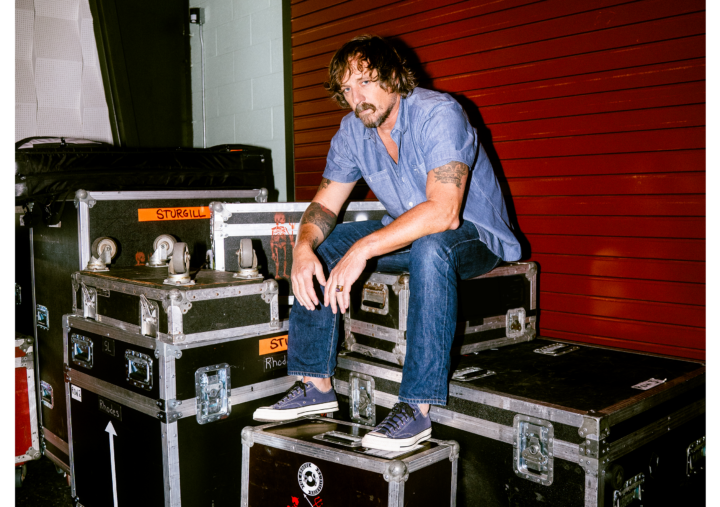
Playboy caught up with Amos for a very long chat in his Nashville hotel room, where he was not only about to finish a tour opening for big Bleachers crowds but also trying to finish the next This Is Lorelei album. Turns out, he’d been singing all morning.
We were just a big music house. My earliest memories of live music are being around bluegrass—pre-memory stuff. And weird, vague, early memories of music are as far back as it goes for me, that and staring at the moon. My dad was hearing live music, and it was all bluegrass. But we were around bluegrass so much that I don’t think my dad was really going out of his way to play more bluegrass around the house. I was being fed a steady diet of classical and choral music. I remember fucking with Beethoven as, like, a four-year-old. That and bluegrass were two separate pockets of memories.
It normalized the idea of having a career in the arts. If I’m being really honest, the first time I was ever like “I’m gonna start a band,” it was because of an episode of Doug where they start a band. I’ve decided I’m never going to go back and watch it, because I don’t want to mess with what it’s become in my head. But I think Doug and Skeeter started a band. There was this little music video, and they were using trash cans and streetlights as drums. I was just like, “Banging on a track underneath the streetlight? Dude, that’s fucking sick.”
I got fixated, coming up with band names before I could play. I was taking piano lessons, but I didn’t start playing guitar until fifth grade. But it wasn’t until high school that I tried to actually start a band. I approached my friend Ryan—who I ended up making music with, who to this day is probably my single biggest influence as a guitar player—because I knew he played trumpet in the middle-school jazz band. I wanted to start a ska band. I was really into Sublime, still love Sublime. He was pretty much like, “No. But I play guitar, if you wanna do something cooler.” And then we were this little misguided indie group, trying to play with screamo bands.
For my 16th birthday, someone gave me one of the big Rolling Stone 500 Greatest Albums of All Time things. I went to work on Limewire. That was my first exposure to Sonic Youth and Pixies and Pavement. In terms of ’60s and ’70s rock music, I got a pretty thorough education from my dad. At some point in the late ’70s, he just pivoted totally to bluegrass and became obsessed. The late ’70s onwards was a blind spot for me.
But throughout my 20s, I listened almost exclusively to music from the ’80s, just because there was so much I’d never heard—Talking Heads was huge, Joy Division, New Order. I recently got a CD player and started a CD collection, went on like an hour-long rampage ordering all the CDs I thought would be essential for my collection. Only two of them were from the ’80s. For every album from the ’80s that popped into my head, there were like five from the ’70s and ’90s. I realized at a certain point I only listen to ZZ Top and nü metal.
I’ve never really thought about it before, but that was something I understood from the jump. When I was experiencing live music, the vast majority of the time it was stuff that no one in the room had written. There was the idea of songs existing as a song rather than a recording.
Once I figured out basic chords, I had that big white Beatles book. It was not a party trick, but, by the time I was in eighth grade, I could whip out pretty much any Beatles song on command. That was how I learned to navigate chord patterns. And there was a point in middle school where, all of a sudden, I was able to play “Purple Haze” and “Manic Depression.” I had that purple velvet Jimi Hendrix CD box set and some tiny practice amp and one of those Danelectro distortion pedals—maybe it was called Roast Beef? [Laughs] I bought some cheap guitar and painted it all different colors, à la George Harrison.
I always had a really hard time singing in front of people. I was totally comfortable playing guitar, but I did not like singing around other people. It’s only in the last like year or so that I’ve begun to feel comfortable doing that. I had a little golden era in sixth, seventh grade before I fully got self-conscious, where I was able to sing at family gatherings. But I was never the guy with the guitar at a high-school party. I was friends with the dude who played Neutral Milk Hotel at the bonfires, but I was never leading that charge. Singing has always felt really, really personal; even recording my own voice, I don’t really like doing it, yet I was recording vocals this morning. My favorite context to sing is at a Lorelei show, which is crazy because, two years ago, I was mortified at that idea.
When the Box for Buddy, Box for Star album came out, it did fine. Six months later, things began to vibrate. It was super scary, because Lorelei was this safe little corner to retreat into. The idea of being out in front of people on any level was really scary. There was this slow crossfade from being like, “Oh my God, I don’t know if I can do this” to “It’s not something I’m embarrassed by anymore. It feels like it’s the thing that I’m supposed to be doing.”
The things that I was singing on before, I was very secretive about. I was never pushing Lorelei stuff around any band I was trying to make happen. I made sure that I was not, like, the singer in a band, but the man behind the curtain. But I had friends that listened to my music and people in the pocket of whatever scene I was in who were really supportive. When Lorelei began to gain some traction, that was a huge confidence boost, the first time I had ever felt that level of validation. It was such a personal practice, and it never really occurred to me that some of these songs would end up having the reach they’ve had. All this stuff that’s happening now, even being referred to as a singer-songwriter, it’s trippy to me. I spent so much time making music just for me.
Probably M.J. Lenderman doing “Dancing in the Club,” but that was weird because we made it together. I was in the room, tripping out hearing him record the vocals. When you ask that question, that’s the moment that pops into my head, but I was involved.
But then people started sending videos of Katie from Waxahatchee covering “Where’s Your Love Now?,” and she was touring with, like, Bob Dylan and Willie Nelson. People would say, “Your song is being played in this building where Bob Dylan is.” I’m not sure if it’s something I ever really processed, not something I’m sure I really do want to process. I get sent videos of people singing the songs, and I see numbers of how much songs are getting listened to. That doesn’t translate into me understanding that that’s going on. It’s such a scary idea. A lot of the last two years has just been me convincing myself to be less scared of being an out-in-the-open person.
Honestly, Nick, my manager from Water from Your Eyes, also became the manager for Lorelei. I just kept pissing him off, because I kept making albums and putting them straight onto Spotify and not telling him. He would be like, “Hey, saw you dropped the new album last night. Let me try and shop one of these to labels.” And I thought, “Well, if I’m going to do that, I’m gonna make an album that feels shoppable.”
That resulted in me leaning really hard into the singer-songwriter, 44-minute album—10 songs that fit perfectly on a vinyl. It was a concept album, but the concept was it’s a normal album. At some point, someone asked me about This Is Lorelei’s “mixtape era,” and I was like, “What’s that?” I got pointed to my Wikipedia page, which I did not know existed. And I realized that the whole pre-Box era is under “mixtapes.” That honestly makes way more sense to me. They’re collecting music. Box was the first time I said “I’m gonna make a record.” It’s held in that pattern since, because, with the way the industry works, at least for someone in my position, I can’t just make stuff constantly and put it out. If I’m going to release something, I have to be OK living inside of that world for a year or two.
Dude, literally all the time. When I was doing that, the dream was always to make a career somehow. Now that it’s kind of a career, everything I’m doing is just so I can be allowed to go back to that, because that’s what I love. I was scraping by doing freelance audio work, mixing and occasional live sound. I would have nothing to do but go crazy in my bedroom 16 hours a day, working on music for three weeks straight. That feeling beats any fucking bender I ever went on. I would love to be in a position where, even if I can’t put music into the world immediately, I can make music in that way again, where there’s fucking nothing else on my plate. I’m gonna sit here and watch some fucking random network TV until I have an idea, then I’m just gonna fuckin’ make it. I’m gonna try to remember to shower and eat enough, which never happened back in the day.
Right now, I have every intention of going back to that format at some point. But whenever I make the jump, I need to be holding as many cards as I can. I have my whole life to do that, so I’m not in a rush. I’m thinking now in terms of pulling off, like, a six-album run before the reviews start being like “This guy’s out of ideas.” There are four- or five-album runs that are this perfect era. I’m trying right now to make a concept album like that over five albums. And the concept is it’s a rock band’s career—really stupid, because that’s literally what’s going on. [Laughs] When I’ve done what I want to do in that medium, where I have been hyper-intentional about everything, maybe I’ll be able to relax and go back to more train-of-thought releases. I do daydream about that period where there was no pressure. I didn’t really have any reason to be working as hard as I was.
That Amerie album with “1 Thing” on it. That’s the best fucking pop song I’ve ever heard in my life. I got the first two Slipknot albums, the first two Korn albums. It took the longest to get them, but old beat-up copies of Ænima, Lateralus, and 10,000 Days by Tool. The 10,000 Days CD has these little lenses that flip up. A lot of Crimson stuff, a couple Stevie Ray Vaughn CDs. I did the whole Beatles collection, but I wanted the shitty first-time CD masters that I grew up hearing. I like holding the same CDs I geeked out over when I was six, seven.
It depends on what you’re listening to. A vinyl has a particular sound. I love listening to vinyls, but it automatically places something in a certain context—hearing the vinyl noise, the crackling. I don’t always want to hear that. If I’m going to collect one medium, the CD has everything I want. It has the high-quality sound with no real evidence of the physical medium it’s stored on. And there’s the physical experience of going through a booklet, diving into this information. When I was a kid, my dad had the first several Moody Blues albums on CD, remasters from the early 2000s. They had all these printed interviews with the guys inside. I just love that shit. It tells you something more about, not even the artist, but that particular world the artist built in that moment.
I must have been a kid, eight. I had a burned copy. My parents would not let me get the CD, but I had a friend whose mom would buy him any CD. I don’t think my dad cared as much. My mom very much wanted me to be into Christian rock, and it just never happened. It really made me hate Christian rock—what a fast track to making garbage. My parents weren’t super hardcore about church, but I was an Episcopalian, which I understand is all the fancy robes and shit from Catholicism with none of the guilt. We went, too, because the choir was really good. Both of my parents sang in big church choirs before my time. I had to do Sunday School and Vacation Bible School. Actually, I was just looking for it the other day—I’ve got it right there. [Amos holds up his hand and points to a spot on his right palm, just beneath his pinky.] I have a piece of pencil lead in my hand from Vacation Bible School. I stabbed myself with a pencil so I could go home early.
I could be like, “OK, it’s the optimal tempo for what it is. It’s catchy. It’s fast. It’s a song about love.” But at the end of the day, songs are weird, because there isn’t really a rule. That song definitely shifted the path I was on. The song reminded me that music can be fun, took me out of a really heady phase where I was mostly dealing with serialism and microtonalism and making not only Lorelei music just for myself but making music for myself that theoretically no one else would be able to appreciate. That song made me realize I wanted to make music that other people could enjoy, something that encouraged a connection rather than presented a challenge for connection. That’s what Water from Your Eyes and This is Lorelei are for me now. Water from Your Eyes is the more antagonistic, puzzle-building side. And Lorelei is about trying to remove the boundary. But these things are in flux. The Singer in My Band is up front about what it is. The next one might be more of a puzzle.
It just happened. It wasn’t a choice. I realized what was going on when I hit up my dad to play the banjo: “OK, I’ve actually crossed over into this.” That was probably halfway through writing the album. That song was asking for banjo. If I didn’t put it on there, I was always gonna hear it. The approach I’m taking to these records is, whatever I do by accident on one record, I try to do on purpose for the next one. I’m encouraging myself to have this longform game of telephone with myself, where I find the happy accidents in the previous album and say, “How do I use those things in an intentional way?”
On Box for Buddy, leaning into the singer-songwriter thing was a total accident. My own perception was not that I was making a singer-songwriter album; I was thinking from the Ween direction, where I was a character. With The Singer in My Band, I thought, “I did it the first time on accident. Let’s see what happens when I try to make a songwriter album on purpose.” That gives direction and momentum without conscious decision-making. That is the whole thing for me: playing games so that it’s something that just happens.
It’s not like that was the first time I tried to write songs. I tried to do it before when I was younger, and I doubt it went very well. It took a long time and a lot of side quests for me to collect my conceptual toolkit instincts to write things that I’m happy with. Before Box, it was so low-pressure. If I put out something I didn’t like or I failed at doing, there would be another newest thing. Who gives a shit? There just weren’t that many people listening. Whereas now, when I’m making an album, a big part of what I’m thinking about is, “OK, I have to be down to rep this thing.” I’m going to be talking about it a lot. I’m going to be playing the music a lot for a long time. That’s weirdly where most of the pressure lies: I have to make something that I’m not gonna hate myself for making.
I was more of a producer than a musician for a long time. It’s just faster for me to do it. I haven’t tested this out, but I have a feeling that, if I worked with a producer, I would be such a stickler about everything that I might as well do it myself. I consider the production part of the songwriting, and it’s really hard to explain to someone what that could mean. I’ve spent so much time honing these systems that never have to go through anyone else. I can speed-run in my own brain something that would take hours to communicate.
The only way it would really make sense to me is if, like, conceptually, the idea of having a producer played into the album somehow. At some point, I would love to do an album where I just make guitar and-voice-demos. I hand it off to a producer and say, “Hire musicians. I’ll be back to record vocals in two weeks.” I can have the concept of the album be that idea.
I think about sounds often as conceptually relevant to the song. Sometimes I’ll use a sound or a voice that’s really outside the general aesthetic area of my music, and it will be for some three-times-removed reason—this particular sound needs to sound like it’s from the ’40s, because of some reason I don’t really want to tell you about because it’s a weird, dark, twisted thing, you know? The levels of conceptual justification for my bullshit are so bad. It’s so stupid explaining that to someone who’s just like, “OK, but why does there need to be barely audible wind in the background of this?” Because it needs to feel like a graveyard but not fully a graveyard. [Laughs]
More specific narratives. That’s the thing I wasn’t expecting to happen with this album. It became more of a storytelling thing; some of the songs have this quality of “I’m gonna take you on a little trip.” It almost feels like an amusement park ride. When I started making Singer, there was not even a hint of that. I decided I wanted to experiment with using names, because I liked the way that particular locations had functioned in Box for Buddy. The whole idea was to bait the listener into building their own world using some sort of proper noun that is hyper-specific but only tangentially related. It serves as a generation point for the context the listener is building.
I’m almost done with the next album right now. The thing I’m consciously exploring is trying to go a little bit further into narratives with characters that feel like very particular. I’ve spent a lot of time writing in very purposefully vague ways. Something I’m trying to take a step towards conquering is being more comfortable telling a story that just is what it is, instead of trying to make a Rorschach test.