Your bag is empty.
From the heart of a diverse, youth-led revolution, Blu Fiefer sings truth to power
It’s a chilly December evening, and Blu Fiefer is sitting in a dim, sparsely populated cocktail bar in Beirut’s trendy Mar Mikhael neighborhood. Recent economic upheavals have reduced an otherwise thriving nightlife scene to relative quiet—a situation that started well before the COVID-19 pandemic.
“We’ve all been victims of Lebanon’s violent history and the bitter taste it has left in everyone’s mouth,” says the Lebanese pop artist, reflecting on the wave of popular protest that began last year and the vicious civil war that preceded it. “When the revolution started, the main comment you would hear was ‘We don’t want another civil war.’”
Fiefer is wearing a turtleneck sweater under an army camouflage jacket. Her fingers are tattooed, adorned with rings and crowned with long, darkly painted nails. She speaks with a latent intensity, but she’s approachable and radiates generosity.
The country she calls home is situated between Israel and Syria, and conflicts from both often spill across its borders. Refugees account for almost a quarter of its population. The civil war stretched from 1975 to 1990, pitting religious communities against one another as a mix of militia groups aligned with different factions split the country. Upward of 120,000 people were killed; thousands remain displaced. To this day it occasionally endures flare-ups in political violence.
But Lebanon, and particularly its capital of Beirut, is also known for its raucous nightlife, progressive attitudes and vibrant arts community. Its bars, clubs and performance venues are legendary across the region.
Last fall, the country’s wild party culture and rough-and-tumble politics collided. An ailing economy, endemic corruption, cuts in services and rising taxes prompted millions of Lebanese people to take to the streets. It quickly became a broad youth-led movement as protesters chanted demands for sweeping societal, cultural and political change.
The atmosphere of the protests was a far cry from those happening in other parts of the world: Demonstrators shared public displays of affection, sang, danced and cheered as DJs blasted their sets into the night. Musicians performed on makeshift stages. Expats joked that the protests were better than Coachella.
Fiefer was one of many Lebanese artists who participated, performing in front of a massive crowd of protesters in Beirut. Her set was live-streamed across the country.
Like Lebanon itself, Fiefer’s life has been defined by constant transformation.

Born in Mexico to Lebanese and Mexican parents, Fiefer has traveled widely but calls Beirut home. She’s reluctant to categorize her music under a single genre, settling on “alternative hip-hop”; to outside ears it’s heavily infused with soul, pop and even classical influences. Most of her songs are in English; as she followed her expat father around the globe, it was the language she tended to speak growing up.
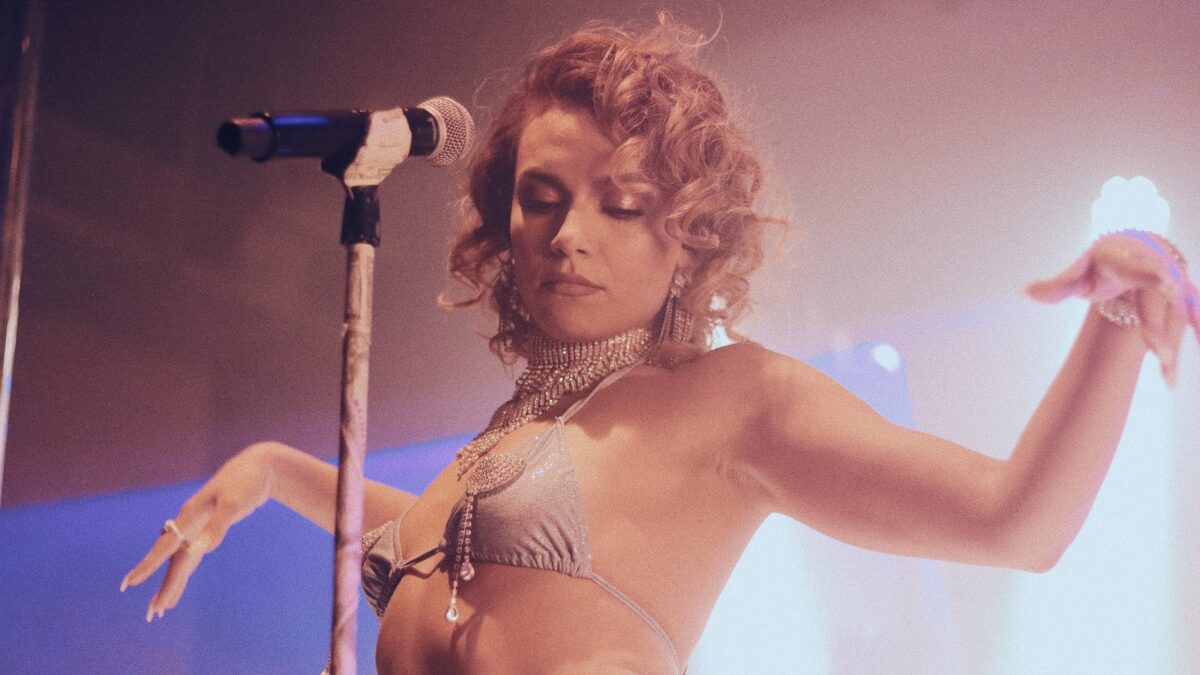
Not content with just singing and writing music, Fiefer is an accomplished producer and director—with a passion for pole dancing, which she has incorporated into her act for the past three years, having first explored it while studying music in England. It has become one of her favorite performance elements.
“It’s a lot of adrenaline. It’s very exciting to do, especially here in Lebanon, and it’s interesting to have that conversation with the audience,” she says.
Initially she didn’t know how the pole-dancing part of her shows would be received, but Lebanese audiences have embraced it. “My specific audience is quite geared toward an open-minded community. I know there’s a strong possibility I’ll do it in front of the wrong crowd and it will go sour, and I’m prepared for that day.”
Pole dancing has become more mainstream as women and enthusiasts of other genders embrace it for fitness. Fiefer is part of a wider community of Lebanese people who have taken it up both for exercise and for artistic expression. But here and elsewhere some get defensive when their hobby is associated with sex work.
“I don’t mind exposing myself in that way or wearing high heels on stage while I’m pole dancing, or calling myself a stripper—because I don’t think it’s a bad thing,” says Fiefer. “I think you need to have respect for where it came from and how it got popular, and on the backs of whom. It’s okay if you don’t want to be a stripper, but show respect.”
Those conversations are particularly thorny in Lebanon. In the cultural and artistic landscape of the Arab world, contradictions are common: The Middle East is in many ways deeply conservative, but it also has a history of presenting female artists as objects of desire, which Fiefer believes has made some independent Arab artists hesitant to put those themes front and center as they try to differentiate themselves.
“I don’t think there’s anything wrong with sexualizing Arab pop; I think the problem is that’s all we’ve had,” Fiefer says. “A lot of people would say I’ve capitalized on my sexuality and my image in my shows. The thing with me is it’s just who I am. The whole idea is there’s nothing wrong with being sexual. If I want to be sexual on stage I can, and if one day I decide I don’t feel like it, I can. It’s just the right of having that choice.”
It’s a beautiful idea; Lebanon is a beautiful idea.
For Arab women, pushing sexual boundaries can invite intense scrutiny. The Lebanese government launched an investigation of Olympic skier Jackie Chamoun after outtakes from a calendar photo shoot leaked online showing her topless and wearing a G-string. The brief porn career that made Lebanese-born Mia Khalifa a global sensation also caused a stir in the country as newspapers condemned her for supposedly dishonoring her heritage.
Fiefer herself has occasionally been a target of criticism—and she’s never been shy about facing it head-on. At the age of 17, when she performed under the stage name Poly, she appeared on a Lebanese talk show wearing a necklace of condoms as she defiantly advocated for safe sex and LGBTQIA+ rights in the face of a scolding male host. But during the fall and winter of 2019 women in the revolution began chanting against sexual assault and talking about consent.
“I didn’t think it would come so soon, actually,” says Fiefer. “I think it’s a conversation we all have when we’re out, when we’re having a drink, when we’re at home together, but it’s not a conversation we have so publicly, on TV or in the streets. So if the revolution stops today, this is a huge milestone.”
Women have played a very visible role in the protests across Lebanon. In the beginning, some handed flowers and gave hugs to soldiers and riot police—though others were photographed fighting back when authorities and paramilitaries tried to attack them. As the situation in the streets has become more hostile, women have responded accordingly.
Some Western media outlets treated the participation of women in the protests as an anomaly. But to Fiefer it was obvious women would be central to an Arab revolution.
“A lot of people don’t really know much about the Middle East, let alone its women,” she says. “I think historically women have been in positions of power but always behind someone, always behind the man. I think with the new generation you’re seeing women in roles you haven’t specifically seen them in before. It’s sparking inspiration in people to be less apologetic and submit less to a certain stereotype.”
Politicians and businessmen have looted Lebanon’s banks to fill offshore accounts; today many Lebanese can’t access more than a small amount of their own money. Many of the country’s once beautiful beaches are now landfills, and the ones that aren’t have been privatized by the ultra wealthy. Last year wildfires destroyed world-famous cedar forests while the government made a lackluster firefighting effort. Meanwhile businesses across the country are closing, taxes are rising and nobody knows where their money is going.
When the protests began, artists sought to inspire revolutionary fervor through songs, paintings, graffiti and other media. For Fiefer, this proved to be a creative challenge. “It was actually quite difficult in the first month,” she says. “I couldn’t even listen to music. Everything felt so superficial. I couldn’t relate to anything I would usually listen to because now I’m talking about basic necessities, about country, about life, about the future.”
Fiefer’s performance before the crowd in Beirut struck a chord. She got requests to do a cross-country “Revolution Tour.” The tour never happened, but it wasn’t long before DJs in other cities started remixing the audio of her performance for protesters in their communities.
Fans tell her she could enjoy greater success beyond Lebanon’s borders. She has considered it: Her Mexican passport allows her to travel with greater ease than a Lebanese passport holder. “It’s extremely difficult to make it here. It’s extremely difficult to live here, yet everyone who leaves is nostalgic to come back,” she says. “All the Lebanese who leave become even more Lebanese abroad than they are here.”
She pauses before adding, “It’s a beautiful idea; Lebanon is a beautiful idea.”
Lately Fiefer has been writing more songs in Arabic; she performed one at the protests. She admits she never thought Arabic would become an important part of her music. It was something she associated with the oppression and war her family had tried to leave behind.
“As I get older I’m redefining what it means to me, and the people around me are redefining what it means to me,” she says. “It doesn’t mean what I used to fear it meant. I can make it what I want.”
Fiefer also wants to use more Spanish in her work, to pay tribute to the Mexican side of her family. “I’ve always felt very lost. When I’m in Mexico I’m a foreigner; when I’m in Lebanon I’m a foreigner,” she says. “There are millions of people around the world who feel the same because they had to leave where they’re from, and I think I have a connection with those people.”
In many ways she’s still working out how to reconcile activism, citizenship and class consciousness with her own creative journey. “Being extravagant as I usually am feels insensitive, because I’ve been on the streets and I’ve seen how much people have,” she says. “I’m not from a wealthy family, but I know the impression I might give out. I’m finding it very difficult to exist right now.
“It took me a good 40 days to put my rings back on,” she adds, flashing her fingers. “And they’re not even real diamonds—but it just didn’t feel right in the beginning. Hopefully I’ll get to a point soon where I can feel comfortable as both a citizen and an artist.”

When the pandemic struck the Middle East, Fiefer had to make the difficult decision to cancel upcoming shows and start urging fans to stay home.
Prior to COVID-19’s arrival in the region, divisions had started to show among the protesters. Activists accused the various political factions of trying to divide them and incite conflict. The economic collapse and rampant unemployment led to a rash of suicides last year. Many Lebanese political leaders seemed to hope they could wait out the protests—that a combination of time and inclement weather would eventually cause the protesters to tire and give up. But the country’s economy continued to tank, and Lebanese people stayed angry.
Sporadic clashes between Lebanese citizens and authorities have already resumed as people on both sides struggle to pay for food and basic goods. Some activists have called for comrades in possession of masks and gloves to return to the streets, practicing social distancing while standing firm on their social and political demands.
“If things stop being peaceful, it’s not our fault at all,” says Fiefer. “If things go sour, you’re asking for it, because you’re giving people no choice.”
When people do leave their homes again, they likely won’t accept a return to business as usual.
“The fact that people made us feel like our demands might be attainable has been very dangerous to the power,” Fiefer says. “There’s no going back.”