Your bag is empty.

Twenty-five years ago, *Jesus’ Son* reaffirmed the power of fiction to shock, challenge and redeem. Join us as we retrace the book’s journey from the barroom floor to the canon

In the spring of 1994, my last semester at the Iowa Writers’ Workshop, I was lucky enough to be selected for the writer Denis Johnson’s fiction workshop. Johnson, who died in May at the age of 67, was then in the middle of his career.
He had published four of his eight novels and four of five collections of
poetry, and his novellas and plays were ahead of him. He had written some of the best foreign-correspondent journalism of that era and would go on to write more. His National Book Award-winning novel, Tree of Smoke, was in the distance, as was his novella, Train Dreams, nominated in 2012 for a Pulitzer—the year the committee famously refused to give the prize. We’ll never know if Train Dreams would have bested David Foster Wallace’s The Pale King, but if anyone could match the intensity of Wallace’s maximalism with a novella, it was Johnson.
To us, his students that year, Johnson was the author of Jesus’ Son, his first collection of stories. He’d taught in the poetry program the previous year—the first writer at Iowa to teach both poetry and fiction—and the poets acted a little as though we’d taken him from them, telling us to read his poems if we wanted to really know him. We knew he had struggled with addictions to heroin and alcohol, that these struggles had influenced his writing and had been partly local—one of the settings in Jesus’ Son is Iowa City. We knew he had published his first book of poems at the age of 19 and had studied at Iowa, and that the beautiful young man around town who seemed to resemble a youthful Johnson was in fact his son Morgan.
The simplest summary of Jesus’ Son fails it: interconnected short stories, told by a narrator identified only as “Fuckhead,” of days spent drinking, using drugs and getting into and out of trouble with women and men. Fuckhead is a young man who tells you very little about where you are or who is speaking, and if he does, you’re told as if you should know already. He’s a drunk and a junkie who spends most of his time questing for drugs. We meet him in the first story, hitchhiking through a drenching storm, and end with him, 11 stories later, sobering up, working in a nursing home and spying on a Mennonite woman’s most intimate moments.
Some reviewers have said the characters are searching for salvation, but I’ve never understood this. The collection reminds me of the stories drunks told me in bars at night in Brooklyn, men who had met me for just a minute and who bought me a drink, hoping I would stay and listen to stories that were really confessions. Stories told without the hope of absolution but with the hope of connection.
While I don’t think any of us expected the quicksilver narrator from Jesus’ Son when Johnson sat down to that first class, in person he was a good-looking, friendly white man in middle age, a little on the short side, with curling brown hair, a quick big smile and, once he knew you, a look in his eyes like maybe he knew a good joke about you. He liked to wear Hawaiian shirts. He laughed a great deal. He also sometimes wept. He told us that when writing short stories, we should treat them like parties: “Arrive late and leave early.” Start later than you think, end sooner than you think. There was no way he could have lived up to his legend, and I don’t think he felt the need to—in person, he simply replaced it.
Before 1992, in a room full of Denis Johnson fans, each might hold up a different favorite book. But after, they might all hold up Jesus’ Son. By 2006, the collection would be on The New York Times Sunday Book Review’s list of the best American fiction published in the previous 25 years. And when Johnson’s obituaries were written this spring, Jesus’ Son was the first book mentioned.
This little book, 160 pages long, one he had almost not published. One he never received a literary prize for, except for that of becoming a legend in one’s own lifetime. And this, like the violence, addiction and madness so bracingly rendered in the book, became just another thing for him to survive.
Jesus’ Son began as stories Johnson had told for years—shocking, funny yarns from his time as an addict—but refused to write down. In a 2012 interview at the Eat, Drink & Be Literary series with New Yorker fiction editor Deborah Treisman, Johnson revealed he had a rule: “If I tell it out loud, I can’t write it down.” He didn’t question that until he was 35 and realized the rule wasn’t true—or, at least, that it didn’t matter. “I sat down and wrote four of these anecdotes out, and I was immediately taken with the voice,” he said.
Johnson started working on the stories in 1984, composing them off and on for years. When The New York Times reviewed Jesus’ Son in 1992, a short profile ran with it in which Johnson said, “Originally…I wasn’t even going to publish it. But then I added a lot of things that never happened to me, though almost everything in there actually happened to someone I know or heard about.” He would say this a number of times over the years, some variation on it, as if the biggest obstacle was a fear concerning the autobiographical nature of the stories, or the darkness, but in all his previous books of fiction, in different ways, the same themes—violence, desperate people, drug abuse, alcoholism—are there.
He told us that when writing short stories, we should treat them like parties: “Arrive late and leave early.”
There was something else, though. Johnson was always writing for his life, but this time was different.
The voice in the stories feels closer to his poems “The Veil” and “The Incognito Lounge.” Bob Cornfield, Johnson’s agent then, to whom he dedicated the collection, believes this also. “That voice, I think, is there,” he says. “Denis’s great comic voice is rarely remarked on and is one of the great triumphs of Jesus’ Son.”
Johnson often said he sold the stories because he needed money. “I didn’t believe him,” says his friend the writer Lee Montgomery, echoing many people. But Johnson’s agent Nicole Aragi recalls he could be straightforward about his financial situation. When she went to sell his second collection of stories, The Largesse of the Sea Maiden, due out early next year, he said to her, “I need to build a road.” He was speaking of his property in Idaho. “I asked him how much it cost, and as I went off to meet with publishers, I was thinking, I need to get that road money,” she says.
In 1988, Johnson contracted malaria on a trip to the Philippines for Esquire. Sick and broke, unable to finish his reporting and needing the money, he sent some short stories to Cornfield, who sent them to The New Yorker, which bought four—“Two Men,” “Work,” “Dirty Wedding” and “Emergency”—for around $4,000 and ran them from 1988 through 1991. Chip McGrath, then a fiction editor at the magazine, worked on the stories with then editor Robert Gottlieb. There was a sense that Johnson had done something entirely new in the history of The New Yorker. “I remember being bowled over,” McGrath says. “I’d never seen anything quite like them—the combination of the subject matter and this startlingly pristine style. We ran the first story a couple of weeks after accepting.”
When Johnson discovered he owed $10,000 to the IRS, Cornfield next sold the collection to Jonathan Galassi, Johnson’s editor at Farrar, Straus and Giroux, for more than that. This was Galassi and Johnson’s second book together—they’d worked on his fourth novel, Resuscitation of a Hanged Man. Galassi recalls hearing that Johnson was annoyed Galassi had asked if there were more stories. Cornfield confirms this, adding, “It caused a rupture that wasn’t repaired until Tree of Smoke.” Galassi is philosophical about it. “Denis was not someone who wanted or took a lot of editing,” he says. “But the stories didn’t need much editing.”
Paul Elie, Galassi’s assistant at FSG at the time, remembers the excitement around the book. “Jonathan kept saying, ‘This is a small book, but it is hot stuff,’” Elie says. “Cynthia Krupat, the book’s designer, was very instinctual too. The jacket art: What is it? Yellow chalk on a blackboard, or on a torn piece of paper, or on a night sky? I’m not sure, but it looks so right. Cynthia also set the whole text in boldface—Bodoni Bold—and the boldness is totally true to the book.”
“I remember it was a little book, almost like a CD,” author Chris Offutt says. Johnson had given him a copy when they met—and then asked for it back. “He didn’t have many. He wanted to know what I’d made of it, and I told him, ‘It’s not bad.’ That seemed to please him.”
“It’s a book that didn’t have the immediate impact that it did over time,” Galassi says. “It sold modestly, and I think he was disappointed
by that. But it became a cult book pretty fast. I think it’s amazing, the resonance that book has for people. I would say also, the myth of Denis Johnson is about Jesus’ Son, or it lives in Jesus’ Son most intensely.”
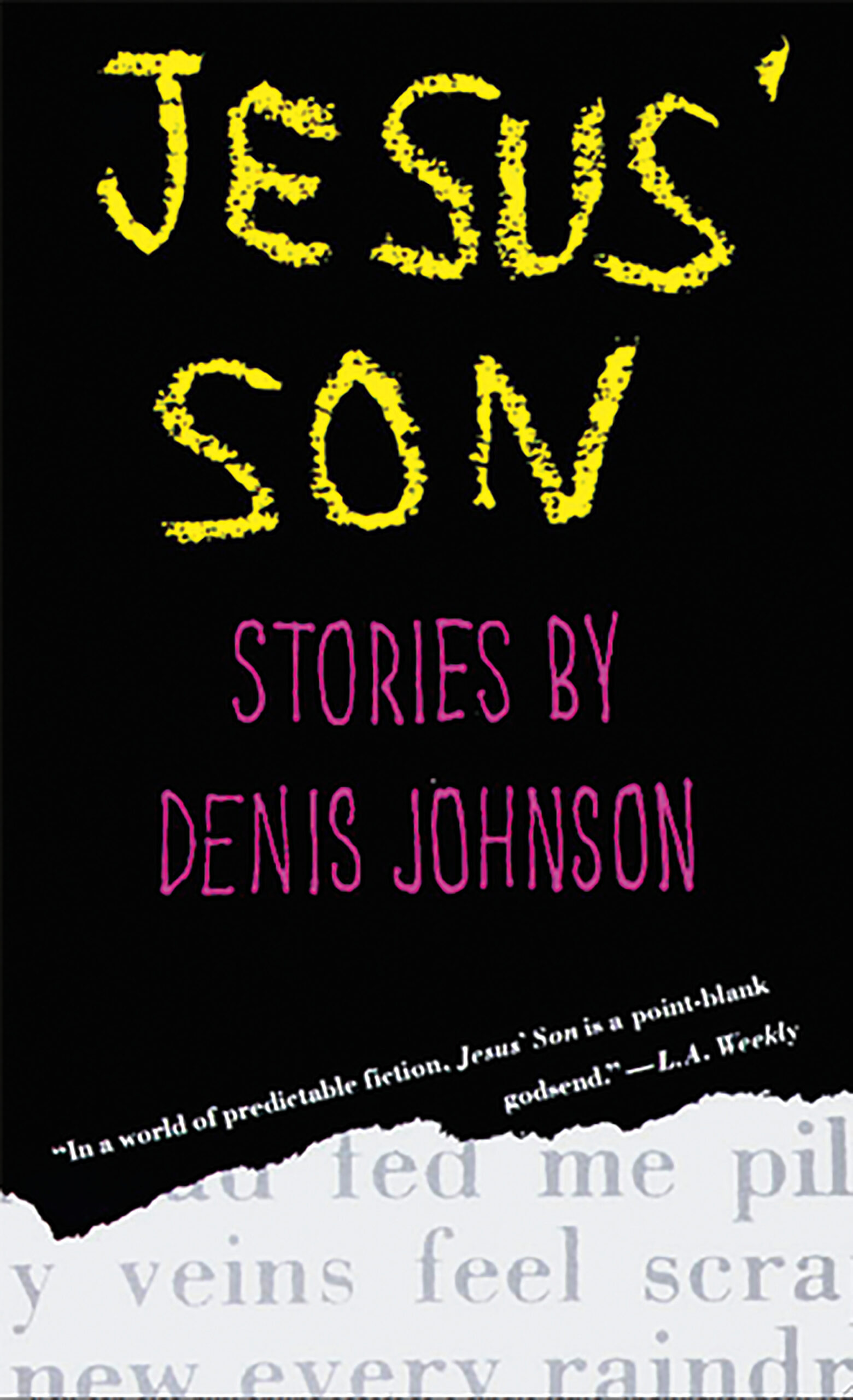
If asked, Johnson would say he didn’t know why people liked the collection as much as they did. In March, Symphony Space held a reading to celebrate the book’s anniversary, with Michael Cunningham, Jenny Offill, Victor LaValle and Chuck Palahniuk. Johnson declined to appear, but he did observe the anniversary in his own way. Around the time of the reading, Galassi received this e-mail:
J— I just heard about a reading in NY commemorating the 25th anniversary of publication of Jesus’ Son. It gives me a warm feeling of gratitude toward you, Mr G. I remember when we discussed possible titles for the collection. We went over a list, and then I said, “There’s one that I didn’t even put on the list, because it scares me.” And without asking what it was, you said—“That’s the title.” And it is. —DJ
The Johnson papers in the Harry Ransom Center archives at the University of Texas at Austin contain items as varied as Johnson’s report cards, a Snoopy card he sent his mother, Vera, for Mother’s Day, cashed checks sent to pay Vera back for money she’d lent him and introductions delivered at readings. They’re almost never signed or dated, but you can tell their vintage by what they describe of his accomplishments.
His letters go back many years. Johnson was a principled correspondent, born into a State Department family and living for a stretch of his childhood in Japan and the Philippines. The letters are almost always typed, and the ones from his years at Iowa are often on what he describes as “stolen” stationery: the back of mimeographed workshop poems, a draft of a poem by Alan Dugan, a page of a story, perhaps his own. A very short letter to his parents announcing that his first wife was divorcing him is written on the back of a description of the MFA in writing. The letter reads almost as if it could have been written by Fuckhead, but the “almost” matters—it is by Johnson. There is fan mail from the writer Amy Hempel, who thanks him for what the collection has done for the short story, and from actress Holly Hunter, who would later appear in the 1999 film adaptation of Jesus’ Son, a note of congratulations telling him how spectacular she thought the collection was. Set photos show Johnson laughing, a knife protruding from his eye socket—he appears in the film as a character out of the story “Emergency,” a man stabbed in the eye by his wife for peeping on another woman.
And there is a folder labeled “Possible collection?” Inside is a manuscript, in Courier font, titled JESUS’ SON. Four stories, in this order, that would seem to be the four he began with: “Emergency,” “Dundun,” “Two Men” and “Out on Bail.” They are almost entirely the same as their published versions.
Johnson had a reputation among editors as a consummate writer, known for submitting near-pristine drafts. Jeanne McCulloch, former managing editor at The Paris Review, recalls the line-for-line perfection of “Car Crash While Hitchhiking,” which she read on submission. “No changes were made,” she says. “The language was so precise and the cadence so well-modulated that nothing was done.” Will Blythe, who edited the stories placed at Esquire, says, “He told me these were reminiscences he’d managed to turn into fiction, and when you read them, they just feel so anchored in real lives. Even the combination of the romanticism, the larger-than-life sentimentality of a drunk and the deadpan comedy.”
It’s remarkably easy to forget that these stories are fictions, but Fuckhead is a character. Johnson never felt that he controlled him and barely even felt that he’d written him. In looking for where the stories come from, we miss both the author and Fuckhead, as well as how they’re separate. The best writing advice you could draw from these papers is that you should try to write stories to pay bills.
“I think Jesus’ Son just became a force in his life that opened doors and allowed him freedom and, certainly, acclaim. Deserved acclaim,” says Offutt. “I asked him once about a story I’d heard, that he’d written all these stories on giant pieces of poster board. I thought it was possible, considering Denis, but a little far-fetched. He just thought it was the funniest thing in the world. ‘Of course not,’ he said. But he really enjoyed that this kind of thing sprang up around him—this sort of legend, you know?”
My favorite tale around the book’s creation comes from the artist Sam Messer, who befriended Johnson in 1981 when they were fellows at the Provincetown Fine Arts Work Center in Massachusetts. When Johnson was moving to Idaho in 1989, to one of the homes he would share for the rest of his life with his third wife, Cindy Fee, he asked Messer for his help. He had two vehicles and needed Messer to drive one of them. Johnson left first in one of the cars, anxious to be with Cindy—“They were so in love, and he just wanted to be with her as fast as possible.” Messer drove the second vehicle, a pickup truck named IDA, “for Idaho,” eyes painted on the sides of the cab. “I may have painted the eyes,” Messer says. “I’m pretty sure I did.” In the truck bed were cabinets packed with folders, including a file for each story of Jesus’ Son. Johnson drove on ahead, but before he left he said, “If you have any problems, there’s a file called ‘Answers’ in there, under A. Just open that up.”
IDA did start to have problems, and Messer turned to the filing cabinet. The Answers file was there. He opened it to find a roll of cash inside.
There is a surprising shortage of good literary criticism on Jesus’ Son. The initial critical reaction ranged from a Publishers Weekly review that dismisses it as “fragmentary and monotonous” to praise from The New York Times’ Michiko Kakutani, who calls the stories “modern-day parables that glow with a strange, radioactive light.” The review that shaped Johnson’s modern legend came in June 1993, a six-page essay by the critic Jack Miles in The Atlantic. “Denis Johnson’s path as a writer—from poetry to the novel to the short story—is as untypical as his vision, but Jesus’ Son may be read not just as a moment in his evolution but as a distinctive turn in the history of the form.”
Miles makes the case we would see so often in later years: that Johnson had done something “deeply new.” He just doesn’t quite say what it is.
Yet it seems to me the better way to understand the enduring life of the collection isn’t in how it was made but in how it is read. It will not change our lives to know exactly which of the stories is autobiographical, but it just might change our lives to consider what Denis Johnson has left us.
Artist Rose McClaren answers Miles, 22 years later, while discussing Johnson’s realism in The White Review: “His prose retains much of the original chaos of thoughts and feelings; the tone and diction can be moody as a man…. His style can feel more like the charisma of a person than anything else—specific, individualized and unpredictably mutable.”
I asked some emerging short-story writers how they view Johnson’s influence. “I think writers pretend to be influenced by other writers all the time,” says Scott McClanahan, “but Jesus’ Son is the one book where the influence is tattooed everywhere on our present now.”
“He wrote expertly about the sensation of being alone in the presence of others,” says Leopoldine Core. “It’s hard to talk about why I like his stories—it’s a little painful to deconstruct them. They really are meant to be experienced.”
Johnson’s violent contradictions are perhaps best parsed by Rion Amilcar Scott. “Before I discovered Jesus’ Son, I spent a lot of time listening to Biggie Smalls’s Ready to Die,” he says. “Both works strike me in a similar way. I could hardly relate to the surface details, the drugs and criminality, but to the underlying emotions—in Smalls’s work, the anger; in Johnson’s, the confusion that underscores each story, word, image.” In Jesus’ Son, “So many of the sentences have a beautiful doubling effect, speaking to the characters and directly to the reader, consolation that we’re not alone in our confusion.”
Johnson’s influence is in the end larger than this: He’s one of those writers other writers are unafraid to love. Jesus’ Son has shaped at least two generations of writers, including the one into which Johnson was born. It may be we are just now grappling with what that was. I think of “Beverly Home,” the final story in Jesus’ Son, of the last time Fuckhead sees the Mennonite woman, staring at her through the window at night. He has watched her shower and brush her hair, but this time he’s watching her fight with her husband:
The bedroom lamp came on. Then a hand drew the curtain aside. Just like that I was staring into her face.
I thought to run, but it was such a nauseating jolt that suddenly I didn’t know how to move. But after all it didn’t matter. My face wasn’t two feet from hers, but it was dark out and she could only have been looking at her own reflection, not at me.
I think the stories are like this—moments so alive, I’m sure I could reach out through the dark and touch the man speaking to me. So sure he could see me too.