Your bag is empty.
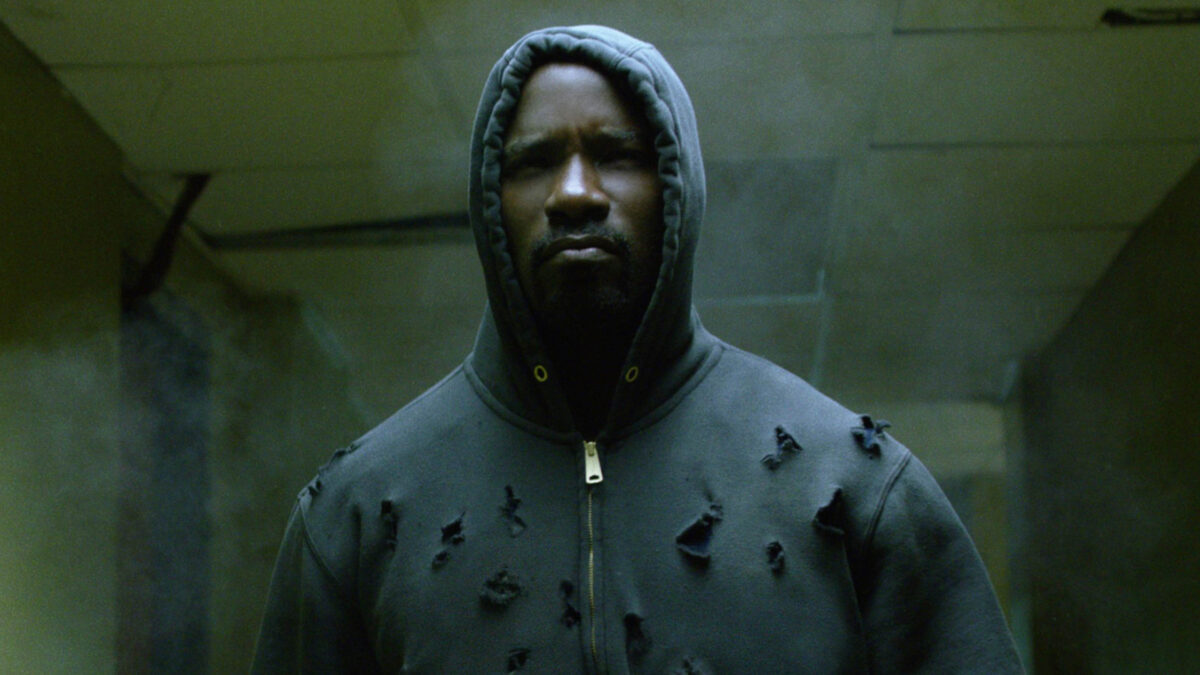
The hoodie has found renewed relevance since 2012 when Floridian teen Trayvon Martin was killed
Outfitted in jeans, a chain belt, metal cuffs, a tiara reminiscent of DC’s Wonder Woman, and a yellow dress shirt that, although rendered in cartoon, connotes the unmistakable texture of silk, Luke Cage was the first black Marvel superhero to get his own comic series as the central protagonist in 1972. Though his original getup is referenced in a scene from the first season of the Netflix version, it’s hard to imagine him rocking a citrus disco shirt today.
“When you think of Luke Cage, you think of those wild looks from the ‘70s, with the bright yellow shirt, the blue jeans and knee high boots, with shirt cut down to the navel with the huge collar. We wanted to modernize that, of course, and make it relatable for a working man’s hero,” costume designer for all of Marvel’s Netflix ventures Stephanie Maslansky told Observer. For this version of the bulletproof man, creator Cheo Hodari Coker and Maslansky favor Cage’s comic book look since around 2000 of form-fitting tees, dark jeans and hoodie—the armor of black men across America.
“[This] becomes his psychological armor, in addition to the fact that he’s bulletproof,” Maslansky told Esquire prior to the show’s first season premiere. “Luke Cage, the first African American superhero, in 2016, wearing the hoodie, it just says so much.”
A symbol of resistance in subcultures such as punk and the uniform of skaters, graffiti artists and the innovators of hip hop, the hoodie has found renewed relevance since 2012, when Floridian teen Trayvon Martin was shot to death by neighborhood watchman George Zimmerman whilst wearing the article of clothing. Conservative commentator Geraldo Rivera insinuated at the time that, given the hoodie’s association with black culture, Martin deserved to be killed because he was “perceived as a menace. That’s what happens. It’s an instant reflexive reaction.”
Cage, then, is a defiant figure in the face of respectability politics that dictates the behavior of black men lest they become victims of violence at the hands of law enforcement or, indeed, those taking the law into their own hands.
“I’m not the first person to point this out, but Martin Luther King Jr., was assassinated while wearing a suit,” comic book artist Marcus Kwame Anderson wrote to me via email. “Being well dressed has never been an antidote to racism and fear. A big part of the problem with respectability politics is that they will never conquer discrimination.”
“Martin Luther King Jr., was assassinated while wearing a suit. Being well dressed has never been an antidote to racism and fear. “
Conversely, “the hood was first added to sweatshirts in order to protect athletes and laborers from the elements,” according to this Rolling Stone history of the garment. Now the hoodie protects Luke Cage from revealing his identity. “It’s true that hoodies do work in modern times for some of our superheroes because you’re able to disguise your identity and disappear into the shadows at night if you’re wearing a black hoodie,” Maslansky told Vogue.
Sam M. Huisache, a writer from Austin, Texas, who has written about Luke Cage for such outlets as Black Girls Nerds, disagrees. “I think people have internalized…racism and distrust of black people so that one of us wearing a hoodie does not become hidden, but even more visible than we were before. The irony is that the hoodie increases our visibility because racists assume that we are up to no good while wearing them,” they tell me via email, evoking Rivera’s words above.
What’s different about Cage’s hoodie is that it’s lined with gold fabric, a throwback to his yellow disco shirt. “We didn’t want it to be too much, because in effect Luke Cage was keeping himself hidden,” Maslanky offers. “He was hunted by the law, he didn’t want to stand out. He never wanted to stand out.”
Cage’s original getup, Huisache says, is “more a product of ‘70s fashion at the time and less interesting to dissect than” the above mentioned chains from the comics, which make a reappearance in a season two fight scene. “If we are talking about the chains playing a major part in Luke Cage iconography, then it’s important to point out that black Americans throughout history have commonly been subjected to play subservient roles either as slaves or as indentured servants. I think looking at Cage’s character design from the original comics to now in his live-action television show portrayal, the chains are ultimately replaced by the hoodie.”
“Regardless of creative intent,” Anderson believes that “the symbol of a bulletproof black superhero in our modern era can’t help but evoke feelings of empowerment. Control over how we’re perceived and represented has always eluded black people in America, so I definitely see Luke Cage as a reclamation of control over our image.”
“Regardless of creative intent, the symbol of a bulletproof black superhero in our modern era can’t help but evoke feelings of empowerment. “
Another Marvel superhero who prefers the hoodie and other street clothes to a cape is Cage’s one-time lover, Jessica Jones. Played by Krysten Ritter since 2015, Jessica Jones has previously donned lycra as her comic book aliases Jewel and Knightress, but for the most part she wears a different uniform of sorts: muted sweaters grabbed from the dirty floor of her Hell’s Kitchen apartment, a battered leather jacket and acid washed Acne jeans, about which many a screed has been written. An alcoholic and survivor of intimate partner abuse, Jones’ clothes act as an armor that desexualizes her abuse and, thus, her body, and at once make her more relatable to viewers than a superhero costume otherwise might.
“She just doesn’t give a crap about how she looks, or what she wore,” Maslansky explains. This could be for ease of access in her unpredictable and tactical day job as a P.I., but it’s also probably a response to her trauma. “When she gets up in the morning, she puts on whichever [pair of jeans] is cleaner, or closest to her bed. When things get really bad maybe she brings them to the laundromat, but it’s easier not to think about it.” Jones may have also felt that her pre-trauma wardrobe, especially what she wore while under mind-control by season one villain Kilgrave (David Tennant), was inviting her abuse, the catch cry of rape apologists.
Sherry Amatenstein, therapist and the author of several relationship books, agrees. “You want to hide your body. [Jessica Jones] wears the same shapeless clothes… [because she doesn’t want to] call attention to [herself] and [the] complicated feelings about [her] own body,” she tells Playboy.
Though Cage and Jones are probably the most visible superheroes in street clothes, the success of The Avengers: Infinity War and Black Panther has exhibited no signs of traditionally costumed superheroes falling out of favor. But it’s Luke Cage, Jessica Jones et al., to whom many can most closely identify, not just because of the more immediate concepts of racism and abuse that they deal with, but also because the stripping away of their heroes’ traditional regalia helps them “navigate the world peacefully and quietly, which is needed when you’re a superhero these days,” Huisache says. Superheroes: they’re just like us!