Your bag is empty.

How many lives could have been saved if we'd acted sooner? How can we salvage our country for future generations?
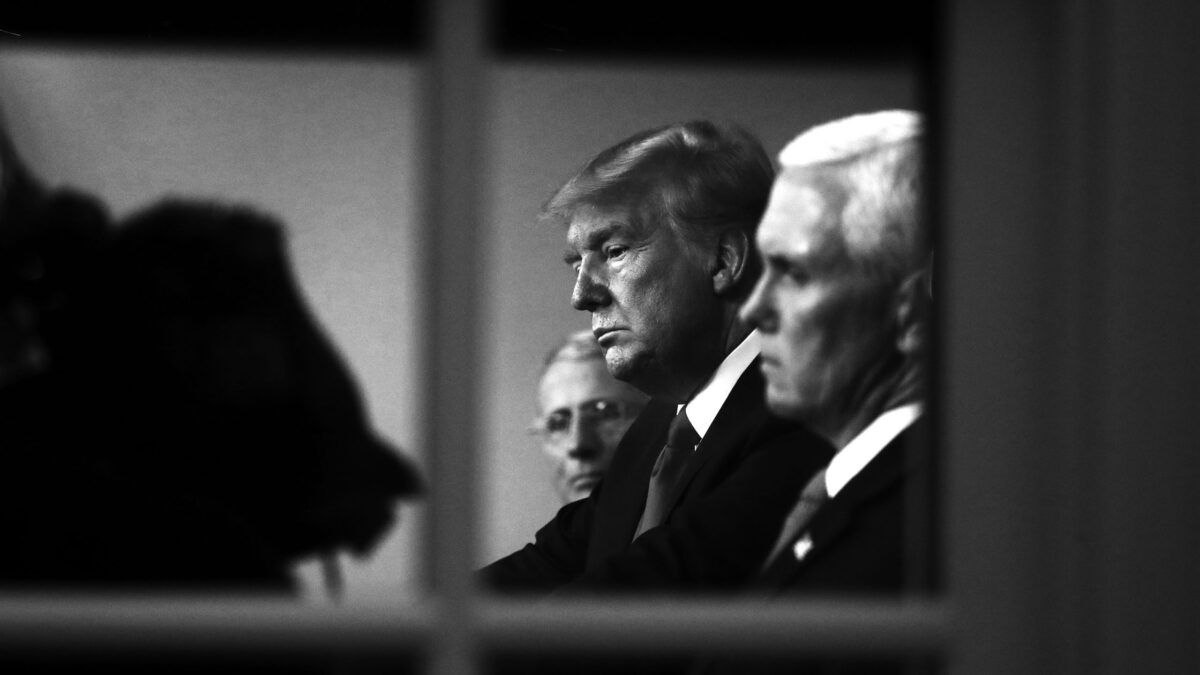
The White House now admits there could be up to 240,000 deaths in the United States due to the coronavirus pandemic. The UN says it’s the “most challenging” crisis since World War II.
As I tweeted yesterday: Was there ever a time when, had we been better prepared, we could have expected fewer fatalities? If so, why didn’t we slow the spread when we could? What specifically, Mr. President, could you have done differently to help lower the number of deaths?
Mind you, I would be happy to ask these questions directly to President Trump. As he’s done in the past, he’d call on me, interrupt my questions, belittle me, tell me to sit down and ignore the questions altogether.
But I’d ask them, and at least the issues would be in the open.
The pandemic, however, has given the president cause to limit access to him. As a result, many reporters no longer get to ask him anything.
It isn’t that Trump engineered the circumstances to his liking in order to screw the press, but true to his nature he’s not above taking advantage of any situation to further his own cause. In this case, he views the presidency by the simple metric of television ratings. Don’t take my word for it: Selectively quoting a New York Times article, he tweeted on March 29, “President Trump is a ratings hit. Since reviving the daily White House briefing Mr. Trump and his coronavirus updates have attracted an average audience of 8.5 million on cable news, roughly the viewership of the season finale of ‘The Bachelor.’ Numbers are continuing to rise.…”
Trump is taking on the roles of television producer, director and star talent in his reality show at the White House. He is, after all, a vampire whose main blood source consists of television and Twitter junkies.
The COVID-19 pandemic has led to Trump taking center stage every day whether we need it or not. He’s also beefing up his onstage presence as the 2020 election hovers just ahead. He can no longer stage large rallies, so he’s settling for briefings to satiate his thirst for public attention.
Trump was slow to take actors off his stage, but he immediately seized upon the WHCA’s offer to limit reporters in the briefing room.
He doesn’t care about governing. He cares about living in the moment. For governance, Trump hires people who still wear short pants and nurse prepubescent grudges against a world that, to them, looks like Mean Girls. He has hired climate-change deniers, Q-Anon supporters, evangelicals, racists, morons, criminals, liars, dowagers, fluffers, grumblers, tumblers and bumblers with equal aplomb. His only requirement is that you’re a sycophant—or, more important, that you give the appearance of being such on camera at the beginning of every public appearance you make—whether or not you actually believe the words you speak.
Meanwhile, in addition to taking center stage, Trump has reduced the press corps covering him to a skeleton crew by limiting White House access to those members in the pool rotation—a small group of television, radio and print reporters who actually have an assigned seat in the press briefing room—and only on the days they represent the pool. The White House Correspondents’ Association, in an honest attempt to get in front of “social distancing,” got played by Trump. The WHCA suggested seating assignments for the Brady Briefing Room that limited access to about two dozen reporters—positioned in every other seat to try to strike a compromise between social distancing and covering the president.
The WHCA made this move while Trump was still cramming 10 people on a small stage, who then preached about social distancing. Trump was slow to take actors off his stage, but he immediately seized on the WHCA’s offer to limit reporters in the briefing room and took it a step further by limiting access to the White House grounds to those in the pool on any given day.
Some of these reporters are unseasoned, some are sycophants and some are tough. But the upshot is Trump has to fight with only one or two reporters, if any, during each briefing. He has exploded on solid reporters such as Peter Alexander, Yamiche Alcindor and Jim Acosta. Alexander even threw the president an admitted softball question only to see Trump swing, miss and then castigate the NBC reporter. Many reporters during Trump’s term in office have felt the Neanderthal cudgel of his temper. But in the past two weeks Trump has been able to lash out only at those in the press pool he can’t otherwise intimidate with his limited charm or perceived power.
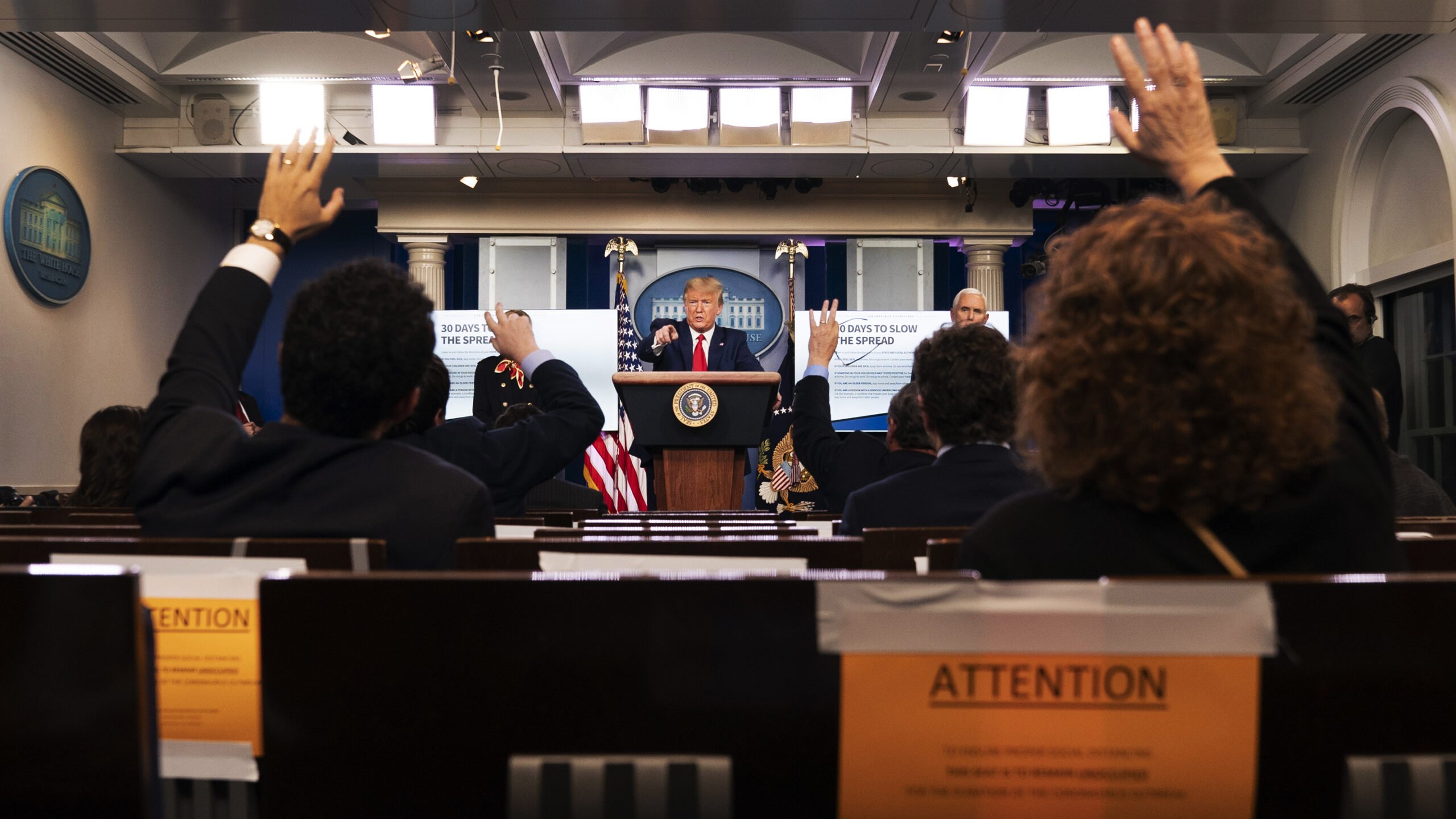
Trump has operated so far outside conventions and for so long that everything chaotic seems normal to him. Nothing matters—except his reelection—and what if it did? His minions are swept up in the dust and debris and react in a similar fashion. Members of the press corps, also lost in the maelstrom, can find themselves adapting to the so-called new normal.
In Trump’s world nothing is tethered to reality. The sentence he speaks now needn’t have any relation to what was said five minutes ago and can directly contradict what he previously said. For his latest trick, Trump is trying to paint himself as the lone warrior who confronted the coronavirus long before others suspected there was a problem. In his eyes, he’s also fighting a knightly battle against those who knew and wanted to downplay the threat.
In reality? He’s a guy who hopes he can con, fool or buy off enough voters to ensure his reelection in November. His voice dominates the airwaves, so he’s a happy camper. Maybe he really can convince folks he’s the hero. Whatever happens because of the coronavirus is ancillary to Trump’s concerns—unless of course he catches it.
We all should know Trump is full of it, but we live in a time when truth is hard to ascertain—especially when some advocate for “alternate facts.” Being a consumer of news thus is an action whereby most consumers are reduced to trying to find an appetizing sandwich in a fetid landfill.
Secretary of the U.S. Department of Health and Human Services Alex Azar conducted the first briefing with reporters concerning the coronavirus on February 28, a day before the first American fatality was reported.
As recounted in my March 5 column, I pursued a series of questions in that briefing whose answers were frightening then and remain sobering a month later.
“The World Health Organization today said that the risk is ‘very high’ for COVID-19 to spread,” I said. “I’ve also read reports that say 40 to 70 percent of the worldwide population could be infected, with a two percent mortality rate. So that could be hundreds of millions of people in this country infected and millions dead. How do you assess the accuracy of those reports? And if they’re anywhere near accurate, of what we’ve heard today, what are we preparing to do in hospitals and clinics to prepare for such an inundation of sickness?”
Playboy readers were among the first to know the sobering reality: Azar said he expected fewer cases and deaths than the World Health Organization projected, but even his conservative estimate meant millions of Americans would get the virus and several hundred thousand would die. Hospitals and health care workers in that conservative scenario would also be severely taxed.
A whole generation of human beings are too small to take action, and they are unknowingly relying on us to make sound decisions.
These facts haven’t changed, and that’s what scares Trump the most. He has been trying to come to terms with the numbers while waging an uphill battle to convince the world he didn’t screw up his initial response. He’s praying for the “miracle” he has spoken about publicly, but if as many Americans die as is projected, then for a variety of reasons his reelection could be in doubt.
On the other hand, it’s rumored Trump has taken some solace in the fact that remote and rural areas have had fewer cases than heavily populated ones. This disparity in the infection rate has given rural hospitals more time to prepare. Social distancing coupled with tests becoming more readily available will help ensure the hardest hit are cities and urban areas, while Trump’s red states will see a smaller number of people infected per capita. That could bode well for the president in November.
The underlying truth of the coronavirus is both harder to grasp than Trump getting reelected and harder to accept. I know this: I have a seven-month-old grandson who will never know the world in which the rest of us grew up and lived until COVID-19 became a daily concern.
Some are slow to accept, understand or even recognize this.
Trump is merely trying to capitalize on it. He continues to call it the “Chinese virus,” even amid reports of hate crimes against Asian Americans. Meanwhile, Pentagon officials delayed sending out ventilators because they hadn’t been told where to send them. Governor J.B. Pritzker of Illinois said the federal government sent the wrong masks to his state for health workers, and Trump has been criticized for enabling the spread of the coronavirus by his delays and inaction. He has also been criticized for allowing personal grievances to factor into his coronavirus decisions.
Historians will be dissecting Trump’s actions for years to come. We’re stuck living with those actions, and at the end of the day you just hope more people are acting on facts than are acting on “alternative facts.”
A whole generation of human beings are too small to take action, and they’re unknowingly relying on us to make sound decisions.
Relying on Donald Trump to get it done just ensures we’ll all get screwed.