Your bag is empty.
From Iranian warships to sinking states—do Trump’s actions foreshadow a fractured America?
Sometimes you can just smell a shitty day coming.
Wednesday morning, shortly before nine a.m. on the East Coast, President Donald Trump tweeted, “I have instructed the United States Navy to shoot down and destroy any and all Iranian gunboats if they harass our ships at sea.”
The image of shooting “down” gunboats aside—unless Iran has flying vessels of which the general public is unaware—the president’s latest attempt to keep us from noting that since February 29 more than 46,000 people in the United States have died of the coronavirus is not only frightening; it was inevitable.
The United States is still struggling to test its citizens for COVID-19 while some, including the president, push to reopen the country’s economy as soon as possible. Trump, in his efforts to deflect and dodge, has announced it is up to governors to test citizens and decide when their individual states reopen—while he claims both total authority and absolutely no responsibility. His daily press briefings resemble a bad SNL skit with no cogent punch line, and reporters are left chasing their collective tail, trying to quantify and verify Trump’s daily vomit of hate and distortion.
He continues to try to consolidate his power, using the coronavirus to become something like a diabolical comic-book villain. He’ll never be more than that, because he has also seriously weakened the federal government—though few have taken notice.
Years from now, if the republic dissolves into many countries where there once was one, historians will take a long look at the regional state pacts created to deal with the coronavirus as the seeds for that outcome.
Governors in Georgia, Tennessee and South Carolina have all announced plans to ease their coronavirus lockdowns.
In the Northeast, New York, New Jersey, Connecticut, Pennsylvania, Delaware, Massachusetts and Rhode Island have all banded together to coordinate their efforts to mitigate the virus.
Out west, California, Oregon and Washington are working together.
In the Mid-Atlantic region, Maryland is informally coordinating its response with Washington, D.C. and Virginia.
In the Midwest, Illinois, Ohio, Michigan, Indiana, Wisconsin, Minnesota and Kentucky have entered into a formal pact. Five of the governors are Democrats and two are Republicans.
Donald Trump’s actions during the coronavirus pandemic shine a light on regional politics as nothing has before, with the exception of the Civil War.
Donald Trump’s actions during the coronavirus pandemic shine a light on regional politics as nothing has before, with the exception of the Civil War. Competing with one another and the federal government for much-needed health resources, states have been forced to come together over Donald. Will it ultimately lead to more? Right now it seems to be a remote possibility—but until he was actually elected, most people thought Donald J. Trump as president was a remote possibility, a bad fiction or a psilocybin nightmare.
Trump’s actions regarding the pandemic spawn so many questions that are left unanswered and give us so many questionable non-answers that one has to wonder if the chaos generated is part of the plan. On the other hand, it seems obvious Trump cannot see beyond the moment to take stock of what he does. Someone has to pick up the slack and deal with reality. It falls to the governors.
When again cornered this week by Jon Karl from ABC about the lack of testing, Trump claimed, “We’ve tested more than any other country,” which is another lie. He also said the “invisible enemy came from nowhere.” The virus is actually visible under a microscope and has never been invisible to scientists or health care workers who repeatedly warned the government during the past decade about a possible pandemic. But that hasn’t kept Trump from spouting his nonsense and claiming the WHO failed to properly inform him about the virus. This particular lie is compounded by the fact that Trump had more than a dozen people working at the WHO.
The question I plan to ask him is this: “Mr. President, you cut funding to the WHO and said it deceived you. You had more than a dozen staffers there. They said you were informed as early as November. Are they lying, or are you?”
I do not expect an answer. I expect more deflection and lies.
Trump cannot answer the question, and he doesn’t want to. That isn’t him and never has been. He likes to brutalize, beat and bully anyone he can. His actions don’t instill hope; they bring on despair and hopelessness. They belittle. They anger. They frustrate. That’s because Trump wants to cultivate fear in order to maintain the illusion of control—and make money. He does it daily under the pretense of informing the public during his de facto mini-rallies in the briefing room.
Someone has to pick up the slack and deal with reality. It falls to the governors.
If you add up everything said after the introductory remarks in these briefings, you could boil it down to one or two sentences. The rest is all show—and as long as he can look at the overnight ratings (which he does) and tweet out how proud he is of the numbers he’s getting (which he also does), then it matters little to Trump what the outcome is beyond the immediate gratification of knowing he drew a large audience. Facts? The fact is Trump thinks he’s a reality-show hit.
“I’ve had great ‘ratings’ my whole life, there’s nothing unusual about that for me. The White House News Conference ratings are ‘through the roof’ (Monday Night Football, Bachelor Finale, @nytimes) but I don’t care about that. I care about going around the Fake News to the PEOPLE!” Trump tweeted on April 21.
You cannot solve social issues in such a fashion, but you might be able to make money from them. Thus Trump’s hotels are asking the Trump government for bailout money. Any bets on whether they get it? To further cover his tracks, the president apparently encouraged armed insurrection against legitimate governments in three states: He wanted to “liberate” states that were ignoring the COVID-19 safety guidelines the Trump government suggested and endorsed.
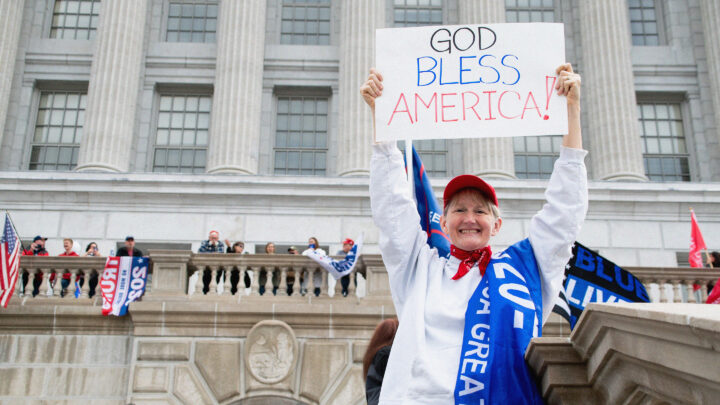
Tuesday he continued his support for those protesters in several states who want the country to reopen for business sooner rather than later. During that day’s circus Trump said he was with the protesters in spirit and the “groups I’ve seen have been very much spread out” and respecting social-distancing standards. They aren’t, and thousands of photographs demonstrate that point.
Imagine any other president in a press briefing first recommending a nationwide course of action during a crisis, then tweeting out contrary advice to his “base” and encouraging protests against the action his own government had recommended. You’d call such a person many things, including immoral, insane and moronic. But you wouldn’t call such a man unifying. Few would call such a man a leader.
Trump is definitely not a leader. He certainly isn’t a decent man and he is no statesman. But he is tearing the country apart.
Still, the endgame is not yet in sight, and Trump’s actions may well be just a speed bump in the history of the United States. The November election could decide that.
Imagine any other president encouraging protests against the action his own government had recommended.
But with no coherent national strategy and Trump’s decision to delegate the responsibility for testing, those states that have extensive health care resources have a leg-up on other states that do not. Making every state responsible for itself not only weakens the federal government; it weakens our ability to battle the virus as it pits state against state. Things are so bad in Maryland that Governor Larry Hogan recently had to make a deal with suppliers in South Korea just to get tests our federal government promised us and lied about weeks ago.
On Tuesday CDC director Robert Redfield threw down a chilling prediction. “There’s a possibility that the assault of the virus on our nation next winter will actually be even more difficult than the one we just went through,” he told The Washington Post.
Trump is apparently determined to make it more difficult. As the Post also noted, a group called Convention of States is behind some protests against state lockdowns: “The Convention of States project launched in 2015 with a high-dollar donation from the family foundation of Robert Mercer, a billionaire hedge fund manager and Republican patron. It boasts past support from two members of the Trump administration—Ken Cuccinelli, acting director of U.S. Citizenship and Immigration Services, and Ben Carson, secretary of housing and urban development.”
A house divided against itself cannot stand, and it is more difficult to keep it standing when you’re actively supporting its destruction and looting its coffers.
This is not a surprise. From the beginning, when Steve “I want to tear it all down” Bannon was on the Trump train, the goal of the administration has been to destroy existing norms and lay low the federal government. The coronavirus has given Trump more fuel to burn it to the ground.
We are at a tipping point, a fork in the road and any other cliché you wish to spout about perilous times—for we remain fractured as never before. There is no denying it.
Trump is responsible for it. He actively encourages it.
The question remains: Do we?