Your bag is empty.
In the third column of our new Philosophy of Pleasure series, New York Times best-selling author Mychal Denzel Smith writes about the bittersweet balance in the iconic drink
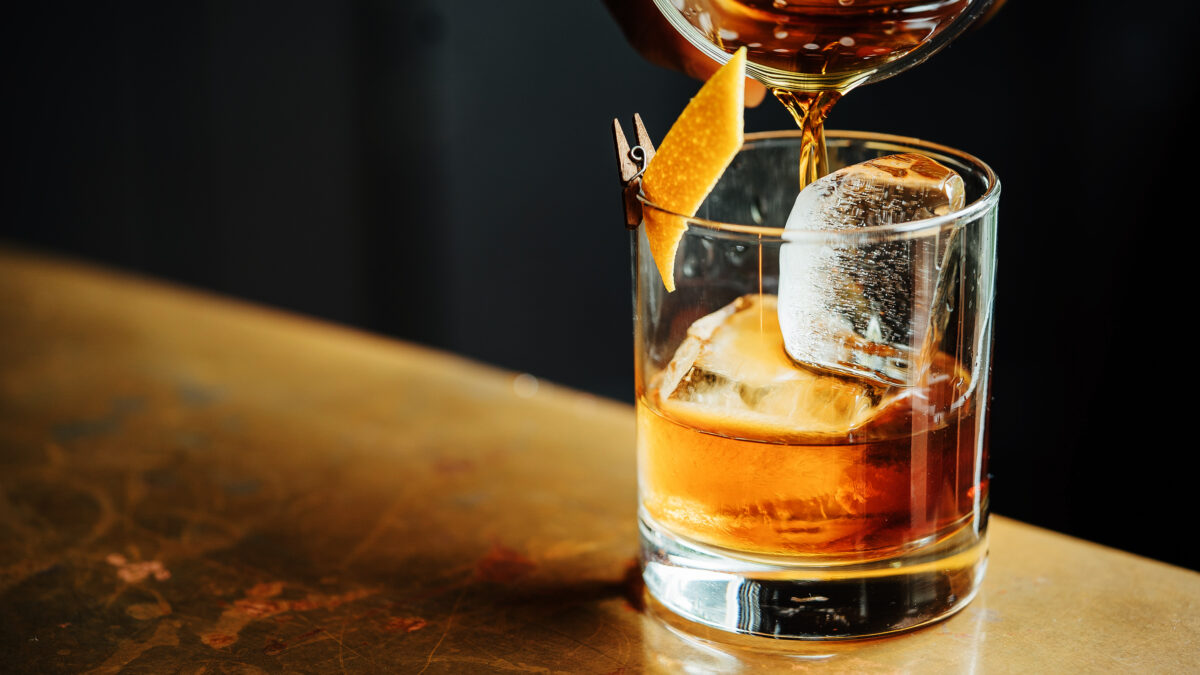
I started drinking old-fashioneds because of Don Draper. He imbibes a variety of spirits throughout Mad Men’s seven season run, but in the very first scene of the first episode, where Don is at alone at a bar, furiously scribbling ideas for the Lucky Strike cigarette account, the old fashioned is announced as his signature drink. True to the era, he drinks a version of the old fashioned that features a muddle orange and a maraschino cherry, a mid-century creation that was meant to mask the taste of the lower quality American whiskey of the time. A traditional old fashioned consists of three basic ingredients: whiskey, sugar, and bitters.
I didn’t know any of this the first time I ordered one. What I knew, or rather what I felt, was that it was time for me to graduate from Jameson and ginger ale if anyone was going to believe that I was, in fact, an adult. I was twenty-eight years old, lived with three roommates in a “four” bedroom apartment where one of the rooms was basically a crawl space with a closet, had zero dollars in my savings account, woke up most days around noon, and ate pizza for lunch (and dinner, sometimes on the same day) more days of the week than not. I needed something in my life to suggest that I was closer to thirty than twenty. I chose my drink order. I wasn’t ready to give up pizza and couldn’t afford to move.
Liquor has its own flavor and can be more than a pathway to inebriation. It’s a taste and sensory experience all its own.
I cribbed Don Draper’s drink, and not because I saw him as some kind of role model — enough has changed culturally since Mad Men was on the air that I hope we can all agree that character was a real piece of shit — but because of all the people in my life, real or fictional, he had all of the grown-up things I didn’t while also possessing a sophisticated understanding of what made for a good alcoholic drink. For months I ordered my old fashioneds as though I had unearthed a buried treasure, arrogant bass in my voice and often neglecting to add a “please” at the end. Then a bartender asked me a question that made me feel about as exposed as the pictures that made this magazine famous: “Bourbon or rye?”
Not only did I not know there was a difference between bourbon and rye, I didn’t know that all that time one of those two had been going into my drink. I didn’t even know there were different categories of whiskey other than “whiskey.” When I say that prior to this moment I was drinking Jameson and ginger ale, it’s only because once after ordering a whiskey ginger I saw that the bartender used Jameson and I figured it sounded cooler to use the brand name. And I only started drinking whiskey because a few too many college nights hugged up on a bottle of Absolut had left me with memories I’d rather have erased, and I hoped never consuming vodka again might help that along.
I played it as cool as I could, telling the inquisitive bartender that either one was fine, all the while internally confronting the fact that the rouse I was attempting to pull was in danger of being exposed.
I can’t speak to how it goes in other countries, but in the U.S. young people aren’t typically given an education on alcohol that isn’t about how they must wait until they’re twenty-one to drink it. When we start, it’s probably with beer, or cheap liqueurs that taste similar to sugary snacks from childhood, or by simply tossing vodka in a previously non-alcoholic beverage. We avoid tasting the liquor, in part because no one has explained that liquor has its own flavor and can be more than a pathway to inebriation. It’s a taste and sensory experience all its own, but it’s treated as if only the most discerning palettes of retirement age can truly appreciate them. When we’re young, no one is there to teach us, and when we’re older we are chided for not knowing.
It’s similar to the very idea of “adulthood.” There are a lot of “adult” things we’re expected to know, that no one has ever taught us, and then when we stumble through them we are reprimanded for our lack of maturity. And look, if you are someone who had to take on major adult responsibilities at an early age and can’t relate, I get it — there’s a certain amount of privilege embedded in what I’m saying. But I can only say for myself that I only recently (sort of) figured out how a credit score works, started keeping track of where my social security card is because it’s apparently very important, found value in a regulated sleep schedule, and overcome whatever anxiety it is that has kept me from turning in paperwork on time (OK, I’m still working on that one). These don’t even feel like the most adult things in the world, but since the major markers of modern adulthood feel so inaccessible for my precariously employed generation with massive debt — home ownership, a retirement account, matching cookware from Le Creuset — they have become substitutes for delineating the difference between adolescence and adulthood. I may not qualify for a mortgage, but I can point in the direction of a great bourbon.
It’s a niche area of knowledge that you only pursue if you’ve got the curiosity to do so. But it isn’t unknowable.
I found that bourbon suits my tastes. It’s typically pretty sweet, since corn is the dominant grain, but years spent aging in a charred oak barrel also can impart notes of vanilla, caramel, and brown sugar. Each bourbon will taste different depending on its mashbill (the recipe of grains that starts the distilling process), how long it’s been aged, and where. After my book editor poured a celebratory glass of Basil Hayden’s when we got the final copies of my first book, and I thought it was amazing. I wouldn’t have been able to tell you much about it, other than thinking it was “smooth,” which is generally used to describe a liquor that doesn’t feel like a liquor because there isn’t much alcohol burn. Smooth doesn’t necessarily translate to good, if what you’re looking for is flavor. I’ve turned away from Basil Hayden’s since then, having discovered the various flavor options available from Wild Turkey, Buffalo Trace, Jim Beam (which produces Basil Hayden’s as a part of its small batch lineup), and many other bourbon producers across the states (bourbon is, by law, a distinctively American-made product, having been declared the nation’s native spirit in 1964). Each one offers something unique — I find citrus notes in Wild Turkey, while Jim Beam has a famously nutty profile — and there’s always something new to discover.
And that’s just bourbon. The world of whiskey is huge and varied. Rye is having a resurgence. There are four different regions in Scotland that produce different kinds of scotch, which also separates itself into single malt versus blended. You’ve got Irish (the birthplace of whiskey), Canadian, Japanese, Indian, and a budding French scene.
There are as many whiskey styles as there are adulthood types. I didn’t realize this until learning as much as I now know about whiskey, in an effort to bolster my adult cred, and subsequently finding that it isn’t something every adult knows. It’s a niche area of knowledge that you only pursue if you’ve got the curiosity to do so. But it isn’t unknowable; you only need to have some helpful guides. What you don’t know, you can just fake until you do.