Your bag is empty.
His influence on what we listen to, and how we listen to it, is almost unparalleled
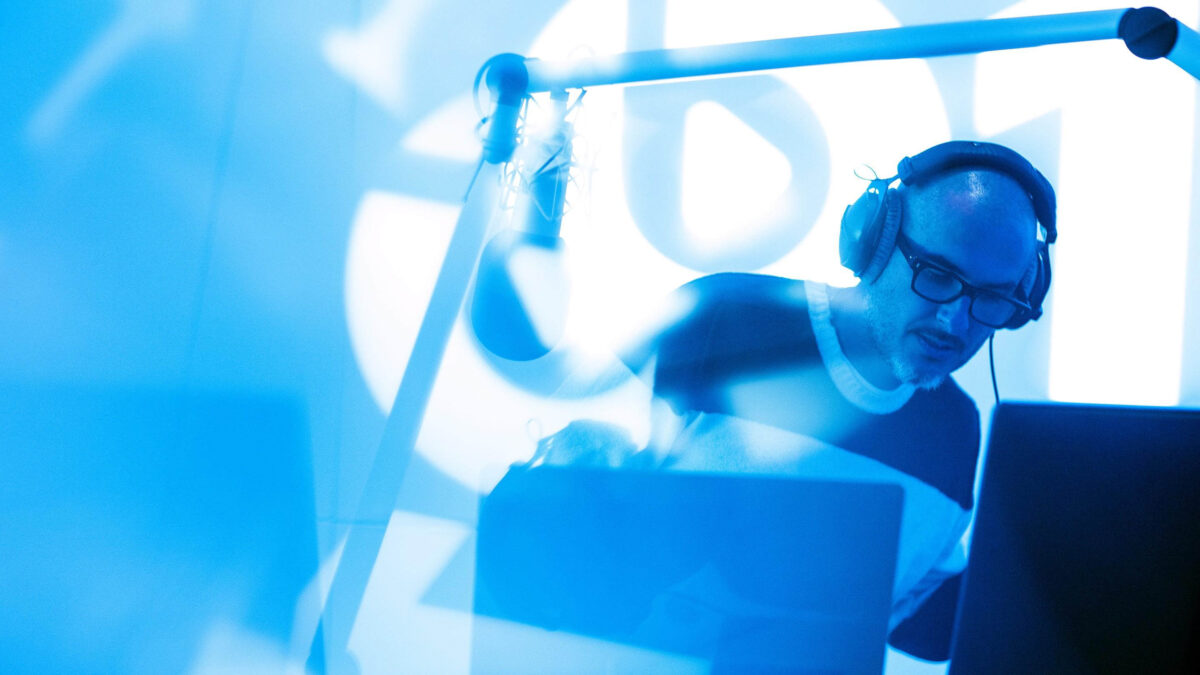
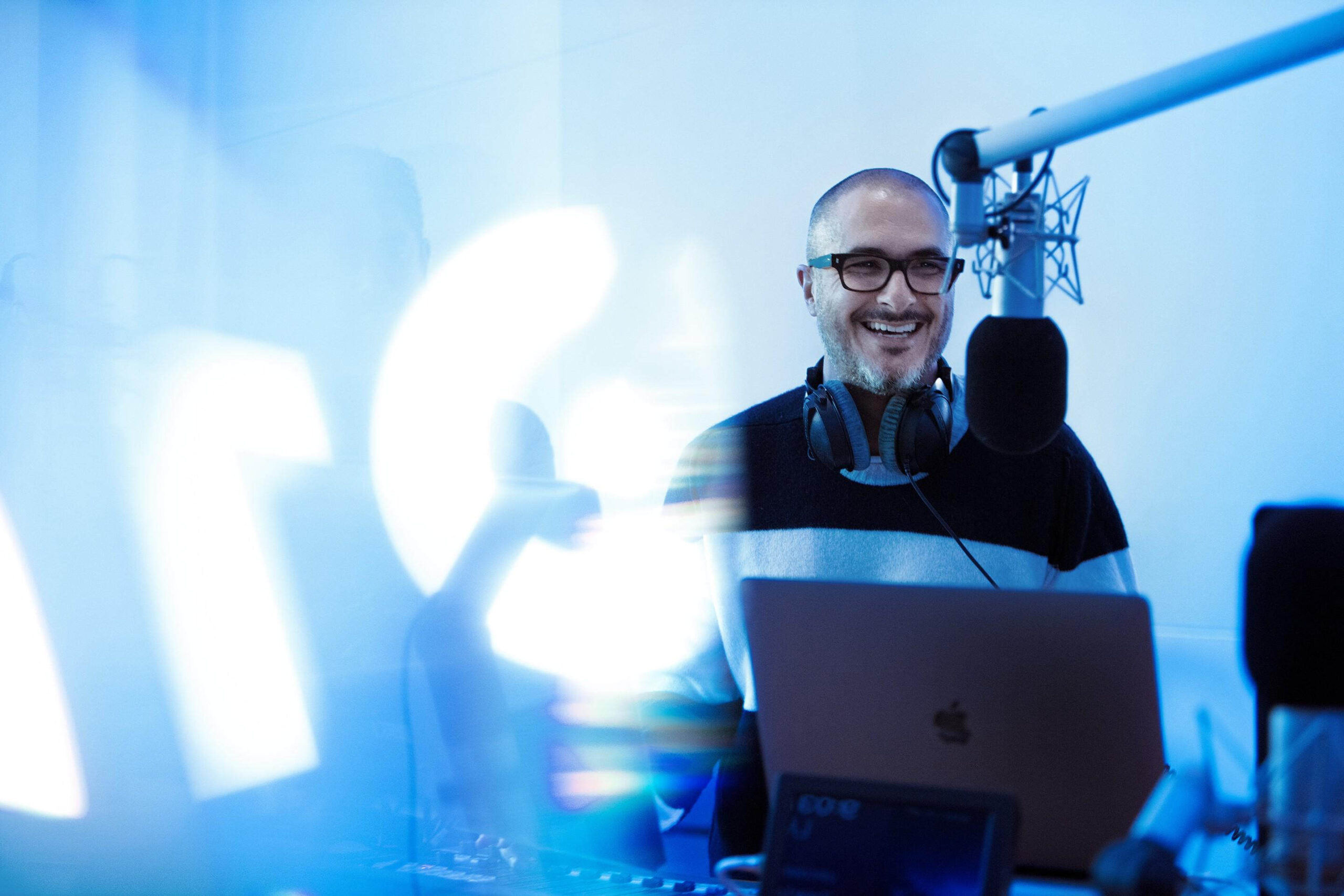
Zane Lowe is right where he needs to be: headphones on, microphone looming in front of him, feet skittering between a trio of mixing boards. Occasionally he bumps the faders, shifting the sound from his ears out to the room via mammoth speakers aimed straight at his face. On this crisp February morning, the New Zealand–born, London-honed and currently Los Angeles–based DJ lords over an airy Culver City recording studio situated across a parking lot from Apple’s fortress-like L.A. headquarters. Most weekday mornings he’s here, surrounded by a small team of young producers, recording his propulsive, almost manic Beats 1 internet radio show.
For the next two hours, the 44-year-old—who regularly lands some of the biggest interviews in music, from Kanye West to Ed Sheeran to Morrissey, and in the decentralized age of streaming now stands as one of the few remaining name-brand radio DJs—talks at motormouth speed. He snatches off his headphones as soon as a song has started playing and launches into conversation with any of several onlookers. As is almost always the case with Lowe, today’s talk centers on music. A lifelong hip-hop fan, he starts assessing the current crop of top-tier talent. Drake is “just so smart!” 2 Chainz is “better than almost everybody.” Donald Glover? “Love him!” Slim and stubble-headed with a salt-and-pepper beard, Lowe has a reputation for being fanatical about all things music. When he believes in something—an artist, a song or, since taking his post at Apple in 2015, the power of the music-streaming economy—the man won’t hesitate to proselytize. He spent 12 years at BBC Radio 1, where he became the U.K.’s most influential DJ by breaking such A-list artists as Sheeran and Adele; conducting lengthy, emotional and often viral interviews with heavyweight subjects including West, Jay-Z, Rick Rubin and Chris Martin; and bringing a rare and palpable intensity to his show that made every episode feel like a vital listen.
Then Beats co-founder Jimmy Iovine sold his company to Apple for $3 billion, helped the tech giant imagine a music-streaming service, dubbed it Apple Music and, with help from former Beats chief creative officer and Nine Inch Nails frontman Trent Reznor, convinced Lowe to join the fray. Soon Lowe had relocated to Los Angeles with his wife and two young sons. Assuming the mantle of creative director for Apple Music, he essentially became the controlling voice for the company’s new internet radio station, Beats 1.
Now Lowe is a true believer in music’s streaming future. Or perhaps he’s just a dedicated company man. Either way, tune in to his show on your Apple mobile device any given morning, and if he’s getting behind a song, listen as he demands, “Add it! Share it! Keep it moving!”
Lowe came to Apple for a new challenge, something different from a traditional radio gig. And though he admits he originally thought streaming “wasn’t even a thing”—more an auxiliary to the music-listening experience than the final destination—he has since become its loudest champion.
“I love how the digital evolution of art and subscription is making things accessible,” Lowe says. “I listen to more music than I’ve ever listened to before.” His job in radio had long felt transactional; these days it’s more collaborative. “It’s not like ‘I’ll play your record and my job here is done,’ ” he explains, taking a deep breath before rattling off one of the many mile-a-minute riffs he’ll deliver today. “It’s more like ‘Do you want me to play your record? Do you want me to get it onto playlists? Do you want to start there and work it up to here? When do you want Beats 1 support? Do you want it at the start? Do you want it after three months? How do you want to guide yourself?’ ”
This cozy relationship with artists tends to rile Lowe’s critics. He has long been accused of being every artist’s biggest fan; some might propose that, in this way, he’s not all that dissimilar to Jimmy Fallon. Then again, Lowe, like Fallon, has seen show business from both sides. Not many people are aware that Lowe is a Grammy-nominated songwriter who wrote for Sam Smith’s debut album. He’s also a beatmaker and was, for the better part of the 18 years he lived in London, a regular presence in nightclub DJ booths. “I could never be a critic,” he contends. “I just couldn’t. I couldn’t sit there and go, ‘That’s an atrocious effort. Terrible collection of songs.’ Being a musician is my primary passion and my strength, but it’s also a weakness in some people’s eyes that I can’t sit there and be more critical over things they think are just undeniably shit.”
Earlier this year, Lowe interviewed Justin Timberlake and gushed over his new album, Man of the Woods, just before the critical establishment almost unanimously trashed it. “As a fan of that record, I don’t question my taste,” he says. “I believe what I believe, or I wouldn’t have said it. I feel bad for him because I’m as big a fan of him as anybody. But Justin’s a big boy; he can forge his own path.”
His longtime friend Mark Ronson tells me, “Zane is highly intuitive and sensitive to -humanity and understands what it takes to be an artist.” And, the music producer adds, “while he might not make you like a shitty song, his enthusiasm for it certainly gets you 20 to 30 percent more hyped on it.”
At the outset of today’s show, Lowe is doing his best to prove Ronson’s point. “One song! One headline! Right around the world! Right around the clock for the next 24! Into all your playlists! You add it! You share it! You keep it moving! This one is huge!” The song in question? Imagine Dragons’ new single “Next to Me.” “This is a pensive and beautiful record,” Lowe tells the band’s lead singer, Dan Reynolds, via a FaceTime call.
If Lowe is sympathetic to artists, it’s because he understands how personal music can be. Beneath the affable but deliberate surface, it’s clear that Lowe doesn’t simply enjoy music; he needs it.
The show concludes, as it always does, promptly at 11 a.m. Not long after, Lowe hops into the backseat of a chauffeured golf cart and heads a few blocks down the pedestrian-filled business-park road to a coffee shop. He sits at a small curbside table and removes his black sunglasses. An order of braised cabbage arrives, and Lowe takes up the subject of music as therapy. Music, he tells me, prevents him from sinking into his ever-present anxiety and intermittent depression. It “keeps me focused on something I love and not drifting off into outer space. So I could be having a terrible day,” and then, after perhaps talking up a new song, interviewing an artist he loves or simply gabbing about anything related to music, “that can turn my whole day around. All of a sudden that little seed of doubt, that little thing that’s been attacking me, it’s gone—or at least way further away than it was before.”
“I find it really hard to not consistently check on the algorithm of life.”
Lowe admits he misses the rush of creating and performing music. During his years at the BBC, he’d go to the recording studio every morning to work on music, tape his show and then go out and play the clubs. But his job at Apple is more demanding. Last night, he deejayed a stuffy corporate magazine party, but gigs like those are becoming a rarity. When he moved to the U.S. to work for Apple, he made a personal pledge: “Let’s just focus on the show and make sure it works.”
Still, even when he’s off the air or taking a rare vacation, his obsession is right there. “I find it really hard to switch off,” Lowe says. “If my brain’s active, I’m probably thinking about something to do with music. I get restless if I’m not doing something with music—manipulating it or creating with it, thinking about it, making a playlist, setting something up. I find it really hard to not consistently check on the algorithm of life.”
Lowe was fixated on music from an early age. He grew up in Auckland, the second of two sons. His father, Derek, was one of the original directors of Radio Hauraki, the first station to break the New Zealand government’s then monopoly on broadcasting by operating illegally off the coast—in the process coining the term pirate radio. “And you can be sure my mom was down at the dock with him,” he adds of Liz Lowe. “It’s sort of the apple-doesn’t-fall-far-from-the-tree scenario,” he says with a laugh.
As a young child, he would stack cardboard boxes in his basement, wield a pair of chopsticks and imagine he was Led Zeppelin drummer John Bonham. He played in bands as a teenager and was a member of an electronic trio called Breaks Co-Op. “But then I started to become older and realized I wanted some money; I wanted some independence,” he says. Recognizing a desire to work in music, Lowe took a job presenting music videos on the local Max TV. In 1997 he relocated to the U.K. There, he hosted XFM’s Music Response, and after landing an on-camera job on MTV2, he was hired by the BBC.
Early in his decade-long stint at Radio 1, Lowe became a star. Here was that rare DJ whose word and taste carried so much weight he could single-handedly drive a song up the charts.
Ronson recalls “the power and the trustworthiness” Lowe built with his audience at Radio 1, “and how he could make the entire country interested in a song.” Metallica drummer Lars Ulrich, whom Lowe invited to host his own Beats1 show, calls him “the coolest motherfucker in the room, on the air, anywhere, really.” As an artist, Ulrich describes interviews with Lowe as “a clear highlight in between the rest of the promotional grind. It was always very energetic and it moved fast. It was like, Whoa, there’s a lot of enthusiasm and energy coming my way!”
In late 2014, when Apple began courting him, Lowe already sensed his time at the BBC might have run its course. “I was always determined to control my exit. I didn’t want to be shown the door,” he says. In Iovine’s telling, he and his team at the then-fledgling Apple Music noticed that Lowe was “constantly interested in what’s happening tomorrow. That was very attractive to us.” So in February 2015, after getting the official green light from his wife, Kara, and informing his sons, Lowe announced he was leaving Radio 1 and heading to Apple.
He has been an Angeleno for three years now, and though he enjoys spending time with his family in their Hollywood Hills home, he admits that adjusting hasn’t always been easy. He misses London: “It’s forever a part of who we are as people and a family and me as a person.
“But when I came to America,” Lowe continues, “I just spent the first three to six months going, ‘Oh my God—I can finally just play rap music really loud in my car and it doesn’t feel strange!’ ”
When I call Lowe one week after my visit to the studio, I find he’s come down with a bad flu. He’s been thinking about our previous discussion and the role his anxiety plays in his obsession with music.
“I’m always looking for something that’s going to keep me rooted in a good moment—something that I can focus on that’s going to allow me to achieve a real value,” he says. “Because otherwise I can spiral off into a lot of what-ifs. What if the world comes to an end?”
“I’m not alone, and if you’re listening to this, neither are you.”
As Beats 1 and Lowe’s role at Apple evolve, the DJ says he’s continually gaining more clarity about why he is indeed the right man for the job. He has come to the conclusion that hosting a show, interviewing artists and even the idea of a 24-hour streaming radio station are all rooted in his desire to feel less alone.
“And making music is an extension of that philosophy,” he says. “Like, I’m not alone, and if you’re listening to this, neither are you. Ultimately, as people, we’re just trying to reach out a hand to one another and say, ‘Life is a scary thing from the minute you’re born, but we’re here to do the best we can at connecting with one another.’ ”
Lowe pauses and adds, “I like the sense that we’re all in this together.”