Your bag is empty.

The Democratic backlash against “defund the police” rhetoric shows the power of white anxiety
Mahamed Sharif Salad, a 21-year-old Somali activist in Minneapolis, remembers the first time he chanted “defund the police” as a 15-year-old high school student. Jamar Clark, a 24-year-old Black man, had been killed by local police, and Salad participated in a walkout after lunch at school.
“The slogan has existed for a while, and that’s the first time I personally said it,” Salad says. “For us to fix the system, we have to dismantle it, take it apart and start over with something more community-oriented, which caters to the people and actually defends and protects citizens.”
“Defund the police” is a call for abolition that has been used by racial justice activists for years, and which surfaced in the mainstream after George Floyd was murdered by Minneapolis police in May, triggering a worldwide uprising of millions of people. Prison abolitionists argue that money funneled into policing, prisons and weapons should be allocated instead to health care, education, social services and community welfare. Defunding the police aims to build a new world in which impoverished, over-policed communities can live with the resources they need to thrive and racial capitalism, the color of one’s skin and the ZIP code in which they were born does not undermine their civil liberties or their quality of life in general.
Abolitionists are already laying the groundwork for what a world without police can look like through shared assistance and survival.
Yet recently, “defund the police” faced attacks from establishment politicians in the Democratic Party, who blamed the radical demand for the loss of seats in the House of Representatives or attributed wins by dangerously narrow margins to the controversial slogan. Republican opponents exploited fears of socialism and cutting off funds to the police, and pro-Trump political action committees spent millions of dollars on ad campaigns vilifying progressives who support climate activism, social equity or police reform. According to media tracking firm Advertising Analytics, approximately 70 conservative ads negatively mentioning “defund the police” aired on television during the 2020 election.
“What the establishment Democrats have tried to do to reassert power—and fundamentally not change themselves—is to use the Republicans’ bad-faith arguments against progressives as evidence [for why it’s not an actionable demand],” says Brandon Soderberg, a Baltimore-based investigative journalist and co-author of I Got a Monster: The Rise and Fall of America’s Most Corrupt Police Squad. “This, of course, doesn’t parse out because the Republicans, especially under Trump, simply call anyone who is left of fascism ‘radical’ or ‘antifa’.”
A particularly melodramatic ad depicts a chaotic breakdown of law and order, and a person dialing 911 only to find out the police have been “defunded” and can no longer help. The same ad obliquely accuses Biden of wanting to defund the police, despite his proposal to pour $300 million into law enforcement, his role in crafting the 1994 crime bill and his choice of Kamala Harris, a former district attorney widely criticized for cracking down on the parents of truant children, as vice president. Although the statements in the ad are false or misleading, this rhetoric likely succeeded in capturing conservative constituencies in states such as South Carolina and West Virginia, voter bases of police and firefighters and expatriate Latino communities that fled socialist governments.
Instead of reflecting on their failure to build a counter-narrative that delegitimizes Republicans, strengthen digital campaigning or shift away from an overreliance on polls, many centrist Democrats opted to blame Alexandria Ocasio-Cortez and the rest of the Squad for the party’s losses.
Representative Kurt Schrader of Oregon told Politico that the party needed a “different message,” and Representative Abigail Spanberger of Virginia said, “No one should say ‘defund the police’ ever again.”
Yet what these same Democrats appear to forget is that it was the party’s progressive base that canvassed and mobilized voters in Arizona, Georgia and Pennsylvania—crucial swing states that helped Biden win the election.
Similarly, former president Barack Obama recently dismissed the slogan as “snappy” and unrealistic in attaining police reforms. “You lost a big audience the minute you say it,” he said. “Do you want to actually get something done, or do you want to feel good among the people you already agree with?” Obama’s condescending and misinformed opinion erases the labor of prison abolitionists, community leaders and activists across the country who back “defund the police” as a concrete political demand. The same people chanting “defund the police” are also posting cash bail, organizing mutual aid after staggering job loss caused by the pandemic, campaigning for the freedom of political prisoners and providing legal aid for protesters attacked or arrested by police. Abolitionists are already laying the groundwork for what a world without police can look like through shared assistance and survival.
Nor is Obama, who in 2013 told the public to accept a jury’s decision to acquit George Zimmerman for killing 17-year-old Trayvon Martin, distinctly qualified to opine on a movement of which he is not a part.
“Defund the police” strikes fear in the hearts of both Republicans and Democrats, because the abolitionist demand challenges the pervasive anti-Black racism that has shaped criminal justice policy for the past four decades and the bipartisan exaltation of law enforcement at the expense of Black communities confronting the ongoing militarization of their neighborhoods. When Biden was questioned by a reporter about Walter Wallace Jr., a 27-year-old mentally ill Black man shot dead by Philadelphia police in October, the presidential nominee reflexively denounced “looting and violence,” a disclaimer that frequently takes precedence over Black lives for most politicians. The excessive focus on crime and riots to justify policing isn’t a coincidence, and deliberately protects white supremacist institutions harming Black and brown communities and represses popular movements for social change.
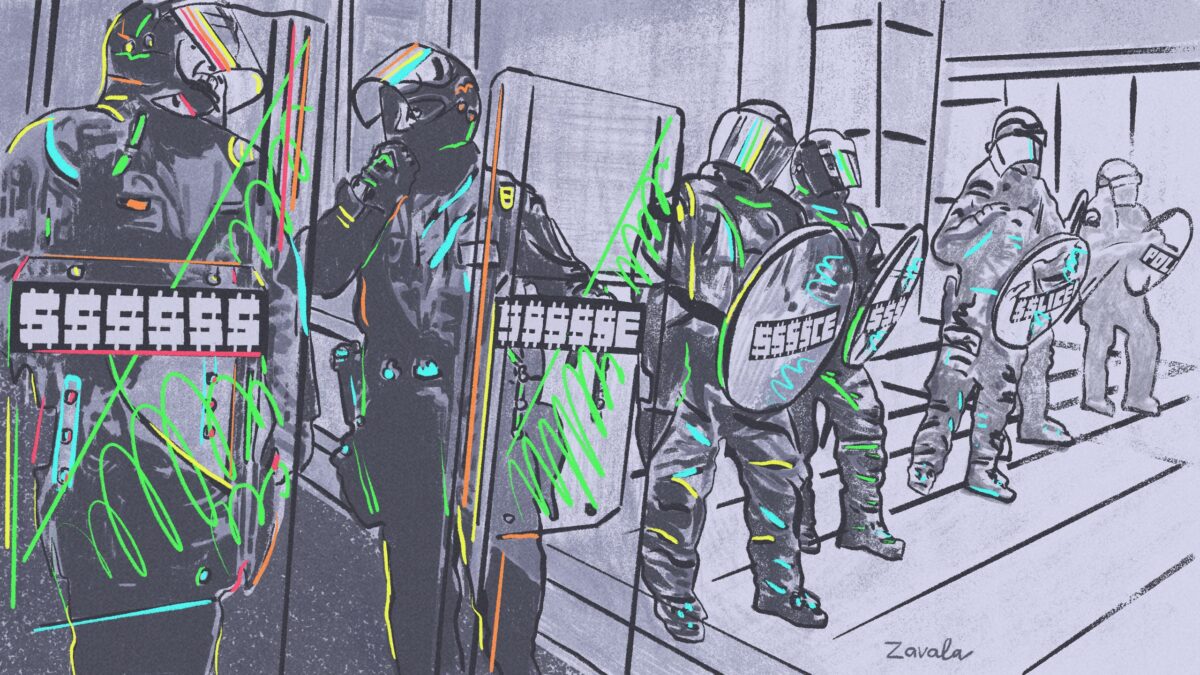
Police departments across the country continue to demand public funds to buy gear that doesn’t belong in any American neighborhood.
“If you look at history, the American police emerged with slave patrols, which returned escaped slaves back to plantations and policed slave rebellions,” says Johanna Fernández, a history professor at Baruch College and an activist with the Campaign to Bring Mumia Home. “In the aftermath of World War II, police expanded in cities across the country when working-class struggles were growing exponentially and people of color were moving to cities in large numbers. They started policing the racial boundaries of neighborhoods. The police play a very specific role, and it’s not to protect the citizens.”
In 2014, photographs of heavily armored vehicles rolling into Ferguson, Missouri launched headlines and spread across the internet. More recently, the National Guard was called into several cities and towns amid uprisings against police. The militarization of local police in America finds its roots in the Cold War, when the military created training programs deploying American police to Asia and Latin America, and the counterinsurgency tactics used against populations in postcolonial countries under dictatorship were subsequently imposed on marginalized Americans at home. Since 1997, the Department of Defense has conveyed military equipment to local law enforcement amounting to $7.4 billion, and police departments across the country continue to demand public funds to buy gear that doesn’t belong in any American neighborhood.
Defunding the police thus also means demilitarizing the police. Although the “defund” part of the demand has been misconstrued to denote only an allocation of funds, defunding the police means totally dismantling the institution and conceptualizing a better world that does not rely on carceral justice to redress harm. Abolitionist activists say defunding the police is a stepping stone to its eventual abolition, a tactic that will pave the way for transformative justice and an end to policing, prisons and white supremacy.
“In Minneapolis, we didn’t want to advocate for a system that is constantly killing and destroying Black lives,” Salad said. “For us to get tangible change, we’d have to defund and get rid of the police, and start over within the community—without the government. Creating a slogan like ‘defund the police’ encompassed all the things we wanted, because we understood we had to take the police apart for us to actually have rights in society.”