Your bag is empty.

Inside the struggle to unite the progressive factions of the two Senators
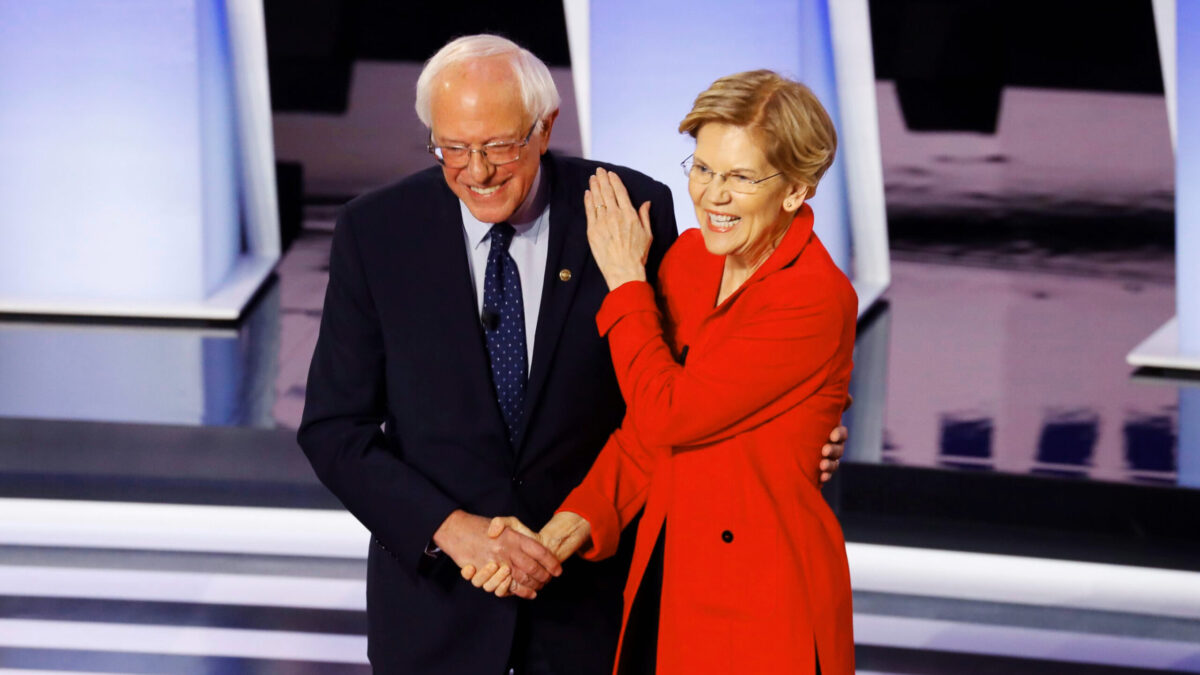
Polls of the Democratic nominating race for president are, months ahead of actual voting, wobbly measures of real outcomes, but one trend is fairly stable: If united, the progressive wing can be the force that determines the party’s standard-bearer. But the legions of diehard supporters of Sanders and Warren have to play nice together so that when the party convention convenes in the summer of 2020, those combined forces can capture the nomination—or hold a Democratic president’s feet to the fire to keep their promises.
The most durable dynamic, at least for the past couple of months, is the strength of the progressive vote. Yes, polls show Joe Biden leading nationally, but I have long argued his lead will dissolve as the voting begins. Without the full backing of Barack Obama, Biden is out of step with the energetic progressive base that is defining the issues in the campaign. And if you take the Sanders-Warren vote together, it surpasses Biden’s. This week’s Morning Consult poll, which reflects ongoing daily interviews of 5,000 registered voters nationwide, gives Biden 33 percent of the vote, Sanders at 21 percent and Warren taking in 16.
The aggregate progressive vote seems credible when you listen to the policy ideas animating the Democratic debate. Medicare for All, free college tuition and higher taxes on the wealthy are now considered central tenets of the party’s agenda, with broad support among the electorate.
Supporters of Sanders and Warren have to play nice together so that when the party convention convenes in the summer of 2020, those combined forces can capture the nomination—or hold a Democratic president’s feet to the fire.
Playing nice comes easily to Sanders and Warren themselves, who repeatedly stress their longtime friendship and genuine affection for each other. Both have eschewed endless attempts by the traditional media to gin up stories with a similar narrative: When will their (perhaps privately negotiated?) nonaggression pact crumble under the imperative to seize sole control over the progressive lane to nomination?
Surrogates for Sanders and Warren fray the comity, mostly on social media. As a longtime Bernie supporter, and the guy who conducted his Playboy Interview back in 2013, I concede that most of the digs come from Sanders supporters—although I also get their passionate support for Sanders based on his decades-long efforts toward durable structural change.
So let’s look at the roots of this potentially dangerous standoff, which could pave the way for an establishment nominee like Biden. The suspicion among Sanders activists about Warren boils down to three overarching narratives:
Sanders is a Democratic Socialist, while Warren explicitly says she is a capitalist who wants to unrig the system
I agree: That’s a fundamental ideological difference. But does it make a practical difference in today’s politics? Sanders has served in the Congress (in both the House and the Senate) for more than a quarter of a century, advocating for a long list of social reforms within a capitalist system. Those positions are embraced by democratic socialist leaders around the globe, principally in Europe. So the Sanders/Warren ideological difference, to be sure, is rhetorically significant, but it’s far less consequential in the reality of American politics.
Sanders and Warren both lay out policies that would defang and restrain the financial elites. On taxes, for example, they both want to make the wealthy pay their fair share. Warren is championing a wealth tax of two percent on household net worth between $50 million and $1 billion and a one percent annual Billionaire Surtax (equaling three percent tax overall) on household net worth above $1 billion, which would bring in $2.75 trillion over a decade. Sanders talks about higher taxes somewhat differently: He promotes closing loopholes for corporations and the wealthy, a progressive estate tax on multi-millionaire and billionaire inheritances and a call to “substantially increase the top marginal tax rate on income above $10 million” (though he doesn’t cite a specific tax structure).
Note my observation above about a “practical difference in today’s politics.” People might want a revolution immediately but there is a real, messy political factor worth considering if progressives want to advance their ideas in a Democratic president’s first term: The Senate. Under the most optimistic scenarios, Democrats would win the White House and a majority in the Senate by a vote or two, or perhaps only control a 50–50 split in the chamber plus the tie-breaking vote of a Democratic vice president. That slim margin of Democrats would include relatively conservative members like West Virginia’s Joe Manchin, who could stand in the way of the most far-reaching proposals—especially on taxing the very wealthy—advanced by Sanders or Warren.
So although the political revolution has sprouted in places and “democratic socialism” is gaining new adherents, especially among younger voters, it would (optimistically) take a decade to dislodge enough incumbents, especially in the Senate, to fully realize a systemic upheaval.
Warren was once a Republican, while Sanders has been consistent in his views for half a century
Her long-ago party affiliation has bred the view that her presidential policy planks aren’t deeply held, compared to those of her progressive rival. Sanders has a loyal base precisely because people legitimately trust him to stay the course.
Yet Warren, long before she ran for office, was taking on Wall Street greed and a corrupt financial system. She was the force behind the creation of the Consumer Financial Protection Board, which is charged with making sure average people don’t get ripped off by banks—and which virtually every Republican and some Democrats tried to block.
More important, if Warren has shifted her views to be more progressive, isn’t it a goal of political organizing to persuade, and then embrace, leaders who switch their beliefs?
Warren is courting “establishment Democrats”
Yes she is, and that reinforces some progressives’ suspicions that Warren would not upend a party system whose elites have resolutely worked against systemic change. Her outreach, though, may simply be a considered strategy to win. Casting our eyes on the state of the race today, there is a strong possibility that no one clinches the nomination before the Democratic National Convention. If no one gets the nod after the caucuses, delegates are free to vote as they please. In addition, “super delegates”—made up of party activists and officials who were not chosen in the primary season—can then cast ballots. So in a close contest, Warren’s outreach today may bring victory.
The yardstick we should use to measure the health and vitality of the progressive movement is the power to hold *any* leader accountable when they assume power.
I am optimistic that sanity will prevail because, respectfully, the loudest social media-driven, die-hard Sanders supporters are out of step with the large pool of voters who would support either candidate. Eight out of ten people who support either Sanders or Warren say they would be satisfied if the other candidate won the nomination, according to the most recent CBS News/ YouGov Battleground Tracker. That indicates that either candidate could enter the convention with a delegate lead that falls just short of a majority but could clinch the nomination with support from the other camp. Alienating Warren supporters with over-the-top attacks could deny Sanders the nomination or, should he be the Democratic party standard-bearer, cost him a slice of support in the general election.
Needless to say, it matters who ends up in the White House, but the yardstick we should use to measure the health and vitality of the progressive movement is the power to hold any leader accountable when they assume power. That is the best assurance that a progressive agenda will be implemented. And that challenge will exist whether the Oval Office occupant is either a President Sanders or a President Warren.
The 2020 goal is clear. Beyond soundly defeating the incumbent, the progressive movement, whose leaders and activists have always understood that movement-building takes time, should strive to show that a new president will win the presidency thanks to fully embracing ideas that are supported by a majority of Americans:
An economically fair society that halts endemic multi-generational class warfare.
A new foreign policy that rejects decades of war fueled by the military-industrial complex Dwight Eisenhower warned of over half a century ago.
And a relentless focus on ensuring we have a sustainable planet to live on.