Your bag is empty.
As Steven Spielberg's harrowing drama reaches the milestone, it remains relevant despite any flaws
Legendary director Stanley Kubrick never had much patience with the idea that Steven Spielberg’s Schindler’s List was the definitive movie about the Holocaust. Conceding the premise that there can or should be such a thing is a whole other debate. Since Kubrick himself never shied from wanting his own projects to be the ultimate word on the subject at hand, we can assume he thought the notion of a definitive Holocaust movie wasn’t intrinsically crazy. He may even have gotten cranky because he’d been beaten to the punch.
All the same, from the point of view of the irascible dude who’d made 2001: A Space Odyssey, A Clockwork Orange and The Shining, the Holocaust meant the technologically efficient mass murder by Nazi Germany of six million European Jews between 1942 and 1945. So how could a story—even a true one—about a German capitalist who saved 1,100 of them by insisting they were essential to running his factory be called a “Holocaust” movie at all, let alone the definitive one? Maybe only in Hollywood, where looking for history’s silver linings is often a surefire path to Oscar gold.
It goes without saying that Kubrick’s dissent was a fart in a windstorm. At the 66th Academy Awards, *Schindler’s List* duly reaped its Oscar gold, winning Best Picture, Best Director and Best Screenplay, among others—although it’s always indicative of an Academy in a pious mood that the acting prizes went elsewhere. Even now, Spielberg’s movie is still thought of by most people as “the” Holocaust movie, not just “a” Holocaust movie.
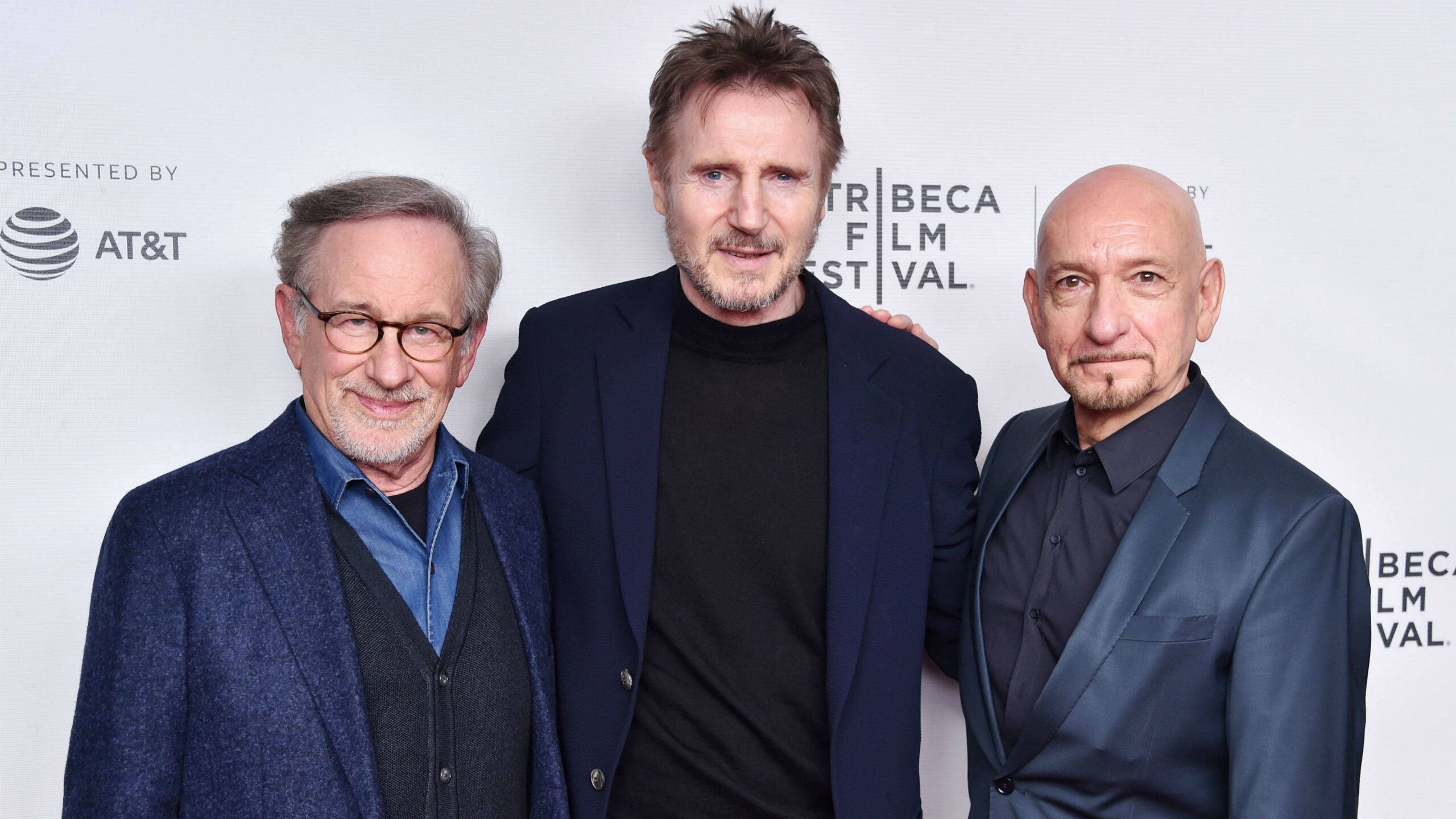
No doubt, that’s partly because your average multiplexer felt no huge craving to sit through more than one. Until Schindler’s List, Hollywood had largely avoided the subject, an omission that was especially noticeable back when a new World War II epic was popping up in theaters seemingly every other week. The big exceptions were 1959’s The Diary of Anne Frank, which timidly cast a Gentile actress in the lead to woo non-Jewish audiences, and 1961’s ponderous Judgment at Nuremberg. Aside from Nuremberg’s inclusion of documentary footage of the atrocities, neither movie was foolish enough to try actually taking viewers inside the extermination camps.
TV stepped in to fill the gap, from 1978’s Holocaust (the major reason we now know Hitler’s “final solution to the Jewish problem” by that name, incidentally) and 1980’s Playing for Time, to the 1983 and 1988 miniseries adaptations of Herman Wouk’s The Winds of War and War and Remembrance. By some accounts, Spielberg considered making Schindler’s List as early as 1983, but his intuition told him to wait a decade—and he was right.
The early 1990s marked the culmination of the Nazi genocide’s rightful enshrinement in popular consciousness as the 20th century’s ultimate crime. Washington, D.C.’s Holocaust Memorial Museum opened just months before Schindler’s List premiered in New York and L.A. in December 1993. The solemn vow “Never Again” was on everyone’s lips, not yet having been reduced to absurdity by unchecked genocidal massacres everywhere from Rwanda and Bosnia to Sudan.
A quarter of a century later, the world looks very different. Nowadays, Benjamin Netanyahu’s Israel is perilously close to becoming a pariah state—one that even American Jews are increasingly alienated from, in a way that would have been unthinkable a generation ago. Anti-Semitism is making a sickening comeback not only on the right, where it never really went away, but on the left, from U.S. college campuses to Jeremy Corbyn’s Labour Party in Britain.
Watched today, minus the genuflecting context that greeted it at the time, the movie is still extraordinarily powerful.
Neo-Nazi parties of various types are politically powerful in Europe. Our homegrown version—euphemized as the “alt-right,” a term nobody should use—has been emboldened by Donald Trump’s presidency, from a spike in anti-Semitic hate crimes to the resurrection of conspiracy theories about Jews that civilized people once believed had been buried along with Hitler’s ashes.
For that matter, according to one recent poll, two-thirds of American millennials can’t identify Auschwitz as a Nazi death camp. Nearly a quarter of them have either never heard of the Holocaust or aren’t sure they have. In Europe, where historical memory used to have more traction, one out of five people aged between 18 and 34 said the same. So much for the Holocaust memorials and museums dotting both Europe and the U.S.A., not to mention the educational power of film.
Clearly, as lessons to us all go, Schindler’s List didn’t get the job done. Nor is its subject matter as likely as it was in 1993 to provoke instant reverence—and at least partly unearned catharsis, since audiences 25 years ago were virtually guaranteed to be overwhelmed by the stark recreation of the Final Solution’s deadly machinery at work. Instead, we’re left to judge it simply as one of Steven Spielberg’s best movies, which at one level is saddening. But maybe that’s all Schindler’s List ever was, or should have been perceived as, in the first place.
Watched today, minus the genuflecting context that greeted it at the time, the movie is still extraordinarily powerful. Spielberg may have meant Schindler’s List as some sort of universal statement, but he and screenwriter Steven Zaillian are at their best when they concentrate on particulars: the ghastly bureaucratic fussiness of the extermination process, for instance, with clerks setting out stamp pads and official documents at folding desks as helpless people wait to learn whether they’ll live a bit longer or die. The dedication that’s gone into making even the most fleetingly glimpsed extra either unnervingly or poignantly authentic in appearance, costume and behavior is remarkable.
The movie’s most celebrated sequence—the mass roundup of the Jews in the Krakow ghetto, with Liam Neeson’s Schindler and his latest mistress watching the pandemonium from a nearby hillside—can’t help recalling the similar episodes in Gillo Pontecorvo’s 1968 classic The Battle of Algiers (when it was French paratroopers hunting down Algerian rebels in the city’s Arab quarter). But Spielberg’s rigorous concentration on keeping us keyed in to the event’s large-scale terror while individualizing its victims in one vignette after another is probably unmatched in his career. By comparison, even Saving Private Ryan’s opening Omaha Beach slaughter looks fatally marred by showmanship disguised as verisimilitude.
He took equal care with scenes—e.g., Schindler the playboy partying with Poland’s new German occupiers—where the temptation to overdo the Nazis by turning them into gargoyles and grotesques must have been fierce. (They don’t have any reason to leer evilly; in their own minds, they’re simply factotums with a job to do or smart opportunists eyeing a payday.) And for once in a Spielberg movie, adult sexuality isn’t flinched at in panic, even when people are using it as barter.
It’s not unreasonable to question a few of his artistic choices—something that would have been virtually taboo in 1993, when discussing Schindler’s List in aesthetic terms instantly outed any critic who risked it as a horrible human being. As unsparing as Janusz Kaminski’s cinematography is, deciding to shoot the movie in black and white looks like a cheat. It’s a shortcut to proclaiming the project’s austerity and historical import, but it also adds a remoteness that makes the experience less punishing. (At the time, Spielberg also couldn’t have guessed that even film students today refuse to watch black-and-white movies.) Sure, a Schindler’s List in color might have been emotionally unbearable—but given the movie’s subject, just how valid an objection is that?
Filming in B&W also led to Spielberg’s worst misjudgment: the Krakow ghetto sequence’s Girl in the Red Coat, who’s seen in muted color to signal Schindler’s conversion from callous profit-making to outraged compassion. She’s obviously meant to put us in mind of Anne Frank, but the real Anne ended up epitomizing the Holocaust’s six million victims because of her diary, not her eye-catching wardrobe. On top of that, the child cast in the part is preposterously cute, leaving you to wonder whether Schindler would have stayed heartless if the kid had been born ugly.
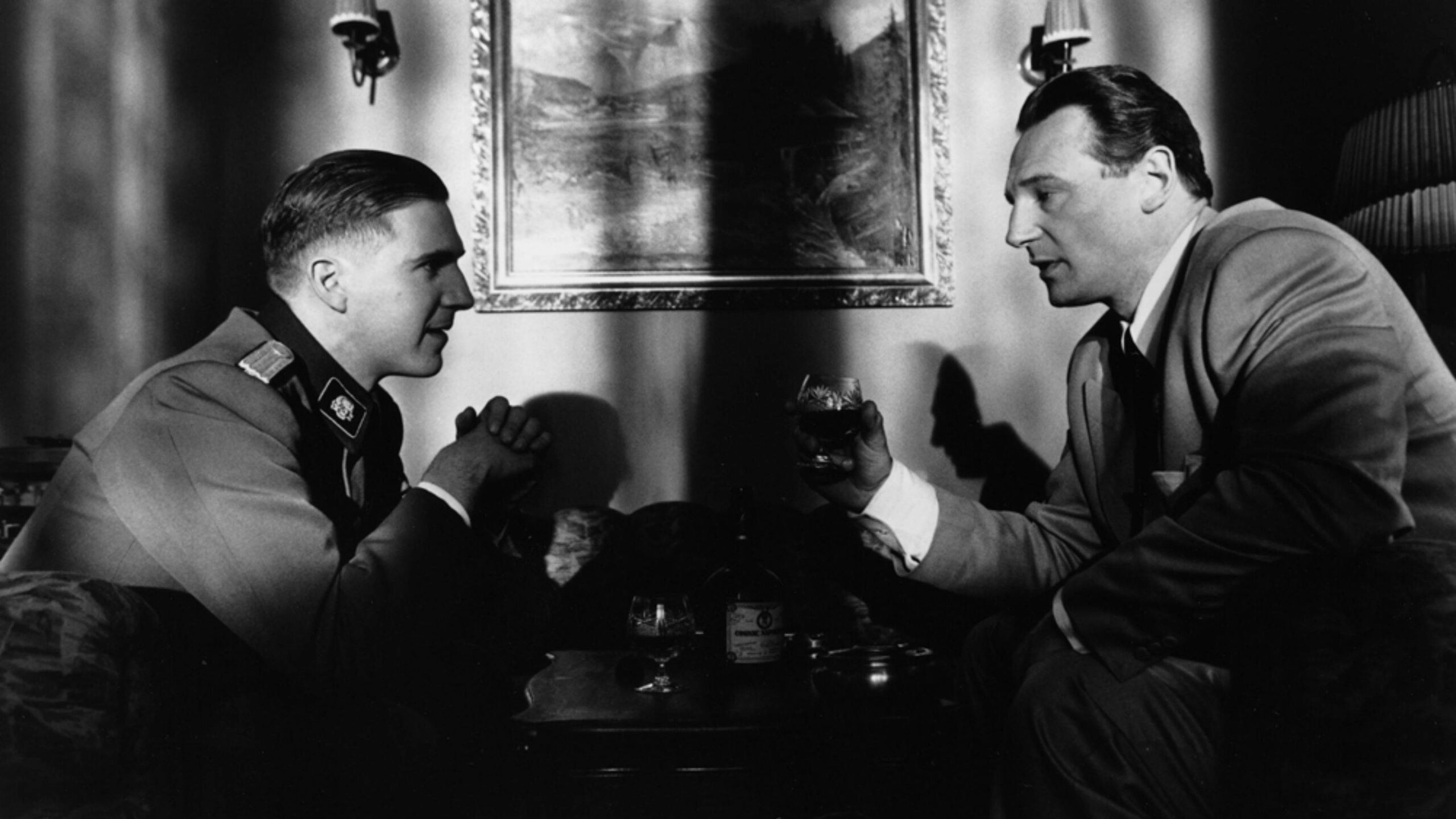
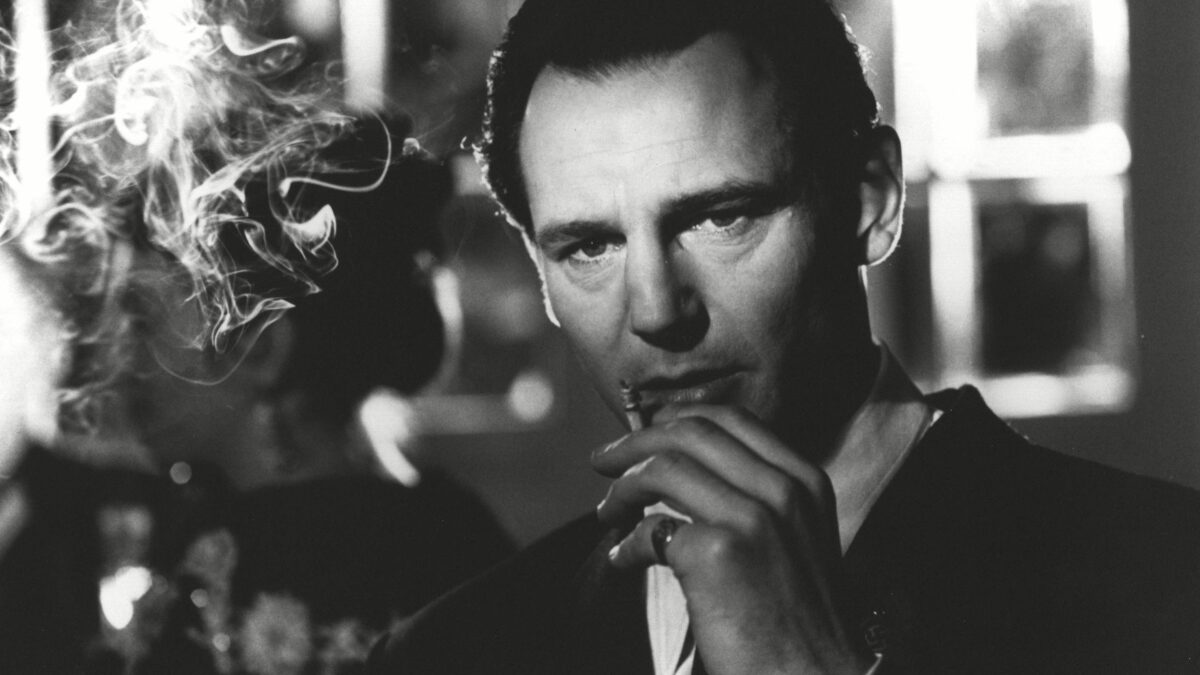
As good as Liam Neeson is, it’s peculiar to see the star of the Taken franchise gunning for an Oscar back when everyone expected him to have a very different career. (Not unlike Peter O’Toole after Lawrence of Arabia, Neeson turned out to be more enjoyable—and more original—once he stopped trying to measure up.) The real problem, though, is that the crucial question of Schindler’s motivation is resolved so simplistically. He goes so completely from being a roguish cynic to being the ultimate “Righteous Gentile”—Israel’s honorific term for non-Jews who saved lives—that scarcely a trace of his former bad habits remains. Spielberg and Zaillian even give us the sop of Schindler promising to stay faithful to his wife from now on; would he be any less of a hero if he’d gone on being promiscuous instead?
The performance that hasn’t lost any of its ability to surprise and disconcert viewers is Ralph Fiennes’ as reptilian Amon Goeth, the Krakow-Plaszow concentration camp’s commandant. It’s the best-written part in the movie, rich in the believably odd psychological curlicues that the reformed Schindler so conspicuously lacks. Goeth is a monster, yes, but he’s also about 17 different kinds of monster: a vicious one, a mediocre one, a pathetic one, a greedy one, a horribly susceptible one, a hesitantly self-doubting one and, ultimately, an oblivious one. He exemplifies Hannah Arendt’s “banality of evil,” but he’s banal and evil in his own unique way. If that’s a contradiction in terms, it’s also one of the reasons Goeth’s characterization—meaning both the writing and Fiennes’ acting—is among the movie’s major claims to greatness.
However, claims to greatness aren’t the same thing as achieving it. If you want our reluctant verdict, Schindler’s List falls short in the crunch: maybe not far short, but short. The movie starts to go soft during what ought to be its most harrowing sequence, when the women workers being transported to Schindler’s relocated factory in Czechoslovakia are shipped to Auschwitz by mistake. They’re herded into a gas chamber, but the prop showerheads turn out to be functional, and the women go wild with joy as they’re doused with water instead of Zyklon B.
Just why this should happen is never explained. Worse, this lucky trainload’s reprieve from everyone else’s fate inside Auschwitz is a reminder that, for all his relative gutsiness, Spielberg has made a movie about history’s most notorious mass murder that never depicts mass murder head-on. We see queues of less fortunate Jews filing into gas chambers and a crematorium chimney belching smoke, but we don’t witness their deaths—and we, at least arguably, need to. Five years before Schindler’s List, the now utterly forgotten War and Remembrance miniseries was much blunter—amazingly so, for old-timey broadcast TV—when it came to showing us people expiring in agony and piles of nude corpses.
Clearly, as lessons to us all go, Schindler’s List didn’t get the job done.
The movie’s Auschwitz episode magnifies what’s been wrong all along with making Schindler’s Jews represent the Holocaust’s victims: They survived. (Kubrick was right about that.) After that, Spielberg’s sentimental streak takes center stage, from Schindler’s floridly out-of-character memorial speech, to his workers at the war’s end, to his blubbering collapse as he laments that he should have done more—at which point “his” Jews swarm all over him to console him. They’ve been demoted to grateful Munchkins, not believable human beings.
Then there’s the present-day coda that shows the actual Schindler Jews, accompanied by the actors who played them, laying stones on Schindler’s grave. It’s touching right up until you recognize the self-exalting implication that Schindler’s List—only a movie, remember—now exists on the same plane as the historical reality. All in all, it’s no wonder that even critics who appreciate the movie’s considerable merits have come around to thinking that it was the lesser of the two movies Spielberg directed in 1993.
Honest fantasy entertainment isn’t always inferior to the contradictions of trying to make a cinematic masterpiece about an unfathomably, maybe even unfilmably horrific real-world event. If nothing else, at least Jurassic Park didn’t end with genuine, astoundingly lucky T-Rexes sharing a hallowed moment of remembrance with their CGI facsimiles. That’s one kind of silver lining nobody will complain about, either.