Your bag is empty.

And the speakers are shocked every time.
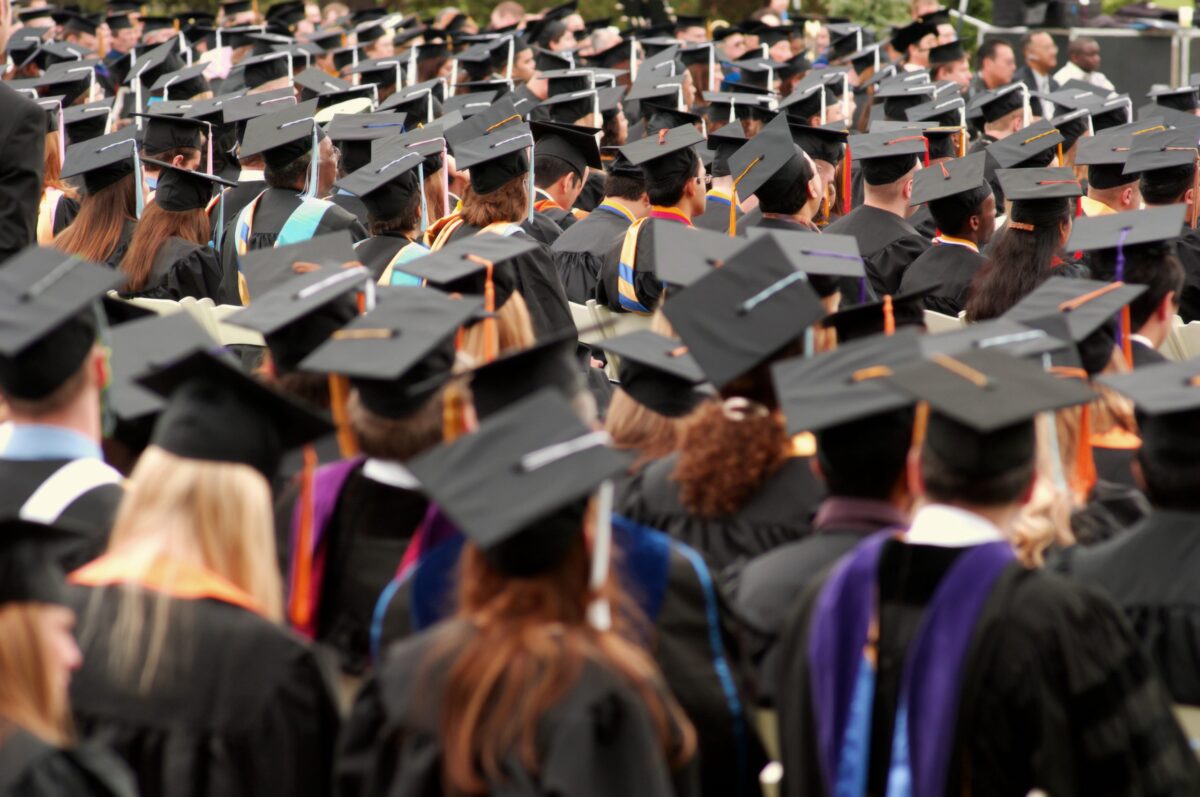
Andrew felt a creeping sense of disappointment while seated at his graduation from the University of Central Florida on May 8. A local business leader, Gloria Caulfield, was giving the commencement speech to a couple thousand liberal arts graduates. She brought up the rise of artificial intelligence and compared it to the Industrial Revolution. That’s when Andrew heard the first boos coming from the arts and humanities section.
Caulfield laughed in disbelief when she heard the booing, as captured in a now-viral video that has been viewed millions of times across platforms. “What happened?” she asked someone off-camera, turning away from the crowd before asking them if she could finish. Caulfield kept talking about AI, and the crowd kept booing her. Andrew, initially dispirited, joined in.
“She failed to communicate properly to the audience, and, you know, we learned in our communications education that the most important thing is knowing your audience,” Andrew told Playboy. He spoke on the condition that only his first name would be used.
“I would say the booing is a really strong response to the increasing loss of humanity in our society,” Andrew said. “It’s not really welcoming to students who have worked four years to get their degrees and are faced with decreasing job opportunities and layoffs in creative fields.”
In comments on UCF’s Barstool Instagram page, multiple recent graduates wrote that they were proud to boo Caulfield. “Incredibly tone deaf to say this to architecture, communications, film, and theater majors (plus so much more physical media),” one posted. “She was trying to convince us billionaires were just like us,” wrote another.
UCF was the first school to go viral over graduates booing their commencement speaker for preaching to them about AI. But others quickly followed. The trend is a visceral reminder of how everyday people, especially young adults on the precipice of their careers, actually feel about the technology’s impact. It doesn’t sound good. But to AI experts, it’s no surprise. The only question is why AI boosters think everyone else agrees with them.
At the University of Arizona—ironically, Caulfield’s own alma mater—former Google CEO Eric Schmidt was booed by students one week later on May 15 after he brought up TIME Magazine naming the “architects of AI” as 2025’s Person of the Year. He persisted through the booing, saying that every career, person, and relationship would be impacted by AI.
“I know what many of you are feeling about that. I can hear you,” Schmidt finally acknowledged. “You are inheriting a mess that you did not create. And I understand that fear. It’s rational.”
Record executive and Taylor Swift’s nemesis Scott Borchetta was also booed while giving his first-ever commencement speech to graduates of his eponymous Scott Borchetta College of Media and Entertainment at Middle Tennessee State University. He was more combative with the audience in response.
“Deal with it. Like I said, it’s a tool,” Borchetta said while the booing got louder. “You can hear me now or you can pay me later.”
The reality is that more than half of U.S. college students surveyed by Gallup in 2026 say they use AI at least weekly in their coursework, so the problem isn’t stemming from inexperience. Programmer Andrew Yoon, who works at the AI education nonprofit CivAI, lists a few other reasons why recent grads would be booing: job losses linked to AI is the obvious one, but there are also growing protests against data centers, environmental concerns, and a building desire for more oversight and regulation.
“AI is deeply unpopular in America, and its unpopularity is increasing every day,” Yoon said. “People see the cavalier way that AI companies are building these tools and then releasing them on society and letting the chips fall where they may.”
A two-hour drive away from where Schmidt gave his unpopular commencement speech in Arizona, a different kind of AI graduation scandal was emerging at Glendale Community College. A new AI system that was supposed to announce graduates’ names skipped over some instead and announced others at the wrong time. A viral clip of students and their families furiously booing the college’s president while she explained what happened also stoked outrage online about faulty AI products seemingly being pushed into every corner of society. It was the perfect example of why students might not be onboard with the AI industry’s mission.
Rage against big AI is increasingly boiling over. In April, a man was charged with attempted murder after he threw a Molotov cocktail at OpenAI CEO Sam Altman’s house. And despite ChatGPT initially setting records as the fastest-growing consumer tech product in history, public sentiment toward the technology has always been split. Dystopian AI crises like deepfake sexual abuse, chatbots encouraging suicide and psychosis, and horny AI slop taking over the internet haven’t exactly bolstered the industry’s reputation.
“As much as we love that convenience, no one likes to consume AI-generated content from a serious perspective,” Andrew said. He and his classmates were already being told to use AI as a professional tool, and many of them obliged. It’s through that familiarity, not fear, that he and other graduates are rejecting the idea of AI replacing them.
“It gets framed as college students are afraid and are not learning enough to handle these changing conditions. I think we absolutely are,” he said. “It is not a tool for replacing people in the liberal arts field. So much more than ever, we need people who can communicate about the human experience.”